



A funny thing happened last week for Mother’s Day.
The Gospel Coalition, a rather mainstream evangelical organization founded by the late Tim Keller and having entirely male leadership, published a Facebook post.
And what was their message for Mother’s Day? Was it about how dads could step up to the plate and appreciate their wives? Was it about the unique contribution women make? Was it about how God is a mother too? Was it about how we should all recognize the extra burdens mothers bear?
No, it was something very different.
This post first appeared on my Substack last Friday! Posting here for posterity!
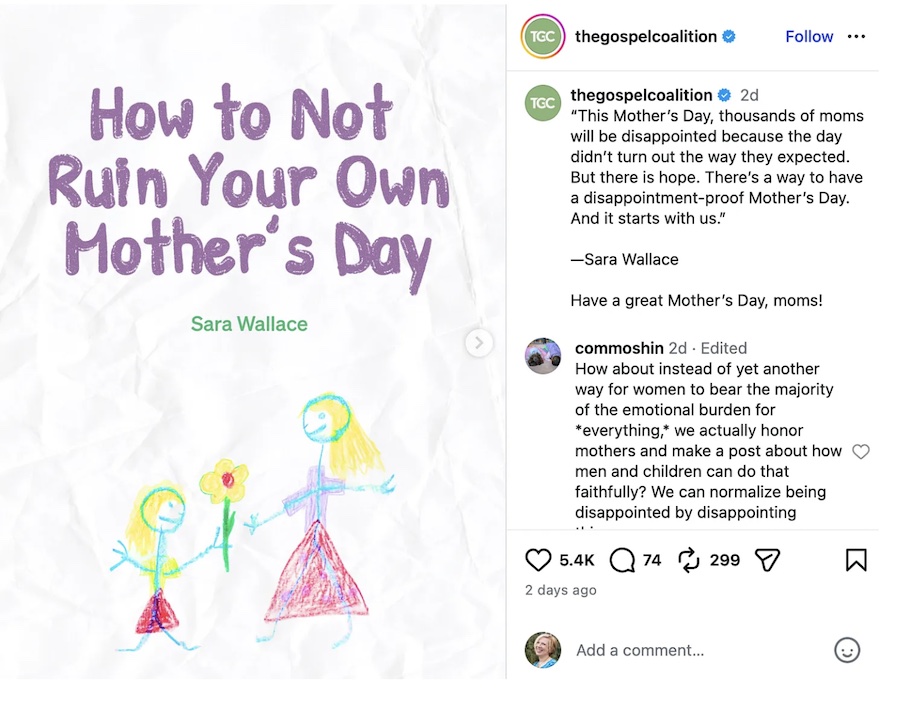
It was: Hey, women, don’t expect anything and you won’t be disappointed!
For an organization that claims to care about men leading their families, this was the message that they wanted to make sure people heard about Mother’s Day: women, don’t expect anything.
The same day that The Gospel Coalition posted that, Focus on the Family chimed in.
This wasn’t specifically a Mother’s Day post, but it appeared the day before Mother’s Day. And what was the message?
Stop expecting your spouse to change. Just let go of all expectations. “Expectations are the thief of joy.”
I talked about this post on my Facebook Page, but I want to elaborate on a few themes here today.
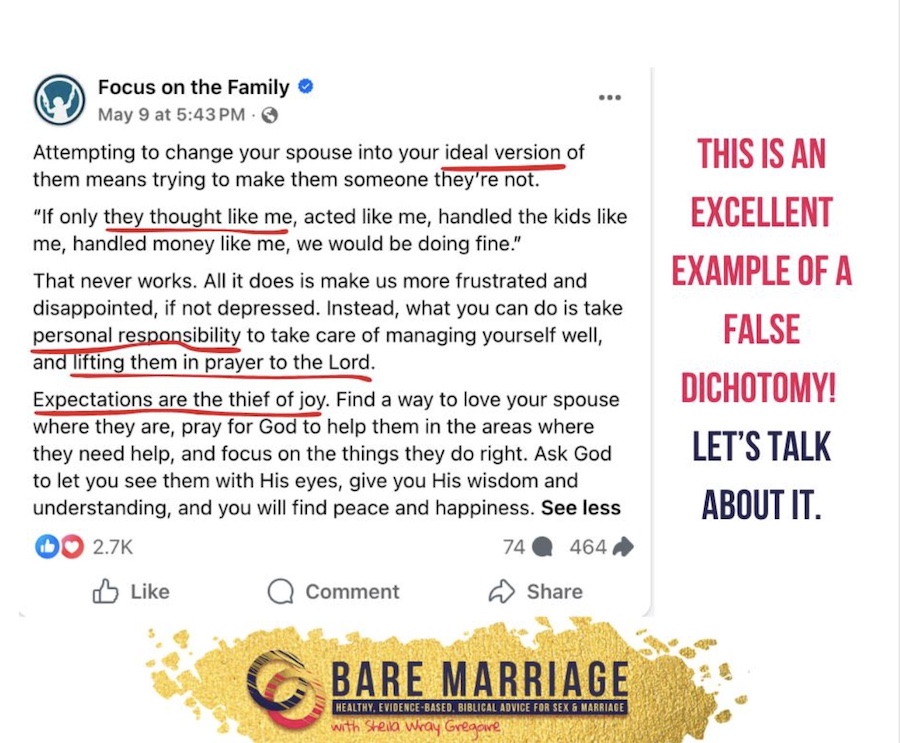
This is an excellent example of a false dichotomy.
Either she is:
1. Expecting him to act in every way exactly like her; or she
2. Leaves her expectations behind, loves her spouse exactly as he is right now.
But what if there’s another option?
What if there’s simply expecting that he will act as a partner in the marriage? You don’t expect him to do as much as you, or in the same way as you. You just expect him to do SOMETHING, because he is a grown adult and he is the father of these children and he promised in his wedding vows.
Expectations are not the thief of joy.
The real thief of joy, as we have found repeatedly in our surveys, is unfairness.
Women can put up with unfairness for about 10-15 years before everything explodes and falls apart.
But posts like this continuously tell women that if you expect the bare minimum, you’re really expecting the moon.
If you expect him to do something–anything–that’s the same thing as expecting him to be just like you.
But those are not the same thing.
And what is the solution that Focus on the Family gives for this situation, where a man isn’t fulfilling his basic responsibilities?
To merely pray.
It’s not to say anything. It’s not to draw boundaries. It’s not to have a big sit down and make reasonable expectations crystal clear. It’s just to pray and learn to live with things just as they are.
This advice doesn’t work. This is the same advice that Emerson Eggerichs gives in Love & Respect, where he reports that he was leaving wet towels on the bed and candy wrappers on the floor, and the solution was that his wife stopped expecting things to change. (By expecting change, she was being “disrespectful.”)
Marriages can’t thrive when one person is being treated profoundly unfairly, and to frame the expectation that you will have a partner in marriage as being the problem is gaslighting.
In our data for our book The Marriage You Want that we uncovered a trend we named “The Unfairness Threshold”. It showed up in a number of different areas of marriage—when they keep having sex but she never has an orgasm; when she does the vast majority of the housework; when she’s the one who always initiates repair in the relationship or when she’s the one who takes care of everybody’s extended family.In all cases, these things don’t bother her for the first few years. Even at 10 years she’s okay. But by 15 years she starts getting really upset, and by year 20 things often fall apart. Marriages end or often become sexless.
Unfairness is not sustainable in the long run.

And overwhemingly, in all the different areas of marriage that we measured, the unfairness tends to go in women’s direction, at at least a 4:1 or 5:1 ratio (with things like kin keeping it’s even higher).
That’s why, when we see advice like Focus on the Family gives, we know that even though it uses gender neutral language, it’s really directed at women, because it’s women who have far lower marital satisfaction than men do, especially in the evangelical church.
I was taught to expect nothing or it was placing him as an idol. So I obeyed that and birthdays and Mother’s Day and Christmas — yeah you get the point. He was so glad to be off the hook. And did nothing. To the point that one family Christmas we all drew names and he drew mine. On the day we opened – whole extended family had a gift but me. I stayed silent sitting there — and then an aunt was like oh wait you don’t have a gift who had your name?? Ended up it was my husband. My mom ran from the room and wrapped up something real quick and brought it back and everyone laughed it off. OH MEN lol was the response. I was heart broken and it was one of the days I got more “woke” to reality.
This is the fruit of telling women to have no expectations. When we marry, we promise to go through life together. To love one another and care about one another. To be faithful and respect one another. When your spouse isn’t following through on their vows, and is showing you disdain, that is not okay.
And to pretend it is simply does what this woman found: It enables selfishness and entitlement to grow. That is the opposite of what Christ wants for us.
Surely Focus on the Family and The Gospel Coalition know an absence of expectations enables entitement?
Yes, I think they do. But remember that one of the founding values of both organizations is male hierarchy. And they value that above marital harmony. The aim is to keep men in power, which means shielding men from accountability.
And that’s why marriage advice is focused on telling the person who is upset to stop being upset, rather than solving the problem. If they solved the problem, they’d have to confront the fact that male hierarchy causes entitlement. So instead, they just tell women to stop being upset.
Pretty much of all of our problems with evangelical marriage and sex books come down to this: They frame the problem as being the person who wants change, NOT the person who is creating a deeply unfair relationship.
The solution to marriage problems is to make the person who is upset feel as if they have no right to be upset, so the marriage stays intact.
But if things are deeply unfair, that relationship is not a healthy one.
If one person is being taken for granted, and carrying significantly more of the load than the other, that is not healthy. If one person is using the other for emotional regulation and using them like a sex toy devoid of intimacy, that is not healthy.
When we become upset because we’re being treated unfairly, that is our emotions warning us of something that is seriously wrong. We can’t have intimacy when there is also deep unfairness.
But instead of treating the unfairness as the problem, evangelical marriage advice treats the emotional turmoil and disappointment that the unfairness causes as the problem.
Yes, Jesus told us to forgive. But He also told us to walk in truth. He also wants us to grow. He does not want marriage to be a place where selfishness is enabled, and where emotional growth is stunted because one partner can use the other to cover up for their deficiencies.
Quite frankly, much evangelical marriage advice ignores everything we supposedly teach about discipleship and spiritual growth.
And that’s why you can read book after book and hear the same messages, and keep feeling like you’re the problem when all you want is actual intimacy.
You aren’t wrong for expecting your spouse to love you and show up in the relationship and be a partner for you. That’s what you vowed, and that’s why you got married. God didn’t make marriage to enable selfishness, and our marriage advice should be pointing people to growth, not entitlement.
What do you think? Were you taught that expectations in marriage were sinful? Let’s talk in the comments!







Mother’s Day is such a fraught thing. My husband and I have mutually come to the decision that Mother’s/Father’s Day, birthdays, anniversaries, etc. are not something we make a huge deal of beyond acknowledging the day. It works really well for us and we both agree to it because we both prefer it that way. Also, I feel like I’m acknowledged, seen, and appreciated all the time (and vice versa). My husband is a great partner and we have a really healthy, flourishing marriage. I feel like churches/religious groups either make too big of a deal on Mother’s Day when they actually under appreciate Mothers/women in general the rest of the year, or they tell us “yeah, don’t expect anything” and crap like TGC and FotF is peddling. It just is frustrating to see how it is played out. It’s like they are two sides of the same coin. They all need your book The Marriage You Want 😂
You know, I remember there was a Spongebob episode that a lot of Christian groups really didn’t like back in the day when I was a kid where Spongebob and Patrick take care of a baby oyster and a lot of them didn’t like it because Spongebob was cross dressing as a woman and they thought that was promoting same sex marriage or something even though it was obviously just a joke (I mean, Bugs Bunny cross dressed a TON back in the day for comedy and most of these people didn’t seem to bat an eye at that at all). Though if you look at the message of the episode, a lot of it is about mental load and Patrick who took the role of the father not doing anything to help Spongebob care for the baby rather go to “work” (which turns out is just watching TV and doing nothing at his house down the street) and then coming home and doing nothing and Spongebob gets angry at him. At the end of the episode, the oyster is old enough to fly on its own and thanks Spongebob, but for Patrick, he just drops a coconut on him which shows that if you aren’t going to be an involved parent, don’t expect to have a good relationship with your child as an adult.
It makes me wonder if there are other reasons aside from Spongebob crossdressing that those Christian groups hate the show. Maybe it was because the men felt called out and could see themselves as Patrick and they didn’t like it.
I wonder how much “expecting him to act exactly like her” has to do with weaponized incompetence. It’s one thing if he loads the dishwasher differently than she does, but the dishes still get clean. It’s another if he loads it in a way that the dishes don’t get clean or loads the knives blade up even though she’s told him a hundred times that’s dangerous as long as the kids are small… You see what I’m getting at. If she’s expecting him to act like her because her way actually gets the job done, well then…
And I wouldn’t put it past these organizations that they know exactly what they’re doing with this, that while they may roll their eyes at the term “weaponized incompetence” (oh so academic!), they know what it looks like in real life and that if they give the husbands permission to perform basic household tasks poorly, they won’t have to perform them for long. She’ll just take over and get the job done once she realizes the man refuses to be taught. And for a while at least, she’ll believe it’s the Y chromosome (men are different than women! you can’t expect him to do things the same way you do) and not plain stuborness.
I think weaponized incompetence is a huge part of it. It’s like at Mother’s Day when they do these sermons about how amazing moms are, and how moms can do all these things and juggle all these things and we just can’t understand how they do it and they’re so amazing. And it’s like–you could do it too, bud.
“…if they give the husbands permission to perform basic household tasks poorly, they won’t have to perform them for long. She’ll just take over and get the job done once she realizes the man refuses to be taught.”
A characteristic shtick of a Mooch-and-Sucker Show in action, specifically an Oscar & Felix Odd Couple.
Oscar is a slob; living in filth doesn’t bother him.
Felix is a neat freak, freaking out at the thought of any dirt.
Oscar just has to wait long enough for Felix to break.
Problem Solved.
Oh I remember that show! That’s so true.
>> They frame the problem as being the person who wants change, NOT the person who is creating a deeply unfair relationship.
Or as I like to say, “calling out the problem seems worse than the problem itself”. I’ve seen this in families, politics, religion and business
Yes, exactly.
If a woman is doing all of the housework and child care; if she’s financially struggling (because the church tells her that working outside the home is sinful); if she’s not having orgasms; if she doesn’t get cards on Mother’s Day or her birthday; if she isn’t getting her emotional needs met, then please tell me exactly what she IS getting out of this arrangement.
Women often divorce because they say their lives are easier. You can yell at them and tell them it’s wrong and evil and God hates them for it; you can scream about Joe awful no-fault divorce is; or you can acknowledge that every action you do during marriage strengthen the union or moves you to the day that your spouse walks out the door.
Yes, there are studies that show that women have more free time after they get divorced, and do fewer chores. And women’s health often improves.
That doesn’t mean I’m against marriage–I’m just against bad marriages!
Early into my now 15-year marriage, my husband and I went through the iMarriage series done by Andy Stanley. This post reminded me of it, so I went and watched the first part on YouTube.
I can say with 100% certainty that this curriculum set us up for unhealthy patterns of conflict avoidance. It says you can have zero expectations of your spouse, not even basic respect. There is no difference described between realistic and unrealistic expectations.
https://m.youtube.com/watch?v=8odUZzmqfnY&list=PLGOAycyZCARIn5AHWMpW0UzRUnR9UjtBi&index=1&pp=iAQB&ra=m
In what other relationship would we find this kind of advice acceptable?
Dang I remember that! When my husband and I were either still engaged or just married, about 15 years ago, we were going to a huge church. They did a relationships series and showed at least one of those Andy Stanley messages. I may be making this up but I think it was in the young adult/singles ministry, and around Valentines Day too! I remember finding it really depressing. I couldn’t fully accept that I wasn’t supposed to have *any* expectations for my marriage at all (what is the point of getting married then??) but it made me really anxious that maybe even wanting to have a basically positive relationship was somehow sinful. It’s such a mind f***- “don’t date a lot of people, don’t have sex till you get married (young), do marriage “God’s way” because that’s the only way to have a good marriage” BUT ALSO “if you think being married will make you happy then you’re making an idol of your relationship/partner, if you expect anything that’s sin and you’ll just be disappointed” like, wait, which is it?? That mixed messaging and the demonizing of expectations definitely contributed to me putting up with problems in the relationship that would have been better dealt with early and head on. Thinking back on it makes me angry! Things could have been so much better if we had gotten practical advice about how to, I don’t know, talk respectfully about problems?!?!
That’s what bothers me so much–there’s so little talk about how to constructively fix problems, and so much talk about how to pretend there aren’t any!
Oh wow! That’s awful. I usually like Andy Stanley, but this shows that it isn’t always comp/egal that’s the problem (I believe Stanley is egal). Sometimes it’s just our evangelical framework of conflict avoidance.
“And what is the solution that Focus on the Family gives for this situation, where a man isn’t fulfilling his basic responsibilities?
“To merely pray.”
To pray(TM) is an excuse for doing nothing and feeling all-so-Pious and all-so-Righteous about doing nothng.
Prayer(TM) is nothing if it is not backed up by some action.
“Give a man a fish and you feed him for a day.
Teach a man to fish and he can feed himself for life.
Teach a man to Pray and he’ll starve to death praying for a fish.”
— paraphrase of some atheist proverb meme that was going around
“Teach a man to pray and he’ll starve to death praying for a fish.” I had never heard that version of this proverb. Thanks for teaching it to me. It exactly describes the complementarian advice to women — and how tragic that so many of them are consequently starving in their marriages.
The last line of the actual meme goes “Give a man Religion and he’ll starve to death praying for a fish.”
Again, prayer — and even demands for prayer – needs to be backed up with action.
PHYSICAL Real-World Action, NOT Spiritual(TM).
Wowwww that TGC post about how your family is probably going to do a bad job on your Mother’s Day gifts, and you should just accept that even before it happens.
My husband is from China, and early in our relationship I had to give him very specific guidelines about how he needed to give me Christmas presents. He needs to wrap them, he needs to not tell me what they are, he has to put them under the tree at least a few days before Christmas- all things that felt obvious to me, but he didn’t know because he really had never had Christmas gifts before he met me. (And he does a good job with this every year, now that he knows what I want.)
It felt really weird telling him “you need to give me Christmas gifts” and all the exact details about what I wanted- it felt like I’m not supposed to say that because it’s “selfish.” I had to overcome this internalized feeling that it’s wrong to want things.
But if something is important to you, you have to communicate about it! Instead of being shamed for wanting something. And your partner should care about it.
Yes, your partner should care about it!
first, I am a man writing this comment. With that out of the way, The solution that a lot of these evangelical organizations give to women is pray. Pray, pray, pray, pray. And after you’ve done all that, pray some more. Well, I guess these organizations leaders have never read Joshua chapter 7 in their Bible. God has stopped answering Israel’s cries for help in defeating their enemies, and Joshua kneel down on his face from sun up till sundown and praise like crazy for a whole day. Finally, the Lord has enough of it. He tells Joshua to get up, and asked him why are you laying down on your face and not doing anything about this situation here? Israel has sinned, etc. It was the story of Aiken when he took some of the things that belonged strictly to the Lordfor his own. Until Joshua got up and dealt with the sin, the Lord would not be with Israel. My point is sometimes we can pray too much. There’s a time when we need to shut up, stand up, and do something.
Wow, that’s a great example. I must go back and reread that story.
Great example, Jes! I love that. I’m going to have a use that.
Channeling my inner Elaine Benes:
You want some expectations? You want some expectations? Here are your expectations:
If you are a woman in waaaaaayyyy too many “churches” or “Christian” marriages today, you can expect to work a paid job (either inside or outside the home); do the entire gamut of the typical adulting chores of house cleaning, meal planning, grocery shopping, cooking, kitchen cleanup, laundry, bill paying, and indoor and outdoor home maintenance; and effectively be a single parent to your children.
—
If men only supply a paycheck and sperm, what exactly are men adding to women’s lives? (shoutout to zawnv on Facebook / zawn on Substack, but be warned about the language she and her readers use)
Sheila and Christy, glad you both find this story helpful and that you might use it Sheila. Another story or illustration of action in addition to prayer is in first Corinthians chapter 5. In the church in Corinth, Paul writes in chapter 5 that he heard that there was a guy sleeping with his stepmother. Did Paul pray and ask God what to do about the situation? Did he pray and just sit there and ask God to change the heart of the man? No! He may have prayed, but ultimately, he wrote to those Corinthians and told them to get the guy out of the church and this fellowship him unless he repentance. Paul said that he was going to hand over the guy to Satan so that his spirit may be saved in the day of the Lord. No praying there was mentioned at all.
Also, James chapter 2 says what good is your faith if you don’t show it by your works? If someone says to you I am in need of clothes and food, and you say to them be well, but you don’t do anything to help them, what good is that? Your faith is dead!
I think a lot of times people say that they’ll pray for one another as an excuse, or a copout, to avoid taking any action or getting involved. Shame on such an attitude!
Ughh, articles like this make me sick with how toxic most husbands are. Sounds like (form other posts) Sheila has hers trained, but I feel so bad for 99% of the wives/mothers out there.
“Surely Focus on the Family and The Gospel Coalition know an absence of expectations enables entitement?”
Yes, they do.
Feature, not Bug.
Yeah, I think so too.