



The world our kids inhabit changes about every eight years now.
With tech and culture changes, the world is speeding ahead as it never has before, and the world our kids are living in is very, very different from the one you grew up in.
We’re living in different worlds.
And we need to understand it.
A few years ago a good friend of mine had a 12-year-old daughter who was experiencing severe online bullying. The root of it was an anonymous Instagram account that had been set up to “rate” and gossip about the girls in two grades of her school. The account posted constantly, inviting people to share gossip on who liked who, on who did what with who, on who was hot and who was not.
If you didn’t participate, you were rated a geek and you were relentlessly bullied.
When my friend’s mom brought this account up to the school, the school said there was nothing they could do because it was anonymous and they couldn’t trace it back to any one particular person.
Again–they were 12.
Now imagine all that with AI images. Because that’s what’s likely coming next.
This week, as we’re talking about our Whole Story puberty and sex course designed to help you teach your kids about sex and puberty, I wanted to revisit how we handle the online world with kids, and this is a big part of what we cover in the social modules in The Whole Story!

We’re constantly bombarded with stories of how the online world is trying to get to our kids, and it feels a little like overkill.
And perhaps it is, because not all kids get sucked in, and you can actually protect your kids from a lot of it.
But you can only do so if:
- You have a great relationship with your kids and they will talk to you about stuff
- You know their friends and what’s going on in their lives
- They have a big life outside of their social media world
The kids who are able to navigate all of this the best are the kids with really high self-esteem and with great relationships with their parents, so that what happens online doesn’t seem like it’s their whole world.
The aim is to be close to your kids and give them perspective.
Do you remember how, in high school, you felt like your popularity with your peers was so vitally important? And then six months after graduation, you realize that you’ll never see like 90% of them again, and in the broader scheme of things, they don’t matter?
How do you get your kids to understand that when they’re 12, 13, or 14?
And then there’s the problem of the internet sucking your kids into antisocial and even evil algorithms that teach misogyny, racism, and violence. How do you stop that from happening, and teach your kids that just like high school isn’t reality, so this algorithm isn’t representing reality?
The Netflix show Adolescence shows in a heartbreaking and vivid way how algorithms suck in young kids, especially boys. If a young man starts a new social media account today, pretty much right away he’s served up some pretty awful stuff in his algorithm that is designed to suck him in–that’s designed to reach part of his brain that simultaneously wants to feel angry and hyper aroused, and that wants to feel important. It’s high energy. And you end up watching for hours on end.
Let’s be clear: None of us grew up with this.
We just didn’t. When my kids were hitting their teen years, we were concerned about the rise of online porn, which obviously is still a problem. But in many ways the new algorithms have replaced porn as the biggest threat, as these algorithms teach boys especially to be violent and hateful.
How do we teach our kids to keep perspective, that this isn’t their whole life?
How do we teach them to question things?
Those become the most important questions for parents.
How do we help our kids see what real life is? What real relationships are? How do we stop them from being sucked in? Or, if they are targeted by peers, how do we help them rise above it and handle it well?
Yes, we need to teach them about the dangers of algorithms and social media and predatorial stalking, but in all honesty, even if we talk about this until we’re blue in the face, a 13-year-old isn’t always mature enough to draw those connections when it actually happens to them. They’re more likely to think, “I understand this better than mom does. Mom doesn’t realize what the world is really like; Mom doesn’t get it.”
So simply teaching them about dangers won’t do it.
What we need is something much more profound than just information: we need relationship.
We need our kids to know that we’re in their corner; that we’re safe; that we understand and care. We need them to know that they can come to us with questions, and we won’t judge, but we’ll answer.
And here’s the thing about relationships: they’re two-way. So we need to be willing to learn from our kids, too, especially about what’s happening with technology.
How do you foster that kind of two-way relationship with your kids?
1. Build a very diverse life and social group.
Kids are less likely to be devastated by bullying, or even be sucked into groups that bully, if they have multiple social groups. So get involved with some extracurricular activities. Encourage them to get a part-time job. Foster relationships with cousins who live in a different city. Volunteer at the local food bank or at the local theatre guild. Do something that works for you as a family that gets them outside of their normal church/school groups.
2. Normalize family activities.
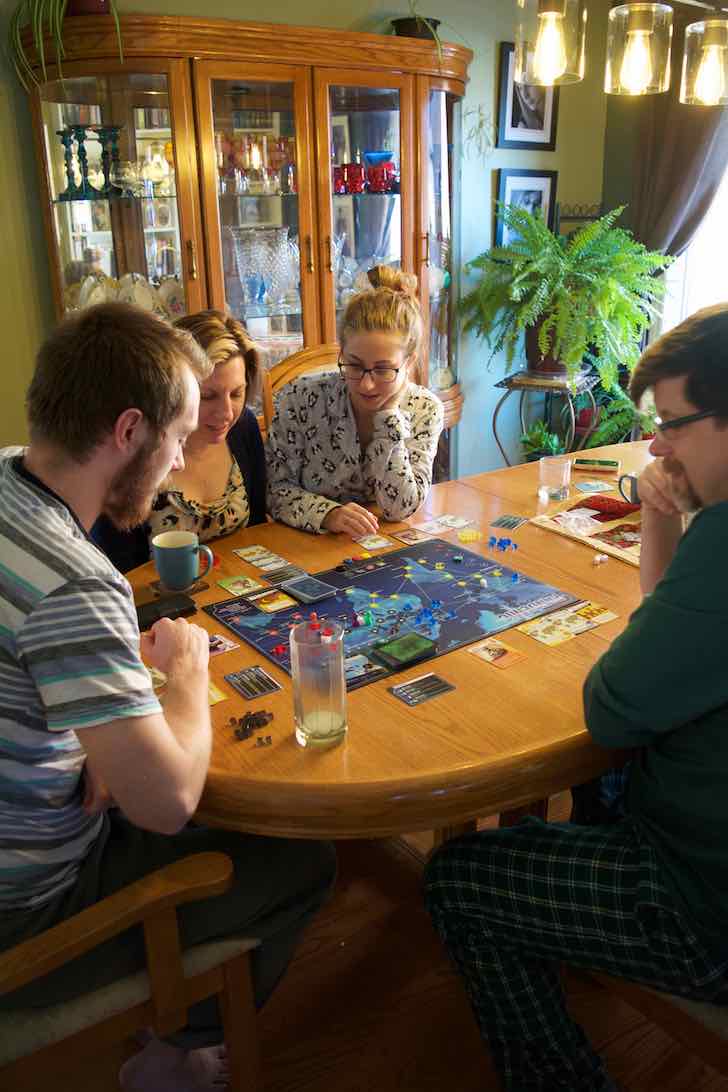
Spend one night a week as “board game night” when the family doesn’t turn on a screen, but instead plays a board game. We used to do this, and when the kids friends and cousins learned about it, they often conspired to get invited over. Like board game nights are cool! And the more you show that you can have fun without screens, the better!
Go for walks as a family after dinner, or go for bike rides. Cross country ski in the winter. Fish. Do things outside all together. I know this can be tricky with different aged kids, because sometimes the youngest just can’t keep up yet. But as much as possible, try to spend some time outside.
3. Normalize family hobbies where you create something.
In our family we knit. I have things my great-grandmother knit; my daughters wore them to my mom’s 70th birthday party a while back. We all knit.
My sons-in-law both like woodworking, and both did that with their dads. Some people bake or cook. Others refinish furniture or create new clothing out of thrifted items. It doesn’t matter what it is, but it’s amazing how being able to make stuff–anything really–changes your whole perspective. It makes you feel competent. And it gives you another source of self-esteem and identity outside of the internet world.
4. Normalize charging devices at night in a central location.
Get a charging station for phones, iPads, computers, etc. in the kitchen, so that taking phones to bed at night isn’t the expectation. Model this for them too. Let them see you charging your devices outside of your bedroom.
5. Talk to your kids. Constantly.
Bake cookies with them. Go on walks together. Make dinner together. Help them clean their room. When you’re in the same room together without a screen on, you will tend to talk. So as much as possible, do activities together in the same room so that talking naturally happens.
6. Plan times specifically to connect.
Here’s where our Whole Story puberty and sex course can really help! The videos in the course teach the concepts, and start those important conversations with your kids. But then there are discussion questions that you can use to keep that conversation going and make it personal.
And we do cover the dangers of the internet world and algorithms; the dangers of social media bullying; and even how to make sure you’re not being a bully yourself. One of the benefits of the course is that it’s relatively young people on the videos teaching it. And when young people who look “hip” are saying the exact same thing that you’ve been trying to tell your kids for years, it helps them hear it, perhaps for the first time.
You can’t just have “the talk” with your kids.
You have to have an ongoing conversation that never really ends. If you’re the kind of parent that your kids can come to with anything, and if you’re the kind of parent that helps kids see that life is bigger than their grade 8 class, then you’re going to do so much better.
And, of course, if you’re the kind of parent that can listen to your kids as they explain Groyper culture or AI, then you’ll learn something too!
Right now, until Monday at midnight, The Whole Story is on sale for $10 off the complete girls’ or complete boys’ version, and for $20 off both of them together. So you can get both the younger and older versions of the girls’ or boys’ courses for just $39, or get lifetime access to absolutely everything for just $59. We do this sale only once a year, so pick it up now! You’ll get access forever, including to any future updates that we do.

Over 5,500 parents have used The Whole Story so far to prepare their kids for puberty; to understand sex; and to keep their relationships with their parents strong through the growing up years.
So check it out–and never, ever stop talking ot your kids.









A great post, Sheila. Thank you. I have, in fact, forwarded it to my grandson’s parents. He’s still very young, but it’s good to have this advice tucked away in their memories. It’s scary to think how much at risk our boys are now. I think we’re somewhat used to thinking of the dangers to girls (and they are real too, of course), but how many of us are aware of the dangers to our boys? As the grandmother of a precious little boy, that was chilling for me.