
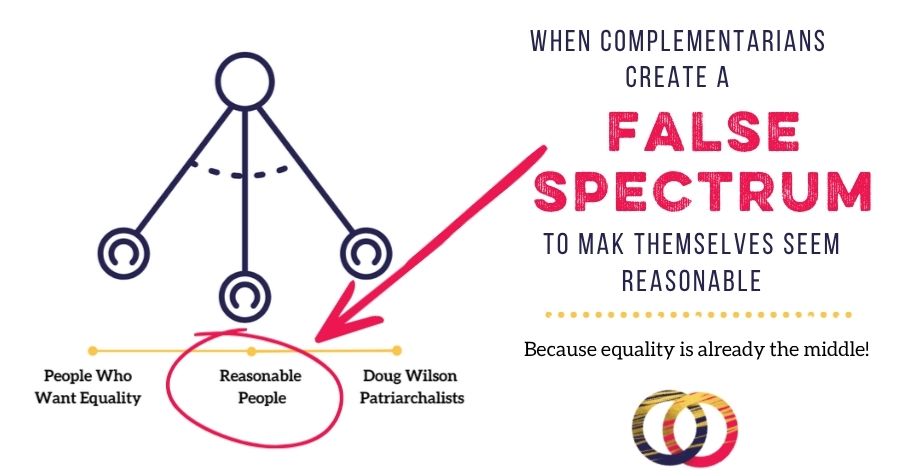


I’m often accused of swinging the pendulum to the other extreme.
Note: this article appeared on my Substack last week, and I wanted it here to to preserve it on my website! Plus I added some good stuff to it!
I remember a commenter writing about how her husband was accusing me of making sex only about the woman. The husband, you see, felt that if he had to care if his wife was interested in sex, and had to make sure that she orgasmed, then sex was now all about her, and the pendulum had swung to the other direction.
He said, “making sex only about me isn’t okay, but now we’re making it all about you.”
I hear that a lot–if we focus on a woman’s orgasm, then suddenly sex is only about her. Except that he is still reaching orgasm too. It’s only that now he has to try to bring her to orgasm, and he has to put in effort, and so it feels very different than when he could just be serviced.
It reminded me of a protracted conversation we got into on the blog a little while ago about how women deserve orgasm too, with a man arguing that the wife should do what he wants 50% of the time, and he does what she wants 50% of the time, and even though I said that meant he orgasmed 100% of the time and she only did 50% of the time, he still thought that was equal.
This comes up a lot–when women ask for fairness, that is seen as the extreme.
A while back, when I was still on X, a video went viral of an ultra-conservative podcast out of the Presbyterian Church of America called PresbyGirls. In it, I was mentioned, rather derogatorily.
They said:
On one side we have sort of Wilsonite, jaded, red-pilled men, sort of more toward hyper-patriarchy, priests of their family. We have this side. And then we have this other side, I’m thinking of the foremost Christian women influencers, this list is great–Kristin Du Mez, Sheila Gregoire, Beth Allison Barr, Aimee Byrd, Rachael Denhollander, and a bunch of other people thrown in there…and you have this other side of the fence screeching about how men are just NEVER trustworthy, and in order for the church to be a safe space for women, women have to run it.
Now, I was totally tickled pink that she thought I was one of the “foremost Christian women’s influencers.” And I’m glad they see Doug Wilson as an extreme person we wouldn’t want to emulate! (To be honest, I’m not sure they’d see him that way now, as he’s gotten more mainstream and the fundamentalists have been normalized).
But is this characterization of us accurate?
Let’s put it in graphic form, using a pendulum.
They’re saying that on one side you have Doug Wilson, and on one side you have “screeching women” who think women need to be in charge in church, and then there is, presumably, these podcasts hosts who are in the “reasonable” middle.
So it looks like this:
Presbygirls’ Depiciton of the Pendulum
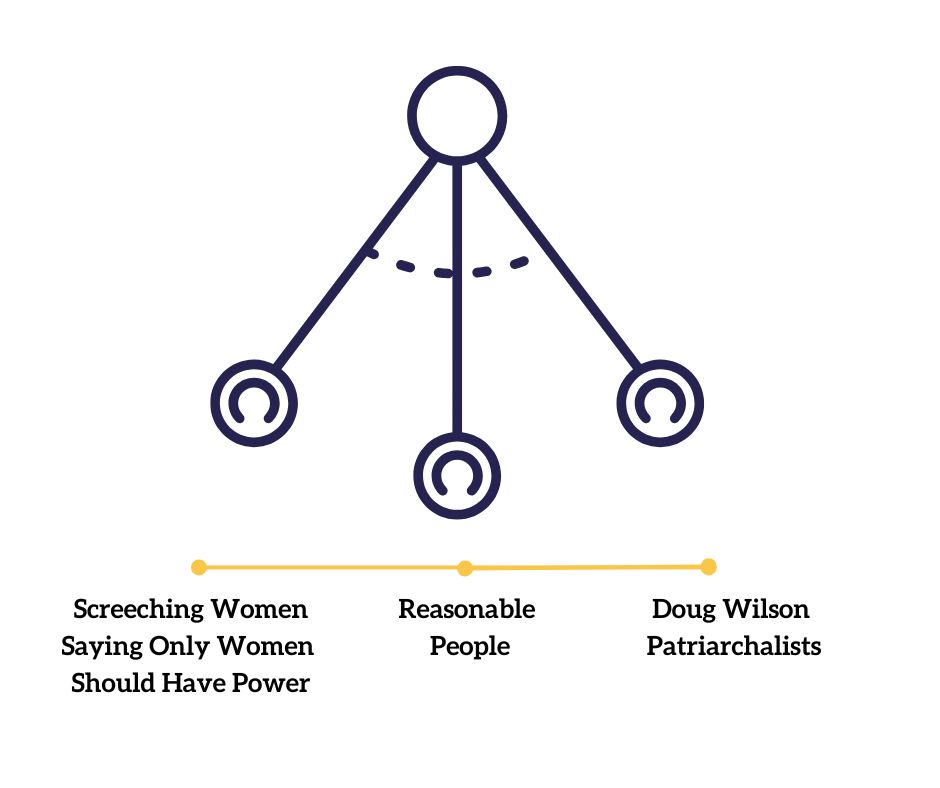
Their Spectrum is deliberately misleading
None of us wants women to be in power alone!
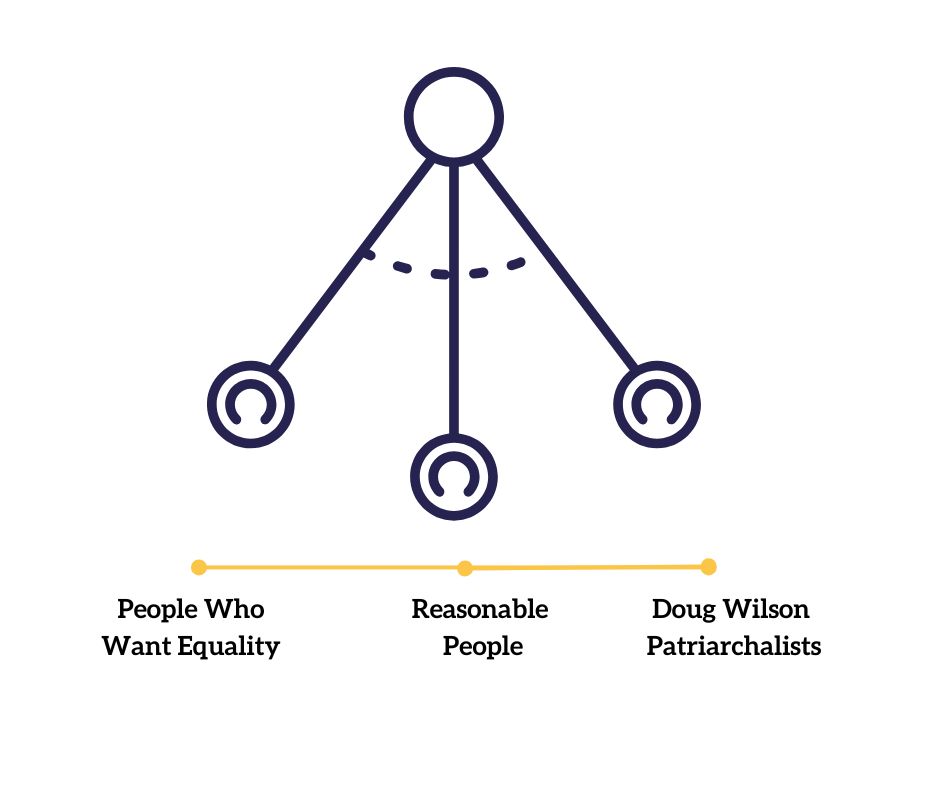
So let’s redo the Presbygirls’ depiction of reality, but this time accurately reflecting our positions (or at least accurately reflecting mine; I shouldn’t presume to speak for everyone else):
Presbygirls’ Actual Pendulum
I heard a sermon recently where Matt Chandler actually used this spectrum. You had the egalitarians on one side, and the unreasonable complementarians on the other, and what we just need is the middle, which is convinced complementarianism. Here’s his spectrum:
MATT CHANDLER’S FALSE SPECTRUM
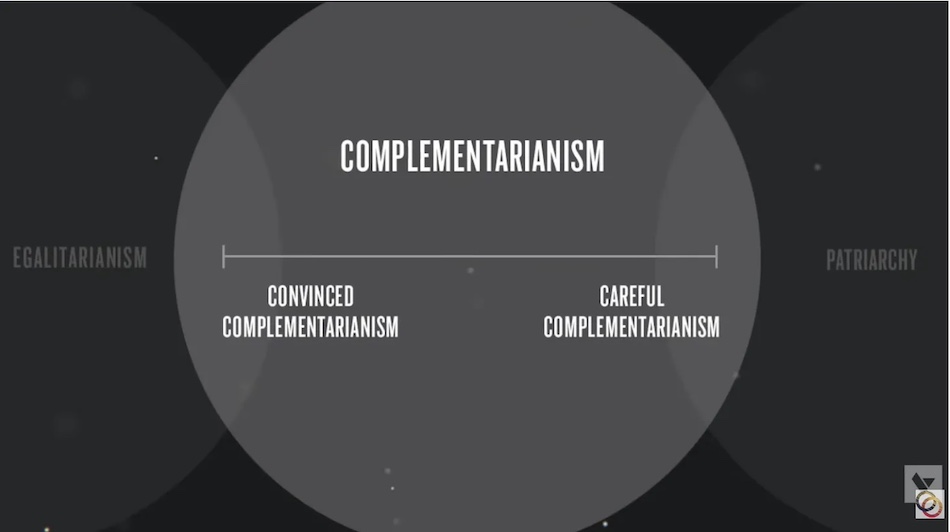
He was entirely misrepresenting the spectrum, putting egalitarianism on the extreme and making themselves sound reasonable.
(You can listen to the clip of his sermon in my podcast on the problems with complementarianism, starting around 27:30).


Do You see the problem with that depiction?
They are placing “people wanting equality” as the other end of the spectrum, as if it’s something ultra-extreme. But is “people wanting equality” actually at the other end of the pendulum from men wanting to hold power and have only men’s needs cared for? Is that really the opposite?
I don’t think so.
I think the pendulum more accurately looks like this:
Accurate Pendulum
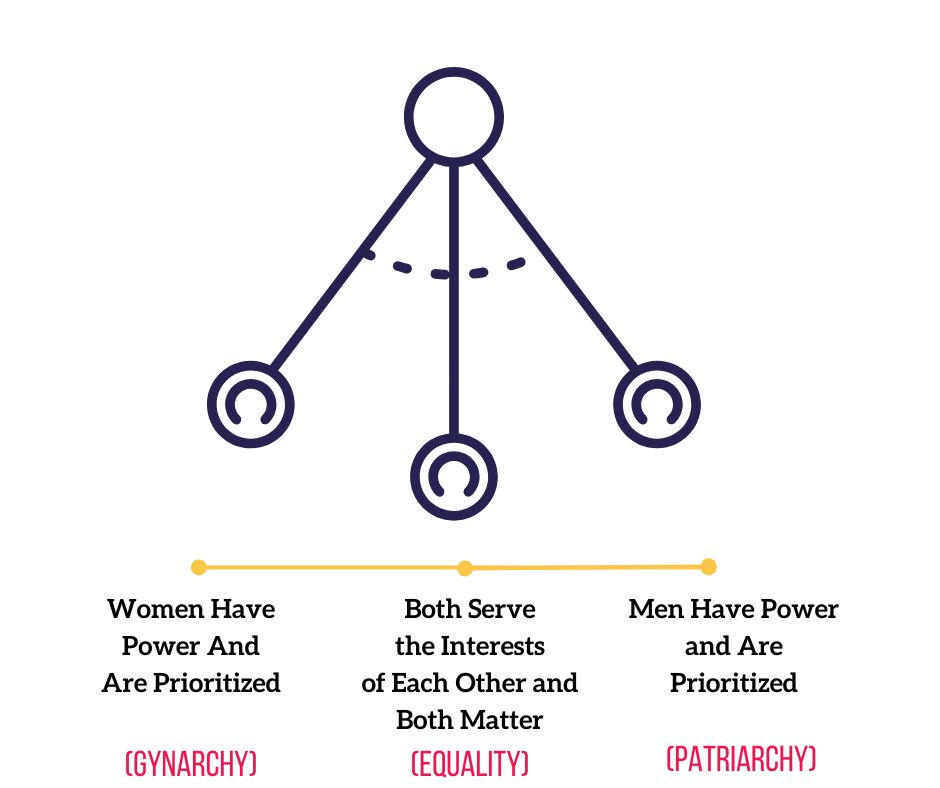
Let me explain gynarchy
Many people think that matriarchy is the opposite of patriarchy, but it isn’t. Patriarchy is about hierarchy and status and control. Matriarchy, on the other hand, is about centering the well-being of children especially and tends to operate largely on a cooperative basis. Societies that have been matriarchal are not hierarchical towards women, as patriarchy is towards men.
There’s not even a real-life example of the opposite of patriarchy, because it doesn’t tend to happen. When women have political power, it is not that women are prioritized at the expense of men; it is that hierarchies tend to be broken down so that children can flourish.
For the sake of argument, though, we’ll assume that gynarchy—the rule of women—exists, and we’ll place it at the other end of the spectrum from patriarchy.
The opposite of patriarchy is not equality; it is gynarchy.
The opposite of caring only for men’s needs is caring only for women’s needs; it is not caring for BOTH men’s and women’s needs.
When you’re used to being the only one prioritized, and when you’ve never had to do any work to care for your partner, then equality feels like a huge pendulum swing. But it isn’t. It’s simply returning the pendulum to its normal resting place.
Asking for men to care about women AS WELL as themselves is not an extreme; it is literally the definition of middle–we each care for each other and we each are equal.
The actual extreme would be to say, “men don’t matter and women don’t need to consider men’s needs; the priority in the home and church should only be women.”
I don’t know anyone at all who is arguing for that.
When people say that I am the extreme and they are the reasonable ones, then, they’re arguing for that space with the question mark below:
True Placement of Those Who Claim to Be “Reasonable”
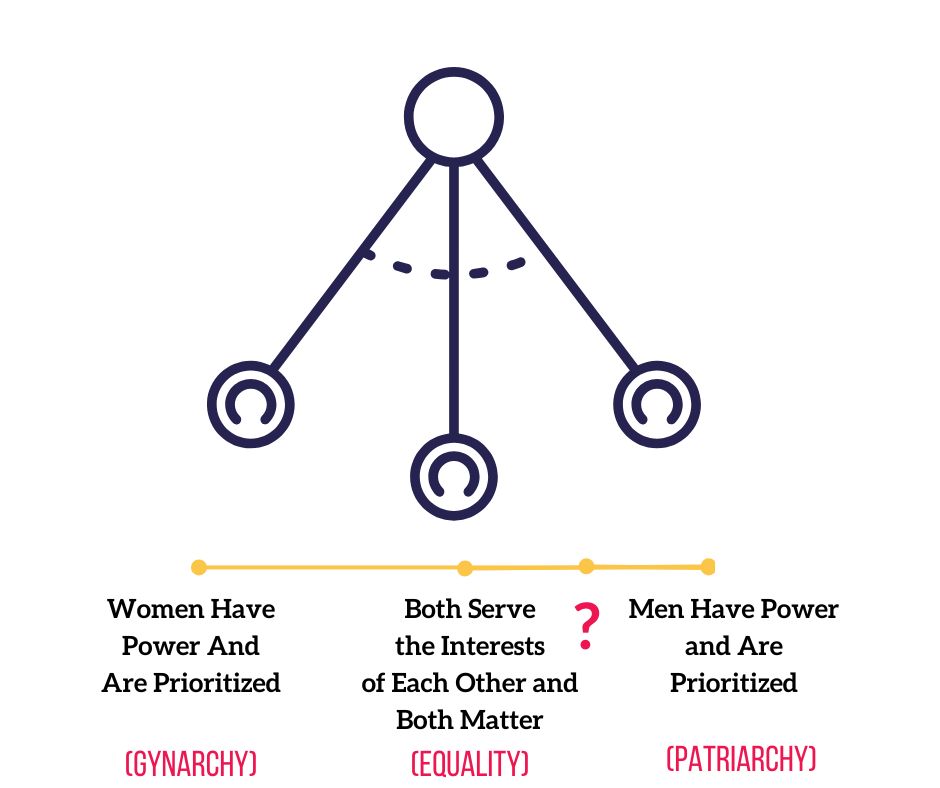
When you look at it graphically, what they think is “reasonable”–a position somewhere between patriarchy and equality–is actually still quite on the extreme, isn’t it?
Why are they creating this false spectrum?
When you create a spectrum, you have to be measuring something. In this case, they’re trying to measure gender power.
If they were being intellectually honest, they would have drawn the spectrum accurately.
But they don’t want to do that, because when you’re looking at two extremes, people usually think the middle is the reasonable position. So instead of basing a spectrum on what logically would be the extremes, they choose the ends of the spectrum based on what definitions will put them in the middle. It’s ridiculous.
Here’s an analogy of what they’re doing: Imagine if you have made a spectrum with enslaving people of colour on one hand, and having no slavery on the other. Then the middle would be Jim Crow laws! But the opposite of enslaving people of colour is not no slavery; it’s enslaving white people.
When you put the ideal at one end of the spectrum, you are already making an argument for injustice.
And that’s what far too many complementarians do to make their arguments sound reasonable.
I hope seeing this graphically can clarify the discussion.
Equality feels scary when patriarchy is all you’ve ever known. It feels so different.
But it is not the extreme.
It is the extreme to say that men’s needs should be prioritized, even if that has become normal within evangelicalism.
That’s what I was trying to say in that discussion a few years ago about women’s orgasms. That’s what I was trying to explain to that commenter this week, so she could better articulate it to her husband.
And this is what we’re saying in our book She Deserves Better. It should not be extreme to say that girls are not responsible for boys’ sins, and that it is not girls’ jobs to make life easy for boys.
That is merely trying to take the pendulum back to the middle, where we all matter, we all serve each other, and instead of grasping for power, we try to follow after Jesus, together.
I long for the day when that is not seen as radical.
Have you seen people create these false spectrums? What do you think? Let’s talk in the comments!









I have seen the “gynarchy” side of the pendulum: People saying that men are always bad, all men are untrustworthy, women should run everything, who cares about the feelings of men, hatred of men, etc.
Disclaimer: I have never seen such things on this site. Anger at Patriarchy and the abuse that it can lead to? Yes, but never extreme hatred.
But is what you list really gynarchy, where women actually have power over men?
If Fred decides to not become friends with new acquaintance Barney, does Fred thereby wield some kind of power over Barney? Or is Fred just deciding his life is better without Barney? Does Fred owe Barney friendship, or can Barney demand friendship with Fred?
If women look at the odds of finding an egal man and decide they’re too low to even try, such that women choose to not have men in their lives, how is that women wielding power over men? 🤔 Do women owe relationships to men, or can men demand to be in women’s lives?
Sometimes yes, and sometimes no. I’ve seen people and websites where they say women should just go their own way and ignore men, and some few that actually say women (and women alone) should have power.
Also, I would place the “complementarianism” belief at the three quarters spot between equality and full on patriarchy. Where women count, matter and have value, just then men are always in charge and have all the authority.
But how does ignoring men and choosing to not be in relationship with them give women “power over” men?
I’m having a hard time seeing how it’s any different than my hypothetical Fred and Barney non-friendship.
“I’ve seen people and websites where they say women should just go their own way and ignore men…”
Like a genderflip of the Manosphere’s “MGTOW”?
(“WGTOW”? We’re seeing something like that happen in Korea.)
“…and some few that actually say women (and women alone) should have power.”
i.e. Actual Female Supremacists, a genderflipped funhouse mirror of Doug Wilson and the Commanders of Holy GIlead. (As Ayn Rand and Vladimir Lenin were funhouse mirrors of each other.)
Shiela, your pendulum diagram should have two more positions beyond Patriarchy and Gynarchy for these two Lunatic Fringes, with the pendulum shaft/cord snapped on both and the weighted ends flying away.
I always found MGTOW funny since for someone going their own way they can’t stop fixating on women and won’t shut up about wishing they had a relationship. At least with women who go their own way most of them just move on with their life and focus on their female relationships. These men should just find some bros to hang out with but wait deep male friendships are too “gay” for them
That’s actually really interesting. You’re right. When women go their own way, they find female friendship and support groups and hobbies, but men tend to still fixate on the women they can’t have. That’s telling.
I had to MGTOW myself around the time I turned 40. Women (with one exception) have never found me attractive, after the breakup with that one exception I burned four figures in ten years on the dating scene without result, was actually building a nest egg… If I were to be cleaned out by a “divorce for fun & profit” gold digger, there was no way I could recover. So I had to do an “I Kissed Dating Goodbye”; the risk wasn’t worth the minuscule chance of reward. It still remains the biggest failure in my life.
“I have seen the “gynarchy” side of the pendulum”
Maybe in the “Barbie” movie because that’s as real as it gets. LOL
Yes! That question mark spot between patriarchy and egalitarianism is called “complementarianism.” and you’re right, people in complementarian bubbles tend to it to realize a whole other half of that spectrum exists.
If you like dystopian novels, you might enjoy “The Gate to Women’s Country.” It pits gynarchy against patriarchy, with a plot twist.
*tend NOT to realize
I would like dystopian novels but it seems like a lot of powers that be whether CEOs or politicians seem to use them as an instruction manual. Even Church leaders already seem to be using Handmaids Tale and Suzette Collin’s Laadan trilogy of books as guides of how to run a church.
And don’t get me started on the entire cyberpunk genre. Tech bros these days don’t seem to get that these settings are NOT a fun place to live in for most people.
Also whoops wrong Suzette. I meant Suzette Elgin, the creator of the artificial language Laadan that wrote a dystopian trilogy centered around it
“Tech bros these days don’t seem to get that these settings are NOT a fun place to live in for most people.”
It is for the TechBro Elites at the tippy-top, and that’s all that matters to their fully-Digital brains.
And/or RL “Cyberpsychosis”, where they are so into Virtual that “Meatspace” (and all those bags of Analog-brained Meat in Meatspace) no longer exists to them. On top of how becoming a Tech Billionaire at 25 can warp your sense of values all by its lonesome.
“The Gate to Women’s Country.” It pits gynarchy against patriarchy, with a plot twist.
So does Norman Spinrad’s “A World Between” (1979), where a world with an Egalitarian society finds itself in the middle of an interstellar “Hearts & Minds” propaganda war between Total Male Supremacist and Total Female Supremacist empires.
I never heard of gynarchy. I thought the term was Matriarchy. Is there a difference?
The term “matriarchal” can be misleading because it sounds like it is the mirror opposite of patriarchy. It is sometimes used that way, but it’s also used to describe traditional/indigenous societies where family lineage or inheritance are traced through the maternal line, or where certain authoritative roles are reserved for women. But this is not really the “opposite” of patriarchy. So people will sometimes use “gynarchy” for the opposite of patriarchy: a hypothetical situation where society is run by and for women and men are oppressed.
“The term “matriarchal” can be misleading because it sounds like it is the mirror opposite of patriarchy”
Linguistically, it IS a mirror opposite using the Latin words for “mother” and “father”.
“Gynarchy” and “Andrarchy” (using the Greek words for “woman” and “man”) would be more consistent with the Greek suffix “-archy” (“ruled by”) .
Yeah it should be Andrarchy I agree. Linguistically this kind of triggers my autism that the Greek isn’t consistent. It is kind of like how people use the suffix -phobia to describe prejudice and hatred against a group rather than -ism like they used to which I often feel kind of downplays the hatred since at least if someone is irrationally afraid of something you at least can sympathize with them and maybe reassure them that this group of people aren’t scary unlike a bigot which are harder and more headache inducing to reason with.
You ain’t the only one on the Spectrum, Courtney.
“It is kind of like how people use the suffix -phobia to describe prejudice and hatred against a group rather than -ism like they used to…”
Actually “-path” or “-pathy” (implying full Hatred) would be more descriptive than either -phobia or -ism. The late unlamented Fred Phelps wasn’t a “homophobe”, he was a “homopath”.
Replying to your comment below, the Greek suffix -path or -pathy or -pathos means “suffering,” “feeling,” or “condition/disease”…it does not mean hatred. For example, the breakdown of the word psychopathy would be mental+suffering. Apologies for being the suffix police. haha
Yes, in actual matriarchal societies we tend to see less hierarchy, and a focus on caring for the needs of all, especially the children. We see an emphasis on community, etc. So matriarchy is not the mirror image of patriarchy; it’s something else altogether.
“Kristin Du Mez, Sheila Gregoire, Beth Allison Barr, Aimee Byrd, Rachael Denhollander… this other side of the fence screeching about how men are just NEVER trustworthy…”
HAHAHAHA that is a great backhanded compliment isn’t it?
But a really silly way to characterize what any of these people actually say. Heck, Aimee Byrd and Rachel Denhollander tried their darndest to stay in/work with their conservative denominations and their churches treated them like trash for their trouble.
What all the women named DO say is that power differentials are dangerous and should be avoided wherever possible, and everyone with authority should be expected to earn their position and be accountable. This podcaster seems to be leaping from “men shouldn’t ever have unchecked power” to “men can never be trusted,” implying that if we consider people trustworthy we should be OK with handing them unilateral power over us. This is not simple exaggeration or straw (wo)man argumentation, it’s authoritarian doublespeak.
So well said!
There’s a hidden premise that’s been smuggled in here (and I’ve seen it frequently from Sheila’s material): Men having authority =/= men’s needs being prioritized.
This CAN happen, and in toxic applications it’s OFTEN true, but that doesn’t make the concepts synonymous. A charitable portrayal of Biblical Patriarchy would be men in authority for the benefit of those in their care (see: women and children). A self-sacrificial patriarchy is fundamentally different from a selfish oppression of men over women. All apes are monkeys, but not all monkeys are apes.
It’s evident the bent of Bare Marriage is to push back against the pendulum of selfish masculine leadership, and in fairness, I HAVE seen SOME material re: “perhaps you’ve done everything perfect, husband, and your wife still won’t sleep with you, I guess that could maybe happen,” but it’s scant and usually ends with, “but before we suggest she be accountable in any way, are you SURE there’s nothing we can blame you for?”
If your sincere goal is complementarianism and equality, perhaps consider why 90% of your material is antagonistic to men.
Bor, we found no evidence of this existing in real life. People keep claiming that it does, but we simply don’t see it. In all of our studies (and in other’s studies), whenever couples believe that the husband has the final say and is in leadership over her, all the markers of relational and physical health go down. If this could be practiced well, we wouldn’t expect to see that. But we do.
Could there theoretically be some marriages where this is handled well? Sure. But it’s such a small number it doesn’t affect the results which overwhelmingly flow in the other direction.
If something only works in theory and not in practice, it bears bad fruit, and we know what Jesus said about that.
I hear what you are saying. I have known men who seemed to both believe complementarian teaching and do their best to love and serve their wives. Not all complementarian men do that much. But EVEN IF they all did, that wouldn’t keep complementarian structures from prioritizing men. In these structures, women are denied access to the highest levels of leadership because they were born without a penis. If only men are allowed “in the room where it happens,” men’s interests *cannot help* but be prioritized. Even if they are kind, caring men who truly want to do right by women, they don’t know what they don’t know. They can’t step fully out of their own perspectives to objectively weigh ones they haven’t lived. And this is not knocking men! Nobody can really do that-not in marriages, not in churches, not on school boards or in boardrooms or legislatures. This is why we aren’t all a hand, or all an eye. This is why organizations that prioritize diversity in leadership do better than those that don’t. Why disability advocates say “nothing about us without us.” And why it matters so much for people of color to be able to elect representatives from their own communities. This goes back to what I said above: the problem with gender hierarchy is NOT that there are no good men.
Yes, well said.
I’ve learned a new word today – Gynarchy – I’m interested in your research and thoughts since you live in this kind of data on a regular basis. I can’t seem to find a clean data set that speaks to how couples report/self identify and then act, but combing data through compilers shows the following:
Of those who report to be egalitarian,
70–75% function egalitarian
15–20% male‑dominated
8–10% female‑dominated
Those percentages apply only to couples who claim to be egalitarian. But when you include couples who openly identify as traditional …the distribution shifts.
55–65% egalitarian
25–30% male‑dominated
10–15% female‑dominated
What do you think the actual numbers are and do you see trends switching as the education gap is widening and the income “financial breadwinner” stats are becoming so much more equalized in the younger couple data? Can you point me to a data set that has direct values? Egalitarian is the middle of the spectrum for sure.
He said, “making sex only about me isn’t okay, but now we’re making it all about you.”
ZERO-SUM GAME.
Where one has to Lose for the other to Win.
Which quickly mutates into Winning by Making the Other Lose.
“Screeching Women Claiming only Women Should have Power”
There are crazies like that out there.
I consider them Rule 63 genderflips of Doug Wilson.
Female Supremacists instead of Male Supremacists.
And like Fanboys/Fangirls everywhere, they may be few in number but they are LOUD in volume.
And Loud Crazies have this way of defining the public face of any movement or group.
“The opposite of Patriarchy is not Equality; it is Gynarchy.”
Shouldn’t “Patriarchy” be “Andrarchy” or “Androarchy” to keep everything Greek?
I can see where the Presbygirls, et al, are making their mistake. They look at all the people who claim the label “Christian.” Then, within that group, they look at the most “liberal” and the most “conservative”, and they label those the “extremes.” Because there are no Christians (that I’m aware of) who are gynarchists, they don’t consider the fact that gynarchy would be the actual ideological opposite of patriarchy.
Another way of trying to understand their POV: both gynarchy and patriarchy believe that authoritarianism is good, they just differ on who should be the group in authority. Whereas egalitarian believes that authoritarianism is generally bad and that collective decisions, compromise and mutuality are good. So, in that sense, egalitarianism and patriarchy are on opposite ends of the spectrum when it comes to the role of top-down authority.
“Another way of trying to understand their POV: both gynarchy and patriarchy believe that authoritarianism is good, they just differ on who should be the group in authority.”
i.e. The Boolean zero-sum equation of Power Struggle: “MY Boot on YOUR Windpipe or YOUR Boot on MY Windpipe”, NO other states possible. And the only way to avoid the second is to make sure of the first; the Universe cannot have two Centers. You can see where this can lead (and has led).
I’m interested in your research and thoughts since this is your area of expertise. I can’t seem to find a clean data set that speaks to how couples label their relationship vs actual life. The best I can come up with is
15–20% Patriarchal leaning
70–75% function egalitarian
8–10% Gynarchic leaning
I’m guessing churches have a separate breakdown. Has any research been done to quantify that data set?
Your “best I can come up with” looks like a classic Bell Curve with two One True Ways defining the tips.
You hold the extreme reputation for views in posts like this and the beliefs it teaches. I will give you two points that show a lack of truthfulness and deception.
First, you state that when women hold power their number one interest is children’s safety. When in fact, the number one voting issue for most women is the right to murder their own unborn children. Tens of millions of women have murdered their own children and many more fight for the right to do so. It is simply dishonest in any way shape or form to make the argument you did in this post. Women, are no morally better in any way than men and yet you make this argument in every sphere of life.
Second, why is orgasm rate the ultimate gotcha that men are selfish and women are victims? You go there again and again. Yet you deceptively miss, forget or intentionally gloss over so many things. First, the way the question is asked you will ultimately skew whether your results are giving accurate reflection of women’s sexual happiness. The question asks the last time, but doesn’t look at the whole. At different times in a woman’s cycle a woman will just have a hard time orgasming, same with when she is first sexually active/married and it takes time, or menopause or even perimenopause, let alone pregnancy, etc. Women’s orgasm are never, ever going to be as regular or automatic as men’s. Never. Stop blaming men. Is biology. You might as well complain that women cannot bench press as much as men and blame it on men. It is absolutely ridiculous and deceptive. You also don’t seem to complain that men usually only get one where a woman can have multiples and generally stronger ones. Why don’t you spend years teaching that it is unfair to men? I mean seriously!
Your dad messed you up as a kid and instead of owning it, healing and moving on you spend your whole life literally tearing good marriages and men apart. You are not doing Christ’s work. I know of several good marriages you have torn apart and good men and kids lives you have ruined.
Actually, Commenter, women in lesbian relationships orgasm almost 100% of the time. Many women orgasm 100% of the time. 48% of them do in evangelical marriages! If it were a problem with women alone, then we would expect that women would always have a problem with reaching orgasm. But they don’t. The women with some of the lowest orgasm rates are heterosexual evangelical women who are married. So it is a problem with these types of relationships which prioritize men’s pleasure and not women’s.
Thank you for the rest of your thoughts, and for showing why my work is needed!
Sir, this is so interesting. Listing the many states a woman’s body can be in, from newly sexually active to various stages of her cycle to menopause, and suggesting these make it harder for her to climax. This set up implies women are just defective. There’s so much evidence that when you subtract selfish men from sex, women orgasm easily (looking at couples where he cares, at lesbians, and at masturbation). I don’t support the last two, but they do clearly demonstrate the issue is the male partner being inept.