
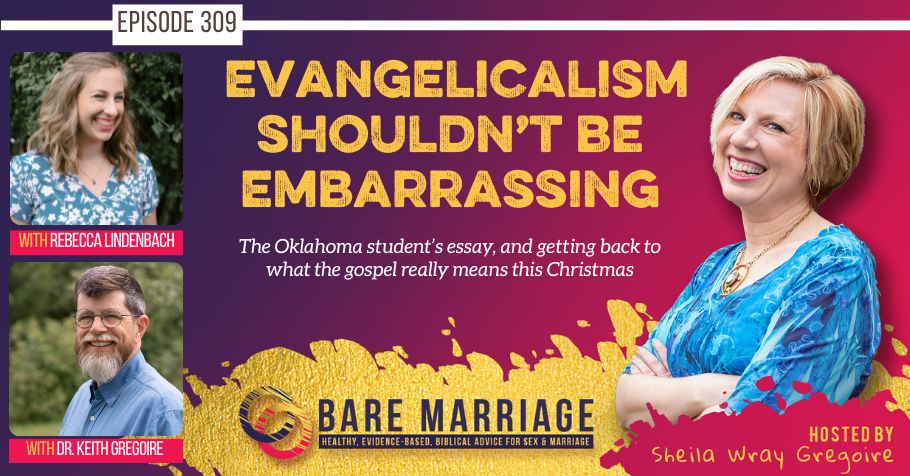


We’re coming full circle for the last podcast of 2025!
We started this “season” (I never know how to count the seasons really!) since we came back from summer break talking about right wing authoritarianism, and how it overlaps almost completely with religious fundamentalism and evangelicalism–and how much that worried us. We had a ton of great feedback on that podcast.
And then, right before the end of 2025, a student at the University of Oklahoma hit the news when she complained about receiving a 0 grade on an assignment, because apparently it was “religious persecution.” Except that her work was atrocious, was not academic at all, and didn’t fulfill the assignment.
Today we want to talk about how that’s the perfect encapsulation of what we were talking about. Evangelicalism needs to stop being embarrassing, and we need to get back to what the gospel really is, instead of engaging in ridiculous culture wars because we want to be seen as persecuted.
Every year, right before Christmas, we share a bit about our own faith journeys. And Keith and I had fun just chatting about what we’re thinking (and rethinking!) about the gospel and sin and so much more!
Or, as always, you can watch on YouTube:
Timeline of the Podcast
00:00 Introduction & Looking Back at 2025 4:28 Full Circle: The Oklahoma Student Essay Controversy and how it reflects authoritarianism 13:14 Anti-Intellectualism in Evangelicalism 17:16 Why Kids Leave the Faith (It’s Not What You Think) 23:04 The action step to learning to sit with other perspectives 26:14 Keith and Sheila: The gospel is so much bigger than we tend to think it is 41:19 Jesus Called Out Religious Leaders, Not “The World” 48:10 Seeing Sin as Brokenness, rather than only breaking “the rules” 54:51 What if the gospel was about creating wholeness 1:01:08 Our 2026 PlansKey Talking Points
- That Viral Essay? It Actually Wasn’t Academic – A student turned in a religious diatribe with no citations claiming “women naturally want to do womanly things” and calling academic research “lies from Satan” and then claimed to be persecuted when she failed the assignment.
- Anti-Intellectualism is Destroying Evangelical Witness – Christians often really struggle to sit with differing perspectives, choosing instead to rally around bad arguments because they agree with the conclusion even if there is no good reason or evidence, behind them.
- Build Your Kids’ Faith on Solid Ground – If your children’s faith is built on bad arguments and false information, don’t be surprised when evidence washes it away
- Faith is Transformation, Not Just Beliefs – Moving away from the “pray the prayer and you’re saved” mentality toward understanding faith as actual life change that leads to wholeness, connection, and secure attachments.
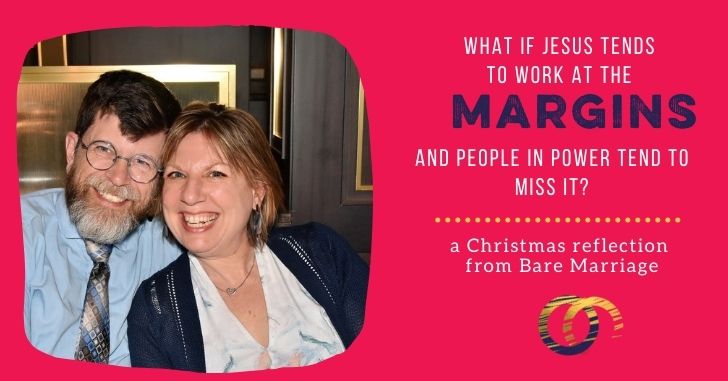
- Jesus Called Out Religious Leaders, Not the World – The people religious leaders condemned felt comfortable eating with Jesus—that should challenge how we talk about “outsiders”
- Sin is Bigger and Smaller Than We Think – It’s not just individual moral choices but systemic brokenness
- The gospel is about a God who truly sees and understands us – He’s not someone who is mad at us all the time or looking for reasons to judge us. He just wants to see us whole and healed so that we can be in right relationship with Him and those around us.

Things Mentioned in the Podcast
JOIN OUR FUNDRAISING CAMPAIGN!
Help us raise money to fund our research, our new podcast docuseries, and our translation projects! Give through the Good Fruit Faith Initiative (tax deductible within the United States) or join our Patreon!
CHECK OUT THE RESOURCES MENTIONED:
- The Whole Story puberty course
- The Great Sex Rescue
TO SUPPORT US:
- Join our Patreon for as little as $5 a month to support our work
- And check out our Merch, or any of our courses!
- Give to the Good Fruit Faith Initiative of the Bosko Foundation
- Join our email list!
LINKS MENTIONED:
What do you think? Has your thoughts about the gospel changed over time? What did you think about the brouhaha over that student’s essay? Let’s talk in the comments!
Transcript
Coming soon







Thank you for sharing this podcast. I appreciate what you and Rebecca said about research. My son did his first research paper for college about two weeks ago. I helped him with it since he had not done very much formal research. Since I have training as a librarian, I emphasized the importance of using good resources and documenting the information he used for his paper. His paper was about the gospels and how they have stood the test of time. He also attends a community college, and his professor liked his paper. He received an excellent grade for his hard work with positive comments for how he presented his arguments along with giving opposing views. By the way, his teacher accepted his proposal for the paper before he wrote it.
Also, you could have been describing my parents (especially my dad). It has always been about image. My husband and I don’t fit the image. We have done very little contact with them for this year because we are exhausted from playing the perfect family game. For the sake of my kids, we will keep enough contact with them, but it can never be the same. To me, it feels like I have to pretend that we have a good relationship even though we don’t. To my parents, limiting contact is the same as rejecting my relationship with Jesus.
Thank you for letting me share my thoughts. I hope you have a blessed Christmas with your family.
I had to cite sources for assignments in community College at a Christian community College. Even with assignments were i did not have to go full on MLF format with the proper paragraph spacing and cover page and sources page I was expected to back up my claims rationally in an essay format or thoroughly thought at and sourced PowerPoint presentation.
That is just embarrassing.
Also if you want folks to investigate Christianity seriously give them good info. I would recommend not only you guys but folks like N.T Wright Francis Collins William Lame Craig Alvin Plantinga Lee Strobel Craig Keener C.S Lewis G.K Chesterton you get the picture.
I eagerly await the day you respond to more red pill content with data. I feel that that could really make waves. Finding out the numbers presenting good data and a message that does nof feel tone deaf to this generation would be great.
In addition to my comment I made a couple weeks ago about this, I must say that one thing that stood out to me after reading this paper is the fact that it gives me hardly any information about what the article she was reacting to was about. I think it was about how gender roles are often enforced by bullying by peers but it doesn’t really engage with it at all I don’t know what it is actually saying and arguing. The fact she says bullying is good is quite concerning and I hope she isn’t trying to be something like a school psychologist where you are expected to be a mediator with bullying that happens.
I also must say that one thing I was taught in school was NEVER write a formal paper in first person because it makes you look narcissistic and most readers don’t care about you as a person and you aren’t that important in the scheme of things. Writing it in third person will still get your opinions across and it will sound less “me me me” that is what I see from this paper is that it is all about her and not the article.
I was taught the 3rd-person rule in undergrad (2000). Then I started seminary in 2024 and in our “how to write academic papers” class, they said that academic norms have changed and it is now acceptable to write in first person. I’ve seen that in published articles I’ve used for research. What hasn’t changed is the need for citations and thoughtful arguments.
Interesting, I do think in my opinion writing in first person in an formal essay is harder to pull off than writing a third person because it can be easy to fall into that temptation to make it all about you and your experiences and personal anecdotes compared to writing in third person which I feel forces you to write with more humility.
I really wish that I could read the article that essay was written in response to. I want to see the arguments and evidence that was presented when it came to bullying and gender nonconforming youth. That is the thing about not citing stuff is you can’t look up the original source to get the other persons perspective which I am quite curious about. Some of my favorite things to do when researching stuff is going down the rabbit hole of a nonfiction books works cited page because it usually contains a ton of books and articles for future reading about the topic and getting the full context of what is cited helps understand everything better. I definitely had a fun time looking at everything cited and referenced in the Great Sex Rescue, She Deserves Better, and the Marriage you Want.
Oh, and reflection papers are always in first person because it is a record of you reflecting on the assigned content. It’s acceptable, even expected, for a reflection paper to say, “On page X, Author says ABC. That made me think about Author B and how in my context, Z is the norm. If ABC and Author B are right, then that brings up the question of … for Z.” Citations and refined reasoning are still required.
For informative or persuasive essays, the author is more removed, but first person can still be used to avoid awkward phrasing like “in the opinion of the author…”
I live not far from Oklahoma and the girl’s mom was on a local radio show not long ago. She’s pre-med. I read her essay today, and oof, that wasn’t what I was led to believe it was by the interview. The article she was reacting to was “Relations Among Gender Typicality, Peer Relations, and Mental Health During Early Adolescents” by Jennifer A Jewell and Christia Spears Brown in Social Development vol 23 number 1.
I have to say that I wrote some opinion essays early in college that were pretty dogmatic and biased, but at least I *tried* to back my opinions up with citations.
I’ve finally managed to find a copy of this essay, and I can’t believe how embarrassingly bad it is. She barely refers to the original article at all, simply uses it as a springboard to preach her views on gender. And she didn’t even manage to get the word count up to the minimum required for submission – if she had, she would have got at least 1 point for that, but it’s like she just ignored every piece of guidance she’s ever had. Having read it, I’m actually wondering if she wrote it deliberately badly so that she WOULD be failed and could then use the ‘religious discrimination’ platform to proclaim her views even further. It’s beyond belief that anyone has been suspended for very sensibly refusing to give a pass grade to such an infantile piece of work.
As I commented on a previous blog post, being able to explain an argument coherently does not automatically mean you believe it anyway. I knew a university student who was studying geology who became convinced halfway through his course that evolution wasn’t true. In his final paper, he dealt with the discussion topic brilliantly, referencing everything he’d been taught during the course. At the end, he wrote a brief statement saying that, while this was what he had been taught about evolutionary theory, he personally did not agree with it, and he passed with honours. The difference between him and this woman was that he actually knew how to write a proper essay. Hers sounds more like regurgitated waffle from TTW.
One of my professors that I had when I was getting my library degree said that some of the things that he had to learn wasn’t what he agreed with. He told me that he would give the answer his professors were looking for on tests and write at the end of the answer F.T.P.O. (For Test Purposes Only).
She has since admitted that she didn’t even read the article that she was supposedly reacting to. And she still thinks she shouldn’t have failed. It’s ridiculous.
I love what Rebecca says at the 25 minute mark. Because it’s so true. This podcast was kind of the “gateway drug” to my entire worldview being flipped on its head. After I started changing my mind about complementarianism and read Philip Payne’s book, I had a moment of realization that if people had been misleading me about what the Bible said and meant about women, what else could that be true for? I started investigating all sorts of taboo topics in regards to theology and politics, and it changed everything for me. It was confusing and scary at times, but I am so much freer now.
Also, Sheila’s comments on how the shallow evangelical view of the gospel hurts our ability to connect with and love others is so powerful. I’d recommend Brian Recker and his book Hell Bent to anyone wanting to dive deeper into that.
I’ve been on the same journey! It is so much more freeing!
This podcast has so much information!
You brought up about college students coming from Christian families that become liberals/non-believers while in school. I remember that problem last decade. I had gone to a Catholic college for two years and was saved by Christ while I was there. I came from a “sort of” Christian family, where my mom had the church handle the Jesus responsibility and my dad was uninvolved. I believe that if someone turns away from the faith, they weren’t saved to begin with. That’s the only explanation for “Christian” young people becoming liberal non-believers. I think the Boomer parents/grandparents just didn’t want to admit that they had failed raising their children/grandchildren concerning Jesus.
What you said had me rethink this whole narrative. If Christians are concerned about their children turning away from Christ, why do they send them to secular colleges? I would think parents that were very concerned about this problem would send their kids to Christian colleges. Or, even with the current economy problem, encourage them to go straight to work.
A lot of Christians ARE trying to stop their kids going to secular colleges. But I don’t think the problem with kids from Christian homes turning away from their faith is the colleges’ fault at all. If you bring your kids up with half-baked arguments, scriptures that have been twisted to fit your world view, explanations that stop at “Because God says so” or “Because you’re rebellious to question it”, never let them question or challenge anything and constantly demonise anyone ‘outside’ who doesn’t think the same way that you do, it’s not really surprising that they are going to kick over the traces as soon as they start hearing other world views.
The kids I know who have stayed steady in their faith through college and beyond have tended to be the ones who were exposed to a wide variety of viewpoints at home, who were challenged to dig into the Bible and discover what it says for themselves, who were encouraged to ask tough questions and discuss and debate their faith. They encountered a real and living faith in their home and early church life, and so when they went ‘out into the world’, they found that it stood up just fine to everything that was thrown at it.
This is so true, Angharad! Kids who were encouraged to think for themselves as teens often did have a robust faith that could withstand scrutiny.
That’s NOT the “only explanation” for Christian people experiencing a lapse in their faith. Some of us have believed whole heartedly for years, and when we are forced to examine critically the things that we always accepted as true, we find ourselves pulling one thread and unravelling a whole sweater.
My moment of truth came the day I found myself telling a client that it was OK for her to “take a break from God for a while” (her words), because if God truly loves us He will understand, and if He doesn’t love us and understand, “we’re all screwed” (my words). That was my thread, and my whole sweater has unraveled. But believe me, I was “saved.”