
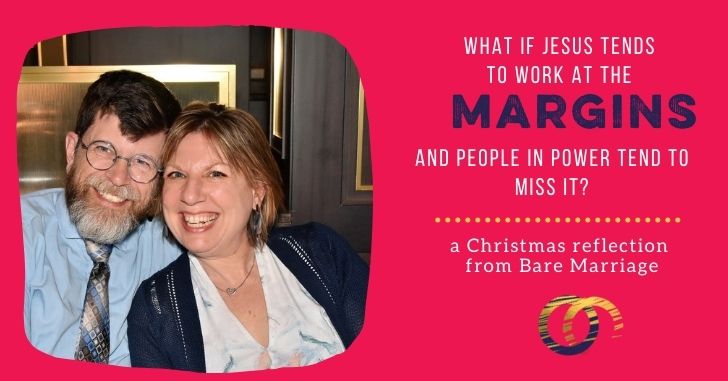


The Christmas story brings peace to me when people refuse to hear the truth.
It’s my last post of 2025, and I’ve been a little quieter lately, having some time to think and process.
And as I’ve shared at Christmas over the last few years, one of the things that has haunted me and plagued me the most since we started our research was that people high up in evangelicalism genuinely didn’t care that women were getting hurt. They didn’t care that their messages about sex and marriage resulted in harm. They just refused to see it.
How could people who claim the name of Christ be like that? How could people who studied the Bible their entire life be like that?
It’s been hard, and I know so many of you have struggled with similar things, even if it’s not the same issues. How could people who love Jesus not see what you do?
And that’s where the Christmas story comes in, and gives us an answer.
When Jesus shows up, He often does so at the margins. He doesn’t enter the halls of power; He comes where people wouldn’t expect Him. And often those in power miss Him entirely.
The Christmas story is a story of women–of Mary and Elizabeth, recognizing the significance of Jesus and their babies, while their husbands took more time. It’s the story of shepherds, the lowliest on the social ladder, getting a visit from angels. It’s the story of foreigners, outside of the chosen nation, arriving to see the King that His own didn’t wecome. It’s the story of an old woman, waiting for decades at the temple to see Jesus. It’s the story of a young family having to flee and become refugees because those in power were out to get them.
And as Jesus grows, the Romans and the teachers of the Law miss who He is, but the regular people, and even the “dregs” of society, don’t.
This isn’t an aberration.
When you look at the last 2000 years, and you’re trying to see where God is working, it’s almost always at the margins. It’s people doing big things for God, and having to fight the religious powers that be to even be able to do that. It’s people starting new movements based on bringing Jesus in a real way to the world, not just on preserving power for themselves.
Think of how Christians were on the forefront of the abolition movement, all social justice movements. It was even Orthodox Christians in the first few centuries who started the first hospitals and welfare programs. God has always been doing a mighty work, but if you want to find Him, you don’t look in the big powerful places. You tend to look elsewhere.
Jesus told us that His kingdom was an upside down one.
It’s the world that focuses on power and having authority over others, Jesus said, But His followers should be focused on serving.
The kingdom of God, in other words, is not about hierarchy.
The problem is that whenever movements get big enough, you start to need structure. They get institutionalized. You have to have a formal structure of power, just to operate. This isn’t necessarily bad; it’s just how the world works. Someone has to run the payroll and someone has to figure out when the meetings will happen and we need to get property and someone has to be in charge of that.
Often what happens is a movement starts with great zeal and devotion to Jesus, but as it gets bigger, it gets so institutionalized that now the effort goes into maintaining the institution rather than the original purpose of the institution (think of how all the donation money to Focus on the Family goes into making sure Focus on the Family stays afloat, rather than actually doing good).
So there’s always a tension there. And when people’s livelihood and status comes from an institution, then when Jesus comes along and tries to say, “hey, this institution isn’t bringing the kingdom of God to people,” those entrenched in the institution won’t recognize Him.
We all have to be careful of our tendency to want to preserve what we have.
All of us have blind spots. But Jesus tells us that the way that we know that we are with Him is if we foresake power and authority and seek to serve others, and if our lives are motivated by love.
That’s what the Christmas story shows us, and every year as we celebrate this baby being born on the margins, let’s remind ourselves to pay attention to the margins. To keep the look out, to keep scanning to see where Jesus is working, because He often shows up in unexpected places!


We got some interesting news about The Great Sex Rescue recently.
We have now officially passed 100,000 in sales (I think we actually passed it a year ago, but the Evangelical Christian Publishers Association recognized it officially last month).
So our cover is now changed to highlight our sales and to highlight The New York Times Book Review quote!

It’s wonderful to have hit this milestone, and it’s nice for us to get notice right at Christmas.
Of course, to reach the people who have read all the toxic stuff we’d likely have to sell a million copies! But 100,000 is still a lot, and Jesus always said that a little yeast works through the whole batch of dough.
But one thing I want at Bare Marriage is to always be on the margins. We started that way, and I want to finish that way, whenever I decide to retire. I think the margins is a good place to be, where you can be freer to just listen to what Jesus is telling you to do, rather than trying to maintain something big.
If you want to be part of that with us, we’re trying to raise $94,000 by the end of the year to continue our work with translating more into Spanish; two other translations in 2026; our podcast docuseries to try to reach the younger generation; and our academic papers and pastor training. It’s a shoe string budget, less than 1% of what Focus on the Family raises. You can get a tax-receipt in the US when you donate, or join our Patreon for some great perks!
The Christmas story reminds us not to get discouraged when others aren’t on board
Jesus shows up at the margins, and those in power tend to miss Him.
That’s been the story for time immemorial. And may it be a reminder to us not to pursue power, but instead to pursue love.
Merry Christmas, everyone! And thank you for being a part of our community in 2025.








Your analysis in many ways reflects the idea of pournelle’s iron law of bureaucracy: That is, as an organization grows, the organization itself takes priority and the original mission becomes secondary.
>> people high up in evangelicalism genuinely didn’t care that women were getting hurt.
I’ve seen this talked about before, and not just on this site. It’s one thing to say “men are in charge, women must always submit” (which is wrong), but it’s even worse when people get hurt, abused, traumatized, etc. and the powers that be really just don’t care, because they’re solely focused on their own power and authority.
Nathan, you’re right. Even if you speak the truth to them, they will refuse to see it. They will disregard your perspective to maintain their image of authority and dominance. Most of the time their apologies aren’t even genuine. They are “right” and that is all that matters. Unfortunately they rarely admit to being wrong.
“My argument’s Perfect, My Logic is Strong,
And I’m Always Right so YOU MUST BE WRONG!
“Hooray, Hooray, for the One True Way,
The One True Way, the One True Way,
Hooray, Hooray, for the One True Way,
It’s the Song of Lobotomized Fandom!”
— Filksong from a 1977 Dungeons & Dragons fanzine, during a slow-mo flamewar between an East Coast Dungeonmaster and half the DMs on the West Coast about campaign power levels and house rules. Essentially the D&D version of “DIE, HERETIC!”
Yes, that’s what’s so tragic about it!
Thank you for sharing this. I think people on the margins get overlooked by those in power. We keep living quietly for Jesus. We don’t really expect recognition for what we do, but we keep living faithfully. Have a blessed Christmas.
You, too!
As I read this, I started to think about how “Jesus in the margins” applies to finding a church. Small churches do have problems, but maybe if we thought about how Jesus didn’t align with the powerful, we would consider a small church the ideal and only attend a large church if no other options existed.
I think there are some lovely small churches that need people’s infusion into them! The problem, of course, is that smaller churches can’t always provide the kids’ programs and youth groups that families want. But I had a great youth group experience with only 12 kids, so small churches can definitely work!
Maybe that’s why I don’t hear sermons on the magnificat. It says what you said.
Oh, so true! I never thought of that, but in the evangelical churches I attended I don’t think I ever heard a sermon on the Magnificat.