
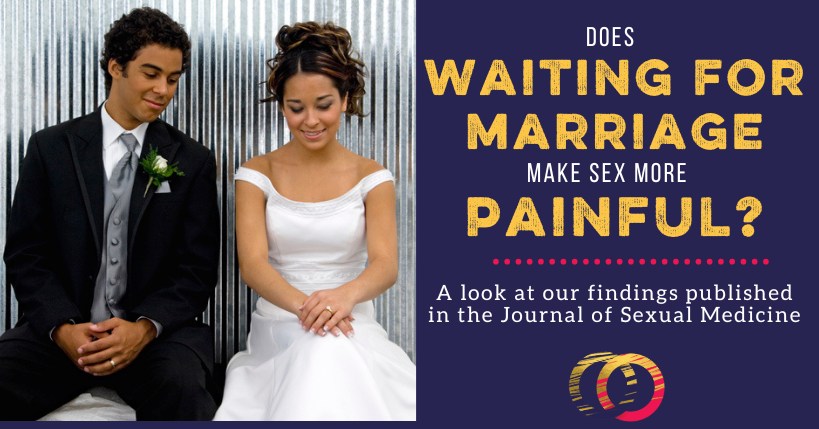

Does waiting for marriage for sex increase sexual pain disorders?
In short, yes.
We found this in our survey of 20,000 women for our book The Great Sex Rescue, and we’ve been trying to raise awareness of this for quite a while. We know that pelvic floor physiotherapists report that most of their clients are evangelical women (or religious women). And sexual pain disorders are an incredible burden to bear. If there’s something we can do to alert medical professionals to why this is happening, so we can improve treatment and even better–prevent the problem in the first place–we want to do that.
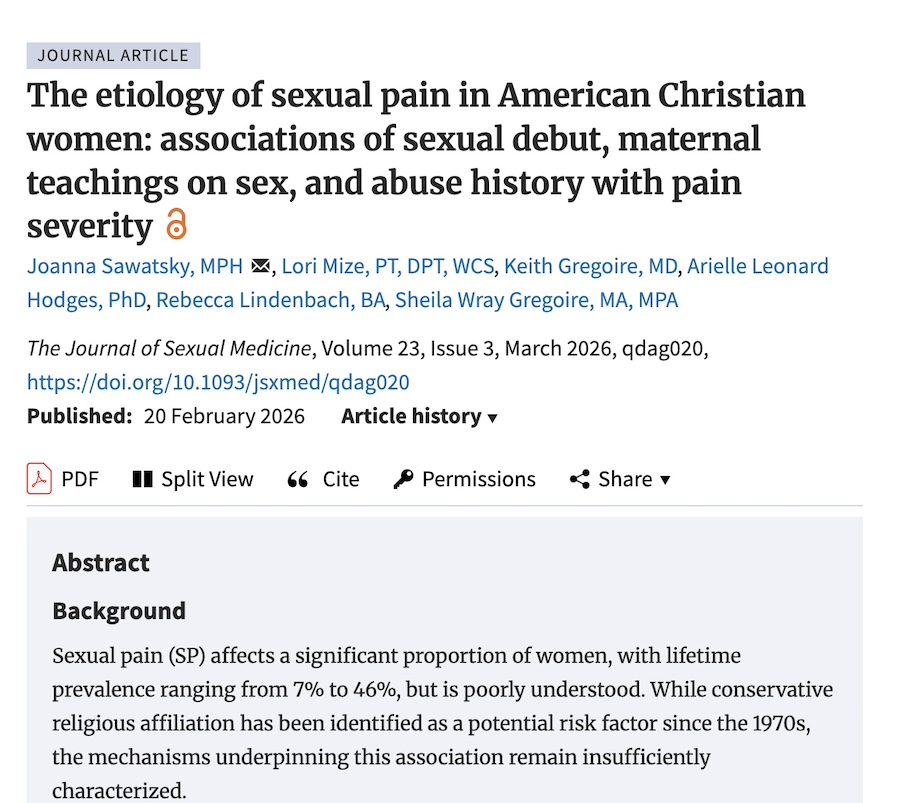
So we’re thrilled to announce that we have a new published peer-reviewed paper, this time in the Journal of Sexual Medicine:
Rebecca wrote about it in our Friday email that goes out to 40,000 readers (she always writes an incredible article for it!), and I wanted to post her article here today, since many of you won’t have seen it. And, please, sign up for our email list! It’s free. We won’t spam you. And it helps us immensely, because if social media algorithms change, or our accounts get hacked, we’ll always have our email list!
Here’s Rebecca:
People, at the end of the day, tend to make sense.
That is the big takeaway that I’ve had in doing research. People make sense. They are logical. They are rational actors, if you want to use the terminology we all learned in Economics 101.
The problem is that usually we just don’t ask the right questions.
Yesterday, our second peer-reviewed paper was published in the Journal of Sexual Medicine!
You can see it here! But I’ll summarize our findings:
We were looking at predictors of sexual pain and sexual pain with obstruction of penetration (in essence, pain that’s so bad she can’t have intercourse). We found that:
- Couples who had sex after they were married had higher rates of sexual pain with obstructed penetration
- Women with a history of abuse had a higher rate of sexual pain, but it did not raise rates of sexual pain with obstructed penetration
So, what does this mean?
A lot of couples on their honeymoon are met with shock and confusion when sex hurts, even after they did everything the way they were taught. They waited, they didn’t do anything before the wedding, but now it’s not working? What happened?
But when you ask more and more questions, it starts to make sense.
The point we made in our article is that for many women, sexual pain might actually be a logical and protective mechanism that the body uses to prevent something bad from happening. When a woman has been raised to see sex as a threat, it makes sense that her body would try to make that simply not happen.
Girls are raised to believe that boys are just “after one thing,” that their bodies can incite men to lust even before they’re finished puberty, that girls are responsible to stop sex from happening because boys just can’t stop it after a certain point, and all sorts of other rape myths in evangelicalism. And that’s before we even get to discussions about obligation sex and threats about how he’ll watch porn or have an affair if she doesn’t put out on schedule.
And THEN she’s also taught that men need sex and want sex in a way she cannot understand, and she hears jokes about how women are frigid and don’t want it and their husbands are always pawing at her.
And so then she starts dating this great guy, they totally love each other, and she’s actually looking forward to having sex! A few times she even feels really really aroused but she manages to shut it down so that they keep to their commitment.
But then when they get married and finally DO get to have sex, the arousal piece just never really arrives.
The other times she really felt into it were after they had been snuggling and cuddling and teasing each other for a while, but now she’s just had the longest day of her life following the most stressful week or her life and although she wants to have sex it’s more of a head desire than a body desire.
Her body just kind of wants to sleep.
But it’s her wedding night, right? This is what she’s been waiting for! So she pushes through. She ignores her body because every teaching she’s heard has told her to, she’s built up this specific night in her head so much that she feels she can’t say no let’s try in the morning because that’s ridiculous! This is what she’s been waiting for, right?
But her body doesn’t respond with pleasure—it actually hurts.
Because for so many women, the first sexual encounter doesn’t happen because her body wanted it—it happened because “time’s up.”
But what if that couple had been told not just “wait for the wedding,” but “Wait for when you’re married and you’re both totally aroused and your bodies are begging for it?” What if that couple had the knowledge that there actually is more to sexual enjoyment than just intercourse? What if they knew that starting with intercourse before they figured out the arousal/orgasm piece in other ways makes it harder for them long-term?
What if they knew that the idea that she wasn’t likely to orgasm the first time was actually a lie setting them up for failure, and instead of focusing on “having sex” after the wedding they focused on being able to bring each other to climax? What if the excited waiting was for giving each other sexual pleasure, not necessarily intercourse?
(And by the way–this is what we teach people in the Honeymoon Course!)
People actually are quite logical. People make sense. You just have to know which questions to ask.
Christian teachings often focus on when we have sex, not how we have sex.
And I think that’s to our detriment. Here’s what I mean—when what we define as “healthy sex” is primarily about WHEN you’re having sex, it’s easy to ignore the HOW.
It’s how we end up with men using their wives in incredibly selfish ways, because she’s his wife! He’s allowed to have sex with her now, he got the go-ahead from God, right?
But if we focus on the how above everything else, I truly believe that the “when” will also fall into place.
If we emphasize that sex should be something that is respectful of each other, thoughtful, pleasurable, and that as Christians we shouldn’t be selfish when it comes to sex but should put the interests of others over the interests or desires of ourselves, I think it becomes hard to argue FOR one-night stands and hookup culture type sex.
If we have the right “how,” the “when” to have sex becomes a lot clearer.
But when the “when” is king, “how” takes a backseat.
Our conclusion in our study was that the “when” didn’t actually have anything to do with sexual pain, it was what the “when” was telling us. There’s nothing magical about wearing a ring when you have sex for the first time that makes sex more likely to hurt. No, rather it’s that this is pointing to a larger issue: a lack of arousal.
It’s far more likely that a couple who is having sex for the first time because it’s a date in their calendar is having sex before becoming adequately aroused, whereas couples who planned to save sex for marriage but ended up having it before they said “I do” likely did it in an extreme state of arousal, which is much more conducive with pleasurable sex and makes it less likely she will experience pain.
Our call to clinicians in the paper is not to start instructing people to have sex before they’re married, or to treat religious sexual convictions as “frigid” or harmful, because they’re not. Rather, our call to people working in sexual health fields is that they maintain a respectful environment for their client’s beliefs while providing appropriate education on female arousal so that the couples who are having sex for the first time on a bit of an imposed timeline are just as likely to have arousing, orgasmic sex.
Get the book that shows how Scripture has been misused–and how to use it to heal instead!
For all too many of us, Scripture has been used to make us accept abuse. To tell us we can’t defend ourselves. To let others control us.
But what if that stems from an improper use of Scripture?
Dr. Tracy’s book teaches how to interpret Scripture in ways that heal, not in ways that poison. And he points out the typical texts that have been weaponized against victims, and shows how they can heal instead!
For those who need to know what Scripture says, or who desperately want their pastor, their father, their sister to hear them–check out this clarifying and life-giving book!
There is so much research that has come out in the last few years—ours included—that has tackled huge questions in sexual research simply by asking, “But was she aroused?”
And it’s interesting how often the answer to that question just makes the mystery so much clearer.
It’s not specifically that waiting gives you more painful sex.
That makes no sense. It’s that having unaroused sex on an imposed timeline makes it more likely you will experience pain the first time you have intercourse, and that problem is actually very easy to prevent with proper education.
It’s not that Christian women don’t desire sex or don’t like sex. It’s that they’ve been taught messages that systematically train them to de-value their own pleasure and arousal. And so then when sex happens, she doesn’t orgasm. And you have enough non-orgasmic sex in a row and it’s not difficult to figure out how it starts to feel like a chore.
And it’s not that women overall are less sexual than men, it’s that women’s bodies are trying to protect them from this thing that’s been taught to them as a threat and as something boys do TO them. It’s not that women are less sexual, it’s that their sexuality was stolen from them.
We’re so proud of this paper and so thrilled we were accepted to the Journal of Sexual Medicine. All of the authors on this paper worked hard, but Joanna really earned that first author spot. She put a lot of blood, sweat, and tears into this, and we are really hoping that there’s better sexual education given by OBGYNs, family practitioners, and public health administrations that is sensitive to religious conviction and emphasizes education over everything else.
Because at the end of the day, if you know what questions to ask, a lot of things start to make a whole lot more sense.
Thank you to Rebecca for writing this post, but especially to Joanna who took a lead on this paper. This is our second peer reviewed paper (here’s our first), and we have quite a few more in various stages of the submission process right now.
If you want to help us with funding to continue to write papers, you can support us through the Good Fruit Faith Initiative of the Bosko Foundation (tax deductible receipts within the United States!). If you don’t need the tax receipt, you can also join our Patreon and get access to our perks! We can’t monetize writing academic papers, so we rely on your support, and we’re so thankful for it.
What do you think of our findings? How should that influence what we teach people leading up to marriage? Let’s talk in the comments!


Honestly wedding night sex is a bit overrated and over romanticized. What my husband and I did on our wedding night was spend the night sitting down and open our wedding cards and gifts we got while drinking wine and it was still quite memorable! Especially reading everyone’s well wishes on the cards!
I’ve heard that one of the most common wedding night behaviors is to spend the first night conked out now that all the preparation and ceremony and reception is over and the adrenaline and excitement has worn off:
THUD.
THUD.
(snoring)
If I ever write a story that includes a wedding night scene, that’s how I’m going to stage it. THUD. THUD. (snoring).
We did everything this article suggests and I still had vaginismus for the first 6 months. The purity mindset is so hard to get out of, even subconsciously.
I feel this! Nearly two years into marriage and still have vaginismus. I faithfully listened, read up, and tried to follow this stuff and shake off purity culture – still my body refuses to forget. It’s going to be a long road (with lots of professional help) to get to a healed place.
“Christian teaching focuses on when we have sex, not how we have sex.”
I think this summarizes what a lot of the issues around sex boil down to. And it also summarizes a lot of the issues I have surrounding sex, as someone who has never even tried to find a romantic relationship because I am unsure if I will ever be comfortable enough with sex to take care of a spouse (plus no desire for children, and a deep fear of pregnancy, but that’s other fields, so to speak). All the talk of “serving your spouse in bed” turned me off even considering romance *hard*, especially since how it was framed by general teachings made a wife sound more like a “legitimate” prostitute. Add in me being more masculine leaning than the typical “Christian feminine” definition, and a deep desire for respect, and you can probably guess the feelings a lot of these teachings inspired in me. You’ve given me more to think about. Ironically, the other thing that made me reconsider if I was truly asexual, besides your articles? Fiction! Namely, realizing that the concept of sex was less repulsive to me, if the two characters in question were regarded as equals. Like a pair of warriors, or two scholars, not primarily focused on the gender roles that “purity” authors insist on. When fictional stories make me more open to a relationship (even if only slightly), than these evangelical teachings, then these teachers need to review their teachings.
We’ve had so many people coming out of purity culture tell us that it’s only in romance novels that they’ve ever understand what sex was supposed to be like! I find that such an indictment honestly. We’ve been teaching everything backwards.
“She ignores her body because every teaching she’s heard has told her to” !!! Oh my goodness, this.
I definitely agree that “don’t have sex til you’re married and aroused” is better advice than “don’t have sex before marriage.” Personally, I had sex before marriage and it was definitely the right decision for me- I can’t imagine how bad it would have been to force myself to keep believing “if I have sex with my partner, it will RUIN MY LIFE, unless it’s after the wedding, in which case it’s THE MOST AMAZING THING EVER”, keep believing that all the way to the wedding day, and *then* finally find out that sex is confusing and painful and makes no sense. I’m glad I found that out way way before the wedding. (I had vaginismus, also I’m asexual.)
I didn’t know about arousal at all back then. I’m wondering how we can do a better job preparing people for having sex in marriage, and it feels to me like it’s more complicated than learning about female arousal/orgasm. It also means dismantling the beliefs that tell us we’re not *supposed* to have desires, or pay attention to our bodies, or speak up about what we want (because that would be “selfish”).
Yes, we need to do all that, but we’re actually quite scared of arousal for all kinds of reasons. And so we just don’t talk about it. That’s one reason that we decided to put descriptions of arousal in our Whole Story puberty course, so that people understood what they were supposed to be feeling in sex, and so that they weren’t surprised if it ever happened to them.
Throwing this out there: plenty of men who wait for marriage are wonderful men who are devoted to God. Some of them might be hiding their own disorders by kicking the can down the road: asexuality, same sex attraction, lack of desire to do the work to please their wives. So women don’t like having sex with those men.
Regarding abuse and pain: I think a big part of that is retraining an abuse survivor’s nervous system. Sex involves someone who is bigger and stronger than you are, you being in a deeply vulnerable position, and you know it’s going to be done for the enjoyment of the bigger and stronger person. Absent many months of teaching her that this is safe and for her benefit, too, that’s a recipe for disaster.
It’s also so incredibly important that an abuse victim be able to say no and stop the proceedings if her nervous system goes haywire.
That cannot happen if you go from chaste pecks to full-on intercourse in a short period of time.
“That cannot happen if you go from chaste pecks to full-on intercourse in a short period of time.”
“Short period of time” as in six-eight hours as demanded by CHRISTIAN Purity Culture?
(Because the first “chaste peck” is at the wedding itself.)
That does not sound like it will end well, and I’ve run across a lot of horror-story testimonies along those lines on YouTube.
Asexuality is not a disorder. It is a normal variation in the way God made people.
Just the other end of the bell curve from nymphomania.
Absolutely it can’t happen on that timeframe! I think all the teaching about how men will just explode if they don’t get sex, and how hard it is for men to wait, makes it quite impossible for women to prioritize ourselves on the wedding night, because the poor guy has been waiting.
Especially when Purity Culture bribes the boys to save themselves for marriage with promises of swing-from-the-chandeliers barn-burning HAWT S*E*X on their wedding night. They’ll still get a sex ed from other sources (like online porn or locker-room bragging) and come in with a lot of Unrealistic Expectations from the combination.
There was a YouTube video on the subject that was not a horror story — virgin bride discovered the hard way on her wedding night that she had Vaginissimus. BAD. Fortunately, her husband (also a virgin) realized immediately that his bride had a serious medical problem (that had not surfaced until now), helped her get into treatment for it, and supported/encouraged her through the treatment. Now that was cool.
The horror story was in one of the comments on the video. Another purity culture virgin bride with bad Vaginissimus, and her purity culture virgin husband had the opposite reaction: “NO! I’VE HAD TO WAIT ALL THOSE YEARS! I CAN’T WAIT ANY LONGER!” and forced himself on her.
More and more as I learn about all of this (through resources like this and experience), I am realizing how important it is for women to know they are–and be considered first and foremost as–human beings.
For so long women have been a complement, an accessory, a support, a helper, a prize. Not always fully human, not their own person, not meaningful and valuable in their own right, aside from getting married or having children or existing to support men or the male world. That doesn’t mean we become islands in reaction, but it does mean being allowed to listen to our bodies and speak up for what we need without shame and without guilt. Even modern medicine for women falls so short of our needs (difficulties with breastfeeding is a prime example I can name from recent personal experience, though there are many, many more).
When everything around you–art, fiction, our imaginative heritage, history, church, politics, family, social dynamics, and so much more, at so many miniscule levels–emphasizes that you are a small side character in a grand drama, you internalize that narrative and it manifests in all sorts of unseen, complicated ways. No human being should ever believe they don’t really matter that much…and yet this is what many of us women believe deep down, and the church contiues to reinforce that belief, explicitly and implicitly.
I’m also realizing more and more that our sexual life / world is often a litmus test for the health of the rest of our body. God only cares about what we do with our bodies because it so deeply affects us, inside and out. It’s like “the Sabbath was made for man, not man for the Sabbath” point from Jesus.
God cares about women. And he made women’s bodies for women; he didn’t make women for their bodies (though many men and women clearly think otherwise, and this is what we are often taught).
Totally random, but the other day I was reading an article about feeding babies solids after 6 months, and they made sure to say at the end: “Remember, solids are complementary, not supplementary to formula or breastmilk. Formula and breastmilk are always primary nutritional resources for babies under a year old. Solids are merely complementary…”
Which is exactly how women are always described in the church. “Perfectly complementary” to men. Not essential, not primary, not even supplementary, but complementary. They are a diverting little snack, the cherry on top, but never the main meal.
I think the words we use speak volumes about what we really believe. And our bodies pay the price.
Thumbs up to “God made women’s bodies for women.” That made me pause and think. I appreciate your thoughtful response — indeed, all of the thoughtful responses so far.
So well said!
Apparently “It HURTS the first time for Women” has been a common folk belief for some time. I remember my father (1925-1994) telling me that at one point. (He told me he’d tell me about sex “when you’re old enough to understand”; he died when I was 38 and I’m still waiting.)
These days I chalk it up to folk beliefs, like my mother’s (1927-1975) belief that men had one rib less than women because that’s how God made Eve.
“It’s far more likely that a couple who is having sex for the first time because it’s a date in their calendar is having sex before becoming adequately aroused, whereas couples who planned to save sex for marriage but ended up having it before they said “I do” likely did it in an extreme state of arousal, which is much more conducive with pleasurable sex and makes it less likely she will experience pain.”
Which explains the joke “How do you stop your GF from having sex with you? Marry her.”
(Which is the trope behind the 1983 Greg Kihn Band song “Our Love’s in Jeopardy”; from the music video, it’s obvious that getting married is what will jeopardize their love, and they call off the wedding at the end. As an aside, I miss Eighties-era music videos, where they approached it as a musical short story instead of an algorithm-and-focus-group-designed ad.)