



Can you tell if a church is healthy using its website?
Absolutely! Or at least you can make a pretty good start and eliminate a lot of obviously unhealthy churches. And you can do it in under five minutes!
One of the big things we’ve noticed in our surveys of 40,000 primarily evangelical people for our work here at Bare Marriage is that unhealthy behaviors and beliefs tend to exist in pockets: In other words, there are some churches that teach more toxic messages about modesty and sex, and those churches will tend to have much higher rates of porn use and sexual assault and harassment than churches that treat women with respect.
Many of us have been really hurt in churches, but we’re so used to a particular type of church, and we’ve been told that only this denomination is healthy or only this approach to the Bible is real, that we have a hard time getting out of that bubble. But if that bubble hurt you, then finding a different church in that same bubble will likely hurt you too!
So how can you tell if a church respects women and fosters good relationship dynamics? How can you tell if a church treats women as equals and doesn’t subordinate them, or has a healthy approach to counseling, marriage, and parenting. Can you figure out if a church emphasizes hierarchy and listening to authority? Can you tell if a church points to Jesus?
Happily, you can tell this pretty quickly by looking at a church’s website! So let’s wak through the steps.
I’m concentrating here on how to tell if a church treats women well, but if there’s another concern you especially have, you can adapt these steps for your own purpose.
And I’ve got a pretty download of these steps that you can print out and use, or keep in your phone to refer to as you peruse websites as well!
How to Vet Your Church
Learn the steps you need to assess a church's health based on its website
Download our FREE pdf by subscribing to our newsletter!
A 12-point plan to evaluate a church’s website
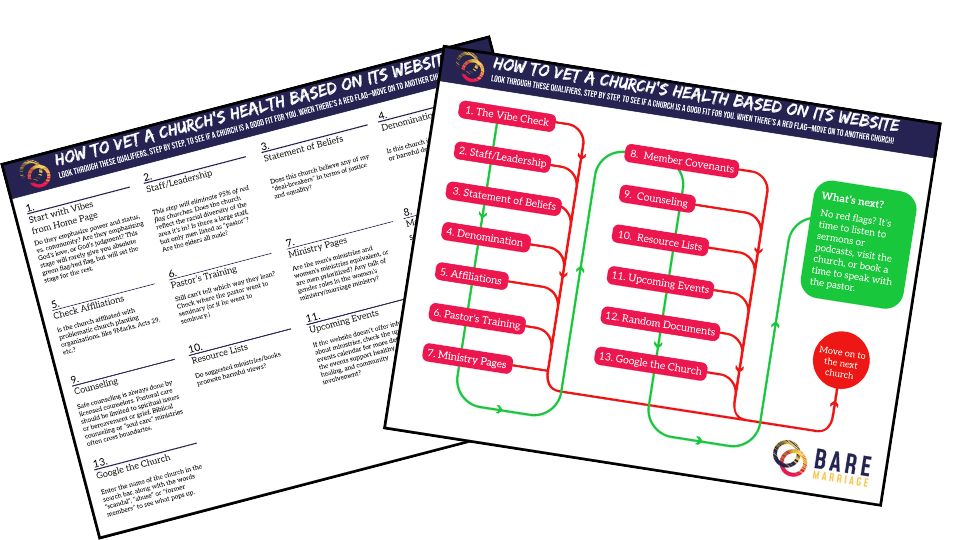
I want to make this as easy and quick for you as possible. So here’s the algorithm that you should use, and the order you should look at a website.
AS SOON as you see a red flag, move on to the next church. If you get through the whole list and there aren’t any red flags, then and only then is it time to listen to sermons or podcasts, visit the church, or book a time to speak with the pastor. Don’t start with listening to sermons–that’s a huge investment of time, when you can often eliminate a church in five minutes of looking at its website.
You don’t have to continue with all the other steps, either, if you find a red flag. If a church is eliminated at step 2, that’s actually a good thing. It’s better to know beforehand that the church won’t work than to spend weeks attending the service and listening to sermons online only to learn that it really isn’t safe.
When we left a church in 2008 because it treated women badly, we went to a slightly better church, but one that was quite similar in terms of doctrine. It had more educated and open-minded people, but ultimately many of those people moved away, and a new pastor came, and we were back in the place we were in 2008. Except that we had now spent another nine years there, and had been wounded again.
In most communities, you can find healthy churches, even if they’re small. And often it takes just a few families to start going to a safe church for it to start to attract more families and suddenly have a kids’ program. But what we often do instead is choose the church with the good kids’ program or youth group, and ignore the other red flags, thinking the kids will be okay. Well, as we showed in our research for our book She Deserves Better, and in our recent peer reviewed article, girls who attend churches as teens that have purity culture messages are 79% more likely to be assaulted and harassed at that church, and the benefits of church disappear for them. So don’t go to a church that’s unhealthy just because of its kids’ program! Your kids deserve better.
Here’s what to look for instead:
1. Start with Vibes from Home Page/Welcome Page
Do they emphasize power and status, vs. community? Are they emphasizing God’s love, or God’s judgment? Remember that a church’s opening statement announces, “this is the big thing we want the world to know about us!” Even if what they say is technically true and theologically sound (and for most websites it is), is that really what they should be leading with? How does it make you feel?
This stage will rarely give you absolute green flag/red flag, but will set the stage for the rest.
2. Check the Staff/Leadership Page
Most churches have a “Who We Are” or “Leadership” or “Staff” pages under the About tab.
Three questions to ask:
Does the church reflect the racial diversity of the city/town it’s in?
If the church is in a primarily white town, then having a white staff is fine. But if it’s in a very diverse town, and the staff is all white, that could be a red flag that marginalized communities don’t feel welcome in this church.
Is the church leadership based on a family dynasty?
If the current pastor is the son of the founding pastor, that’s usually a red flag. Just because someone is the founding pastor’s child does not mean they are the most gifted to run the church. This is a sign that the family sees the church as existing to serve them, often rather than them existing to serve the church. This isn’t always a red flag, but it would certainly be a strong orange one.
Are women included appropriately in leadership?
*This one step alone will eliminate 95% of red flag churches.*
Here’s the big tell! If it’s a large church, are the men listed as pastors but the women only listed as directors? That’s a sign that the church doesn’t value women. If the church helpfully lists its elders, are they all men? Check out this Leadership page, for instance, from the Church of the Highlands, a megachurch in Alabama. Note how the pastors, trustees, overseers, and campus pastors are all men.
If it is an all-male leadership in a large church, it is guaranteed they also teach complementarianism in marriage, which we found leads to worse marriages. And women attending a structurally sexist church lose the healthy benefits of faith as well.
HOWEVER–and this is a huge caveat–smaller churches that are egalitarian will often have male senior pastors and even male youth pastors and not be complementarian. When a church has a very small staff it is harder to judge its approach to women, and so you should continue with the following steps.
Now, I know this is hard for many of you, because many people are trying to find that unicorn–that church with an complementarian approach that is still healthy. Maybe you think all the churches in your area are complementarian, so you don’t think you have a choice (I used to think this too!). But churches that view women as under the authority of men will inevitably teach harmful things about marriage and harmful things to your teenagers, and will be more likely to cover up abuse. All the websites from unhealthy churches that readers sent to me last week could be eliminated through this step alone.
3. Read the Statement of Beliefs
Does this church believe any of your “deal-breakers” in terms of justice and equality? You will never agree 100% with a church on everything. But you should have some things that you absolutely won’t bend on. See from their statement of beliefs if anything stands out to you. One tell that I’ve found: If they talk about the doctrine of “man” rather than people, that will tend to be a church which values women less.
4. Discover the Denomination
Is this church involved in any sexist or harmful denominations? Usually they will list their denomination on their “about me” or “statement of beliefs” page. If they don’t, you can also go to denominational websites and search for it. The SBC in the US, for example, has a church directory here. Many churches that belong to some of the more questionable denominations, like the SBC, do try to hide their affiliation, so you may have to use such directories.
Denominations to be wary of include the SBC, the PCA, the IFB, or the FBC in Canada. There are many other problematic denominations, but these ones definitely have a complementarian approach, where women are more likely to be abused and abuse is more likely to be overlooked.
5. Check Affiliations
Is the church affiliated with problematic church planting organizations, like 9Marks, Acts 29, etc, that are heavily complementarian and authoritarian?
6. Evaluate the Pastor’s Training
Still can’t tell which way the church leans? Check where the pastor went to seminary (or if he went to seminary.) Often non-denominational churches or even megachurches will be headed by a person who has not had any training, and that is often a red flag (Matt Chandler, Josh Howerton, and Doug Wilson have no seminary training, for instance).
If the pastor went to a seminary that is heavily complementarian, or went to an unaccredited seminary, that is often a red flag of what approach the church will take.


7. Peruse their Ministry Pages
Are the men’s ministries and women’s ministries equivalent, or are men prioritized? Any talk of gender roles in the women’s ministry/marriage ministry? Are the men’s events catered, while the women’s aren’t? Do the women’s events provide childcare, while the men’s don’t, so the expectation is that women can care for kids during the men’s events, but men can’t care for kids during the women’s?
8. Do they have a Membership Covenant?
Spiritual abuse is common in churches that require membership covenants. These churches tend to be hierarchy based. The Village Church, for instance, used a membership covenant to ex-communicate a woman who refused to work on reconciling with her husband who was caught using child sexual abuse materials (they later relented when the case made national news headlines). John MacArthur’s church has used membership covenants to excommunicate women who divorce abusive husbands, even husbands who were sexually abusing their children.
Membership covenants give the church incredible power over the congregation, without accountability for church leadership. Here’s The Wartburg Watch explaining.
9. What is Their Approach to Counseling?
Safe counseling is always done by licensed counselors. Pastoral care should be limited to spiritual issues or bereavement or grief. Biblical counseling or “soul care” ministries often cross boundaries, and are red flags that the church doesn’t understand mental health or healthy relationship dynamics. Biblical counseling has been highly implicated in some of the worst toxic marriage advice.
10. Skim their Suggested Resource Lists
Not every church offers resource lists, but often larger churches will have resource lists on their ministry pages–such as suggested resources for marriage or parenting. Do the suggested ministries/books promote harmful views? Here, for instance, is one of Lakepointe Church’s resource page for family books, and note how they promote Martha Peace’s book The Excellent Wife, one of the most harmful, abuse-enabling books out there.
11. Glance at their Upcoming Events
If the website doesn’t offer info about ministries, check the upcoming events calendar for more details, since often ministries are listed there. Do the events support healthy growth, healing, and community involvement?
12. Read Random Documents!
Peruse employee handbooks, vision plans, annual meetings, or other documents to get a sense of how the church treats members. Some churches helpfully post their safety plans for kids, or other documents that give a sense of what the church prioritizes and how they operate.
If you’ve gotten this far without any red flags, that’s amazing!
So there’s one more bonus step:
13. Google the church
Enter the name of the church in the search bar, along with the words “scandal”, “abuse” or “former members” to see what pops up. It’s also helpful to do the same for the pastor’s name, and include the city in the Google search. One particular church’s website I was researching for the podcast tomorrow looked good–until I took this step. The church had scrubbed the name of the pastor from the website, and when I googled “abuse”, it was clear why!
What if you still have all green flags?
Now’s the time to listen to sermons online, visit the church, or book a time to talk with the pastor. A healthy church will wecome a newcomer asking tough questions, and explaining what they’re concerned about. But don’t bother listening to sermons or doing any of that until you’ve worked through these steps on their website.
When I originally decided to create this template, I asked on social media for churches to check out. So many people sent me the churches that hurt them, and in about 90-95% of cases I could have eliminated them by step 2. But I also found churches that looked really healthy!
There are healthy churches out there, but if you’ve grown up in unhealthy churches, they’re likely outside your normal bubble. They may use liturgy for their services. They may be more lowkey–or more high brow. They may not feel the same as what you’re used to. But if what you’re used to hurt you–perhaps it’s time for a change!
So don’t be afraid to check out a very different church, if it has all green flags. And hopefully we can all find healthy places to end up, so that the healthy churches grow, and the unhealthy ones shrink.
Download our template of this flowchart to keep on your phone for handy reference, or to print out to use!
How to Vet Your Church
Learn the steps you need to assess a church's health based on its website
Download our FREE pdf by subscribing to our newsletter!
What do you think? Anything you would add? How does your own church hold up if you work through these steps? Let’s talk in the comments!




Great guide! I have also heard about the BITE (Behavior, Information, Thought, and Emotional Control) model for determining if a church has cult like tendencies as well (and many of the complementarian churches do), but this is even more extensive since the weakness of the BITE model is it works best if it usually involves visiting the church or listening to the sermons first before determining whether or not it is a cult since they like to hide some of the more sinister stuff from their website, but it goes to show that not all of it can be hidden and there is still subtle signs.
Yes, listening to sermons would involve a much more intense process. But you can tell a lot just from a church’s website!
You could probably make one for Christian schools and homeschool curriculums as well. Like how they teach science especially things like evolution and presenting the evidence for both sides reasonably with up to date facts and encourage scientific literacy when it comes to interpreting stats and articles, also does their curriculum promote critical thinking, does the history curriculum teach the perspectives of women and minorities of those eras they are teaching, and is the dress code very strict and how is the girls sports teams treated compared to the men’s and there is so much I can go on about.
This is all really helpful. We have recently visited a bunch of churches while looking for a new one and have used a lot of these ideas to figure it out. One thing I did start to notice about some churches where there are lots of women of staff that have director titles and not pastor does have to do with ordination requirements within the denomination for the pastor titles. But one key that helped figure out whether this was a red flag or not was both looking at those womens roles in more detail and looking to see if men in prominent leadership roles also have the title director.
This method works! We did something very similar when we left our complementarian mega church, and it was crazy how many churches in our conservative city were eliminated by step 2. But when we found a small church with a female children’s pastor, a racially diverse staff, and a mission statement that said they interpret the Bible through the lens of Jesus, we started listening to sermons. The sermons said it was ok to have questions and doubts, and we don’t have to agree on everything as long as we’re moving towards Jesus together. I love my church so much! I knew I’d be safe there when we went to a marriage small group and the homework was to listen to a marriage podcast. It was kind of problematic and I got so upset. I called the pastor and told him I don’t think I could come back. I’d been too hurt by Christian marriage advice and I couldn’t be “normal” in a small group. He was so great about it – he said it was just really hard finding good marriage material, and I didn’t have to agree with it. He invited me to speak up about why it was bad at the next meeting, and asked if I had any better resources. The next week’s homework was the Bare Marriage podcast. 💗
Oh I love that! What a great story!
The first green flag when looking at our current church’s website was also that they had a woman children’s pastor (emphasis on pastor). The second green flag was when I attended a service for the first time, and the man senior pastor said they had decided to formally recognized her pastoral calling after the entire leadership team read A Church Called Tov.
The third green flag was having coffee with her and hearing that she follows Bare Marriage, too 🙂
I love that!
What a great resource for assessing the probability that someplace is a safe church! I applied this checklist to the website of my own church, which I’ve been attending for about five years now, and was delighted (though not surprised) to find that it passed with all green flags!
That’s great!
For me, it’s also a small red flag if the website advertises separate men’s and women’s ministries, because this presupposes that the two genders are so different that their needs are completely different. I’m uncomfortable saying this (and am willing to have my mind changed) and hold the position only tentatively because I understand that many women, historically, have found joy in being part of a group of other women (and men have probably felt the same way), but is this healthy, or is it because these women were in a hierarchical church and it was a relief to be able to take the masks off and be themselves without worrying about being judged by the men in the group? In a truly healthy church that sees men and women as equals, why would they need to be separated for gender-specific ministries? The church I first attended as a new Christian had weekly youth group meetings (in which we throve!), prayer meetings, and Bible studies, but no one ever suggested that any events were limited to specific and exclusive groups within the church. The assumption was that we all, no matter our age or gender, were chasing after Jesus, and the focus was on corporate worship and growth for all of us. I don’t think I’d even want to attend a “women’s event,” but I would love to attend a Bible study on the book of Romans, or a lecture on the history of the nation of Israel, or a prayer vigil for peace in Europe, or a day of service to our community, or any of a thousand other events, none of which have anything to do with my gender. Only with my status as a follower of Jesus. Isn’t it time to reevaluate this, too? Because the mere sight of the words “men’s ministry” and “women’s ministry” on a church website makes my skin crawl.
I am uncomfortable with women’s/men’s ministry that leans heavily into the stereotypes, but I do think separate ministries can have their place, especially for building friendships. There are some topics that people may feel uncomfortable discussing/sharing in mixed groups while those who have experienced abuse or assault from the opposite sex may find it difficult to cope in mixed groups.
Friendships for sure and experience of abuse or assault are about safety too. An example in a local community near my church, there are outreaching activities for new immigrants and vulnerable people. Those people have told the churches and community programs about concerns about mixed events. The churches respond to the community need there with separate activities that are safe and welcoming for them. Another example is a volunteer in church who starts a small ministry because they have a heart for a group. A woman with a heart for women in professional or business settings for example. I want to encourage for us to ask questions and understand why?
I’m in agreement with both of you. I bristle at seeing the 2 listed, yet I can see how some topics, situations, and friendships can best be approached in separate spaces.
Perhaps one could look at the balance of men’s vs. women’s events? A friend at an unhealthy church says the men meet once/month and the women cook the meals for them, while the women have a couple events/year and, I believe, have meals brought in.
I know what you mean! I far prefer coed events. I just know that a lot of healthy churches still have men’s/women’s events, so I can’t call it a red flag. But, yes, I hope we do move more away from gendered events and more into themes/topics/interests.
I also always tell people don’t be afraid of asking questions. If you reach the point where you’re considering watching their services, possibly attending, don’t be afraid to ask questions if you’re unclear about anything. The church I just left after the new year I regret not asking more questions than I did. With the one I’ve been visiting the last few months I almost immediately emailed the pastor and had a veritable novel of questions about the church, the denomination, the pastors themselves… and this was after reading their website, the denomination’s website, the wikipedia page about the denomination, and stalking all related social media pages. I’ve also met with the pastors a couple times to discuss things. And they encourage the questions, which to me is a massive green flag. And while for me, I’m still hesitant to fully commit to this church…it’s only strengthened my belief that any church worth going to will be able to handle a metric ton of questions
Yes, if churches are safe they welcome questions!
“any church worth going to will be able to handle a metric ton of questions”
Yes! I ended up going to a tiny church (we think it’s a crowd if 12 people are there) that has a horribly outdated website with content that was a huge turnoff to me. Why I visited and arranged a meeting with the pastor is another story, but the end result is, they have never made me feel bad for asking questions. Everything from trying to figure out their doctrine to asking if it is a requirement that the pastor gives an update on his family’s activities for the week to explaining why I don’t attend church on certain holidays. Every question, even the ones challenging their practice, has been met with respect and given dignity. I have explicitly told the pastor that they have some theology I disagree with, but because of other theology and how they treat people, I feel at home there. If the pastor was offended or defensive, I’ve not noticed any change in how I am treated.
It’s so encouraging to hear that a dire website didn’t put you off – we are a small church (If we get 20 on a Sunday morning, we think revival has broken out!) and our website is cringe-worthy, but none of us has the skills to update it and everyone we talk to produces designs that are really glitzy but give a totally fake view of the church, so anyone looking at their version is likely to turn up expecting some kind of mega-church… So for now, we are stuck with the clunky one we have. I try to keep our Facebook page updated, but IT is definitely not my strong point!
And a good minister will LOVE questions as long as they are sincere, because it shows people are interested and wanting to engage.
I don’t think a clunky website is necessarily a bad thing! At least you don’t have the red flags either!
I’m pretty sure mine would pass all of these, and most sermons would as well. It’s rare that it’s mentioned, but the pastor definitely believes in hierarchy in marriage. The church also has had some not good book or video series offered in groups that would be easy to miss if you don’t go to them. I happened to look at the info online or would never have known. It makes it feel pretty overwhelming to think about actually finding a good egalitarian church. I’ve definitely seen red flags in either the websites or sermons I’ve heard in other churches. My husband loves our church and my son does too so it makes it extra difficult to try and switch.
Yes, sometimes churches pass these but then they’re still not healthy. It won’t weed out all the bad ones.
I’m sorry that your husband and son like this one. That is tough. You can also go to a different church a few tims a month.
Check out the church’s attitude to singles. Even if you’re not single yourself, it’s still helpful, as it tells you how they view men and women in general. Is the focus on all the advertising ‘family, family, family’ or is there some acknowledgement/space for people who don’t fit the ‘married with 2 kids’ mould? If a church assumes that everyone is married (or that anyone that isn’t needs help preparing for marriage) then they probably also believe that a woman’s only role is wife/mother.
Thanks for clarifying that #2 doesn’t necessarily apply to small churches. We are TINY and while our current leadership team is evenly split, it used to be more men than women, and it was so disheartening to read articles telling folk to avoid churches that had more men than women in the leadership team, without making any reference to the size of the church. We have around 35 members, and getting ANYONE to serve on the leadership team is a challenge, without stressing about their gender!
NB: For anyone visiting the UK, it might be worth noting that ‘membership covenant’ has a different meaning in churches here (at least, all the churches I have attended – we do have some ‘American import’ church plants in the UK, so it’s possible their approach is different). I’ve been a ‘covenant member’ in several churches, and it’s been pretty much limited to saying that I will be an active part of the local congregation for as long as I feel called to remain. You can resign at any point without giving a reason (although unless the person has had a falling out or lost their faith, they will usually explain why because that’s just polite!)
Oh, good point about membership covenants! Yes, I was talking about the quasi legal documents that you have to sign, which are so problematic.
Perhaps this reflects my personal bias, but I noticed that the page of the Alabama church page you linked to is listing pastors of all their different campuses. I avoid multi campus churches. It sends a message that the church is really just a business.
It also means that the other campuses are reporting to the pastor at the main campus, so he probably isn’t really shepherding his flock so much as running things, and he is likely to be inaccessible to the average congregant.
” I avoid multi campus churches. It sends a message that the church is really just a business.”
No different than WalMart or Starbucks.
A church with multiple “campuses” (parishes) is not a church but a DENOMINATION that won’t admit to it.
But Head Pastor Superapostle (whose face is ten meters tall on all campus Telescreens) can pretend he’s the Pope.
Grew up in the IFB, so DEFINITELY agree, UNSAFE and needs to be eradicated!!!
I definitely check the staff, and even if they have women pastors, if they’re ONLY ‘pastors’ for the children, not everyone…I find that suspect!
Before the rise of Calvary Chapel and the Megachurches, IFBs were the type example of a church gone real sour and destructive to the point of madness.
One thing that I think is missing from this list: If a large church only lists 1-2 people as the leadership, that to me is a HUGE red flag that can indicate that those 1-2 people have no accountability. I (sadly) often find that is particularly bad if there is just 1 couple listed – yes there is a woman, but very often a couple at the head with no other leadership becomes a cult pretty quickly. (I’m thinking of the moonies right now but that’s not what I meant when I wrote it.) There should always be a plurality of leadership and not all in one family for sure. Even in a tiny church, they can have accountability through some elders or perhaps via the denomination they are part of.
Yes, very true.
ooooh and can I add another? Watch a video of the senior pastor. Does he exude pride? Does he swagger when he walks? Or does he exude humility? Has he ever genuinely suffered for Christ (it’s a great green flag if he has).
Yes, i think that’s really important–I just wouldn’t bother taking the 40 minutes to listen to a sermon until you’ve worked through this list!
I’m working overseas as an MK teacher and supported by a church that I now see is staunchly complementarian and the network we’ve recently joined, the one gospel network, is led exclusively by a ton of white men. This podcast inspired me to look on the one gospel network’s website and I found that their ‘creation of humanity’ section preaches a mini sermon about how women should know their place. Barf. Now I realize that if I ever move back to that area again after finishing my overseas work, I wouldn’t attend this church. But they support me financially. (to be honest, they’ve never been generous or even reasonable in the amount they give, though. So I don’t feel guilty.) It makes it awkward to do my visits every few years… I even got married at that church. I also love a lot of the people there. But if we have kids, I wouldn’t raise them there where they’d learn that boys rule.
That’s tough! I think you can be grateful that God is taking money from people who are hateful and funding you! And you owe them nothing later. They were giving to the Lord’s work, and that’s what you were doing.
I would love to hear more about “Soul Care” from Rebecca. Our church used the book in small group last year and there were a few things that gave me the ick.
I know Joanna’s done a deep dive into that one! Maybe we should do a video series on it or something.
This is like the Burned Haystack method for churches, I love it!
I’m curious where I can find the statistics you referred to showing that the more modesty and such are taught, the higher the rates of pornography and abuse. It for sure seems true, and so I was wondering where I could find the studies on that, because it’s so counter-intuitive to what many people think should be the case.