


Teaching modesty messages makes church more dangerous for teen girls.
That’s what our newest paper, out in the Journal for the Scientific Study of Religion, shows.
It’s based on our dataset for our book She Deserves Better, and the lead author on it (Nicole Gallego) collaborated with us through the Good Fruit Faith Initiative, so the funding that you all donated allowed us to partner with an amazing professor who wrote this up for us! We have a number of partnerships on the go where we provided some funding so other profs can write journal articles based on our datasets, allowing more information to get out into the academic world and change the way pastors, counselors, and other professionals are trained.
We’re so excited, and this paper especially is so ground-breaking and well-written. I’d like to share some highlights with you today, though you can read the whole thing here!
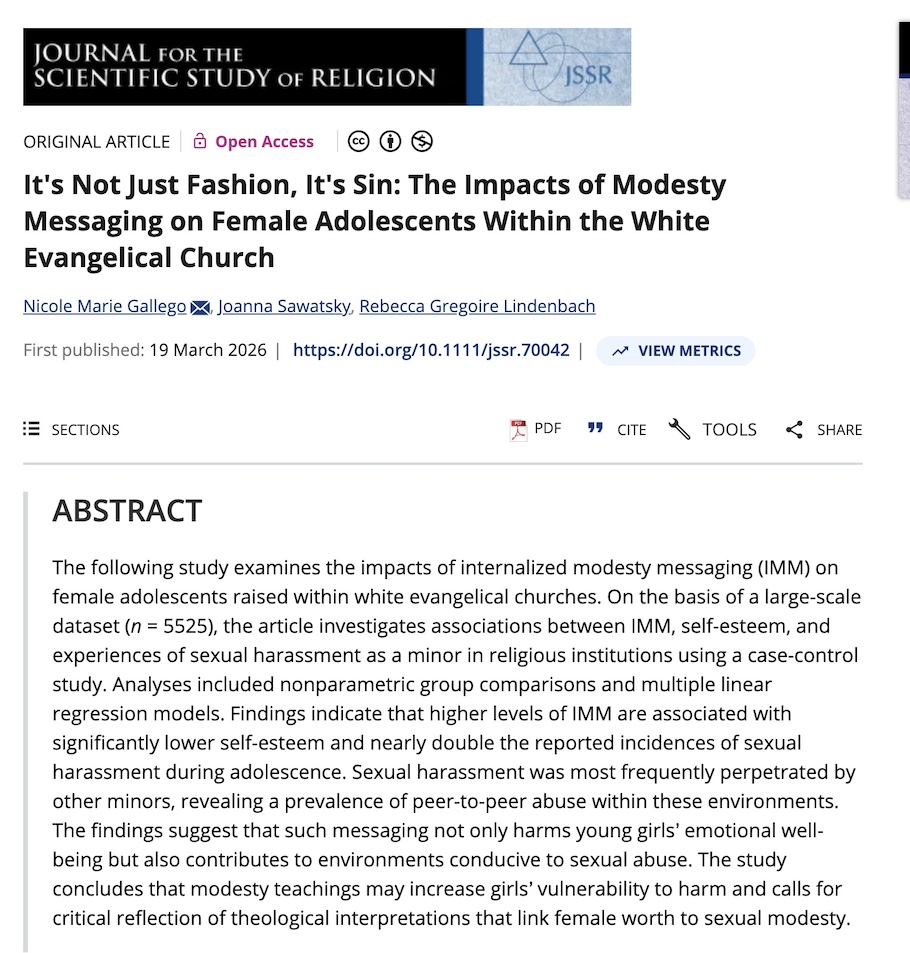
Professor Gallego wrote this so well, so I’d like to just summarize and share a bunch of quotes with you!
Purity culture taught girls that they were responsible for boys’ behavior
Using the “tropes” that we asked about in our survey, Prof. Gallego measured modesty beliefs based on five points:
- gender essentialism (“boys struggle with a visual nature in a way that girls will never understand”)
- sexual prosperity gospel (“If you wait to have sex until you are married, you will have the best sex life possible”)
- immodesty as a “stumbling block” where girls pose a threat to boys: (“Boys can’t help but lust after a girl who is dressed like they are trying to incite it”)
- gendered surveillance, where you can judge a girl’s character and walk with God by what she wears: (“Girls who dress immodestly are worse than those who don’t”)
- inner modesty (“girls talk too much”)
She quoted liberally from Dannah Gresh and Shaunti Feldhahn’s work to show how these ideas were spread, and how wrong and dangerous they are. It was very validating to see that other academics noticed the same things we did when we looked at literature for teen girls during purity culture! Here’s a basic summary of the argument of the article:
Now let’s break it down into showing the argument Professor Gallego makes:
1. Our respondents showed a strong purity culture effect
Our survey of 7300 women for our book She Deserves Better showed a strong purity culture effect to these modesty messages. Girls growing up during purity culture were more likely to internalize them, and were more likely to have had the harmful effects we measured.
This paper focused on a subset of the data of people who had completed all the relevant questions. (Often people take surveys but only complete a certain percentage of the survey!)
2. Girls who internalized modesty messages were more likely to be assaulted in church as teens
This is the HUGE takeaway that I desperately want pastors, churches, and authors to understand: When we teach the modesty messages, we put girls are heightened risk for sexual assault and harassment.
Professor Gallego divided respondents into high IMM (high internalization of modesty messages) and low IMM (low internalization of modesty messages). From the article:
Do you see that? Girls who internalized modesty messages were 79% more likely to be assaulted or harassed in church.
She goes on to explain that churches that teach these messages, that girls are responsible for not being stumbling blocks and putting the responsibility on girls for controlling boys’ behaviors, end up enabling sexual abuse, making it more likely.
3. Girls are more likely to be sexually assaulted by peers when churches teach modesty messages.
Another big finding: when we hear about sexual assault and harassment in church, we usually picture the creepy youth pastor–and that is a thing. We did find a significant percentage of girls who reported sexual harassment and abuse were targeted by pastors and youth pastors or adult volunteers. But about half were also targeted by peers. In other words, boys who wouldn’t otherwise be predators are becoming predators because of these messages.
This part is so good I’m going to quote a longer passage:
One of the most significant contributions of this research is the expansion on our understanding of the impacts of purity culture on young males. The primary aggressors of child sexual harassment in religious spaces were identified as other minors (40%) within the congregation, which was an unexpected finding as the majority of research surrounding sexual assault in faith communities focuses on pastors and clergy as the main perpetrators (Denney 2022; Denney et al. 2018; Scarsella and Krehbiel 2019; Więcek-Durańska 2022). Although it was beyond the scope of this study to analyze further the profiles of minors who committed the sexual assault, the findings can be interpreted to mean, based on prior research (Muldoon and Wilson 2017), that spaces where modesty messages are promoted not only vulnerate female adolescents but also normalize sexual aggression (specifically perpetrated by boys). This can be linked to the idea within purity culture that male sexuality is something that is innately uncontrollable and that all men struggle with lust (Muldoon and Wilson 2017; Owens et al. 2021; Sawatsky et al. 2024; VanderHeide 2023; Wolfe 2024). Modesty messaging therefore teaches young men that they are not responsible for their sexual desires. Many of the items used in this study focused on this specific facet of the modesty messaging, measuring the internalization of tropes such as “Boys will struggle with their visual nature in a way girls will never understand” and “Boys can’t help but lust after a girl who is dressed like they are trying to incite it.” These ideologies can provide a justification for male sexual aggression as it sanctifies predatory behavior as God-ordained design. This further supports quantitative research linking purity culture tropes to a higher rates of rape myth acceptance (Barnett et al. 2018; Owens et al. 2021) but adds an additional layer of understanding by associating IMM with peer-to-peer sexual harassment experiences. (emphasis ours)
4. Girls who believe modesty messages are more likely to have low self-esteem long-term.
The problems don’t stop with sexual harassment and abuse; modesty messages also erode girls’ self-esteem, and low self-esteem is linked to worse economic and job outcomes; more abusive marriages; more mental health struggles; and more.
In this vein, the current study found that higher church attendance, net of modesty messaging, was positively associated with self-esteem. Church settings that promote extreme modesty messaging, however, appear to mitigate this positive effect. This study found that when religious institutions reinforce sexist ideology, it comes at a psychological cost for young women. This aligns and expands previous research that has found that women attending structurally sexist religious institutions report significantly poorer health outcomes compared to those attending more inclusive congregations (Homan and Burdette 2021).
5. Girls who most internalized the modesty messages are most likely to leave their faith tradition
Girls who grew up in these churches that preached this form of modesty messages are most likely to deconstruct their childhood faith, and far less likely to call themselves evangelicals today.
Additionally, the study uncovered that disassociation from evangelical beliefs—although not a central focus of the initial hypothesis—emerges as a significant factor, particularly given the high proportion of participants with reported levels of high IMM who now identify as former evangelicals.
6. The Big Conclusion: Modesty Messages made church more dangerous, and undid the benefits of church
This is something we’ve talked about at length on the podcast, especially when She Deserves Better was published, but girls who grew up in churches that taught these messages, and then internalized them, lost all the benefits of religiosity, and would have been better off not going to church at all on many measures.
In other words, all of the people who taught this stuff made things worse for girls than they were before. Attending church is overall a good thing, and helps all of us tremendously. Faith is positive. But when girls are taught these messages, those benefits disappear:
The authors, teachers, and pastors of purity culture did tremendous damage.
And now we have numbers for it: Girls who attend churches where they teach the modesty messages have a 79% higher rate of being abused–and the boys are more likely to become predators.
That is ugly. That looks nothing like Jesus! And we have to listen to Jesus and look at the fruit. The fruit is rotten.
Remember survivor bias and pastors:
A Facebook commenter brought up a great point that has to do with survivorship bias. When something is hurtful, it doesn’t hurt everybody. And the people who are really hurt are more likely to leave or drop out. That’s what this study found–those who were most hurt by these messages were the least likely to still call themselves evangelicals.
What this means is that those who grew up in this, but didn’t experience it as harmful, stayed. These are today’s pastors, youth group leaders, and adult volunteers. Those who knew purity culture was bad largely left; those who remain in leadership positions in evangelical churches are more likely to still cling to it.
And the men who are the pastors and youth pastors are also the men who are more likely to have assaulted their peers when they were teens, and are more likely to believe that this was somehow the girls’ faults.
This is all the more reason to be very, very careful about what church you take your children to, and talk to the youth pastor and pastor about their views of purity culture. If they do not loudly repudiate it, or even understand why it is an issue, that is a huge red flag.
Resources to help others understand the importance of eliminating these modesty messages
Want to dive deeper, or show others why these modesty messages are hurtful? These can help:
- Read the whole article (it’s open access) at the Journal of the Scientific Study of Religion
- Download our Toolkit, which has beautiful handouts summarizing the problems with all the harmful things we measure, including the modesty message. There’s a great handout to talk to your youth pastor/Christian school about dress codes, etc.
- Read our book She Deserves Better! There’s a much longer discussion about modesty, and it will change how you parent. It will validate the things you felt as teens. It will let you reparent yourself! We also have a free video series that goes along with it if you want to study the book with some friends.
Help us publish more articles like this one!
We were able to collaborate with Professor Gallego, who did an incredible job, because of people who donated to the Good Fruit Faith Initiative.
Frankly, writing academic papers doesn’t pay. There is no way to monetize it. But with our four huge studies, we have a wealth of data that can be mined for more articles that show what is actually heathy in evangelical relationships and teachings. We’ve barely scratched the surface.
Articles like these can change how things are taught in seminary.
Be part of the change you want to see in the church, and help us get more papers out there!
Were you surprised by the findings? What was your experience with modesty messaging? Let’s talk in the comments!







I am delighted that there is finally some proper research to back up what many of us have known in a ‘common sense’ way for years. Tell a girl that if she dresses the ‘right’ way then men will respect her and not lust, then of course she is going to blame herself if she is assaulted because ‘Godly girls will always be treated respectfully by men’. Tell a boy that he can’t help lusting and that he will feel lust towards women who are immodestly dressed, then of course he is going to put the blame for his lust on the object of it, because ‘girls who dress in a way to arouse lust are trying to tempt you – they want you to lust for them.’
It really should come as no surprise to anyone that this teaching is inherently harmful. I just pray that leaders, youth workers and parents will LISTEN and that church will be a safer place for future generations than it was for me and my peers.
Exactly. It makes girls responsible for boys’ sin. Of the boys sin, it’s the girls’ fault; if the girls are victimised, it’s their fault.
Shockingly, that doesn’t bear good fruit.
But to the Boys, that’s a Feature, not a Bug.
That’s my prayer too–that people will actually listen. I think some will, but I don’t think many at the top will. My conversations so far with them have them saying, “well, even if it’s true, it wouldn’t be true if women just understood men better.” So the problem seems to be that women get upset about how men are. It’s just crazy.
“This is how men/boys are” seems to be the heart of it. The post suggests that the 40% rate of peer-on-peer abuse in church reported by girls with high IMM is unusually high, but doesn’t say compared to what. This seems like a really important point. If boys in the general population, or in churches that don’t push modesty messaging, behave measurably better, that would go a long way to showing that all this “boys can’t help it” crap is a self fulfilling prophecy. Maybe the paper speaks more clearly to this?
My parents pushed purity culture hard, and my dad was abusive. And I think he would have been abusive without religion. And he specifically took us to a very small, conservative church (reformed Baptist which is *very* Calvinist) that was a 45 minute commute rather than the local church with the large youth group. So, I think these churches also attract the misogynists. But I wonder if you compared the groups with secular childhood abuse and religious childhood abuse, how those two groups compare? My childhood abuse had “God’s stamp of approval” so that makes it different from secular childhood abuse, but are the outcomes more similar than different?
I love what you’re doing here because you’re quantifying harm and that’s a step to codifying modesty messaging as a type of child abuse. Maybe we’ll see a future where people who push this messaging can be held accountable.
I’d love to see some accountability, but I doubt we will hear “I’m sorry” from very many authors. But perhaps people can move away from these churches in large enough numbers.
Congratulations on the article Sheila! Nicole did amazing.
Is she open to answering two questions about some stats? Or could Joanna answer?
First, Table 1 with the stats on sexual harassment. When I calculate them from 6621 valid responses and 7330 total all responses, I get: 5037 said they’d never been sexually harassed (76% of valid responses and 68.7% of all responses). 1238 before turning 18 (18.7% of valid responses and 16.9% of all responses). 346 after turning 18 (.05% of valid responses and .05% of all responses). I calculate totals of 1238+346 = 1584 (23.9% of valid responses and 21.6% of all responses had experienced sexual harassment). The Discussion says there was 31.38% rate of abuse? Where did the additional 10% come from?
Second, Table 6 with sexual harassment indices. It has 1511 in low IMM and 4010 in High MMM. That gives the total of 6621, same as the total valid responses correct? Though Table 1 has only 1584 women who had said they had been sexually harassed. If Table 6 has all 6621 responses, where are the women who have High IMM, but who weren’t sexually harassed? I can’t work out what I’m missing? Thank you so much!
Hi Eva!
Given the size of the sample that we had, we simply allowed missing values to be missing for this paper (different statisticians have different perspectives on this. I tend to use complete case analysis in a case like this, but that’s because I like to build multiple models and compare them. Nicole took a different path and so it’s completely good to go from my perspective!)
Another option people use a lot is called imputation, but we’ve got a large sample and it adds a lot of complexity.
I wish we could get everyone to fill out every question on a survey but people often skip! Or stop part way through. We actually did really well for completion rate compared to averages but it’s still a thing!
Re the rate of abuse – that was drawing from a different question from the survey and was not reported in a table.
Hi Joanna,
Thank you for answering my questions! (Cue fangirl moment)
For class we are reading peer reviewed journal articles on how to manage non responses and how there are different views. Data cleaning is a skill and an important skill!
Thank you I found the data on the abuse question too.
May I trouble you for two more questions? About the ARDA pdf.
First there is a question on the first page. The question is “Where did you attend church growing up?” All of the answers are coded with “school_”.
Can I go ahead assume the question is mistyped and should ask about “school” instead of “church”?
Second is on the last question on the last page. The question was “If your previous marriage has ever been abusive, what type(s) of abuse was present? (Check all
that apply)”. All of the data is blank? Is it an error? Thank you.
Has anyone thought about a study of how teaching girls to assume atypical boys are creepy just for being polite and even saying “hi” or normally proper things to them? The mom’s of the girls perpetuate this. It really harms and confuses boys and makes them feel disconnected in church because they don’t fit the mold. Guess who leaves the church also and has no interest in Christian mean girls?
I’ve seen the attractive Christian boy football stars say all kinds of suggestive things and get away with it, the very same girls and their moms giggle, blush and tolerate it.
If you would like to do a study on that, go ahead! That is not our field of interest, since we are specifically looking at evangelical teachings directed at young women and seeing the impacts of those teachings on marital and sexual satisfaction later. Other people may be interested in other fields of research, but that is not ours.
SOMEONE needs to do studies on how Purity Culture affects Christian boys/young men.
Concentrating on girls/young women only covers half the problem/effects.
Remember that other Purity Culture with Modesty Messages, Wahabi Islam (i.e. the Saudis and the Taliban).
NOBODY does Purity Culture like the Saudis and the Taliban, and look how it affects Wahabi MEN as well as women.
The male is an equation in marriage too and boys have suffered abuse as well at the hands of evangelical girls perpetuated by their mothers too. I misread the website name. Sorry you have no interest in helping everyone and looking at the entire picture.
Oh, who cares about women and girls! Come on, Sheila – stop all this focusing on the harms perpetuated against females by men and the power structures that keep protecting them. Can’t you see the important people are men!! We need to focus on them all the time. And how it’s women’s fault that men keep sinning against them.
I notice you used the Manosphere’s inconsistent terminology of “men” and “females”, which can be a red flag.
When I use it, it’s deliberate for emphasis on the “dehumanize the Other” attitude that so often pops up.
So I truly want to understand, you have never had interest or done any surveys with men that grew up Evangelical?
And people being sarcastic in their responses implying that we shouldn’t consider men in the equation or research is like saying that we are bettered by implementing years of reverse discrimination on a generation that wasn’t even alive when such things took place. It is not helpful in drawing people into the honest conversations about the complex dynamic.
Rocky, in the evangelical church there are specific teachings that put men in power over women, and tell women that they have to service men’s sexual desires.
There are not the same the other way around.
Women are not in authority over men; men are in authority over women. This is dangerous and needs to be addressed. Again, if you would like to address other problems, you are free to do so.
You don’t appear to want to answer the question. You indicated you have no interest in surveying men and only survey women in your work. Do you survey any men or plan to in any of your research?
Maybe I am misunderstanding your original response that you only are only specifically looking at evangelical teachings directed at young women and seeing the impacts of those teachings on marital and sexual satisfaction later.
This question is about any of your work. I just want to read some of the studies you have surveying men if they are available. If not, that’s ok.
I’ve heard anecdotal stuff about this happening. Girls more and more use “creepy” simply to mean ANY boy that isn’t attractive, isn’t cool, or is shy or quiet. No formal studies, though, just notes from here and there.
“Girls more and more use “creepy” simply to mean ANY boy that isn’t attractive, isn’t cool, or is shy or quiet.”
I think the TikTok Algospeak for that is “The ICK Factor” or just “ICK”.
Another reason we need studies on what’s really going on. And how this affects boys as well as girls.
Because the InCel boards and sites and the Andrew Tates and priests of Elliot Roger are recruiting.
In my experience, atypical kids of both genders are usually treated poorly by their peers. It’s not just girls avoiding “creepy” boys, it’s kids avoiding any kid that’s too different. Sometimes it’s for lame reasons, and sometimes they just don’t know how to interact with someone who acts differently than they’re used to.
My uncle was quadriplegic and also couldn’t speak (due to a surgery gone wrong) and it was interesting (and sad, honestly) watching people try to interact with him. They didn’t know what on earth to do with him and for the most part avoided him because of it. Or found reasons to leave the room. And these were adults. Teenagers are even more self-conscious and qlso less experienced socially. They also don’t have much compassion yet 😥
Also, girls are taught that “boys wills be boys” and that you can’t trust them. Even more of an excuse to avoid a boy that’s not seen as “normal.” Unfortunate, but the reality. Just as it is a reality that women have to constantly be aware of their surroundings because there are horrible, sick men out there that can hurt them.
Personally, I always distrusted the cool dudes more than the shy, quiet guys!
“In my experience, atypical kids of both genders are usually treated poorly by their peers.”
BEWARE THOU OF THE MUTANT.
— John Wyndham, “The Chrysalids”
“Also, girls are taught that “boys wills be boys” and that you can’t trust them.”
Funny… I ended up getting taught the exact same thing about girls.
“Has anyone thought about a study of how teaching girls to assume atypical boys are creepy just for being polite and even saying “hi” or normally proper things to them?”
As a neurodivergent atypical kid genius, I am glad I did NOT grow up in an Evangelical church culture.
It would have killed me.
Only two years involved with Koinonia House CHRISTIAN Fellowship some 50 years ago left permanent damage.
Now as for “even saying ‘Hi'”, in Christianese Purity Culture even saying “Hi!” is Commitment to Marry, under pain of “defrauding”. Just acknowledging a girl’s existence means God loads his shotgun and sets a date for the shotgun wedding.
40 years ago after my breakup with Ann, I was flushing a couple grand down the crapper of (pre-Tinder) dating services. Including CHRISTIAN Dating Services (those were the most surreal). The couple “dates” I actually got in-person were best described as “One-Shot, All-or-Nothing Job Interviews” and the stress was extreme — All-or-Nothing, you have to sell yourself at the Job Interview, one wrong word and you’ll never see her again.
Now imagine what it must be like when just saying “Hi!” means You Have Committed to Marry Her. Imagine the stress. Imagine the fear of just saying one word (“Hi!”) and getting chained for life in a bad marriage. Especially when all you can know about her is how CHRISTIAN she is.
I mentioned the CHRISTIAN dating services were the most surreal. Here’s the weirdness. All the “who I am” profiles were walking Jack Chick tracts — no interests except SCRIPTURE, Witnessing, SCRIPTURE, Prayer and Devotions. Nothing else. Like Twilight, except with JESUS instead of EDWARD. And the “what I’m looking for” was for a Super-Spiritual Uber-CHRISTIAN so CHRISTIAN even Christ couldn’t measure up. Real attractive.
Now imagine if just saying “Hi!” immediately railroaded you into a shotgun Marriage For Life with that. Would YOU even say “Hi!” or acknowledge her existence?
That was with 1980s dating services.
Yeah I am a woman and I thought after a successful first date it pretty much meant you were a couple now and one step away from marriage. Imagine my surprise when I left my Christian high school and went out in the real world and realized that that is not how it works and you are expected to go on a few dates before you talk commitment. Unfortunately my now-husband didn’t get this memo either and we never had a “define the relationship” talk and were always just boyfriend and girlfriend the moment he asked me out. I didnt know that was not how it worked until I was four years into the relationship. I then learned the guy I dated before actually didn’t cheat on me like I thought, we were never committed in the first place and he was still playing the field before going steady if you will. It was for the better though he would constantly text me late at night asking to sext which and would constantly push my boundaries which I thought was normal so I put up with it until I found out he slept with another girl.
“Now as for “even saying ‘Hi’”, in Christianese Purity Culture even saying “Hi!” is Commitment to Marry, under pain of “defrauding”. Just acknowledging a girl’s existence means God loads his shotgun and sets a date for the shotgun wedding.”
This closely parallels the Manosphere dogma that just making eye contact with a “modern woman” means an automatic false rape or sexual harassment accusation. WAY too closely, like we’re seeing the same dynamic with two different coats of paint.
And both can easily lead to self-defense MGTOW, if not active “If someone’s out to Get you, wouldn’t you try to Get them first?”.
Firstly, complaining that the Bare Marriage team aren’t doing research into how rude behaviour from young women affects young men is a bit like complaining that a centre researching cures for cancer isn’t doing studies on heart disease or asthma. No one can do everything. People need to specialise. Just because Sheila’s team are primarily focussed on the impact that harmful teachings have on women, it doesn’t mean that they don’t care about men, just that this is not their area of work. There are plenty of groups and individuals out there who are focussed on young men, so why not go and hassle them to do the research?
Secondly, while I get that it can be tough to be treated unkindly when you try to be friendly, can you just stop and think about the article you are commenting on? This article is talking about harmful teaching which increases the risks that girls will be sexually assaulted. Do you seriously think that an appropriate response to this article is to complain about how hard it is to be called ‘creepy’ when you say hi to someone? Having a hurtful comment directed at you is a really unpleasant experience, but it is nothing like as horrific as experiencing sexual assault or rape.
Thank you, Angharad.
I think you done a great job on how this hurts boys and men too. If it hurts women it’s going to hurt men too.
You making a distinction between noticing and lusting, teaching sexual attraction in not sin and men learning this is a huge anxiety reducer for men. Less anxiety and not having to view women as a threat for fear of listing really helps with having more self control.
Thank you!
What Angharad said!
Great article!
Many of the books and articles about modesty are also very inconsistent and even contradictory in the way they’ll tell girls not to wear this, but this is ok. Even though what they said was OK to wear can also be sexually attractive to a guy. They’ll say don’t wear a bikini but wearing a One piece is ok even though a guy can be attracted to that too
and possibly “stumble”.
If the whole premise is too prevent men from becoming sexually attracted in order to prevent him from lusting don’t you have to say women shouldn’t wear anything and everything that can be sexually attractive, not just some things?
Its like they are saying don’t wear this, don’t show this ,because you’ll be a stumbling block.
But you can wear this even though you still can still be sexually attractive to a guy and still be a “stumbling block”
There’s also the issue that when they emphasize a style or body part as scandalous and make it taboo, it will only intensify many men’s attraction to that, while ignoring many things that are not scandalous that can actually be more sexually attractive that are scandalous,
As many women have been saying for years, there is no clothing on the planet that will keep a guy from lusting if he wants to. Some guys even get turned on by super-modest clothing.
Wear something revealing and you are tempting men by ‘flaunting your body’, wear something modest and you are tempting men by ‘hiding your mystery’ and ‘making’ them want to find out what’s underneath those layers of fabric.
Decent guys will treat women respectfully regardless of what they are wearing. Predators will treat women as prey regardless of what they are wearing. It was never about the clothing.
“As many women have been saying for years, there is no clothing on the planet that will keep a guy from lusting if he wants to. Some guys even get turned on by super-modest clothing.”
Some guys even get turned on by BURQAs.
(And then there’s Bill Got Hard and the Christian Burqa-equivalent of Long Denim Jumpers…)
Jay, back the late ’90s (if I remember correctly) there was a “modesty survey” put out by the younger brothers of Josh Harris (author of I Kissed Dating Goodbye). It asked boys/young men about whether or not things girls wore or did (such as taking off a sweatshirt) were sexy. I read through the results of it when I was a teen/young adult, and I remember thinking that just about everything a girl wore or did was sexy to SOME guy out there. The feeling I remember is that there is just no way for the girls to win.
Yes, I remember that! You could never jog or have wet hair, for example.
I finally got around to reading the article and this line (p. 7) really struck me: “taking a purity pledge as a minor had a significant positive correlation to experiencing sexual harassment.” After everything we know about everyone from Souther Baptist youth pastors to Jeffrey Epstein’s buddies, I now see those young girls pledging their purity and ballroom dancing with their dads as being put on display for predators.
I also noticed that the women who internalized the modesty message the most were also most likely to leave, which explains the survivorship bias.
Yes, exactly. There’s a huge survivorship bias here, and when Matt Chandler says things like people deconstruct because they want to sin it makes my blood boil. Because we know the people who deconstruct were often the most faithful teenage followers.
“Because we know the people who deconstruct were often the most faithful teenage followers.”
Because they got BURNED one time too many.
Same reason why in artist-driven Furry Fandom there’s such a turnover of artists; I call it “One Fanboy Too Many” Syndrome. You just hit critical mass, can’t stomach it any more, and bail out. Often with a revulsion to what attracted you in the first place.