



This has been a tough but clarifying week for the North American evangelical church.
The Southern Baptist Convention, the largest Protestant denomination, voted 3-to-1 to further restrict the roles of women, limiting their ability to pastor or preach to congregations.
But that means that 25% said no. And likely a higher percentage of those in the pews also would reject this, because churches that agree with restricting women would only send delegates who felt the same way.
Far more than 25% of SBC members, then, are very disappointed and feeling unmoored right now And today, I would like to write specifically to the women wondering what to do, because I have been there.
The blog is supposed to be on vacation right now, but I posted this on Substack last week, and I wanted to make sure it showed up on my website too! So here are my thoughts on the SBC. Please subscribe to my Substack so you don’t miss anything there!
Let’s be clear about why the SBC wants to restrict women.
The SBC is not doing this to be faithful to Scripture, because the case for women not being pastors is incredibly tenuous (as we’ll see in a minute).
The SBC is doing this because they want to.
This fits with their theology of hierarchy and exclusion.
This fits with how they have ignored the sexual abuse crisis in the church, and refused to deal justly.
This fits with how they have belittled abuse victims.
This is not about Scripture. This is about power.
We can tell it’s about power because, as Michael F. Bird said earlier this week,
“It sounds like all prohibitions are permissible, but there is no interest in protecting women from needless and unfair prohibitions.”
The SBC will crack down on churches who let women do too much, but not on churches that let women do too little. So a church that lets a woman preach is bad, but a church that campaigns to repeal the 19th amendment and end women’s right to vote, or a church that refuses to let a woman on a praise team, is presumably okay.
The SBC is making a huge decision based on 2-3 verses using obscure Greek words and phrases, ripped from their context.
When you ask whether or not women can serve as pastors, people usually turn to two passages:
- 1 Timothy 2:11-15, which they say claims women can’t have authority over or teach a man;
- and 1 Timothy 3:2, which says that elders must be “husbands of one wife”.
But that 1 Timothy 2 passage is includes a Greek word normally translated as “have authority over” that is used nowhere else in Scripture, and is very rare even in other Greek literature at the time. It is not easily translated.
To use a verse that is not clear to disqualify over 50% of people in the pews from the pastorate is to do the opposite of humbly and soberly walking with God.
And what about 1 Timothy 3:2? Many scholars have made a great case that “husband of one wife” is an idiom for “faithful” or “married only once”, and did not literally mean the “husband of one wife.” If Paul had meant that, he himself would have been disqualified from eldership because he wasn’t married.
Besides, in 1 Timothy 3:12 Paul writes the same thing about deacons—and Paul calls Phoebe a deacon and assigns her the book of Romans to read to the people of Rome. Paul had female deacons, so he obviously didn’t intend that “husband of one wife” to exclude women.
There is so much more that could be said, and I’d point you to Marg Mowckzo’s amazing site to look into her articles on 1 Timothy 2 and 1 Timothy 3.
When people say that the SBC is just obeying the Word of God, then, they are displaying incredible hubris.
So many evangelical scholars started off defending complementarianism, and as they looked into the evidence, they realized egalitarianism made more Scriptural sense. Philip Payne who wrote The Bible vs. Biblical Womanhood, Terran Williams who wrote How God Sees Women, even Preston Sprinkle who wrote the recent From Genesis to Junia all were surprised by what they found.
The case that the Bible excludes women from leadership, in other words, is not a slam dunk in the least.
It requires ignoring so many biblical scholars. It requires taking 2-3 passages with obscure Greek out of context, and ignoring how Paul treated women; the witness of Jesus; the message of the rest of Scripture; and the original languages. It requires explaining away all the female apostles, deacons, prophets, preachers, teachers, and more who appear in the pages of the Bible.
Despite this, the SBC has decided that quenching the Holy Spirit in over 50% of its congregants; turning the name of Jesus into disrepute in the eyes of the world over its treatment of women; and prompting millions of young people to flee the church is a price they’re willing to pay in order to keep men in power over women.
If they’re wrong, the consequences are enormous and tragic.
If those arguing that women should have enhanced roles are wrong, all that has happened is that more people have talked about Jesus.
So let me ask: are you willing to take that risk?
My friends who are still in SBC churches, you know that this has gotten worse over the last few years. The votes are winning by larger margins.
Are you willing to dedicate your life to a church that may be seriously hindering the kingdom of God?
What are the ramifications of staying?
If you have children and they grow up in this church, there is a large likelihood they will walk away from the faith because of things like this. Especially if they are girls.
The church is the only place in society today where men can tell women “you’re subordinate to me” and still be called the good guy. In academia, in the workplace, in government, if men ever did that they would be chastised, ostracized, and fired.
But in church, men can declare it and be called faithful to Scripture.
That means that church is the ONLY place your daughters will be overtly discriminated against wholeheartedly and deliberately. Yes, tragically they will likely experience harassment and misogyny elsewhere, but it won’t be sanctioned from the top like this.
What is the chance that your kids will want to be associated with that kind of sexism as adults? And if they learn that this is how God sees women, they’re likely to abandon God too.
That’s not what you want for them.
Yes, you want them to have great community, great children’s programs, great friends, and a great church, and if they’ve got that at an SBC church now, it’s really hard to walk away.
I get it, because I’ve been there.
And so I’d like to tell you my story.


Twenty-seven years ago I started going to a church that welcomed me with open arms.
I was a Toronto transplant in a small town, raising our two girls (aged 2 and 4) while my husband had a super busy job as a pediatrician and was on call a lot. I needed to find a place where I could belong, find friends, and have a safe community.
We tried a variety of churches before landing at Parkdale Baptist. We landed there largely because of my husband’s job. A nurse on the floor was the wife of the pastor, and she and Keith clicked, talking about obscure Bible passages and her recent trip to Israel. A patient of Keith’s was a little boy with a health issue no one could figure out, and Keith got to know his mom Lisa over hospital visits. We started camping with Lisa’s family that summer, and went with them every year for the next 15 years, spending our best summer memories with that family.
I started attending the church’s women’s Bible study, and I loved it. Baby-sitting was provided, and women of all ages got together for an entire Thursday morning.
I was still testing the waters three weeks in when I developed a horrible stomach bug. My husband was in an ambulance accompanying a little boy to the Hospital for Sick Children and couldn’t help me. But I literally could not look after my children. I didn’t know what to do. In desperation, I called the leader of the Bible study group, whom I had only met twice, and asked if she knew anyone who could possibly look after my kids.
Half an hour later Sue was at my door, transferring car seats into her car, carting off my kids, and driving me to the hospital where I stayed for the next twelve hours.
I had found my community.
I loved that when I walked into the church with my girls, adults knew their names and showed interest in them. They had friends we hosted for playdates. They enjoyed the kids’ programs.
A year later that pastor and his wife left, and a new one came, whose daughter Annie bonded immediately with my youngest.
Over the next few years I started leading one of the women’s Bible studies, and met my good friend Jill. I assisted my friend Susan as she directed kids’ plays and productions. I served on a praise team. My husband became a deacon. Life was good.
And then the praise team leader quit, and I was appointed the new leader.
The first morning leading, after we sang our opening song, I said into the microphone, “As you sing this next song, leave the concerns of the week at the foot of the cross, and look to Jesus.”
I didn’t know the impact that one sentence would have on the next year of my life.
At the next deacon’s meeting, one of the members asked whether it was appropriate to have a woman give directions to men while leading worship. Women could sing, but could they pray? Were they permitted to speak if men were in the congregation? Did they have that spiritual authority?
For the next year, as I led worship, my husband Keith had to defend me in deacon’s meetings against other members who wanted me removed–or just to shut up.
We lasted a few more years before I just couldn’t take it anymore.
Yes, I had my community, but could I raise my girls in a church that didn’t think they were equal and that treated women like this?
There’s so much more to the story, but you likely know just what I’m talking about. When a church has a doctrine that focuses on hierarchy and men being in authority over women, the problems are not just theological ones. It has ramifications for who is likely to be in leadership; for how problems are solved; for what kinds of Bible studies will be offered; for what marriage advice is give; for what is taught in youth groups about purity.
It has ramifications in all areas of the church.
But could I leave? Could I leave Lisa, and Susan, and Jill, and everyone else who had made us feel so welcome? Could I take my daughter away from Annie?
Eventually we decided we had to. I was so tense during each church service, and on edge for the rest of Sunday. It wasn’t good for my mental health, and we kept wondering,
“If we’re attending this church, aren’t we lending our reputation to it? Will our friends and acquaintances and even patients think this church is safe because we’re here? If I’m busy helping to create great kids’ programs and good worship, then am I not pulling people in? And what if they hear that God doesn’t love women as much as He loves men? What if they get sucked into some of this bad theology and teaching?”
And so we left, trying to find someplace that wouldn’t see my giftings as a problem, and that would welcome my daughters no matter what God made them to be.
I know that’s a hard decision, and I likely had a lot of the same reservations then that you do now.
So let’s work through them as we figure out what to do:
1. “But my kids love the programs at the church!”
One of the things keeping me at that church was concern for my children and their friends.
But after conducting studies of over 40,000 evangelicals since, I’ve realized that churches with toxic theology end up hurting kids. Our team recently published a peer reviewed paper based on our dataset for our book She Deserves Better that showed that girls who grow up in churches that teach modesty and purity messages—which the SBC is more likely to do—are more likely to be harassed and abused in that church by both adult volunteers (10% of all girls) and peers (another 10%).
In fact, boys who attend these churches are more likely to be abusers than boys who go to other churches!
While religiosity is helpful when it comes to self-esteem measures and later marital and sexual satisfaction, when girls internalize toxic things as teens, they actually would have been better off never having gone to church at all. All of the benefits of church disappear when toxic things are believed.
No matter how flashy and fun or huge the youth group, then, if it’s teaching toxic stuff, it’s hurting your daughter, and she’d be better off not going at all.
But take her to a healthy church, even if the youth group is smaller, and she’s more likely to thrive.


2. “But I love my church and I don’t want to just abandon it!”
Loyalty is good and lovely—but it can also be misplaced.
As Karen Swallow Prior said on Threads this week:
“I say this in love and humility (having learned the hard way myself): at some point, even the most well-intended effort to bring about change simply becomes complicity in the status quo.”
We need to ask if, by staying, we’re going to change things or if, by staying, we’re allowing a church with toxic theology to keep functioning.
You staying is very unlikely to change the church that you’re in. The leadership has already decided what it wants to believe, and there simply aren’t systems in place to change that.
But by staying you may boost the church so that it attracts more people.
3. “We don’t agree with the SBC as a whole, but we’re just joined to cooperate in missions!”
It’s laudable to want to invest in missions. But what happens when you partner in missions with people who promote patriarchy? Especially since so many of the places where those missions dollars are being spent are patriarchal already?
Missionaries come in, and instead of freeing people from patriarchy, they baptize it.
How is missions like this good news for women?
I received emails this month from missionaries in Kazakhstan, Slovenia, Rwanda, and Tanzania. All of them were dismayed that their fellow missionary workers were bringing the toxic evangelical marriage books, like Love & Respect, with them, and teaching them in a whole other culture.
If you want to partner in missions, why not join a Baptist organization that won’t export patriarchy as part of the gospel?
4. What would happen if you put that energy into a healthier church?
When you grow up in a system, or exist for decades in a system, it’s hard to picture that there’s an alternative out there—a church where women can be welcomed, where hierarchy isn’t lauded, where control isn’t the focus of church.
But healthy churches exist. Good churches exist.
And often they’ve been squeezed out by the megachurches with the fog machines and the intense worship experiences. They may not have as many people, or kids’ programs, or amazing facilities.
But what would happen if everyone who disagreed with the SBC in your church left and filled the pews in these churches? Then there would be workers to grow kids’ programs and youth programs in a healthier way. There would be money and energy to make more of a difference in the community. And the churches that are hurting people wouldn’t have as many bodies or tithes to continue to grow and hurt others.
Clarity is lauded in Scripture.
Jesus said that it is better to be hot or cold than to be lukewarm.
When good people leave, then that which was keeping the toxicity in check is gone, and the toxicity will become more apparent. That’s sad, sure, but not actually a bad thing in the long wrong. When it’s clear what a church is like, then it’s harder for it to attract healthy or vulnerable people.
Clarity can be a gift. When people stay in churches that hurt them, they prolong the fog.
We need to welcome the clarity.
What if what is happening right now is a big shaking, a big separation of the sheep and the goats?
What if God is allowing the church to make it apparent who is going after power, and who is going after Jesus?
I still mourn the church that I lost.
That women’s Bible study is still the best community I’ve ever had in a church space. I still miss it, and I know I’ll likely never find it again.
But here’s the thing: When you leave a church because the church isn’t healthy, chances are other people will also be leaving the church for the same reason. The idea that your community will stay just as it always was is a pipe dream.
Everybody that was my close community at that church isn’t there anymore. But the people who made the church toxic for our family still are, twenty-seven years later.
I had Lisa over for dinner on Tuesday night.
Jill has been my hair dresser now for twenty-five years, and we have a lunch date next week (and she came on our Bare Marriage cruise last year!).

Susan did the decorations for both my daughters’ weddings, and I was the MC at her daughter’s wedding. Here she is a few years ago at my daughter Rebecca’s baby shower (with Lisa in the background and her daughter in the foreground):
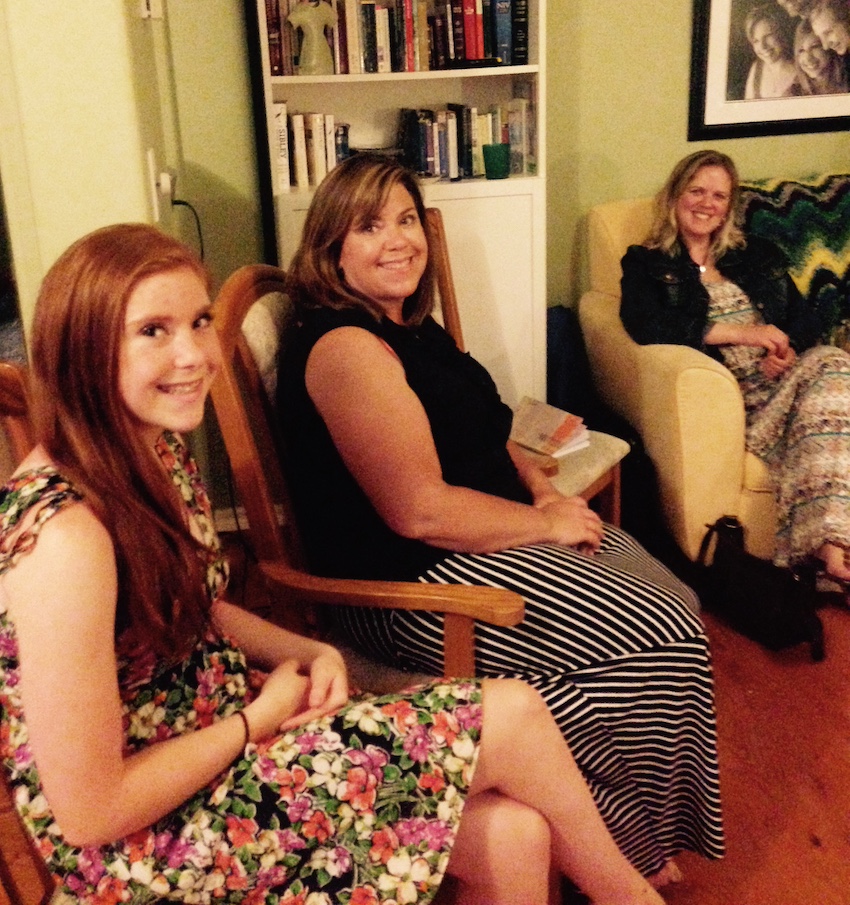
And Annie? She was in my daughter’s wedding party.
We didn’t lose the people we cared about, because they cared about the same things we did. And they all eventually left too.
I know it’s hard.
But the Son of Man had nowhere to lay His head, and we shouldn’t be sacrificing Truth and the well-being of women so that we keep a community that likely isn’t going to stay anyway.
When things get toxic, good people leave.
The community you think you’re keeping will be going away.
So it’s time to do the right thing, for yourself, for your daughters, for the generations of women coming after us.
It’s time to do the right thing for the church, and for the kingdom of God.
It’s time to put our energy into spreading the kingdom, rather than fighting against those who are trying to stop us.
Leave them behind, let them fight amongst themselves.
And let’s get busy, get the work done, and build something healthy.
Have you ever had to leave a toxic church? What was your experience? Let’s talk in the comments!









“But that means that 25% said no.”
And how many have ALREADY left the SBC and its churches? After all, it’s much easier to get “consensus” and “high approval ratings” when you run off the people who disagree.
“BUT MY KIDS LOVE THE PROGRAMS AT THE CHURCH!”
Reminds me of something my writing partner (a retired rural church pastor) told me once.
His small and aging congregation was getting “sheep rustled” of younger families with kids because of a Mega in the area that was attracting “young families with kids” by offering an onsite amusement park for the littles.
Thanks for sharing your story. It’s very relateable, as a queer Christian. And I agree that if a church restricts women, and tells us we’re not allowed to do very normal “talking about Jesus” things that men can do, that *is* a dealbreaker.
When my husband and I visited a Baptist church two years ago and right after they said they agreed with what the SBC voted on about women not being allowed to be pastors and their stance on IVF, I told my husband that I had enough and we walked out. We went to the Nazarene church where we had been visiting on and off throughout the year and just stayed there. Women are allowed to be pastors in that denomination.
I’ve been in other churches where they try to restrict women not in church roles but in family roles by trying to enforce gender roles in marriage. I am so sick of it. Well, if it works for some couples, great. But, don’t make it the status quo for all couples.
I’ve observed that when people quote the verse about women not exercising authority over men , the assumption is that men exercising authority over women is acceptable. They forget that Jesus himself said that to lead one must become a servant, not lording over anyone.
My parents went to a Church of Christ when we were kids, but not every time the doors opened. As my sister and I grew up, we attended church less and less. When I was a teen, I started picking up on the message that females were inferior to males and god made us that way. I couldn’t “love” or worship a god that didn’t think much of me as a female and obviously preferred men. I never attended a church more than one day (I only went when I had a sleepover with a religious friend) so I never got baptized. I knew I didn’t want to have children in the future in fear of having a girl that would feel like I did, inferior just by being born female. I got married in my late 20s and, a decade later, my husband and I attended several services at a church of a different denomination. The sermons were better. Covid got me out of the habit of going though. I didn’t read the bible cover to cover until my mid-forties because I had heard so many stories, preachings, and passages that reinforced the female inferiority. I am now in my early 50s and I still haven’t been baptized. I’m still confused about what to believe, a god that loves everyone equally or a god that prefers males and places females in inferior roles. Maybe if we had attended a different church when my sister and I were babies my “relationship” with god would be different
That’s so sad! And I’m not surprised you’re put off by church if that was your experience. You were recoiling from something which wasn’t of God in the first place.
Thanks for writing this. I have been thinking so much about this section you wrote; “ The church is the only place in society today where men can tell women “you’re subordinate to me.” Appreciate your clarity on this topic. Praying daily over this sad situation.
If the husband wants to stay at an SBC church and the wife wants to leave (with the kids), do you think that is grounds for divorce?
I doubt that’s all that’s going on in the marriage. If the husband wants to stay and she wants to go, it’s likely because he agrees with the power that the SBC gives him as a man, and he could be controlling with her at home. And THAT is grounds for divorce, yes.
I’m also wondering why a good husband would want his wife and kids to attend a church that she feels harms her? Why not go to a church where all can feel safe? The fact that he doesn’t care is a big red flag.
I asked my 34 year old daughter who was brought up, and still, is SBC what she thought about the whole situation. She replied that it was no big deal to her. She said she expects the same opportunities pop up to share Jesus that she’s always had. She really doesn’t care whether she speaks in church or not.
Saturday evening my wife and I were sitting out in the screen porch watching the sun set. I asked her her opinion on the issue. Wife replied that she was born SBC, raised SBC and when her time came she intended to rest next to me behind the church along with my parents, brother, grand parents and great grand parents. She said she’d never needed a title to do the work of the Lord.
The subject was discussed instead the lesson In connect group Sunday morning. Almost all of the women gave their take and none of them disagreed with the decision. More than one woman observed that if anybody just couldn’t live with it the Methodists were just two miles down the road.
“I asked my 34 year old daughter who was brought up, and still, is SBC what she thought about the whole situation. She replied that it was no big deal to her. She said she expects the same opportunities pop up to share Jesus that she’s always had. She really doesn’t care whether she speaks in church or not.”
That’s pretty sad and very self centered coming from someone who claims “it was no big deal” to her. Maybe she’ll have a daughter or granddaughter who may feel it is her calling to become a pastor. Will it still be no big deal? That’s how many women change their minds when it happens to someone they care about. That said, it’s “no big deal” coming from the SBC that has Mary Kassian teaching biblical womenhood to these kinds of followers. Or for men of the SBC that listen to Mary Kassian on video recordings than claim Kassian isn’t “teaching” them because it’s not live. I would rather be a methodist.
“No title to do work” (Boone’s post)
Okay, that sounds great and is true. A person doesn’t need a title or earthly authority to be a good person, be a Christian, do God’s will, etc.
I’d like ask those people two questions. First, if this is true, why does the church make such a big deal about what power, speaking and lines of authority are denied to women? And secondly, at least SOME men are obviously obsessed over this same stuff and DO need official titles and authority to do work. Do they consider that to be ungodly or a weakness?
Adding to both Boone’s and Nathan’s posts, I wonder how these women would feel if they were told they no longer had the right to vote because they were women. There are some well known far right men in American government and churches that want to do away with the 19th Amendment. It’s appalling and I don’t want women to go backwards as a society. We have worked hard to have the same rights as men.
I just cannot be comfortable being in an environment where I cannot do something like preach the gospel because of my gender. Yep, I’ll go down to the Methodist church even though preaching is not my calling but I want to support the women who believe it is their calling.
Apparently there are women who say they are willing to give up their vote. A (well dressed) woman attending an ‘Erica Kirk rally’, when asked about her thoughts on the talk of women no longer being able to vote, said that she would be for it, because then her “son wouldn’t be forced to have to cut off his penis”!
My concern with the ‘if you don’t like it, you can always go to another church’ attitude is the lack of love and concern that seems to imply.
I can understand people coming to this decision about women’s roles. It’s something that I’ve spent a lot of time digging into, and I’m still not sure what is right, because I can see things in the Bible that seem to point both ways. But what I am sure about is that a lack of love and concern for those with whom we differ is wrong.
If my church votes on something and the result of that vote causes some people to no longer feel welcome, that should be a matter of deep sadness to every member, even if they 100% believe the vote was the right decision.
Also, it’s very easy not to be bothered by an issue that doesn’t affect you personally. If you don’t feel any calling to speak in church, it doesn’t matter whether or not your church allows it. But if you feel that is what God wants you to do, then it suddenly becomes extremely important.
Yes. I feel like those women saying it doesn’t concern them or bother them tells me a lot about their community. They’re probably already very segregated–so busy with their secular jobs, children, keeping their husbands satisfied enough, and investing in their female friendships that they feel whatever the men decide to do won’t affect them much; they will just keep living their lives. When you’re floating on ocean waves and caught in a rip tide you might not notice what’s happened until you try getting out. Once you do? That’s when you realize where you are, where you are. It’s when a woman feels led or called to do (or not do) something outside of her allowed “sphere” that she begins to run into resistance, social outrage and spiritual stonewalling.
I do wonder what it will take sometimes for people to understand that limiting women limits all of us. If the gospel of Jesus is not as fully for women as it is for everyone, then it is not the gospel we were promised it was.
>> some people to no longer feel welcome
Or, in this case, you’re “welcome” but only on the outskirts. You’ll never be part of the true inner circle.
I don’t think it’s always helpful or feasible to tell women they should leave. I say this as someone who wouldn’t touch the SBC with a 10-foot pole.
The one thing I recommend to all women is to make yourself as independent and informed as possible, so down the road, you *can* leave if you want to.
Are you staying at that church for childcare reasons? Start looking for a babysitter.
Are you financially dependent on the church or its members? Find a job. (I know, not easy in this economy, but neither is being an unpaid servant to the patriarchy. At least McTacoHut has mandatory breaks and a minimum wage.)
And always, ALWAYS read and learn as much as you can. Visit other churches and other houses of worship. Make friends from all kinds of backgrounds. Cast your social support net as wide as possible, and it’ll be there to catch you when you fall.
Years ago, a man prominent in his Church brought numerous motions, appeals, overtures, etc., relevant to women’s issues, roles and ecclesial polity. These, he presented on the floor of the most general assembly of his denomination. For years, I participated in a small, tightly knit group of 5-6 other church leaders. One of them was the gentleman [some years deceased] mentioned.
As would be expected, this provoked responses, often angry, across the Church. A number of congregations left the denomination over these developments, because however heated the debating, motions were passed. Sometimes congregations left the Church, often with their pastor[s]. In other instances, pastors left without their congregations.
Obviously, this was known to our group. But after we had been meeting for several years, he began attending also. In time, he realized that this group understood confidentiality and practiced integrity. We were discussing a particularly heated event soon after it occurred. Then something happened.
The gentleman in question had been with our group at this point several years. Then after a heated, denominational episode erupted, he — being at the heart of much of the conversation — was able to give us rare inside information. That was illuminating enough.
But at a point, the conversation took a completely unexpected turn. As questions went across the table . . . he stopped. For 20 seconds perhaps. Then he said . . . I receive letters from the wives of the men we’re discussing . . . Jaws dropped. We went silent.
It came out that many, many women wrote letters to him. His stands were known across the denomination. His contact information was in the denominational Yearbook. He had received not scores, but many hundreds of letters. They discussed everything imaginable, and possibly some things which are not.
Our colleague had a first rate mind. He could quote at length things they said. More times than you would guess, he affirmed that yes, he heard from this woman, from that woman, from another woman, and on and on and on and on and on. It was always the same.
From chronic disrespect to demeaning behavior to humiliating remarks, to mocking wives by repudiating their professed goodness to them on the assembly floor, to . . . yes . . . being bedroom disasters.
This is not to say that he necessarily indicated who said what. But it would be a list of other speakers on the assembly floor — and the things their wives had said explaining who and what they truly were. Did you hear from so-and-so’s wife? Yes. What about … Yes. And . . . yes. It was simply stunning.
I have said these things for a reason; and I hope that I will not overstep my bounds when I explain it.
Would you consider seriously making a periodic yet regular statement of appeal to the wives and women of the SBC? Take the issues you hear. Put together a few lines on it. Raise a few questions. Offer some perspective?
My guess is that human nature and patriarchal religiosity doesn’t vary much from denomination to denomination. I suspect that the very reaction your letter brought indicates that such matters as you address await redress in the SBC. The critics know and resent it.
Which is exactly the reason for which their wives and other SBC women will benefit therefrom.
Thank-you for your consideration of this matter.
GS-z-14-1