



Alisa Childers recently critiqued The Great Sex Rescue on her podcast.
Childers calls herself an apologist. She became well-known in Christian spaces as a member of ZoeGirl, and now hosts a podcast where she critiques anyone who doesn’t endorse conservative Christian complementarian beliefs. Recently, for instance, she agreed with Al Mohler that women shouldn’t be on church podcasts because that could be pastoring.
She decided to take on The Great Sex Rescue, and did such a bad job that her followers roundly criticized her.
I have posted about this on social media, because I believe that she owes evangelical women an apology. I want to post it here, as well, so that it is here for posterity, since social media posts tend to get lost.
Here is my statement:
Will Alisa Childers issue an apology to the women she dismissed and misrepresented last week?
Recently, she decided she was going to “review” The Great Sex Rescue on her podcast, inviting a guest on who was embarrassed to talk about sex.
Her followers pointed out that:
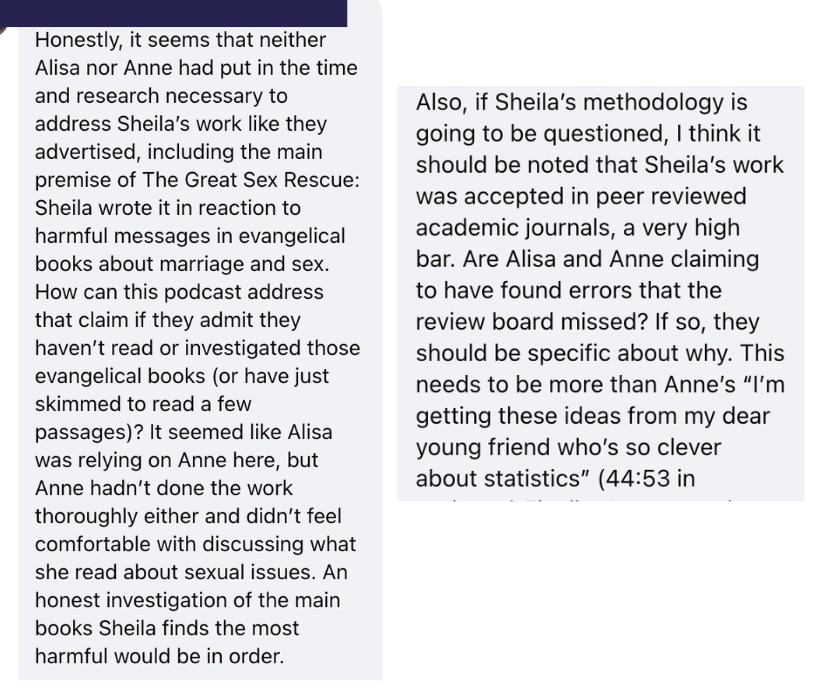
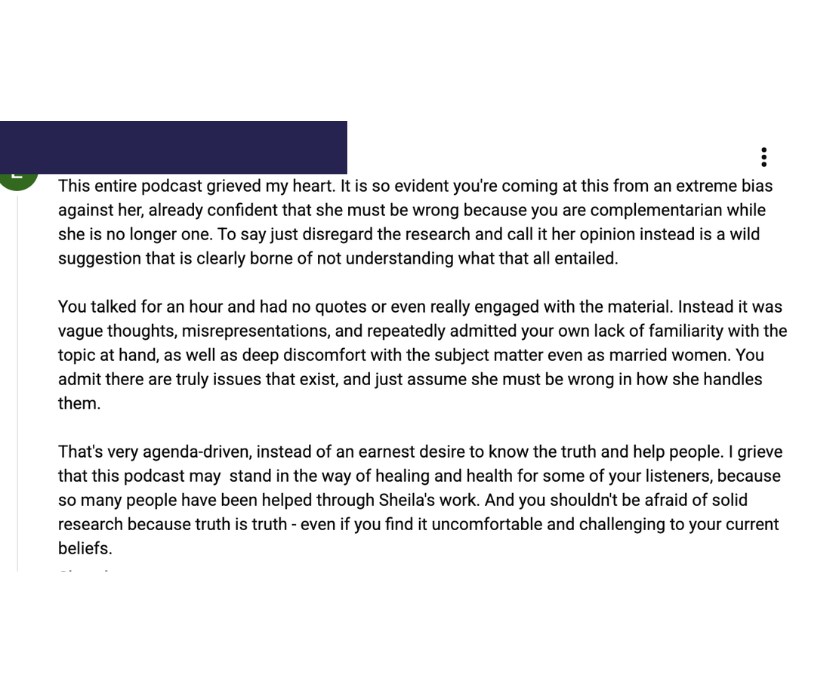
(a) They admitted they weren’t really familiar with our body of work.
(b) They did not quote from our book until minute 59.
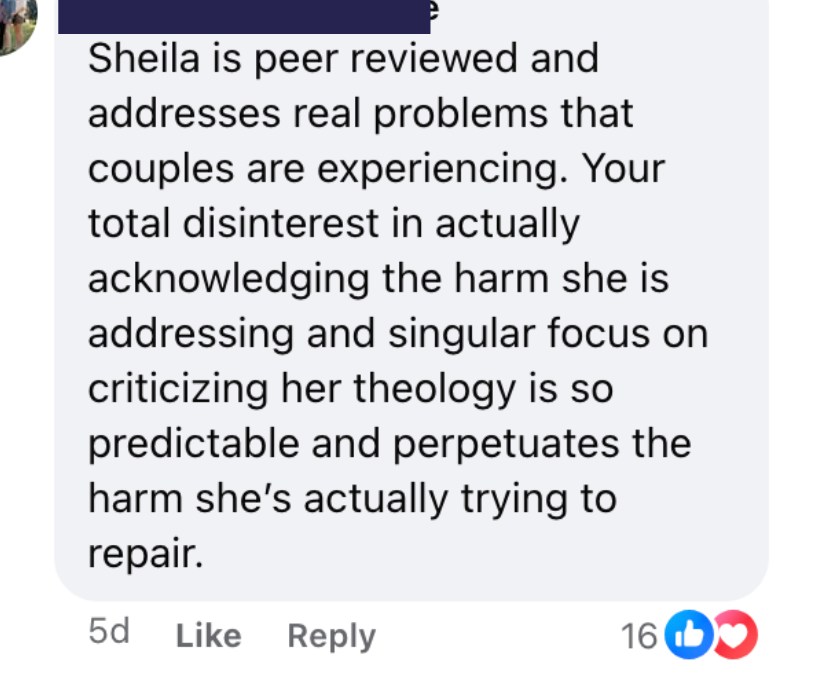
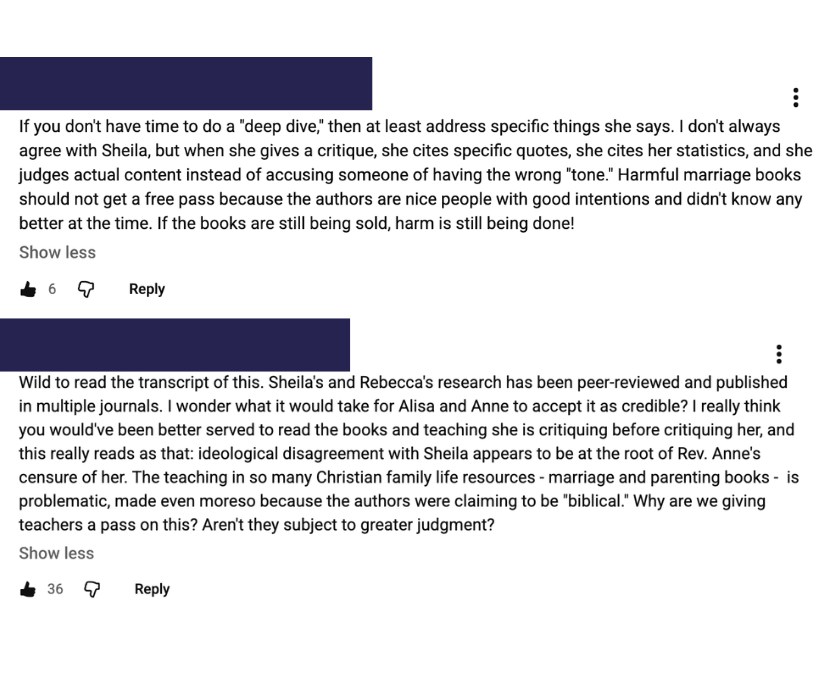
(c) They claimed that we did our stats wrong because they would “need a sociologist to chime in,” conveniently ignoring the fact that our work has been peer-reviewed and accepted at multiple sociology journals.
(d) They say that our book was based on anecdotes and personal experience & bias, all while providing absolutely no stats for their claims, and ignoring the overwhelming data that we provided.
Childers doesn’t like me because I’m egalitarian. That’s okay. We in the church are allowed to not always like each other and to not agree with each other.
What we as Christians are not allowed to do is to lie and misrepresent.
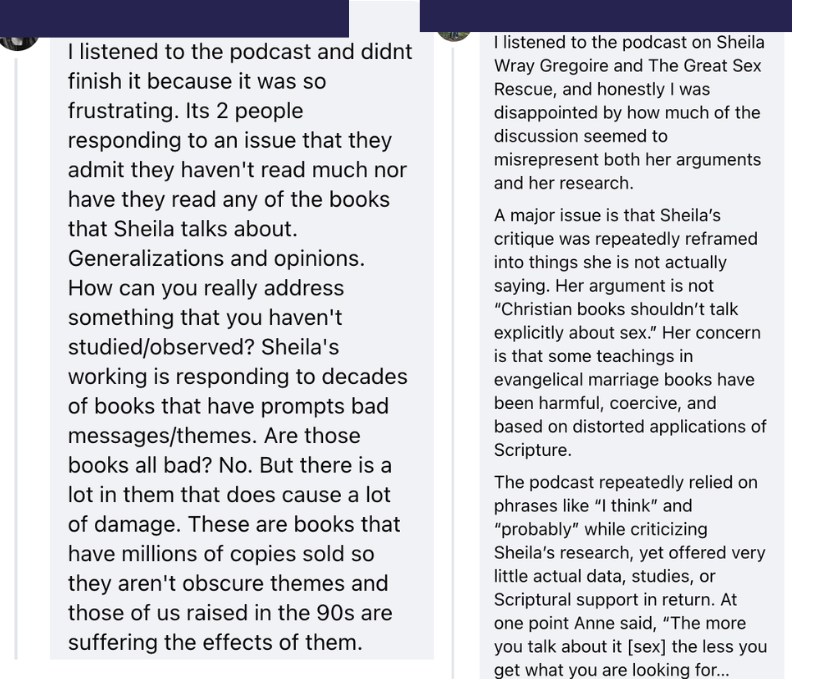
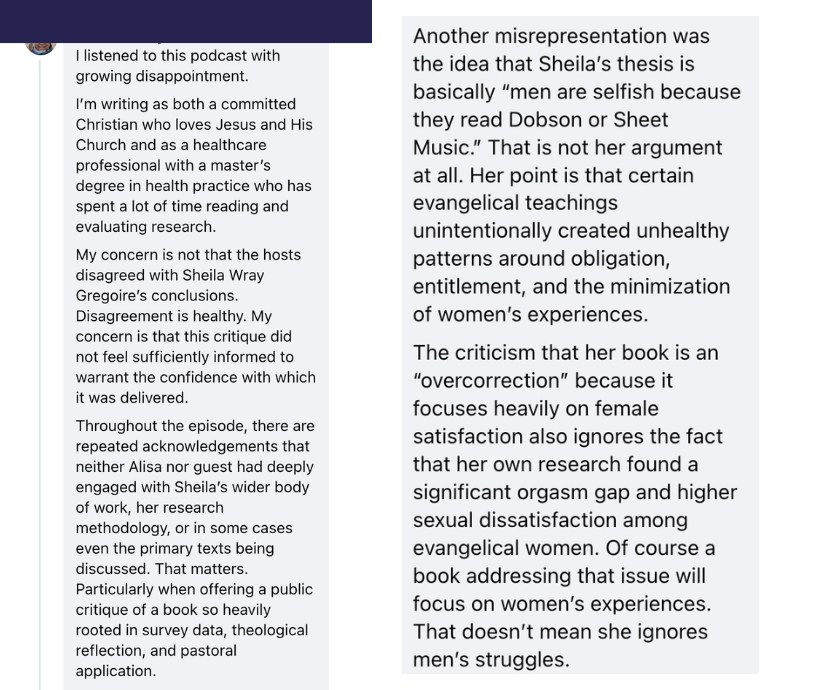
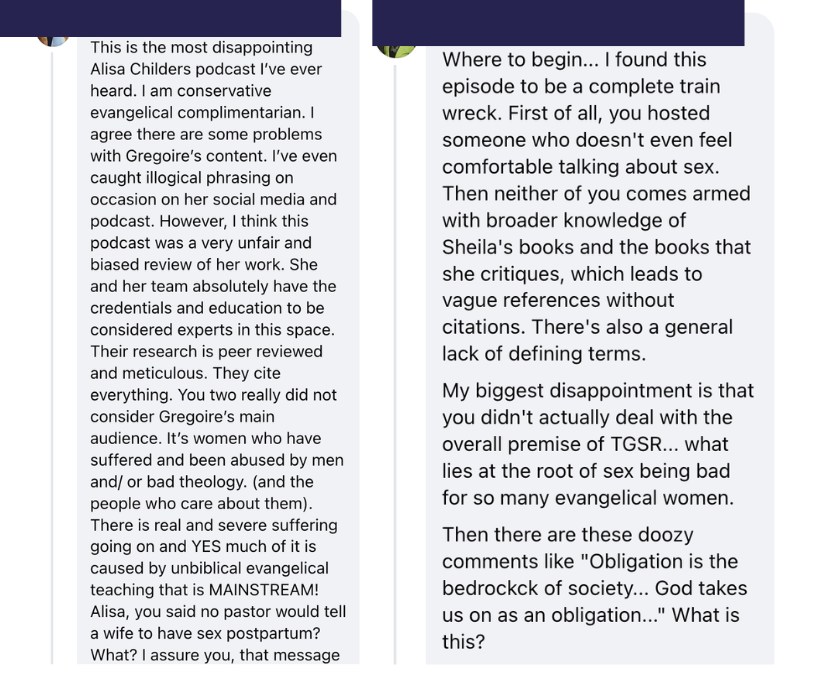
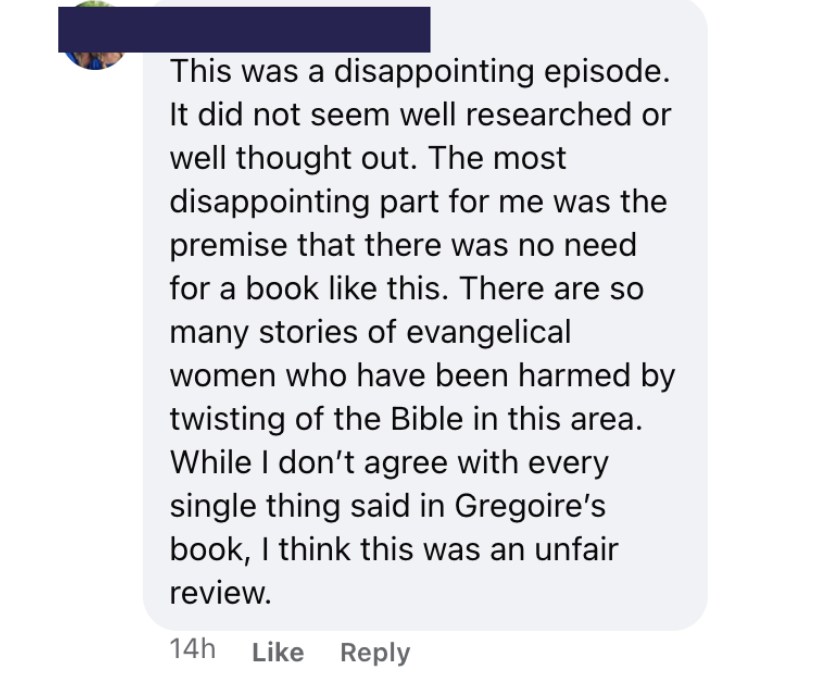
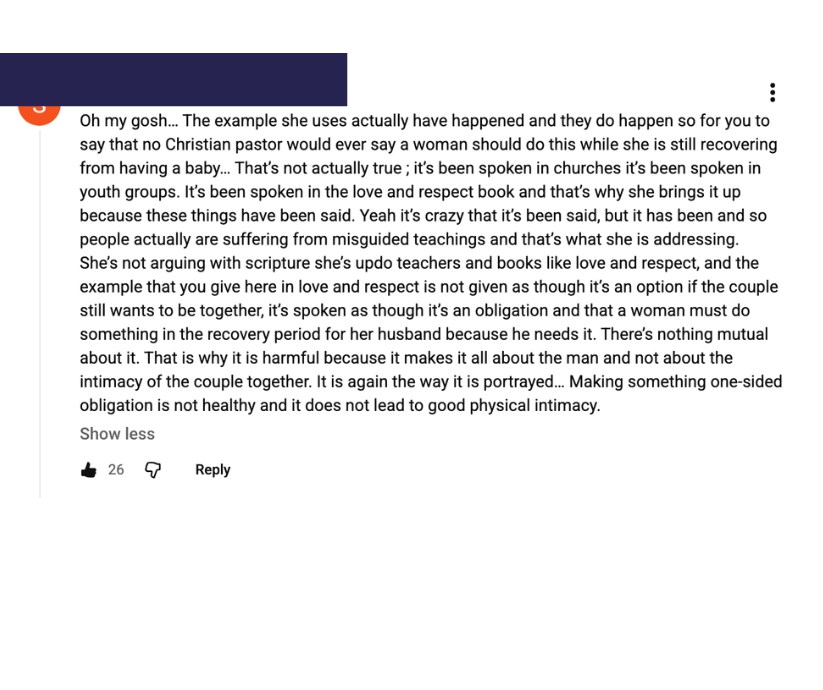
Alisa Childers’ followers quickly pointed out how this “review” wasn’t really a fair critique, but was a smear campaign that ended up denying the very real, measurable emotional, physical, and relational pain that evangelical women are experiencing at the hands of terrible teachers because they just wanted to get at me personally.
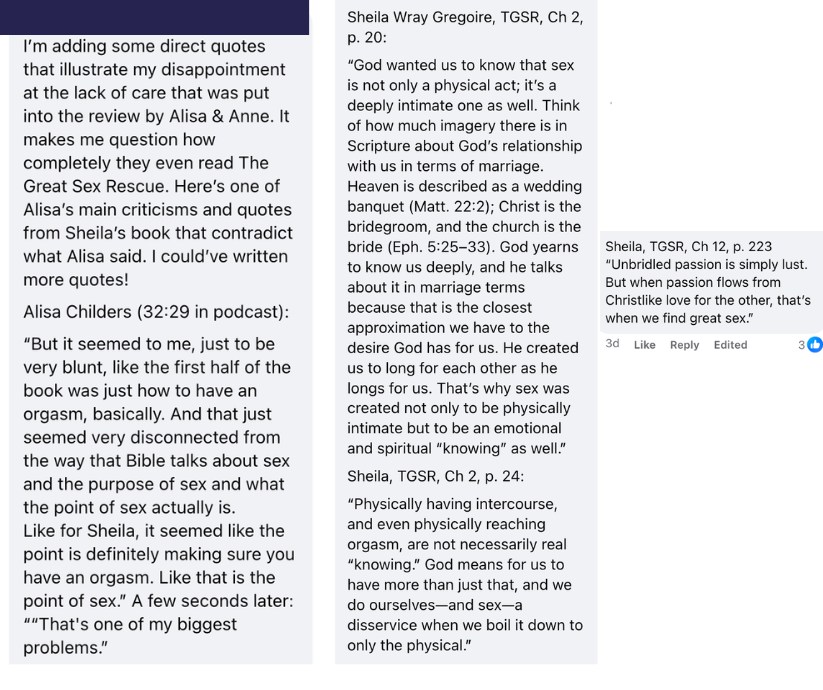
The podcast hosts claimed that the things we fully quoted from other books and authors would just never have been said or weren’t that bad. No one would ever actually tell women to give postpartum favours, they said! Except these books did, and we had receipts. They ignored them.
They claimed obligation sex wasn’t that bad–even though we found that it was one of the biggest drivers of the reason that evangelical women suffer from twice the rate of sexual pain disorders as the general population.
They were so intent to paint me in a bad light that they ended up invalidating the very real pain that evangelical women–including their own followers–are experiencing, laughing at the mere thought of it.
They sounded like the prophets in Jeremiah, going around saying, “Peace, peace,” when there is no peace.
Evangelical women deserve better than this.
They deserve for their pain to matter, and not be diminished, ignored, or belittled all in an attempt to earn theological brownie points for your position.
Alisa Childers presented what was not a fair nor accurate review of The Great Sex Rescue in order to discredit me because I’m not complementarian. In so doing, she threw complementarian women who have been hurt by these teachings under the bus. I, as an egalitarian, will continue to speak up for the dignity, well-being, and safety of all women, complementarian or egalitarian, Christian or not. Because that’s what Jesus did. I will call out harm when I see it, but I will do so by bringing receipts and quoting people, not just slandering them broadly.
Alisa Childers owes me, my team, and evangelical women an apology, and I hope she has the humility and integrity that Jesus modelled to give it.
The comments screenshotted below are taken from her own followers on her platforms for this podcast episode. Alisa, I hope you listen. And if you ever want to actually and honestly know what our stats found (since you claimed you had lots of questions), my team and I are always willing to jump on a zoom call and chat with you.
And now screenshots, many from her own followers, that were all left on her social media channels. This is just a few of them; there were literally hundreds.
I’m going to put more of my thoughts at the end, so scroll down!

Random thoughts on Alisa Childers’ take
She seems almost panicked by the conversation around women’s orgasm
She says saying these words are explicit, and a lot of her conversation with her guest revolved around whether it was sinful to talk about this stuff.
She also says that The Great Sex Rescue is a how-to manual about how to have an orgasm.
I mean, I think that may help me sell books, so that’s nice! But The Great Sex Rescue is not a how-to manual. The Good Guy’s Guide to Great Sex and The Good Girl’s Guide to Great Sex are, as is our Orgasm course! The Great Sex Rescue merely points out the orgasm gap. That’s it.
Also, we spend one chapter talking about orgasm, and one chapter talking about problems with arousal, but she said that was the whole book. She basically ignored what we said about lust, obligation sex, marital rape, demands about postpartum favours. She acted as if the whole reason we wrote the book–to critique evangelical teaching–didn’t really exist.
Our research shows the more explicitly you talk about these things to kids, the better they do
One of the things I personally was surprised by in our dataset for She Deserves Better was how stark the outcome differences were for women who received lots of sex ed as teens and for women who didn’t. Women who couldn’t identify words about sex (like ejaculation, clitoris, etc) did far worse long term, and were even more likely to marry abusers. Understanding words about sex enhanced self-esteem and self-confidence.
When she and her guest insinuate that only mothers should talk about sex to daughters, and it shouldn’t be that explicit, they do directly against evidence. The worst outcomes we saw were for homeschooled girls who got the least sex ed. That matters.
Want to do this well with your kids? Check out our Whole Story puberty course to talk to your kids about sex & puberty! And the curriculum is based on our findings from our surveys about what kids need to know when, as well as other best-practices from peer reviewed studies.

You're telling me WHAT goes WHERE?!
Talking about sex with your kids doesn't always go smoothly.
That's why we created The Whole Story, our online course that walks parents through the tough conversations and does the hard parts for you!
How do you explain to someone who is so uneducated that they don’t understand research?
I’m truly at a loss on this. Their guest, talking about our article in Sociology of Religion, said that they’re not even sure it’s peer reviewed.
Ummm….it’s in a peer reviewed journal! They started saying all kinds of things criticizing our research which are just factually untrue, but more importantly, display an alarming ignorance about research.
I feel like we’ve done high level calculus, and they’ve only done math up to long division. And we’re trying to explain why they’re wrong, but how do you even explain that when they don’t actually understand that calculus exists?
This is the problem we face in evangelical circles. They are so anti-intellectual, while painting themselves as the only smart ones. And the rest of us are looking at them, trying to figure out how to explain complicated things to a 5-year-old, because that’s what it feels like when they make some of the same critiques (they don’t understand that the word “bias” in research is a mathematical term, not an implication of mindset, and that there are mathematical tests you can run to eliminate bias, for instance).
I’m so frustrated by this, because we’ve done something no one else in evangelicalism has done. We did an absolutely huge study that has blown academics away, and have been peer reviewed even though we’re citizen scientists and not even affiliated with a university. And they all think they know better than us.
I just want to say–go ahead and do your own study and get it peer reviewed and then we’ll talk. But they don’t even understand that.
Sigh.
The bigger problem: They ignore the pain.
They completely ignore the main focus of our book. Her guest even said she didn’t even know what argument we were trying to make in our book, even though anyone who has read it will tell you.
It’s quite simple.
It’s on the back cover. It’s in the synospis. It’s in the subtitle.
The evangelical church has taught toxic things about sex and marriage that have harmed people, and we need to correct those things so that people can flourish and find real intimacy and satisfying marriages and sex lives.
They denied the problem existed. They didn’t deal with the fact that evangelical women have twice the rate of sexual pain as the general population. They didn’t acknowledge marital rape. They thought obligation was okay!
And so they deny and dismiss the very real experiences of millions of evangelical women, because they want to call me unbiblical because I don’t believe like they do that men should be in authority over women.
The crazy thing is we don’t even talk about egalitarianism really in The Great Sex Rescue.
There are maybe three pages where we share Gottman’s findings that when men don’t share power and make the final decisions marriages break up, and we share our findings that say the same thing.
But this is not the majority of the book. They make it sound like it is, because they want people to dismiss us.
But in so doing, they dismiss their own followers. Their own readers. Their own people who have experienced genuine pain.
And honestly, in listening to how hesitant and embarrassed they are to talk about sex, and how dismissive they are of women’s experiences during sex, it wouldn’t surprise me if they’ve experienced a lot of these bad things too.
That makes me sad for them. It makes me sad for all the women who will feel overlooked, ignored, and their pain invalidated.
And I hope and pray that maybe, just maybe, she will apologize.
I doubt it, but I will hope, because I want to believe that some of these people who say they believe in Jesus really do. I want to believe that hearts can change. I haven’t seen any evidence of that from evangelical thought leaders or influencers yet, but I’ve seen it from people on the ground. And so that is who I will continue to focus on, while I still hold out hope that some integrity will still be found among those with large platforms.
What do you think? Will anyone ever apologize? Why are people ramping up critiques of our work? Let’s talk in the comments!






Sinful to talk about orgasm and sexuality? That doesnt make sense. Also do they have any idea how much worse lorn problems get if you feel like you are this isolated degenerate who has desires that nobody could understand? Being able to talk about sex in a healthy way is a big part of how I hsve grown as a person.
It’s a Pelvic Issue and Pelvic Issues always make Christians crazy.
I’m going to indulge in some snark, so please delete if it’s too much. I want to start a vibrator company for all the sexually unfulfilled evangelical wives, and I want to name every single one of my products after a famous theologian’s wife. I imagine that Katharina von Bora will be my bestseller. Her husband, Martin Luther, bragged to his students about how they have sex three times a week. (Just in case you thought “my smokin’ hot wife” was a modern American invention.)
Do you have a link re Martin Luther’s comment?
You can’t Google? Here’s his cutsie rhyme about it in the original: “Die Woche zwier, der Weiber Gebühr, schadet weder mir noch dir, macht’s Jahr hundert und vier.” (And I was off by one, he said twice a week, not thrice.) He also said that women could either be wives or prostitutes, that’s it’s OK if they die in childbirth because that’s what they were created for, that their large behinds prove they were created to sit at home, that girls mature faster than boys because weeds grow faster than roses… I’m currently working on an article on the Church Fathers as the original incels. If Andrew Tate was more familiar with the history of Christian theology, he would have had no reason to convert to Islam.
Sorry for late reply. I kept sitting down to respond and I’d either get sidetracked or the website would time out on me. I realize you might not see this but I’ll respond anyway.
If any non-German speakers are reading this, my rough translation is:
Twice a week
Is what is due to a woman
Doesn’t harm you or me
And makes 104 times a year
No direct reference to sex but Deutsche Welle and a couple of other websites quote it in the same context (https://www.dw.com/de/wenn-es-dem-esel-zu-gut-geht-13-luther-zitate-die-bis-heute-zutreffen/a-38403391), and it’s hard to see what else it would be about. So I’m assuming it is something Luther actually said (though even with the quote I can’t find the actual source) and that you’re right about the subject.
I don’t know that much about Luther really, but it’s probably likely he said it to his students (???). And I guess maybe you could call it ‘bragging’, but I’m not surprised it didn’t come up in my Google searches based on your paraphrase.
The second line is really interesting. German is my second language and I had to look up “Gebühr”, but when I asked AI it was pretty insistent that it’s saying sex twice a week is what is due *to* a woman/wife. Obviously AI can be wrong and we don’t have any context for when he said it or why, but if that’s correct it’s somehow refreshing to see sex cast as a male obligation and female entitlement. I can’t decide if that’s progressive or regressive in another direction but it’s different. If you (or another fluent German speaker) happen to still be checking this thread I’d be interested to know if that’s how you read it.
All that said, I don’t think nonsense rhymes about sex are a particularly helpful way for a church leader to address the topic! Can’t imagine a context where I’d say something like that myself, (other than quoting what he actually said if it was ever relevant).
I guess you have to see it in the context of the time though – reaction against a very sex negative culture (celibacy of priests as a sign of ‘holiness’ prior to reformation etc etc). E.g. this article (unfortunately also in German) that came up when I was trying to find the quote mentions it in the context of the cliche about sex dying off after the early years of marriage, which apparently Luther recognised as a bad and avoidable thing. She (author of the article) also talks about Luther apparently saying that a husband who was impotent and wouldn’t give his wife pleasure another way gave her grounds for divorce. (I think I have that right, again, not my first language). If the poem was said in that context I guess I could see where he was coming from.
https://www.liebesbegehren.ch/blog/2017/martin-luther-befreit-sex-und-frau
Sheila, is it possible that your research is being dismissed out of hand because they believe that by conducting scientific studies on sex you are negating scripture, rather than enhancing it. In their hearts, they believe it is an oxymoron (or even worse, sacreligious) to pair the Bible with science.
Treating orgasm like a social pariah does no one any favors. Setting aside the fact that it is the funnest part of the sex act, in a society filled with an overabundance of unhealthy sexualization, you would think that Christians would be first in line to correct bad assumptions.
One of the most important thing my husband and I did as parents was talk openly about sex with our four sons. Yes, in a move which may seem shocking to those who believe the job of sex ed belongs solely to the father, I gave them the low down on sex from the woman’s perspective – and we didn’t just discuss it once. We had repeated conversations. Now, as grown adults, our boys have thanked us for modeling a healthy marriage in which they were well aware that sex played a vital a vibrant part. (Bonus benefit: My daughter-in-laws have expressed their gratitude, as well.)
I love that! And, yes, I think that’s a big part of it. They think we shouldn’t be studying this at all because women shouldn’t be questioning their marriage or sex lives.
She says it’s not biblical to care about a woman’s pleasure. Well it’s not biblical to use the internet, or the bathroom, for that matter. You’re supposed to take a paddle and go dig a hole outside the camp.
Not to mention sitting on a camel saddle for the duration of your period every month.
Well that is really sad.
I don’t know anything about these podcasters so I’m speculating heavily here:
If you believe “it’s not biblical to care about a woman’s pleasure,” you are probably in a church that doesn’t value women. You may be in a marriage where your sex life is based on this belief. Perhaps you have been putting up with terrible sex for years and convinced yourself it’s fine, this is how you please God.
So when someone comes along saying, no, it doesn’t have to be like this, here are the receipts, you aren’t going to jump for joy. You might well get defensive, and flail, and say anything you can think of to discredit that idea. Because you know that if your belief is wrong, all the misery you’ve experienced was for nothing. If you even consider the possibility, that threatens everything you believe about your relationship with God. It rocks your marriage and your standing in your faith community. And maybe that risk is just too great.
Again, I don’t know anything about the specific people involved here. But if people scramble to reject an idea they don’t appear to fully understand, by any means they can, however poorly reasoned, well, that at least suggests the idea threatens them on a deep level.
I think there is a lot of that sunk cost fallacy going on. They’re already put in all of these years of unfulfilling marriages and sex lives, and so they don’t want to believe it could have been different.
It’s like mothers who refuse to help their daughters leave abusive marriages because if they admit that their daughter has a reason to leave, they have to admit that they could have left twenty years ago too.
Wow. Major props to all the women who disagree with Sheila and team on certain things but still came to the defense of GSR because of unfair criticism. I have spent years in those circles and know how hard that can be. Way to go, ladies!
Yes, that was lovely to see!
I thought so, too. It took courage and integrity to stand up for Sheila in this context. I applaud these women.
And I wonder if you’ll allow me now to segue to a tangential but somewhat related topic. I’ve learned something about how the Bible defines lust, and I don’t want it to sit all summer (since this is your last podcast for awhile) if it may be helpful to someone now.
Sheila, I know you’ve always said that lust is not the same as noticing. I thought I’d point out that apparently, Jesus agrees with you.
I’ve been listening to podcasts from The Bible Project lately, and one point caught my attention recently. It is Jesus’ own definition of lust, which he gives in Matthew 5:28. This is usually translated as “Anyone who looks at a woman with lust . . .” or “Anyone who looks at a woman lustfully . . .” but according to Dr. Tim Mackie, the actual Greek (a present active participle – “is looking/goes on looking/keeps looking” – followed by an infinitive – “to lust/in order to lust”) is properly translated as “Everyone who goes on looking at/stares at a woman in order to cultivate lust for her, he has already committed adultery with her in his heart.” (You can find this at bibleproject.com, in their series The Sermon on the Mount, episode 12, “Jesus’ Vision for Sex and Desire”, beginning around the 7:16 minute mark and continuing through to about 16:06, although the entire episode is worth listening to. They bring Dr. Lucy Peppiatt on to discuss the topic with them.)
Tim explicitly says that noticing is not lusting. That present active participle form of “look” indicates a sustained action, a sustained look, the kind of stare that Dr. Peppiatt characterizes as being “horrible and creepy” and “really intimidating for a woman.” And that infinitive, “to lust/in order to lust,” indicates the purpose of the look. It is deliberate. It is done for the purpose of activating and cultivating a mental fantasy about the woman.
So Jesus’ definition of lust is that it is not accidental. It is not something that can just happen TO you. It is deliberate. It is a choice. It is (1) sustained and ongoing, and (2) done on purpose in order to activate and feed lustful fantasies. And by the way, if you listen to the rest of that podcast episode, you will hear them point out that Jesus also makes clear that this lust is the man’s problem, not the woman’s. Trying to blame her by getting her to cover up more, or even getting her out of the room entirely, won’t solve the problem because the problem is in the man’s heart. It is internal. It is his. It is not external. She is not the problem here. But that is another topic.
So if any of you men are still “bouncing your eyes,” stop it! It is dehumanizing and creepy. Just looking at a woman is not going to imperil your purity.
Sheila and team, have a long, lovely, restful summer, if it can be restful when you have to finish moving in to your new home.
That’s beautiful! I love that. We quote Tim Mackie on Exodus in our new book on the Fawn trauma response!
Speaking of Fawn, do you know when pre-ordering will be open? I want to make sure I don’t miss it!
Thanks so much for sharing this. I read the Sermon on the mount a lot last year and thought quite a bit about that passage. That’s roughly what I thought it was saying but I never figured out how to tell if that was correct. Will check out the podcast.
Being a woman harmed by ALL OF IT (marital r*pe, obligation sex, pornified mindset, pain, sexual abuse, and on and on) and still dealing with the aftermath more than a quarter of a century after escaping, the willful ignorance these women displayed is especially hurtful. Their criticisms of your work are intentionally meant to keep evangelical women in bondage and enduring continued harm.
And they claim to represent the heart of Jesus? How?
First, I’m so sorry, and I’m so glad you found me! But you’ve hit on the point exactly. This isn’t about portraying the heart of Jesus to people. This is about winning culture wars, and in their culture wars, male hierarchy has to win. And so anything that challenges that can’t be talked about, even if women continue to be harmed.
I found it funny Alisa Childers podcast that they brought up sex in medieval times (before pornography) that sex must have been better. (Where is the evidence for that?) AND they said something to the effect of – if a woman had a sexual issue in marriage back then, she would go to her mother for advice. Again, where is the evidence for that and also…if I was born in the medieval times and had Alisa Childers as my mom…you can BET I wouldn’t feel at all safe to talk to her about bedrooms matters. You know who I would feel safe talking to? Sheila Wray Gregoire!
I just read “Jesus Through Medieval Eyes” and Jesus as a Knight, Jesus as a mother, Jesus as a LOVER were more common images then than now. Alisa should read it!
I am glad you have called this out. Unacceptable, Alisa.
I was surprised to hear them saying that the more we talk about sex, the “less you get. And that’s why we shouldn’t read sex books.” Where is that coming from? This idea that if we talk about it, it is less mysterious and less holy. Like that we shouldn’t be removing shame and embarrassment around the topic. That was such an odd point to me and I don’t understand the reason to make it.
I wonder if it could be that once you learn there is more to an experience you realize what you have been missing? If you don’t read those books then you won’t know that you are missing: an orgasm, intimate experience, etc.
Alternately, perhaps the women they are referencing (themselves included) are married to the type of men who would need to “teach them to know their place” re: sex and make it even rougher, more painful, and less intimate than even what they had been experiencing before? Sounds horrible but… not out of the realm of possibility considering some of the men in those circles.
It was honestly bizarre.
Wait, the part they are stuck on is “is it sinful to even talk about orgasms”? Oh they are not even in the ballpark of understanding what the problems are with evangelical teaching about sex and how to solve them.
I am really struggling with the whole concept of Christianity and what it means to be a Christian. I thought “Christianity” was the Body of Christ made up of different parts, but all working together to be Christ-like in service, in ministry, and to one another. I thought “Christian” meant that you are working toward being Christ-like, following Jesus, and that you understand the foundation of why Jesus came and why Jesus died. I am discouraged by the practice of patriarchy, hierarchy in marriage, entitled and emotionally immature men and my discouragement stems from the women who perpetuate these vile things. Let’s just say, for sake of argument, Childers had a legitimate reason to call Sheila and her team out – did she do it in a way pleasing and honoring to God? Did her words and blatant tomfoolery bring glory to God? Did she rebuke Sheila in loving-kindness and respect? And if Childers IS a Christian then why did she not follow Matthew 18, respecting another fellow Christian’s walk, and perhaps “sin?” Did Childers got to Sheila privately? Did Childers go to Sheila with two or more witnesses? Did Childers ask Sheila to stand in front of the church? I believe the answer to these questions are a resounding no. How does one call themselves a “Christian” when they are not even remotely close to behaving like Christ? Does Childers even know the things that God hates, and especially hates? Does Childers know what the Bible states about bearing false witness? I am exhausted with these people. I am also very content calling pastors, who sexually assault or abuse for monetary gain, and women, who wish to have a seat at the men’s table, traitors of the faith, even “not Christian.” Step 4 of Matthew 18: treat them as an outsider. Funny how they are trying to do just that to Sheila and her team and the research. If they cannot first see and understand that one “Christian” marriage book hurt just one marriage and they visually saw the abused woman and children, how do we expect that they would ever recognize conclusive research academically completed? Childers did not even read Sheila’s book so at least for me, I am content stating that Childers doesn’t read her Bible enough to know that SHE is the one in sin.
It is so frustrating to see people who truly don’t care about looking like Jesus! To be fair, I don’t think that Childers had to come to me before saying anything, because when teaching is done in public, it should be corrected in public (if it needs correcting). So I’m okay with that part.
What I’m not okay with is going after someone because you disagree with them, and then misrepresenting their work completely to discredit them. When we take on bad teaching, we quote the work, and explain how it’s harmful. We don’t just say “I don’t like this person and you shouldn’t either.”
Unfortunately Sheilla, Alisha doubled down on her thoughts in a follow up episode about what she actually said about you in the episode she did with Anne. I listened to both her episodes on you and she did a horrible job. I used to respect her work years ago but now find some of her thinking and reasoning illogical.
Thank you and your team for the work you do. Can’t wait for you’re new book coming out next year btw!
Thanks, Clark!
“Their guest, talking about our article in Sociology of Religion, said that they’re not even sure it’s peer reviewed.
Ummm….it’s in a peer reviewed journal! They started saying all kinds of things criticizing our research which are just factually untrue, but more importantly, display an alarming ignorance about research.”
Sheila, I hoped you would actually address this claim beyond just saying “academics were blown away.” They weren’t saying it wasn’t in a peer reviewed journal. They were saying that your methodology was suspect because your respondents were more likely to be women who were already having trouble in their marriage, because women could self-identify as evangelical without specifying which denomination, and because some of your questions were wide open to interpretation (such as “have you been abused”) and thus could not give you accurate data. I’d love to hear more about your response to what seemed like actually very valid criticisms if true.
I have spoken about this multiple times. Most of our respondents were not in troubled marriages. But we found that those who believed in complementarianism and acted it out were MORE LIKELY to be in troubled marriages.
Honestly, this isn’t hard, and the fact that they are so ignorant about research is ridiculous. Basically, we’ve done calculus, and she doesn’t know anything beyond long division and doesn’t realize calculus exists. And people are asking us to correct this. But how can we when people don’t believe in calculus?
We have been accepted in three of the biggest and most prestigious peer reviewed journals, and she thinks she’s more qualified than those journals to say that our research wasn’t true. Even though she didn’t even know that having a Limitations section is mandatory for papers and isn’t a sign that we don’t believe in our research. It’s ridiculous, and at some point people have to recognize expertise and that some people don’t have qualifications to speak on a subject.
Again, that’s not really an answer. “We’ve done calculus” and “those journals are peer reviewed” still doesn’t address the specific objections to your methodology and how, most importantly, that means the data could have been skewed. Do you have an article where you specifically address the criticisms and justify your methodological decisions? Could you point me to it? Thanks for engaging.
This article may answer those:
https://baremarriage.com/2026/05/why-the-bare-marriage-research-studies-are-so-ground-breaking-and-you-can-trust-them/
I noticed a line from the post previous to this one: “Belief in complementarianism means that you don’t prioritize your own pleasure or happiness. ”
My gut reaction is- I thought belief in Christ means that you don’t prioritize your own pleasure or happiness. This was a core belief I absorbed growing up in conservative Christian spaces. Really, to me it wasn’t that gendered, I thought it applied to everyone and women just happened to take it more seriously or be more spiritual on the whole.
In my concept of Christian teaching, it was ok to enjoy something if you just randomly got it (in spiritual talk, if God gave it to you), but you weren’t supposed to be sad if you didn’t get it or it was taken away. Whether that is an orgasm, or money to enjoy things you care about, or opportunities, or anything. If you were sad, disappointed or angry, that meant you had made an idol out of it. You were always supposed to remember that you deserved nothing and were entitled to nothing.
It’s such a fundamentally different view of self and of God than what I’ve encountered on this site. I’m honestly not sure which view is biblical.
I’ve struggled with this too in the past, and I think the idea Sheila was trying to get at wasn’t best communicated by the word “prioritize”. Let me explain what I’ve found, and then I’ll come back to that word.
As Christians, we are to “love your neighbor as you love yourself”. Often we take this to mean that we *always* prioritize ourselves in sin, but after conversion, we *always* prioritize others. But that’s not what that actually says. We are to love others to -the same degree- as we love ourselves. This means that we hold others- their needs, desires, comforts, dreams, fears, etc.- as equal with our own. Sometimes, our hopes are placed “below” their needs, and sometimes our pain is placed “above” their comfort. The priority changes based on *context* not based on *who*. This means that our self-respect and dignity and care matters just as much as respect for others, and the dignity and care of others.
I think- and please chime in if I’m wrong Sheila- when she says “don’t prioritize your own pleasure” what she means is that there isn’t any value in our own pleasure, and that we harm ourselves rather than truly caring for them or ourselves. This is because when we harm ourselves to “uplift” others, we are teaching them that they either deserve the world bowing to them (not Christian) OR that, because they also believe this “lesser than” idea, they must “outdo” us in hurting themselves for us otherwise they are in sin simply by being cared for.
Placing one person above another in any context creates an equation, a transaction. X+Y-B = this response /reaction /attitude. While that falls into the category of relationship, God calls us to a relationship based on love, not worth, not status, not service. A relationship of love does not determine the difference in the value of *the people* in a relationship, but instead invests value and worth *in the relationship itself*.
I hope that made sense!
Thank you for your thoughtful response. I guess I was thinking less about prioritizing oneself over/under other humans, and more in the sense that prioritizing self takes away from God’s process of transformation. (I would like to say that I am expounding all of this as someone who doesn’t know what she believes, has stopped most spiritual practices, and is primarily afraid of eternal punishment, which is my motivation for trying to figure out what seems most likely to be true.)
The picture I have formed of God, which I feel is supported by the extensive Bible study I did throughout my life until I stopped completely 5 years ago, is that God is someone who is constantly testing those who want to follow him, for the purpose of refining and transforming them, and also influencing others (such as Job). I see this in Jesus’ interactions with most people, but especially his disciples. This view sees human nature as full of folly and selfishness, and is easily deceived. This is still present in Christians as the “old man”, and there is a constant, daily struggle to overcome it. Even righteous actions are tainted by the sinful nature and motivations that remain.
I’ve been at times confused and challenged by the ideas I’ve encountered here (which is a good thing). I realize that this site is not about Sheila’s personal devotional life, so I don’t have a full picture of her beliefs, but the impression that I get is that she doesn’t feel like God is asking her to repent of something or surrender something on a continuous basis. If she realizes that on occasion she is doing something that hurts others or herself, she’ll correct it and learn from it, but life is 90% just living your life the best you know how and trying to enjoy it and make it productive, and 10% being corrected or repenting. I see a lot of confidence and little self-questioning.
Whereas in most (conservative) Christian resources I’ve seen it’s *always* this is what God showed me I need to repent of today, this is what God asked me to surrender today, this is what I realized I need to sacrifice to God. And it’s not necessarily overtly sinful stuff. I have a clear memory from my early adolescence about a testimony in church given by a man I admired, a dad of one of my friends. He talked about how when he was young, he had a hobby that he really loved- I think it was model airplanes or something like that. And he felt like God was asking him to give it up because he loved it too much and was getting in the way of serving God, so he burned all his materials and books. And he was choking up as he talked about it, many years later. Or the story of Eric Liddell, who gave up a chance to win an Olympic medal, because the race was on Sunday. Both are in line with the act that basically defines our faith- Abraham’s willingness to offer his son to God as a sacrifice (and Isaac’s willingness to be that sacrifice). Which was mirrored in the NT with the ultimate sign of faith being martyrdom/self sacrifice.
So, if God wants us to surrender our rights to hobbies, passions, and even our own lives, it’s conceivable that he might ask some people to surrender their experience of orgasm, too. I dunno. It jusT seems like God is more concerned about the state of our souls in eternity than our pleasure or even wellbeing here on earth.
Have you ever read any of George McDonald’s Unspoken Sermons, by chance? I have found his work so helpful in re-discovering Jesus. He is not an easy read (Scottish Victorian author), but you can easily find his stuff online since it is in the public domain.
I’m late to the party here and realise you may not see this, JoR, bit I just wanted to say I’m so sorry that you were taught to think about God that way.
That was meant to say Jo B!
Jo B- I don’t know if this will help you but I will say that I come at this from a similar standpoint, of having similar beliefs and trying to slog through who God really is at his core, and feeling like my main motivation is escaping permanent damnation.
In his fourth year of elementary/primary school, my son was told about standardized testing which would begin that year. Throughout the year his teacher would so strictly impart the importance of this testing and to take it seriously that he would come home nearly every day and cry. He felt every word, every chastisement, was aimed directly at him and felt he personally was slacking in some way he couldn’t see.
He was one of the students who took it seriously but, in her attempts to get the students who were NOT serious about testing, his teacher overwhelmed him.
I am trying to see the bible, and its prophets and many in pulpits or leading bible studies today, as the teachers who were warning the “less serious students” to get them to listen. They had to use more extreme language, examples, etc. because they were failing to grab the attention of those who wouldn’t listen. The students who willingly listened didn’t need such a severe, attention-grabbing message. In their hearts, they were already trying their best.
I have a feeling in your heart you have been trying your best all along, and you overly took to heart the messy methods the teachers used to try to ignite the less-heart invested students. Perhaps I am wrong, but I see in you someone who is trying to love God but has had so much muck thrown at her, it is difficult to get all of the stench out.
It is hard to not resent the methods employed for the sake of others when they have hurt you.
I don’t know if that helps you but I’m sharing just in case it does.
“They are so anti-intellectual, while painting themselves as the only smart ones.”
Dunning-Kruger Effect.
First documented some 3000 years ago:
“The way of a fool is right in his own eyes.” — Proverbs 12:15
(Dunning-Kruger Effect + Bible = Holy Nincompoop Syndrome)
“The crazy thing is we don’t even talk about egalitarianism really in The Great Sex Rescue.”
When all you have is a Complementarian hammer,
Everything looks like an Egalitarian nail.
(And if at first you don’t succeed, GET A BIGGER HAMMER.)
Sheila,
Alisa has several good critiques about you and your work. You are not teaching Scripture. You are rejecting clear teachings and introducing confusion. Alisa does not owe you an apology, because she did not slander or misrepresent you, she is merely holding your book up to the Bible and pointing out the differences. (Hint, hint, you are not in line with Scripture). However, I have read your work and am sick of you building your entire brand on your own elevated opinions and “enlightened” interpretation of Scripture, and slandering and misrepresenting others, then acting offended when you’re called out. Be careful…you will give an account before God one day of how you have taught and led and influenced others.
Not many of you should become teachers, my fellow believers, because you know that we who teach will be judged more strictly. James 3:1
Who is wise and understanding among you? Let them show it by their good life, by deeds done in the humility that comes from wisdom. But if you harbor bitter envy and selfish ambition in your hearts, do not boast about it or deny the truth. Such “wisdom” does not come down from heaven but is earthly, unspiritual, demonic. For where you have envy and selfish ambition, there you find disorder and every evil practice.
But the wisdom that comes from heaven is first of all pure; then peace-loving, considerate, submissive, full of mercy and good fruit, impartial and sincere. Peacemakers who sow in peace reap a harvest of righteousness.
James 3:13-18
“Be careful…you will give an account before God one day of how you have taught and led and influenced others.”
Oh, I think Sheila will be okay….
Thanks, Shoshana!
“We did an absolutely huge study that has blown academics away, and have been peer reviewed even though we’re citizen scientists and not even affiliated with a university.”
They’ve already anticipated you, Sheila.
Your credentials are for and with the Approval of MEN, NOT GAWD(TM)!