



Is it necessary to critique complementarianism to help people have a better sex life?
One of the critiques I get at Bare Marriage is that I’d be more impactful if we stopped critiquing complementarianism so much.
I was talking last week about a big podcast that did an episode critiquing The Great Sex Rescue (and critiqued it badly; the guest was very uncomfortable talking about sex, and insisted that we should be talking about procreation instead of orgasm).
Most comments were supportive of me (which was surprising to me, actually, but rather heartening), but over and over many of them were something like:
I like what Sheila has to say about sex, but I wish she’d keep complementarianism out of it. She loses people that way. We need to listen to what she has to say about sex, but you can discard the rest.
This is actually a debate that we’ve had internally as a team, and I want to address it today. Can we critique the evangelical take on sex without critiquing complementarianism? Can we just leave it alone? Wouldn’t that be better strategically, because then churches wouldn’t be warning people off of my books?
Here’s the analogy I’d use in response to that:
Let’s say instead my goal was to help people get healthy. My goal was to help people live longer and higher quality lives.
Now imagine I was told: “You can do that, but you must never, ever mention what people eat. You can talk about everything else, but you can’t talk about that.”
Okay, there’s still lots to talk about–exercise, good relationships, sleep habits. But what if a HUGE part of health is what you eat? What if it matters whether you eat Cheezits or veggies? What if sugar consumption actually does matter? Should we not talk about it at all because it makes people uncomfortable?
And that’s the problem we face:
Our research shows that the BIGGEST driver of marital and sexual problems is complementarianism.
It just is. And it’s not just our research that shows this either. John Gottman found that one of the biggest signs that a marriage was in trouble was when husbands made the final decision and refused to share power with their wives. A husband being in power over a wife leads to bad outcomes.
So if our goal is to help people get good marriages and sex lives, how can we ignore the biggest problem?
A few years ago Keith and I were talking with a couple that organized marriage conferences.
They were personally egalitarian, but didn’t teach specifically on that. Why? Because they didn’t want to take a stand, since they needed churches of all stripes to send people to their marriage conferences.
Keith and I challenged them on that: “But what if, among Christian couples, complementarianism is the biggest problem? How can you improve marriages if you leave out the biggest problem affecting Christian couples?” They didn’t have an answer for that, but they left the conversation still determined to not bring it up.
Our studies have consistently found that the biggest driver of problems is men being prioritized over women.
Think about it–we have a 47 point orgasm gap in the evangelical church between men and women. When we ask husbands whose wives don’t orgasm if they do enough foreplay, 71% say yes. Over 70% say they prioritize their wife’s pleasure–even if she doesn’t orgasm.
How is this possible? It only makes sense when you realize that men and women are being taught that men’s sexual needs come first, and that a woman exists primarily to meet his needs. Women don’t have needs in and of themselves. And if sex isn’t good for her, it’s a her problem, not a him problem.
When it comes to marriage this is even more stark. Among Christian couples, things tend to go really well UNTIL they believe that the husband should make the final decision. Then everything starts going badly. People who don’t believe that are more likely to divide up mental load. They’re more likely to communicate well. They’re more likely to be emotionally mature. They’re less likely to have fits of anger.
But when you believe that the husband is in authority over the wife, things start to go haywire.
This doesn’t mean that all egalitarian marriages are good, and all complementarian ones bad.
Obviously you can have overlap! And some complementarian ones can be really good.
But we also found evidence for the rose coloured glasses phenomenon, where women who believed in complementarianism were more likely to rate their marriages and sex lives well even though the objective measures were bad. So, for instance, a complementarian woman who never orgasms is 25% more likely to say she’s satisfied with how often she orgasms than a woman who doesn’t believe in complementarianism. Belief in complementarianism means that you don’t prioritize your own pleasure or happiness. And that may mean that more women are satisfied with bad marriages, but it doesn’t mean those marriages are objectively good.

Intimacy in marriage requires equality.
What is intimacy? It’s the ability to show up in marriage fully, with everything you are, and be accepted and loved. But you can’t show up fully if someone else’s opinions automatically matter more than yours do. And definitionally, that’s what complementarianism is. It’s the belief and practice that the husband’s opinions take precedence over the wife’s, because he gets to make the decisions.
That’s why you’ll see in books like Love & Respect, for instance, that one of the big ways marital conflict is avoided is husbands just declare certain things off limits. So when Emerson Eggerichs’ wife Sarah is sad (not angry, just sad) that he forgot her birthday, the response is that she’s being disrespectful for not voicing loudly that she firmly believed he’d never deliberately do that, so she can never bring it up again. When she’s upset that he leaves wet towels on the bed, he labels this disrespectful, so she doesn’t mention it again.
In complementarianism, the husband has the ability to label her issues as finished, solved, off the table. And that means that intimacy is short-circuited, because her issues don’t get solved or addressed.
You can’t have real intimacy unless both of you matter. And complementarianism declares that some animals are more equal than others.
That’s why:
Complementarianism feeds entitlement.
When men are taught that their opinions matter more, and that their needs are centered, this will automatically breed entitlement, even if that’s not intended or even if they give lip service against entitlement. One of the findings about people in power is that they’re less likely to notice the needs of those under them, and they’re less likely to be emotionally attuned to them, because they don’t need to be. And that’s how entitlement starts.
If entitlement kills marriages, and complementarianism breeds entitlement, then to not talk about complementarianism means that we will never really solve marriage problems. And we showed this in spades in our data in The Marriage You Want!
Would we have a larger platform if I stopped talking about complementarianism?
Yes, we likely would. But we also wouldn’t be as effective. We wouldn’t be true to the data. And we wouldn’t be intellectually honest.
And so I have to keep going back to what Jesus said: “Whoever has ears to hear, let them hear.”
Some will have ears to hear, and some won’t. It isn’t up to me to make the message more palatable to those who don’t want to hear the truth. It is up to me to tell the truth, in the best way I know how. But I can’t fudge it. I can’t water it down. And I think I’m being pretty faithful to Scripture as I take this stance.
Keith and I talked about this on our Friday round up last week.
So here’s this discussion in video form (with Keith’s input too!)
Remember to subscribe to us on YouTube, because I’ll be taking a summer break from the blog starting next week for about six weeks! I’ll still be posting on Substack and social media and having some quick videos on YouTube, so catch up with me there!
What do you think? Can we fix the problem without addressing complementarianism? Let’s talk in the comments!



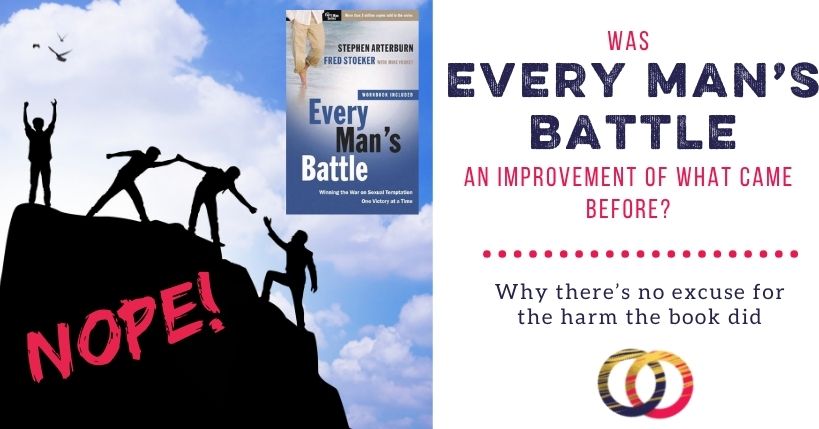




This seems closely parallel to what happened when you read L&R. You had been giving advice about how to improve marriages and sex lives, but you didn’t realize the water we’re all swimming in is poisoned. When you had the nuclear bomb go off when you read L&R, you realized that the water is polluted and set about trying to clean up the cesspool.
This is just the next step in cleaning up the cesspool. You critiqued specific advice from specific books, and now you’re gathering all those seemingly disparate threads out from under the big, fat umbrella from which they’ve been growing for decades (well, centuries, or millennia) to get to the full root, not just the individual rootlets.
More generally, it’s just another way to abuse half of God’s image. If women’s needs don’t matter, or if they aren’t even real, why do so many men pay so much lip service to meeting them BEFORE marriage? Because those hypocrites know full well they won’t score themselves a wife appliance (s/o to FB’s zawnv, on Substack as zawn) if before the wedding men treat women the way too many husbands will treat their wives after the wedding.
It’s the same in too many churches as well. “Look, we care about women! We have a women’s ministry! Women can sing and play piano! They can be in charge of the nursery! They can be involved!” Yeah, sure, women get to be the domestic-labor appliance at every church event, exactly the way women are at home. Yippee! (What’s the cartoon? “When we go on vacation, you get to clean up after us in a whole other state.”) The lip service is obvious when women are “directors” of ministries which a man would be a “pastor” of. (A church we attended on the other side of the country twenty years ago had a women as “Mothers Day Out director” and “choir director” while the man who coordinated all the music for Sunday mornings was called the “worship pastor.”)
Yes, that’s exactly what happened when we read L&R. We realized that we have to look at the root of the whole thing, and that root is male hierarchy, even if it makes people uncomfortable.
You have to continue to talk about the things that matter even if they make people uncomfortable.
There all plenty of people who have ears to hear and are willing to hear. Please keep doing the work you’re doing and enjoy your well needed break.
Thanks, Laura!
“More people would listen if you just helped women figure out how to have more orgasms. So how about you do that, and stop pointing out to them how they’re being oppressed in their churches and their marriages?”
Yeah, let’s think, who would benefit from that, hmm?
Side notes:
“What’s the cartoon? “When we go on vacation, you get to clean up after us in a whole other state.””
This is from “The Simpsons”.
Also, from an episode of Roseanne. She and Dan were deciding on a place to go for a vacation. Dan mentioned this place that has cabins in the woods, complete with a kitchen, washer and dryer. Quoth Roseanne: “Oh, boy! I get to go on vacation and do all the same cr*p that I do now!”
This is a bit off topic but there´s a song by Rachael Nemiroff called “Breaking News” about church abuse and some other things wrong with some churches.
https://www.youtube.com/watch?v=56QfMN9VSMM&list=OLAK5uy_m06SRidZ48GKFByVKdi-0Ll4hz9D6gonc&index=5
Real whop up side the head lyrics:
“They said he spent some time in Montana
And they say he’s a different man now…”
With an Angel Encounter (no witnesses) at a rural gas station?
Where the Angel (in the form of a male human) laid hands on the ManaGAWD and Commanded him to return to Ministry?
“La la la la la
Nothing’s ever wrong!
La la la la la
Let’s all sing along!”
So, just to give a bit of a personal anecdote to this. I wouldn’t say that I am egalitarian, I am probably complementarian, although I haven’t done an absolute ton of research on it so that could probably change if I became convinced of it. But I do think that the way that my husband and I conduct our marriage sounds similar to what you are describing as egalitarian, but I still think I believe in complementarian views. While I do believe that my husband is the ‘head’ of our household, he also does not try to implement control or demand respect. When we make decisions we make them together, but honestly I think that when we do disagree about something that we MUST make a decision on quickly, he’s the leader of the household and I’d probably defer to his decision. Although really we’ve never disagreed on something very strongly, or something that had severe connotations for our lives. Additionally we have a great sex life in my opinion but I have to give it to you, that only started because my husband encouraged me to get away from more of the purity culture beliefs I had been holding on to, although I wouldn’t really associate those beliefs with complementarianism. It makes me think more that the complementarian view is not wrong, but that many wrong views have infiltrated complementarianism. Regardless, I appreciate you continuing to talk about egalitarianism regardless, because I enjoy the different viewpoints and I don’t think that it means that I can’t agree with your sex advice even if I don’t hold your same views on everything. Thanks for what you do!
Love this. Well said, Sheila. Stay the course.
Yes, you absolutely have to call out complementarianism for what it is. You are literally saving lives. This is holy work!
As one who has been rescued from grips of a husband who believed he had the right to kill his wife, thank you. Thank you for helping me change and change the next generation – my 5 kids who were also rescued. Without your work (and a few of your like-minded compatriots) I would quite literally be dead by now.
Oh wow! I’m so glad you found me and you and your kids are safe now!
“Can Complementarians Have Great Sex?”
Remember Grinning Ed Young and his Seven-Day CHRISTIAN Sex Challenge?
To rub exactly THAT in the Faces of All the Heathen?
What I don’t understand about all these “Christian marriage books” is this: They claim that the man’s libido / sex drive is just naturally ‘wired’ a certain way and can’t be changed. But the woman’s libido that is naturally wired a certain way can and SHOULD be changed to make the marriage work??
What’s the logic? Why must a woman’s libido become like a man’s to be ‘correct’? Do these men want to be with a woman or a man?
I notice that in nature, in all other animals especially mammals, the amount that the male has sex is determined by the FEMALE sex drive. By when she is fertile. In many cases this is only once a year in the spring.
If a male chimpanzee or lion would try to mate with a female who is not in season, he would get his face ripped off! And even if she is in the mood, she will choose the worthy mate and only allow him anywhere near her.
The female is the one who chooses and she is fierce and respected.
What has happened in humanity, that the MALE of the species is trying to determine when and with whom sex happens?? I think we all know that for women not on the pill, the fertile window is when libido is highest. And even the Torah acknowledges this – a husband isn’t even allowed to TOUCH his wife for half of the month, and they come back together when she is ovulating.
There’s something terrible going on when these male authors are telling women – override your natural nature, your choice and your hormones and just satisfy mine – even when that’s not what God designed. I’m not sure they would be saying that if women had the massive teeth of a lioness!