
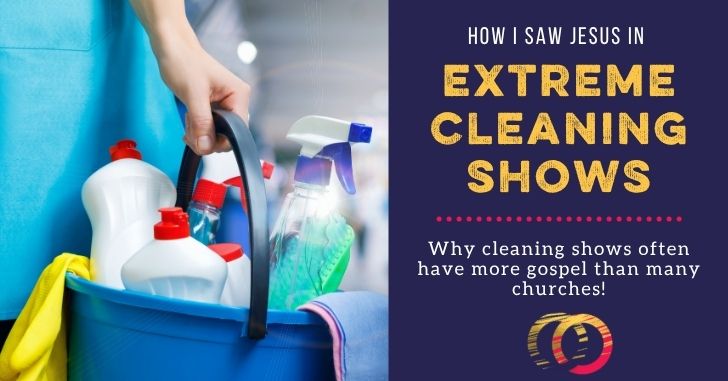


Sometimes Jesus shows up in weird places–like cleaning shows.
I want to do something different today and let you in a bit on my personal faith reflections.
I’m currently on Day 9 of a really bad cold (likely COVID) and my husband is on Day 11 and I think has finally turned the corner. But when I’m sick and can’t do much, I find my normal TV shows that I like don’t work.
I’m a big British crime girl (Vera and Shetland will forever be in my heart), with a bit of SVU thrown in, but when I’m sick I just can’t follow plots. And so that’s when I turn to decluttering shows.
I remember when I found the British show Sort Your Life Out in my last big illness. They go into poeple’s homes who are basically hoarders, take all their stuff out of their home and display it in a warehouse, and then help people pare back at least 50% (and hopefully 70%), while they renovate their home and then put the remaining back. It is lifechanging.
But what really touched me was the compassion that the host showed to the people. Most people end up hoarding for very emotional reasons. And the host wasn’t judging these people or wasn’t angry at them. She was genuinely trying to understand, and to help them understand and move on.
Sometimes the story was about grief, and losing someone and then being unable to get rid of stuff, or just unable to function. And she would end up crying right along with them. And I’m watching this show with a woman with funny hair and a really extreme accent, and I’m bawling along with her, because I kept thinking, “this is how Jesus would show up.” He would help them get through their stuff, but more importantly He would SEE them. He would care about what they were feeling. He would enter into it with them.
This weekend I found the Aussie show that I think Sort Your Life Out was based on–Space Invaders. And I binge-watched two seasons of that while I went through two boxes of Kleenex. And it was even more intense and more that way. The host, Peter Walsh, always got to the root of the emotional reason people let their lives and homes get out of hand, and he named it. He saw it. He validated it. But he also empowered them to choose freedom and life.
In both cases, the hosts saw the people without judging.
Yes, they knew that these people had to get rid of a ton of stuff, and that they were ruining their lives and relationships by keeping this stuff. But they weren’t calling the people bad or lazy. In many cases, they were praising them: “You are incredibly strong! Look what you’ve done! You’ve raised four amazing kids and given them everything. But you don’t have to do that anymore.”
They were getting to the root–“You are enough. You are good enough. You keep 1000 books telling you how you can fix that about yourself and this about yourself, but maybe you just need to say, “I like myself.”
And I thought–that is the kind of thing Jesus would say.
But then I saw something much, much bigger that left me speechless.
While I was watching Space Invaders on YouTube, a suggested video popped up from a channel CleanwithBea, and she’s who I really want to talk about today.
Some of you may know where this is going, because apparently I’m late to the party. She has millions of subscribers across her social media channels. But I’d like to tell her story, and what it showed me about Jesus this weekend.
Bea goes into people’s homes that look like they should be condemned and cleans them over the course of 7-10 days for free. Think homes with mountains of trash that hasn’t been thrown out in years; food garbage; cat waste (it’s always cats!); and often human waste. They need shovels to get through everything. It’s absolutely wild.
She started doing this a few years ago, and people have to apply to get her to come for free (her sponsorships pay for her to offer this). And Bea is, well, amazing. I think she’s a Gen Z (I may be wrong), but she looks late 20s to me. She does this with her partner Harry (no idea if they’re married or not), and the two of them go and help the most desperate of people. (They were full PPE and those extreme masks so they’re very careful with biohazards!).
What she explains is that usually this is caused by extreme mental illness and trauma. And she talks about their stories with such compassion as she’s literally shovelling their waste.
The amazing thing about Bea is that she doesn’t get judgmental at the residents (as she calls them).
She knows they are desperate people, and that there is a reason that things got like this, and she wants to help them and bless them. She tells their stories, and it’s clear that she brought some people back from the brink of suicide. Others were reconnected with family once their place was liveable and the shame was lifted. She treats them with kid gloves, never revealing anyone’s identity or even where they live, but just telling stories in enough detail that you understand.
Here is a young woman literally walking through people’s waste, and she just wants to clean it for them.
It’s such a beautiful picture of Christ.
Bea herself doesn’t openly claim any religion that I can tell (I’ve only watched a few videos), and she acts like a typical Gen Z in many ways (making ridiculous faces, being caught up in the same novels and trends, etc.), but she just wants to love the most desperate of people and meet them where they are at.
She doesn’t tell people they have to clean up first; she gets in the dirt and helps them when they literally can’t help themselves.
Bea is doing two things here that I find inspiring:
She is literally being Jesus’ hands and feet, and she is doing it with no judgment.
I can’t think of a better example of what the church could be. It’s just lovely. Jesus didn’t turn people away; He showed up and met them where they were at. And that’s what Bea does too.
Now, here’s where my thoughts really started spinning:

The evangelical church largely can’t do this because faith has been reduced to a series of beliefs.
Bea, who is just a Gen Z young woman who cares about people, has humanity in her heart. She wants to help, and she’s good at cleaning, so she created this mission for herself of helping those in the most dire straits.
I’m not suggesting that churches should become experts on biohazard removal, but rather that this example of what faith could look like is missing from many churches because of the way we’ve defined faith.
In evangelicalism, faith has become about a certain set of beliefs.
Every church may have its own specific ones, but in order to be a Christian, you have to adhere to certain beliefs.
Now, Christianity requires some sort of core beliefs (the Apostle’s Creed is a good starting point), but what’s different now is that beliefs have been so elevated that how you act no longer matters. By saying “grace alone”, we’ve preached cheap grace, where you can be a totally terrible person, but if you believe the right things, you’re still going to heaven.
This is not the emphasis of Scripture, which expected Christians to act like Christ, and follow a Saviour who said that they will know us by our love, and declared that we will prove our faith by our works.
Yet somehow these works got overlooked in pursuit of the correct doctrine.
Emphasizing doctrine automatically produces “us” vs “them”
When faith becomes about having the right doctrine, then we can easily see who is in and who is out. We can see who is worthy and who is not. We start seeing the world in terms of us vs. them. There isn’t entering into people’s pain; it’s seeing people as “they’re suffering now because they haven’t given their lives to Christ, and that suffering is what will bring them to Christ.” It wrecks empathy.
Empathy does not mean withholding help until they believe like us.
Because belief has been elevated over acting like Christ, the definition of love also changes. Love starts to mean withholding actual love until they get their beliefs right. After all, if wrong beliefs send you to hell, then the nicest thing you can do for a person is to punish them for wrong beliefs, so they have an impetus to believe rightly.
And so our emphasis on belief over action allows us to step back from human suffering in the name of–you guessed it–love.
Several times while watching Bea I got upset on her behalf at the residents she was cleaning for. I found myself thinking, “if they couldn’t be bothered to take out the trash before, how is it not going to get that bad again?” Or “how could anyone actually live like that?” But every time I had that fleeting thought, Bea’s commentary would come back on explaining the person’s background and how things got this bad, and helping us picture them as people again. She invited us beyond our judgments to see humanity, and to help, even just for a moment, to restore order and peace on the chaos.
If our faith makes us act unloving in the name of love, then likely our beliefs are wrong.
If our beliefs make us act less like Jesus to follow Jesus, then it likely not Jesus we are following, and we likely have to go back to reading the gospels again and just looking at Jesus.
Sometimes I look at young people like Bea, and I think, this is what humanity is supposed to be like. This is what we could be like if beliefs that make us into “us” vs. “them” hadn’t become so prominent. She’s young, she’s passionate, and she’s doing something tangible to make the world better, without judgment.
It seems as if “toxic empathy” has become the buzzwords in evangelicalism lately, as we’re able to convince ourselves we don’t really need to act loving, because the most loving thing we can do is to “other” people so that they will know Jesus. But “othering” people doesn’t bring them to Jesus. And Jesus didn’t “other” people–except religious leaders who were busy “othering” everyone else! All of the people Bea were cleaning for had been othered–and they didn’t get things sort out until someone stepped in their dirt with them and truly saw them.
I think the evangelical church has largely forgotten what the gospel really is (I also talked about that in this podcast), and in so doing, we’ve missed the plot.
Jesus should help us love, not excuse us from loving.
And that’s the picture I got this weekend watching a twenty-something woman wade through decades of trash, in order to give a desperate person back their dignity.
What do you think? How have we missed the plot when it comes to loving others? Let’s talk in the comments!








Sheila, I couldn’t agree more! I am going through a small group study called “Practicing the Way” started by John Mark Comer. The goal is to be with Jesus, become like him and do what he did. That’s what I’m hearing from your post. We need to become like him so we can do what he did. How best to show Jesus to those around us – DO the things HE DID! And how sad (and embarrassing) that so many so called Christians do the opposite, using tough love or withholding what people need until they agree with our theology or doctrine or even our basic beliefs.
Thank you for sharing this post with us! It is a great reminder that how we conduct ourselves in the world MATTERS. May we each one who claim to follow a Rabbi from the middle east who changed the world put our claim into action and BE LIKE HIM, so that the world can see HIM.
https://www.practicingtheway.org/
I like the post, but I feel i need to push back some. These shows you are watching are indeed about compassionate people trying to help others and you need that in the world. However, they are only able to truly be compassionate by being able to say to people you have a problem and if you do not take concrete steps to solve it it will kill you. It is a similar thing with shows like 600 pound life. Toxic empathy is shown by the people who smuggle in junk food or who tell hoarders only no you dont need to get rid of that old stuff that reminds you of loss and grief because who are others to tell you about pain and loss? Think about it another way you are able to be actually empathetic by saying yeah no the evidence is in Eggerichs is wrong.
I think the phrase “toxic empathy” was unfortunately developed as rage-bait, and it’s working. If we use the phrase “enabling bad behavior,” it might communicate a similar idea without all the emotional baggage.
But yes, productive empathy would both step into the hoarding with someone *and* help them realize the need for personal change so it’s not just a rinse and repeat of destructive habits. At least in my three former young-restless-reformed churches, they’d do really well at telling people things needed to change, but not so great at stepping into the muck and compassionately helping people forward. I think this is a both-and situation, not an either-or.
It’s a little of both. There are (very few) core beliefs in order to be a Christian, but above and beyond that, is acting and living like Christ. Faith and belief are a first step, but then you put love into action.
And of course there’s a HUGE difference between telling somebody that what they’re doing is wrong versus telling them that they’re bad people for doing it.
Sheila. This is somewhat the trap our daughter is in. I have other theories as well, but Grace has been spending a lot of time listening to a woman and reading her materials on the current teenage culture. The main theme? They want more empathy. Or you could say less accountability. What does this equal? Toxic empathy. Part of this foundation is the new meaning of words. Taking words like abuse and toxic and making them “normal” is one example. We believe this teenage culture feeds our daughter’s situation. Us vrs them is definitely the theme and withhold love until they “crack” is also part of it. I cant really imagine this concept taking strong hold in a church. Sad to say, I am sure it already has. I am just glad I have not witnessed it in a church culture first hand. As always, love your insight -Jesus insight 🙂
See I have a different take on the whole toxic empathy thing. I see it like this because I used to have what you could call toxic empathy. Say you want to help somebody who is homeless. You sit there thinking I want this person to succeed. You know what doesnt help someone succeed even though it may seem gracious at the time? Bending rules. Because it ultimately isn’t all that gracious even if it feels that way because you set them and yourself up for failure. Empathy is a good thing. Without it we wouldnt have homeless shelters, but you can not expect to be able to help anybody if you set them and others around them up for failure. It can feel harsh and I know I have lived it, but ultimately this is the actual loving thing to do. I am not withholding love when I say I am sorry but you missed curfew.
I agree with Sarah that “enabling bad behaviour” is a more helpful phrase. I’ll go further. I think it’s more accurate. I haven’t taken time to really think long and hard about this, but off the top of my head, I’d say that empathy can never be toxic. It simply means to enter into other people’s feelings, to feel with them. That is a good thing — understanding how other people are feeling — and it is impossible for it to be toxic. What might be toxic is what you DO in response to that understanding. If you smuggle drugs into the rehab facility where your friend is trying to get clean because you understand that your friend is experiencing the pain of withdrawal and you feel compassion for him, then it’s not your empathy that’s toxic, it’s the really bad choice you make in response to your empathy for this person, the choice to enable your friend’s self-destructive behaviour. Feeling empathy for someone doesn’t mean you automatically do whatever that person wants you to do. It simply means that you understand how they are feeling. For example, if your child is ill and needs to take life-saving medication but is crying and refusing to swallow the medicine, you would probably feel empathy while still pouring that medicine down her throat. So let’s stop using the phrase “toxic empathy.” It’s a red herring and I think it’s used to excuse hardness of heart and make it sound somehow righteous. Empathy is good. It is Christ-like. It is something we all should have. It is one way of loving other people. It means truly seeing them. Enabling bad behaviour, on the other hand, is bad, and we should not do it. Can we stop using the two terms as though they were synonymous? Empathy is what you feel and understand. Enabling is what you do. In fact, I’d like to see a ban on the ridiculous and misleading phrase “toxic empathy.” It’s a contradiction in terms.
And Sheila, I’m so sorry that you and Keith have been so sick. I hope you recover soon, both of you.
Beautiful, Sheila.
It strikes me that you’re describing Catholicism. 🙂 We believe in both spiritual and corporeal acts of mercy.
Related to faith: anything that you can do to help people out of a vicious cycle usually has outsized benefits for their lives. There are obvious ones: someone falls behind on bills, electric is about to be turned off, once that happens, you can get evicted and then you have to get your stuff out with no money for a U-Haul and you have an eviction on your report and…. If someone swoops in and pays your electric bill, all that is avoided.
Emotionally, it’s even worse. You hoard because of emotional reasons, then the mess you’re living in causes you to feel worse, then you’re isolated, and then….
Jesus taught us how to get out of the vicious cycles of sin. Confess, repent, don’t let your sin spiral out of control.
I will leave it to the reader to decide if Doug Wilson, Dale Partridge, et al, are letting vicious cycles overwhelm their lives.
GOD’s Special Pets Can Do No Wrong.
The rest of us?
“You Were Born in SIN, and You Dare To Lecture US????????”