
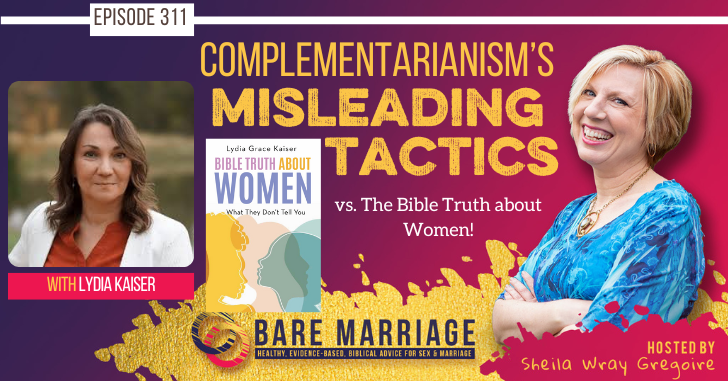


Every now and then a book comes along that is just so succinct and clear about women.
And Lydia Kaiser has written a gem of a book in Bible Truth about Women! It’s out next month, and I read an early copy, and I’m so excited to share it with you in today’s podcast, and encourage you to pre-order it (because pre-orders help authors so much since bookstores look at numbers!).
There are so many books that look at the Greek of passages about women, or the context, or even the effects on women when theology is used to keep us down.
But Lydia combines all of that into this very easily read, concise book that covers an incredible amount of ground.
And what makes her book different is that she lays out the strategies that those who try to keep women down use to misapply and misconstrue Scriptures. Once you see these strategies–it’s hard to unsee them.
We had a great conversation I think you’ll enjoy!
Or, as always, you can watch on YouTube:
Timeline of the Podcast
0:00 Introduction: Bare Marriage Helpful Playlists 2:05 Introducing Lydia: The Book We’ve Been Waiting For + From IBLP to Seminary 9:49 The 20 Categories of Misleading Tactics 12:55 The Impact Of Misleading Tactics On How The Church Views and Treats Women 16:24 Key Principles To Keep in Mind to Interpret the Bible 24:37 The Eternal Subordination Heresy Debate 32:02 God is Freeing Women and Revival is Happening! 38:32 How Jesus Elevated Women 46:02 Authority in Marriage: What Jesus Actually Said 54:11 The “Head” Debate: What Kephalē Really Means 1:06:10 How Complementarianism Hinders the Gospel 1:11:47 Advice for Those in Complementarian ChurchesI love seeing so many people see the truth about egalitarianism!
As Lydia explains on the podcast, she’s theologically conservative, about as conservative as you can get. But when you honestly read the Bible, as we are taught to do, the truth about women is pretty undeniable. And as we see people from all ends of the political and religious spectrum see that Jesus does value women and doesn’t restrict them–we’ll start to see big changes in the church.
Her book is so well done. The Kindle version is available now, and the paperback is coming next month!

Key Talking Points
- The Misleading Tactics of Complemntarianism: Lydia identifies 20 categories of misleading tactics many complementarians use, including poor translations, illogical arguments, widely repeated teachings not in the Bible, and cherrypicked verses
- The Eternal Subordination Heresy: How complementarian teachers created a hierarchy in the Trinity to justify women’s subordination to men, but never retracted it from their books
- Translation Bias: How Christian lexicons like Strong’s Concordance added “authority” as a meaning for kephalē (head) based on ideology, when secular Greek lexicons list 48 metaphoric meanings—none of them “authority”
- Jesus’s Revolutionary Treatment of Women: Fresh look at how Jesus elevated women (Samaritan woman as first evangelist, Syrophoenician woman winning a debate with Jesus) contrary to first-century culture
- Authority in the Kingdom: Jesus explicitly said “Do not exercise authority over each other” – yet complementarianism makes marriage all about authority and submission, creating a terrible witness for nonChristians in the process
- Ephesians 5 Reframed: How the passage was revolutionary in telling husbands to submit (in a culture where men literally owned wives), but we’ve turned it backwards to emphasize women’s submission instead
- Gospel Implications: Examples of how complementarianism hinders the gospel, including holding back half the church, driving young women away, enabling abuse, harming missions, and distorting our view of God


Things Mentioned in the Podcast
TO SUPPORT US:
- Join our Patreon for as little as $5 a month to support our work
- And check out our Merch, or any of our courses!
- Give to the Good Fruit Faith Initiative of the Bosko Foundation
- Join our email list!
LINKS MENTIONED:
- Get Bible Truth about Women by Lydia Kaiser! Kindle available now, or Pre-order the paperback
- Bare Marriage podcast playlists for people getting introduced to our podcast
Have you seen any of these misleading tactics? What did you learn today? Let us know in the comments below!








>> hierarchy in the Trinity
I’ve seen this argued elsewhere as well. Some say the Father is in charge, others say the Holy Spirit is in “first place”. I believe that the totality of their relationship is beyond human understanding, but it seems to me that all three ARE God, just different aspects of Him.
>> complementarianism makes marriage all about authority and submission
This ties in with a rule of thumb you mentioned once about how to quickly analyze Christian marriage books. Are they all about love, trust, God and building a life together? Or is it all about power dynamics, who’s in charge of what, who has to submit, and who gets to tell who else what to do?
“…all three ARE God…” According to the legend, this was the concept that St. Patrick illustrated using the shamrock. Tradition itself indicates that there is no hierarchy!
Thank you for the interview on this this book. I just ordered it for my Kindle. I can’t wait to start reading it. Your conversation reminded me of a recent comment another man made about my husband “giving me permission.” I just about laughed out loud at the absurdity of his comment. I told my husband about the comment, and he also thought that the comment was absurd.
I hope you love the book!
So far, so good.
The fact that a project like this had to exist is kind of sad to me. It seems so telling that pointing out the obvious real-world harms and inconsistencies of gender hierarchy isn’t enough to get people to abandon it.
The author talks about wanting to critique the (conservative) church from the inside to bring change. I would have liked to hear more in the interview about her experience of that. Because at least from my perspective, these churches don’t seem to be willing to change, from the inside or otherwise. Thinking of the SBC-how it systematically ignored abuse survivors for years. And then, even after the scandals were widely publicized, didn’t really do much of substance about it, and instead seems to be doubling down on restricting women. The author acknowledges the structural factors that will keep most pastors from listening to arguments like hers. I wonder if she has had experience of some people in authority actually listening and changing their perspective? Or, if not, what kind of change is she working towards?