


Complementarians often warn about the slippery slope of egalitarianism
For the last few years, the Southern Baptist Convention has been trying to get rid of female pastors.
At first it was just about expelling churches that called women pastors. Now it’s becoming more than that–it’s making sure that women can’t even do the work of pastoring. In fact, Al Mohler, the head of Southern Baptist Theological Seminary, said this week that women couldn’t even be on a church’s podcast talking about the sermon with the pastor, because that might be doing the work of pastoring.
He has said that making sure that women don’t pastor is an urgent priority of the SBC, though apparently dealing with sexual abusers is not.
To SBC leaders, a woman speaking about Jesus to a man is more dangerous than someone covering up child sexual abuse.
All of this reminded me of an article Keith wrote a few years ago.
He wanted to articulate something he’d been musing about–namely that the “slippery slope” argument applies to complementarians too. So often egalitarians are warned that we’re going down a slippery slope towards not believing the Bible if we believe that men and women are equal before God and don’t need to live in hierarchy.
But as Al Mohler showed today, there’s a slippery slope in the other direction too. Two years ago the discussion was just about women not being pastors. Today it’s about whether or not women should vote (Mohler says he understands the arguments against women voting, and might not oppose them, but that can’t work in the American context), and whether women can even talk to pastors on podcasts.
I thought it was time to bring this article back, because suddenly it’s relevant all over again!
Do marriages really fall apart if there is no “tie breaker”?
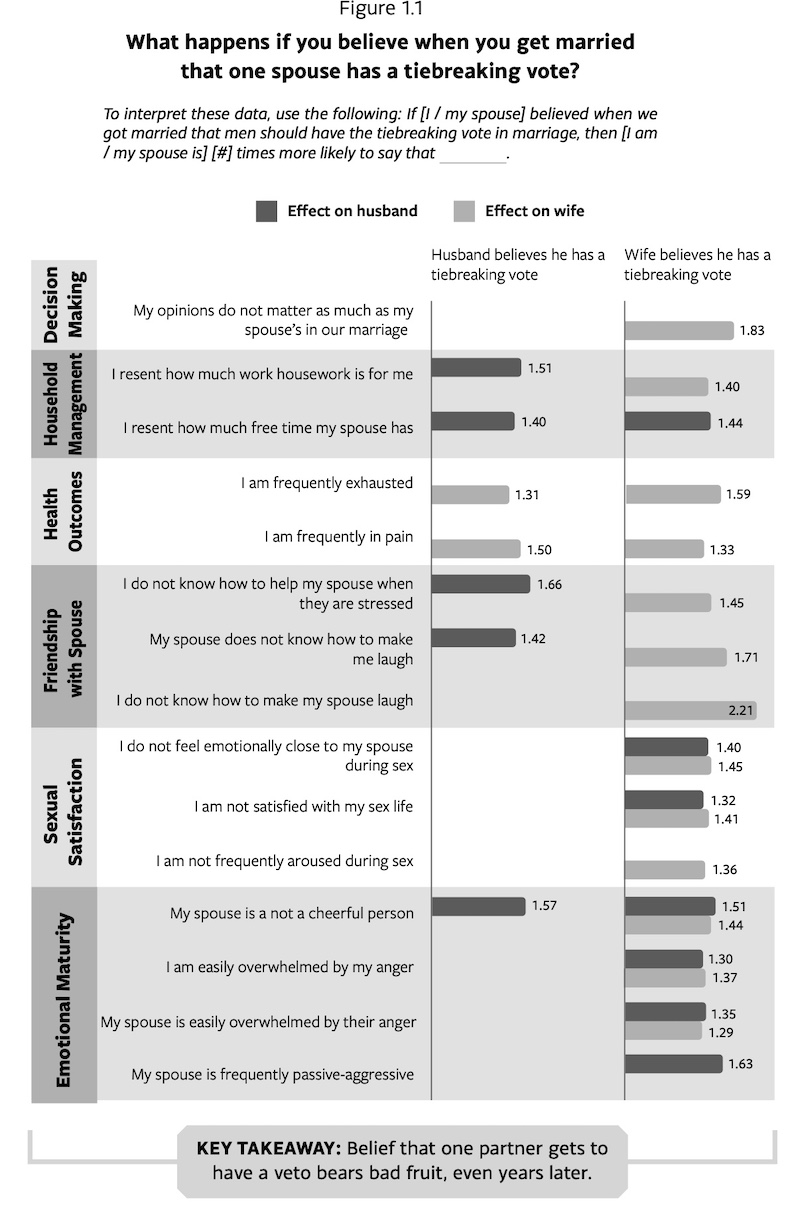
As Sheila and her team found in the survey of 20,000 women for their book The Great Sex Rescue, the majority of Christian couples say they believe these ideas, but in reality they are collaborative in their decision making. And those couples do well. But the ones who actually put hierarchy into practice, where the husband really is in charge, have bad outcomes.
We found the same thing in our study for our book The Marriage You Want. When you believe that the husband has the tie breaking vote, the marriage does worse. Here’s one of the charts from chapter 1 that shows all of these outcomes:

Whenever we talk about this, we get pushback from people saying that we don’t believe the Bible.
A while ago Sheila was talking on social media about how most pastors actually practice equality in their marriage, and that’s a good thing since hierarchy is so destructive. So Sheila said: Hey, pastors, how about preaching what you actually practice?
The pushback on social media was immense. I was entirely unsurprised by the fact that they almost universally did not engage her arguments, but instead did the same thing they always do. They basically stated that:
- “husband-as-boss” is the Biblical model;
- anybody who says otherwise is twisting the Bible into their preconceived feminist ideology; and
- we are all headed for hell in a hand-basket if we allow this heretical idea–that husband and wife are equally sanctified, equally Spirit-filled and equally able to hear God’s voice–to prevail.
Do you see the slippery slope argument here?
The Bible is meant to be interpreted a certain way, they warn, and we will get further and further off-base if we ever deviate from that. I will leave aside the fact that some of our greatest heroes in Church history are shining examples of how amazing it can be for us to look at the Bible with fresh interpretation. Instead, I am going to focus on something that all these “slippery-slopers” miss: that there is a slippery slope in the other direction, too! If you cling to the concept of hierarchy in marriage, the natural and logical progression is to take you down truly bad pathways in several areas.
What does the “slippery slope” of believing in hierarchy and power get us?
First: It warps your sense of reality
My first blogpost was about how couples do better with collaborative decision-making. This has been shown time and again. Dr. John Gottman’s research showed that when husbands are unwilling to share power in their marriages, they had an 81% chance their marriage would self-destruct. Sheila’s research for the Great Sex Rescue showed that marriages were 7.4x more likely to end in divorce when the husband makes the decisions-even if he consults with her first. This is not opinion. This is fact. The collaboration model is better than the husband-as-boss model. But people who believe in hierarchy in marriage as God-given and who are unwilling to re-evaluate their interpretation of the Bible, now face a big problem. They find themselves in the situation where “God’s way” doesn’t do as well as “the world’s way”.
How does one reconcile that?
Answer: Ignore it completely and continue to believe what you want to believe anyway. Emerson Eggerichs is a typical example of this. In his book Love & Respect, he says “To set up a marriage with two equals at the head is to set it up for failure. That is one of the big reasons that people are divorcing left and right today. (pg. 221)” He gives no statistics or evidence to back up his position for one simple reason—there are none that he could give! All of the available evidence proves exactly the opposite of what he is teaching.
You may also enjoy:
- Our Open Letter to Focus on the Family about Love & Respect
- Our one sheet of the problems with Love & Respect
- Our rubric of healthy sexuality teaching, with our scorecard of how different books did (including Love & Respect)
- Our docuseries about Love & Respect
Evidence is very important to me as a physician. When a new drug comes along it doesn’t matter to me what I “feel” about it. It doesn’t matter to me if a friend is on the research team that developed it. What matters to me is if it works. I don’t ever want to lose that; for me that would mean completely losing touch with reality. I reject hierarchy in marriage for the same reason.
Second: Hierarchy in marriage warps your theology
The idea that if you stop believing in hierarchy in marriage, your theology will get progressively more off-base is completely unfounded. In fact, the very opposite is true, as we see with the current rise of the doctrine of the “Eternal Subordination of the Son”. If you are not familiar with this, let me do a quick synopsis. Basically, the idea of a wife being in subjection to her husband has not been a problem throughout the vast majority of history since society incorrectly saw women as fundamentally less than men. Saying that only men could lead, then, made sense, because women weren’t capable of it.
In our society, though, we have arrived at the point where we realize that women and men are actually equal. This creates a problem because we can no longer make a case for female subjugation based on women being innately inferior to men.
Enter Biblical Manhood and Womanhood and the introduction of the concept of “roles” in marriage.
Rather than consider that we have been misinterpreting some passages of the Bible and perhaps husbands and wives should share in decision-making as co-laborers in Christ, the proponents of Biblical Manhood and Womanhood insist hierarchy is God’s plan. Although husband and wife are equal, they preach that God has given the husband the “role” of being in charge and the wife the “role” of being subject to him.
The “fly in the ointment” is that it is perfectly obvious to everyone that it is impossible for two people simultaneously to be equal and to have one in subjugation to the other. These are mutually exclusive ideas. The “Eternal Subordination of the Son” doctrine fills the gap by explaining that just as Jesus is equal to God the Father, but eternally subject to Him, so wives are equal to their husbands, but also must be subject to them.
The only problem is that this is complete heresy.
In fact, it’s a heresy that almost tore the Church apart sixteen centuries ago, but was considered dead until its recent resurrection in the last few decades by those trying to promote male leadership. I stand amazed that I have personally been told that if I reject hierarchy in marriage I am rejecting the Bible. But those very people are so invested in clinging to the idea of hierarchy in marriage, that rather than considering maybe they are the ones mistaken in their interpretation, they are willing to change their concept of the Trinity, arguably one of the most fundamental aspects of our faith!
Finally, male hierarchy warps your sense of justice
I recently read Beth Allison Barr’s The Making of Biblical Womanhood. If you love history (as I do), it is a very informative and enjoyable read and I highly recommend it. In addition to giving a phenomenal description of the historical attitudes toward women in the church through history, she tells some of her own story as well. As a university professor, she was not allowed to teach the high schoolers at her church since that would mean she, a woman, would be teaching men (i.e. 13-year old boys). When they challenged the matter with church leadership, her youth pastor husband lost his job.
How did we get to the point where a person who is clearly trained, equipped and (as her book shows) gifted as a teacher could be prohibited from teaching purely on the basis that she was born a woman? The prevalence of this teaching in the church is appalling to me in itself, but it gets even worse when I see the attitude of its supporters on-line.
The one commenter who did actually engage Sheila’s arguments countered that Sheila’s teaching also had “bad fruit”. What was that bad fruit? Basically, he was saying people are unhappy because they are being taught these damaging things about equality and don’t want God’s way anymore. It took me a while to understand what he was saying: namely, that women–having had a taste of freedom–are unwilling to go back to how things used to be.
In other words, the problem with Beth Allison Barr is not how unfair it is that she can teach in university but can’t teach at church. The problem is that she should never have been teaching at university in the first place! I am not suggesting that all people who promote hierarchy in marriage believe we should go back to not allowing women to have an education or to work outside the home. But it is clear that some do. And if we accept hierarchy as God-given, there is a certain logic to their argument. So that’s another reason I don’t accept it; I see the slippery slope where I would lose all sense of justice.
Perhaps the most appalling instance of this happened during a debate with a man whom I considered a friend at the time. I was suggesting that some of the Biblical passages which look like they call for the subjugation of women needed to be taken in the context of the culture and the time at which they were written. He responded with the standard argument that it was dangerous for me to shift beliefs based on cultural changes. If it was true when Paul wrote it, he said, it is true now, full stop. I then pointed out you could make the same case in favor of slavery since Paul talked about it and never specifically condemned it. I thought I “had him” and he would have to concede the argument, but he looked me straight in the face and said, “Well, maybe God doesn’t see slavery as evil.” I was floored. I still cannot process how anyone could ever believe that.
May I never see the day that I would be so wedded to a doctrine that rather than considering whether I could be wrong, I would instead twist my theology to the point that I could actually imagine that the idea of one human being owning another could ever be from God.


Nobody comes to the Bible as a complete blank slate.
The things we have learned or experienced in our life will undoubtedly influence how we interpret Scripture. Certainly it is wise to remember this and to consider when we study the Bible whether we are bringing something to the Bible which is not there.
But remember that this applies to all readers.
We all come to the Bible with preconceived notions, including those who believe in hierarchy in marriage. And the more I hear men like Piper, MacArthur, Grudem and Strachan talk, the more it is clear to me that ultimately their main goal is not preserving the authority of the Bible, but preserving the authority of men. And those men will only be happy when everyone else brings that same bias to the Biblical texts–or are completely silenced.
I admit that I come to the Bible with the idea that women are equal to men in dignity, value and significance.
I see this as self-evident, not needing Biblical proof to be true. I make no apologies for the fact that I believe God loves His daughters just as much as His sons. So when I read in 1 Corinthians 14:34 “Women should remain silent in the churches”, I admit it makes me do a double-take.
This does not mean I am refusing to believe Scripture. It means I am trying to make everything I know fit together. In fact, my “check” over this passage prompts me to remember something those who espouse hierarchy seem to miss – that in 1 Corinthians 11, Paul talks about women praying and prophesying in church! How do they not see the contradiction? Do they believe the Corinthian women prayed and prophesied with some ancient version of sign language? (Or maybe it was mime!)
The intellectually honest approach is to wrestle with these difficult passages and see them in a way that truly honors God as well as women and men who are created in His image. But assuming hierarchy is God-given and embracing it wholeheartedly easily allows you to skip past all that, pluck 1 Cor 14:34 entirely out of context and use it to try to silence talented women like Beth Allison Barr. And Sheila. And Beth Moore. And so many others.
Tragically, I expect maybe that’s the point. The Jesus I believe in said whoever wishes to be greatest must be the servant of all and his first post-resurrection act was commissioning the women to go tell the men. Let’s all resist a slippery slope that would create a Church where women are silenced and where our focus is on who has the power rather than on serving one another as Jesus commanded.
What do you think? Why do you think nobody talks about the slippery slope in the other direction? Have you ever heard anyone defend slavery to justify men being over women? Let’s talk in the comments!




There’s a horrible youtube video where a woman describes a dream she had. Jesus took her to visit Hell. Apparently, according to her dream, 70% of Hell is female, and the main reason they’re there is that they disagreed with God’s plan of male leadership.
Oh goodness! I feel so bad for that woman, if that’s what’s rolling around in her subconscious 😓
Once you’ve been catechized along those lines, some of the damage will be permanent.
Even before the AI slop takeover, YouTube videos about Dreams and Visions and Guided Tours of HELL were a dime a dozen.
Something I noticed about all of them I checked out (hovered over, not clicked):
For alleged visions of the same place, EVERY DESCRIPTION OF HELL WAS COMPLETELY DIFFERENT. Every one of them. The only thing in common was Adolf Hitler was always a stop on the guided tour. That was it. (And compared to his contemporaries Comrade Stalin and Chairman Mao, AH was a rank amateur when it comes to kill count and sheer brutality racking up said kill count.)
I have not heard anyone defend slavery directly (not in person, anyway), but I can guarantee that here in deep red Tennessee, many of my neighbors would fall right in line if the courts decided to abolish the 13th amendment. People allow their politics to inform the choices they make about how to treat people, and to inform their faith choices as well. It’s horrible.
Our former pastor defended it up here in Canada (Fellowship Baptist church). And it always comes up in the comments. Lots of people don’t see it because the second anyone defends slavery they get blocked. Automatically. I don’t stand for that.
“How did we get to the point where a person who is clearly trained, equipped and (as her book shows) gifted as a teacher could be prohibited from teaching purely on the basis that she was born a woman?”
I think of the Matt. 25 story where the servant who buried the money instead of investing it or even simply letting it collect interest is severely chastised for not making decent, much less good, use of the money. I wonder how upset God may get at those in today’s churches who are so willing- so desiring- to waste God’s prepared servants?
I completely agree!
I am in Southern California and we have family friend who, during our back and forth conversation about women in ministry, etc, admitted he didn’t think slavery was actually all that bad. I, too (like Keith), was floored. This man had been my literature teacher and was one of the first to teach me about the value of human life and faith…and he absolutely knew better than to say such a thing. But he had become so fixated on believing women as inferior (“but still precious and valuable!”) to men, and clinging to the view that God made women FOR men in his mental framework and theology, that it was like he became someone else. Not only did he say slavery was probably not all that bad, he also started jumping on board with the subordination of the Son to the Father stuff too. Again, he should have known better. It still makes me a little sick when I think about it.
It reminds me a lot of Hitchcock’s film adaptation of “Rope.” A professor has all of these grand, abstract, radical ideas about the superiority of some men over others and is always vocal with his students…and then some of his students take him literally and kill a fellow student whom they deem “inferior” right before a party and hide the body in a trunk in the very room everyone is eating in. The professor is absolutely shocked and horrified when he realizes what they’ve done, and because of what he taught them and told them…how I wish more men could get a wake up call like that! But before anyone gets needlessly hurt.
Oh, wow! I’m not surprised the conversation went that way, because I’ve been in so many that went that way!
And frankly they have to. The support for women being inferior to men in Scripture is exactly the same as the pro-slavery arguments. You can’t argue slavery was bad and also argue that God wanted men to be in charge of women in perpetuity. If someone is trying to be consistent–and intelligent people often are–then to defend complementarianism, they must logically also defend slavery. And that’s why they do.
Yes, it’s absolutely wild! I remember my husband responded to his slavery comment by asking, “And would you like to try being enslaved yourself first?”
They’re fine with it…as long as they’re not the recipients 🙁 That’s not how it works!! If anyone’s humanity is in jeopardy, then everyone’s is.
I remember my husband responded to his slavery comment by asking, “And would you like to try being enslaved yourself first?”
In this, your husband echoes a certain A. Lincoln almost word-for-word.
Similar Furry Fandom lore dating to shortly after Y2K:
According to my spies, “slavery is KEWL!” was common in Furry Fandom parties around 2000-2010. When the subject turned to speculation on genetically-engineering real Furries, there would always be some Millennial furry fans who’d gush on about “and then I can OWN one!”. These furry Doug Wilsons would then ALWAYS bring up the subject of an Owner’s sexual rights to his Animate Property a la Roman Paterfamilias.
Yes, it’s like when they talk about slavery, they say “I would have treated slaves well”, because they picture themselves as the master, not the slave.
I feel that’s why they focus on only seeing the “good” side of things… I’d guess they think slavery isn’t so bad because they are looking at the best possible examples of slavery (which were still so incredibly wrong but *seemed* not so bad when you compared it to worse situations) so they begin to make the exceptions of “good” slave situations as the norm… (again, slavery in it’s least abusive forms is still atrocious!)
They look at women similarly- if we would just realize there are women in “extreme” situations that are far worse off than us, and comparatively we are so much better off and thus subjugation of women isn’t actually bad, then what do we really have to complain about?
I grew so exhausted being told to look for the good in people, stop being critical, that I was pulling others down with me by pointing out the negative, and so on…
And yet somehow that didn’t stop the men from seeing the bad in women wearing yoga pants or shirts with one too many buttons undone.
“They look at women similarly- if we would just realize there are women in “extreme” situations that are far worse off than us, and comparatively we are so much better off and thus subjugation of women isn’t actually bad, then what do we really have to complain about?”
I had one guy, who was debating me in some online forum about women’s rights, etc, say to me that if women don’t like it in America, we should go live in Saudi Arabia so we can appreciate how good we have it here by comparision and shut up about wanting more rights etc. blah blah blah. So I asked him if he is going to tell African Americans to ignore systemic racism in America because they might have it better here than black people in some poor third world African country with less rights? Of course, that was a hard no. Well, why should women in America ignore sexism here just because we have it better than women in Saudi Arabia? He couldn’t answer that one. He just danced around it so I told him to go live in Saudi Arabia where he would have even more rights over women than patriarchal men here if he didn’t appreciate how good he has it here. As a white so-called Christian male, he wouldn’t have any rights there more than he has here, but I doubt he saw the parallel. This game of go live somewhere else to experience less rights than we have and ignore injustice here is real cognitive dissonance.
Good for you!
If you want to know where the slippery slopes of the female subordination and of the modesty message end, Look to the Islamic world. Especially to Taliban Afghanistan. In Islam, male physicians are prohibited from treating female patients. Which hast worked as long as there are enough women physicians. But not long ago the Taliban banned women from university education. In the name of God, of course.
Yep. So soon women will not have any health care. And they’re okay with that.
Good article Keith. I have posted in comments on YouTube, “If women are to keep SILENT in churches, how do they reconcile Paul referring to women “praying and prophesying.” Rather if you read the passage, Paul is referring to women not being disruptive with chatter. (if they didn’t understand something (being taught) save it for later to discuss it with their husbands. Centuries of this passage so poorly being taken out of context. Still evident today in various denominations.
I feel like it’s a stretch to say Paul never condemned slavery. Look at Philemon.
If departing from 1st century gender norms is sinful and unbiblical, then departing from 1st century economic norms is also sinful and unbiblical. By this logic, slavery is not simply justifiable as a past system, but we must be required to maintain it and are being sinful if we don’t. If you try to argue that it’s really all about observing a structure of authority, then having an equal business partner must be sinful, because how could you have a business without a hierarchy of authority? What about corporate boards of directors? Trade unions? Collective bargaining? Those must all be unbiblical, because they don’t reflect the hierarchy structure that the Bible mandates.
Applying the same logic, aren’t democracy and voting unbiblical? The New Testament talks about obeying the king. How can it be acceptable to get rid of the monarch and overthrow his divinely- appointed authority?
How can churches today allow voting on church leadership and decision-making? Shouldn’t they be doing that the biblical way by casting lots?
“Applying the same logic, aren’t democracy and voting unbiblical? The New Testament talks about obeying the king. How can it be acceptable to get rid of the monarch and overthrow his divinely- appointed authority?”
I expect this from the MAGA Christians any day now.
Regarding slavery, you have to ask, what is slavery?
Is it race-based chattel slavery, where humans were considered property, such as was practiced in the great Christian nation, the USA? Where you could sell, rape, torture or murder your slave and were entirely within your rights?
Is it debt bondage, which was common in the ancient world and today might be seen as a very restrictive employment contract, usually with a defined end date and specified rights for the enslaved?
Is it working for a corporate employer?
Is it capitalism?
We should work to reduce exploitation, oppression, racism, paternalism, etc while recognizing that humans are never totally free from these sins. We may not be as superior to the people of the past as we think. Many efforts to make everyone equal (think 20th century communism) were not successful and created crushing oppression, just in a different form.
We don’t know why polygamy, slavery, concubinage etc was something that God allowed his people to practice in the ancient world. But I do not think that allowing it and regulating it meant that God was displeased when humans decided on their own that they would get rid of these practices.
“Many efforts to make everyone equal (think 20th century communism) were not successful and created crushing oppression, just in a different form.”
Community cannot be forced from the top down.