

Eric and Leslie Ludy completely distort the trauma of sexual assault
This husband and wife team (who got together first when he was 21 and she was 16) wrote one of the “Bibles” of purity culture–When God Writes Your Love Story. We talked about it at length in our book She Deserves Better, and today I want to focus on one specific aspect of it, and ask what we do about it now.
Here’s the passage I want to talk about. It tells the story of 16-year-old Jason grooming and raping 12-year-old Rebecca, and then moves on to the story of Todd and Karly, both college-aged students who were in love and had consensual sex when they got carried away. What’s the commonality between these two stories? They’re both about “losing your virginity”, of course!
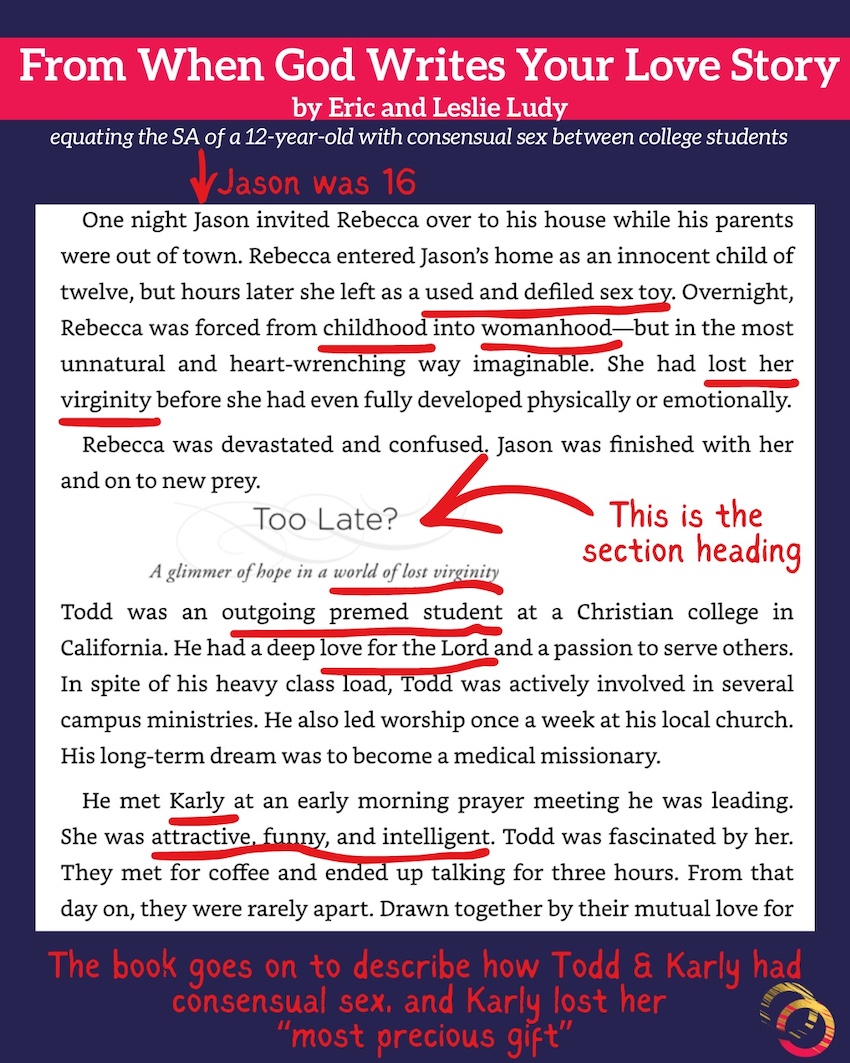
For further context, this chapter is about how you can deal with lost virginity, and how God loves you anyway and there’s redemption. Which is good that they said that you’re not ruined for life, I guess.
But it’s how they frame the problem of “lost virginity” which is so heinous. So let’s take a look here.
They competely downplay sexual assault
Look at the words they use to tell Rebecca’s story: so much is in the passive voice. They don’t say that Jason attacked Rebecca; they say:
- she “left as a used and defiled sex toy.”
- she “lost her virginity”
- she was forced from childhood into womanhood
Think about how else they could have told this story:
For months 16-year-old Jason had been deliberately grooming 12-year-old Rebecca. Rebecca felt flattered by the fact that Jason wanted to be her friend, and liked hanging out with him. One day, when his parents were away, he invited her over to his house, and she went.
There, he raped her. He brutally traumatized this child that he had deliberately deceived.
See what I mean? They could have told this story as being something that Jason deliberately did to Rebecca, to emphasize that sexual assault is only ever the rapist’s choice and action. But instead, they told it as if this was something that Rebecca just had happen to her.
Eric and Leslie Ludy now identify Rebecca with her rape
They called her a “used and defiled sex toy.” They didn’t say that she FELT like she was used and defiled; they said she was.
They also said that she had gone from girlhood to womanhood–as if raping a girl makes her into a woman (does the act of rape make a boy into a man?). But let’s be clear what’s happening here: Rebecca wasn’t a woman because she was raped; Rebecca was a traumatized child.
Think of how this episode would have sounded to a sexual assault victim reading it
They now hear, “I am a defiled sex toy.” They don’t hear “this boy did something heinous to you that caused you trauma”, they hear “this episode changed the very essence of who you are.”
The Ludys may think that they wrote this chapter to offer hope to those who “lost their virginity,” but their emphasis shows they understand absolutely nothing about trauma or the dynamics of sexual assault.
But that’s not the only thing they got wrong.
Even in consensual sex, her identity is the one changed, not his
In the story of Todd and Karly, once they have sex, Todd moves on from Karly and is disgusted by what they’ve done. But Karly? She’s “lost her most precious gift.”
They don’t describe Todd as losing his most precious gift; they only describe Karly that way.
Now, let’s be clear: all biblical commands and admonitions around sex are given equally to men and women (at least in the time of Jesus and the epistle writers!). There is not a “this is holy for him” and “this is holy for her.” No, it’s all the same. So to say that she has lost something when he hasn’t has nothing to do with the Bible, and everything to do with American purity culture.
There’s so much more I could say here about the concept of “losing one’s virginity”
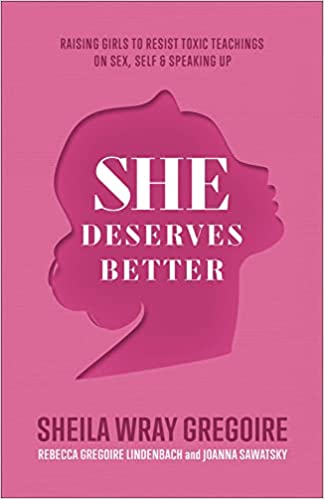
We talked about this at length in She Deserves Better, and the male/female double standard and how harmful this is to sexual assault victims, besides the fact that our sexuality is not defined by one encounter, but rather by choices we make everyday. I don’t want to repeat that all here, but I’d encourage you to pick up She Deserves Better! It’s specifically written for moms of daughters, but I think most women who read it do so to reparent themselves, and find it very validating and healing.
Eric and Leslie Ludy wrote a highly problematic and traumatizing book that should never have been printed, and needs to be retracted now before it can do more damage to another generation.
Which leads me to the big question I wanted to ask today:
What should accountability look like for the authors of these books?
What should it look like for publishers? What should we do now?
Let’s talk about When God Writes Your Love Story specifically now. Here’s how it ranks on Amazon right now:
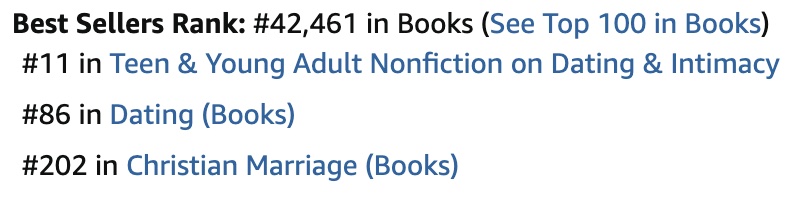
For comparison, She Deserves Better is currently ranked 50,000, so this book is right now selling better on Amazon than our healthy alternative. This is actually quite a decent sales ranking.
That means that the author and the publisher are still making quite a bit of money from this book which traumatizes sexual assault victims.
And because they’re still making money, it’s very unlikely that the authors or publishers would willingly stop selling it.


The dilemma of evangelical publishers with toxic books
Here’s the thing: pretty much everyone agrees that purity cuture was either traumatizing, or at the very least went too far. This is quite widely acknowledged, and even pastors who still teach the very tenets of purity culture will tell you purity culture went too far (it’s hypocritical, yes).
So if we agree that it went too far, why are the books that sold purity culture to a generation still for sale? Why aren’t they being recalled?
Especially because, as our data from She Deserves Better shows, this does measurable and demonstrable harm to women long-term (and creates predators out of boys).
This book hurts people. It does not just spread a theology we know is wrong; it actively causes harm that we can measure.
Shouldn’t, then, the publisher of such a book bear ethical responsibility for taking it out of print? Yes, we know that publishers are allowed and encouraged to share books of all different viewpoints. But this is not just a case of a different viewpoint; this is a case of spreading messages that do long-term harm, making it more likely women will marry abusers; making it more likely women will suffer from sexual pain disorders; making it more likely that they will have long-term deleterious effects on their self-esteem.
But here’s the bind that publishers are in:
1. Most are publishing far healthier books today than in the past.
2. Their backlist is what allows them to still be profitable and take a risk on new books.
3. Much of the backlist that generates that profit is MAJOR TOXIC.
This particular publisher is Multnomah/Waterbrook (the same one that does all the Every Man’s Battle books). I know that the current editors would never publish When God Writes Your Love Story today. But I also know that the sales from When God Writes Your Love Story allow them to take the chance on newer and healthier books, most of which won’t earn back their advances. When a publisher takes a chance on a book, they never know if it will sell or not. And usually only a small proportion of books really take off, and they rely on these books that consistently sell to keep the company afloat.
What happens when the books that are keeping a publishing company afloat are actively harming people?
Here’s my opinion: Jesus compels us to do the right thing, and believe that God will honour that. It may mean the company goes under and something else grows instead. It may mean that this is the end of an era in Christian publishing. I do not believe that keeping companies afloat outweighs the harm that is being done by continuing to sell these toxic books.
The Christian publishing industry is largely responsible for purity culture
This is not the fault of any one publisher; pretty much all of the big evangelical publishers had best-selling purity culture books. And it was because of these books that the messages took off.
If they were responsible for that harm that was done, then they are also responsible to fix it.
It is a moral imperative. One cannot call oneself a Christian if one knowingly and willingly continues to do harm, as publishers do by continuing to sell books that we have now proven cause long term harm.
This was always our aim when we started our research projects–to show how these books and messages are harmful. We’ve done that. It’s now up to publishers to do the right thing. But I have no idea how to see that happen. So I’d like to know what you all think: How can we move forward here? Saying “boycott the bad publishers!” wouldn’t really work, because the good books are also published by these same publishers (Baker, who publishers our books, also publishes His Needs, Her Needs, for instance.) The good books that undermine purity culture are also published by the publishers of the purity culture books!
So what do we do? And do you agree that publishers have a moral imperative to take books like Eric and Leslie Ludy’s When God Writes Your Love Story out of print? Tell me what you think in the comments!




I chose to post a link to this article on this Brooks’s Amazon review. I hope that is okay to do? Thank you for all you’re doing to prevent more damage from purity culture.
At the very least, I think they should add a slip-in paper inside each copy sold, as well as online stating the trigger warnings and sites available to find applicable research/data related to the content.
This doesn’t address your question but looking at Rebecca and Jason’s story while keeping the “precious gift” spin (which I hate but humor me):
Rebecca had an item that she kept with her always, it was so precious to her. She knew it would be at least 6 years before she could legally give it to the recipient. Jason saw the gift and decided he wanted it so he befriended Rebecca until she let her guard down.
Deciding it was time he should take it, he invited her over. She trusted him so felt safe enough to go visit him. It was then that he tricked her (like Adam and Eve in Eden) and underhandedly *stole* the precious item from her. Afterwards he avoided and ignored her so she could not get it back.
It’s egregious it is only labelled *her* gift but at least in this altered story, the truth is that he deceptively stole it. Why do they not at least approach these with the shame on the party that clearly is acting hatefully, intentionally, and selfishly?
Do you happen to know if it’s similar in secular publishing companies, where they are largely kept afloat by continued sales of older books? Just wondering if they’ve already figured out a system that might work better that Christian publishing companies could borrow from.
I think it’s the same at most publishing houses–it’s the backlist that funds the current publishing.
I had this epiphany while reading the post today Sheila. Seems the same problem we have today with the current generation giving new meanings for words like toxic and abuse happened at some point in the past with the word rape. Someone softened the word into non-consensual sex and so when you tell the story in a way that shows “she participated” then it wasn’t rape. It was just a mistake. Sigh. As for the answer to the book publisher issue and money? Time is the only thing that comes to mind. Your work and the work of others will turn the tables… eventually. Now from a business standpoint there is an answer. It is a story but basically you build your own publishing company and you buy out the competition and close it down and do it your way. My first real job for a larger company had that exact story. The son of the founder grew the business and eventually he bought out the competition and shut them down. And the company he shut down was the company his Dad had worked for that afforded him to start the business in the first place. It was probably 20 years in the making but he did it. I know…long shot answer but hey, know one said this was gonna be easy right? I did give you at least a plausible answer. Wish I had some better answers. Its a good one to mull around…
We just need some multi-millionaires to dedicate their money to shutting down the books! To buy all the publishing houses and putting the toxic ones out of print! A girl can dream…
Amen Sheila.
Missed an Op – You know it…
This reminds me of another purity culture book for kids I remember reading called “The Princess and the Kiss” where the princess’s virginity (her kiss) was depicted as some glowing orb and she was told to pick wisely the suitor she would give it to. I always wondered what if her evil uncle (because every good medieval fantasy book with a character that is a noble has an evil uncle as a main villain) steals her kiss and destroys it maybe as a way to take over the kingdom? What about that scenario? I actually thought about that and wrote about that scenario one year for NaNoWriMo where she goes on an adventure and meets a bunch of people who also lost their kisses nonconsensually in different ways to save the kingdom it was pretty amazing. I might still have it on a USB somewhere
I remember that book. My mom got it for my daughters, but I probably read it to my oldest daughter once. There were some necklaces that went with it, but my oldest daughter was allergic to the chain. She ended up not wearing it. I don’t have any idea what happened to the necklace. That book is on one of my bookshelves. The illustrations are lovely, but that is probably the only positive thing I can say about it. I think that Focus on the Family and Family Life Today promoted it quite a bit.
Yeah the art was beautiful. In my book she discovers she can use magic and meets a knight who was coerced into giving his kiss to an older women, a girl who is good with a bow whose father sold her kiss to pay for his drug addiction, and a healer who is gay and wanted to give a kiss to his long term lover but when his family found out he was gay was forced to give his kiss to a girl in an arranged marriage that he ran away from. The evil uncle also was a complete incel and as a result forged his kiss into a magic weapon to harm people and he and his minions proved that just because you are a virgin doesn’t mean you are a good person. After they defeat the uncle the princess and the knight get together and despite neither having a kiss to give, it doesn’t matter because that is not what true chastity is about so the kingdom is saved and they ride into the sun set on new adventures after a small marriage ceremony with their new friends. Her parents want to apologize for disinheriting her after her kiss was destroyed but she says it will take more time for her to forgive her after the pain they caused her and she decides to be an adventurer with her husband and new friends.
This is adorable. I’m not sure if you can call it a fanfic-maybe a fixed-it-for-you fic?- but it sounds like it was fun and therapeutic to write. I think stories can be deeply healing, whether we find ones that speak to us or invent them ourselves. Something about the way they let us envision possibilities we haven’t been allowed to see or experience in real life. In my experience fantasy is an especially rich source.
Okay, I really have to get this thing!
A bunch of people have mentioned that book to me but I’ve never seen it! It sounds horrific!
You really should! Especially since the boy’s version Squire and the Scroll actually has the young man go on an adventure and is about Christian character. Why can’t girls go on an adventure too? That’s the reason why I wrote a fanfiction about it. If I still have it, I will email it to you.
The Princess and the Kiss sounds just YIKES, but a tiny evil part of myself regrets, only just a little bit, that I’ll brobably never be able to see the book with my own eyes. This book, just like many others discussed here, simply are not available where I live, which certainly is a good thing. I would like, however, to own some of these monsters. I’d like to dissect and study them in the same way dangerous bacteria, viruses and cancer cells are examined in medical studies.
I’m not sure which bothers me most. The “used and defiled sex toy” comment (implying that the girl is tainted and ruined forever and will never have any worth because of the actions of another, and she can never get that back), or the passive voice, trying to suggest that she was raped “accidentally” or by some undefinable force of nature, and the older boy just happened somehow to be nearby.
It’s all so horrid.
I read this book about 20 years ago. I was around 30 and had been divorced a few years. I wanted to do things right the next time around which caused me to have a legalistic mindset when it came to dating. I thought I was setting boundaries, but subconsciously I was putting up walls. Maybe, without realizing it, some of the material in this book caused me to think that way and after what my ex had done to me, I felt like damaged goods.
I’m glad I wasn’t a teenager when I read this book, but to have it affect me negatively at 30, that’s bad.
It was bad! I’m sorry.
I think about this a lot. I don’t have enough social followers to pitch a non-fiction book to an agent, but I have two drafted. I keep thinking about how I wouldn’t want my book published by a company that also publishes harmful books. I mean, intellectual freedom and access to diverse opinions is important to me. At the same time, I don’t want my name and work associated with the same company that has caused harm and isn’t actively trying to fix it. In my research to figure out if I even qualify to pitch, I’ve ruled out agents just because of the books they’ve represented. Maybe that’s unfair. I wish there were a list somewhere of publishers that have a reputation for publishing neutral-healthy books. I think about the same thing for articles. I write something I think is at least as good as what I find in research databases, then I get overwhelmed trying to figure out who the non-harmful magazine publishers are and just post my work on Substack or let it sit in a file.
It is hard. I think most Christian publishers have published harmful things. So trying to find one that never has is likely a losing proposition!
I appreciate you talking about this. I knew the Ludys as a young teen, right as they were starting to write and speak publicly. It has taken me years to disentangle myself from what I was personally taught and the very deep ways it shaped how I viewed sexuality, marriage and myself.
I’m so sorry! I’ve had so many people reach out to me this week and tell me Ellerslie is a cult too. Like what they run now is so scary.
I work in Christian publishing. Unfortunately there are lots of Christian books that are bad for various reasons, and they keep selling. Margins are tight in publishing. I hope that with younger generations moving into leadership, some things will change, but there’s a lot of uncertainty. I would echo what has been said before on this site: Buy, give away, and recommend good books. Write reviews, positive and negative, on Amazon and other places. Talk to your church leaders about books they recommended. Support authors you like. Give recommendations to bookstores and libraries in your area. You can contact publishers and tell them your concerns about specific books, though they may be limited by contract in what they can do.
Yes, absolutely! Buy the good books so that publishers don’t rely on the backlist anymore!
I think we need to start leaving SO MANY negative reviews of the ‘best selling’ books that they stop selling. I honestly think that’s the only way to turn the tide.
Yes, I agree. But I always tell people not to leave a review unless they’ve actually read it–or read it portions of it. I don’t want to spam reviews or wreck the review process, but so many people HAVE read these books and were harmed by them, and they can leave reviews!
Thanks for addressing this and not letting your own publisher off the hook. Harley and Leman lead the problematic pack at Baker.
“THE CHRISTIAN PUBLISHING INDUSTRY IS LARGELY RESPONSIBLE FOR PURITY CULTURE”
The Christian Publishing Industry is responsible for a LOT of unadulterated sh*t.
As detailed in these two essays having to do with one of my passions for 50 years, F&SF and similar imaginative/creative arts:
https://alanloewen.blogspot.com/2016/09/guest-editorial-why-is-christian.html
https://medium.com/@katherineheline/why-the-devil-gets-all-the-good-music-dbe4335e7098