
How does neurodiversity affect marriage?
It can be tough mixing neurotypical and neurodiverse marriages–or even marriages with different kinds of neurodiversity. And many times the typical advice that is given doesn’t work when autism or ADHD is involved.
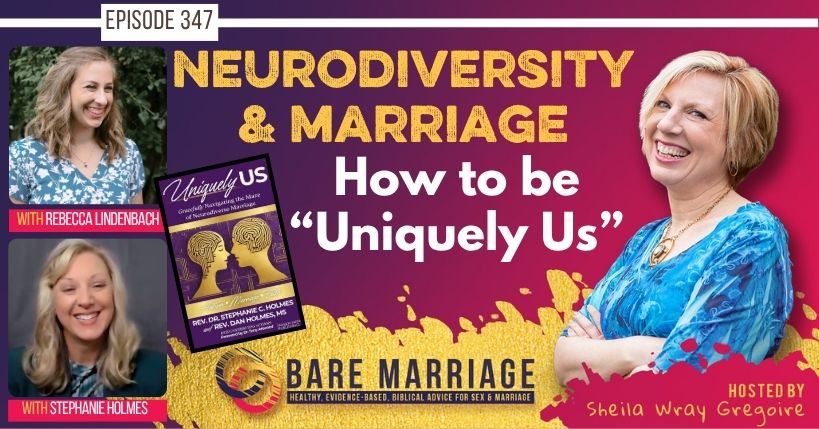
Today one of the Bare Marriage team members who is neurodiverse–with an adult diagnosis–interviews Stephanie Holmes about the new book she wrote with her husband–he on the autism spectrum and Stephanie a neurotypical. Rebecca brings her questions about female ADHD, and they talk about how all of these things impact marriage dynamics and how you can feel close!
Or, as always, you can watch on YouTube:
Timeline of the Podcast
00:00 Intro: Can Neurodiverse Marriages Thrive?
01:27 Welcoming Dr. Stephanie Holmes – Inside “Uniquely Us”
03:34 The Problem with Neurodiversity Stereotypes
08:25 Communication & Accommodation Without Self-Sacrifice
12:13 ADHD, Autism, & Gender Differences
18:07 Accommodation vs. Enabling
25:58 Why Christian Neurodiverse Marriages Struggle
32:08 Emotional Regulation & the “All Feelings Are Valid” Debate
38:36 Why Sometimes You Need a Nap, Not a Conversation
44:20 Managing Your Spoons & Mental Load
49:36 Entitlement, Burnout, & Gender Expectations
56:44 What Neurodivergence Is & What It Is Not & Adjusting Your Family Systems
59:00 Conclusion: Building a Marriage That Works for YOU
Key Talking Points
1. Neurodiversity Is Not One-Size-Fits-All
One of the biggest misconceptions we need to challenge is the idea that if you’ve met one person with ADHD or autism, you understand everyone with that diagnosis. Neurodivergence presents differently depending on the individual, gender, co-occurring conditions, and life experiences. We also need to recognize how many women have gone undiagnosed because research and diagnostic criteria historically focused on male presentations. Understanding the actual person in front of us is far more helpful than relying on stereotypes.
2. Accommodation Should Never Require Complete Self-Sacrifice
Dr. Stephanie Holmes makes an important distinction: accommodating a neurodivergent spouse should not mean that the other spouse has to erase their own needs. Both people deserve safety, consideration, and the opportunity to thrive. A healthy marriage requires mutual reciprocity, not one person becoming the center of the relationship while the other continually adjusts. The goal isn’t to make everyone function identically, but to create a relationship where both people can be satisfied.
3. A Diagnosis Explains Challenges, But Doesn’t Eliminate Responsibility
A diagnosis can be incredibly validating, especially for someone who has spent years feeling like they’re failing at things that seem easy for everyone else. But we need to be careful not to turn a diagnosis into a permanent excuse for avoiding difficult tasks or responsibilities. Some executive functioning skills can be developed with support, practice, and accommodations. We can extend grace without enabling, recognizing that something may be harder for our spouse without assuming it is therefore impossible.
4. Emotional Regulation Comes Before Communication
We spend so much time talking about communication skills in marriage that we sometimes overlook a more foundational issue: emotional regulation. When we’re dysregulated, our brains aren’t operating in the same way, and we’re much more likely to interpret ordinary interactions as threats. Sometimes the best thing we can do for our marriage is take a break, get some rest, and return to the conversation when we’re regulated. Not every disagreement needs to be resolved before bedtime, and sometimes a snack and a nap are more productive than another hour of arguing!
5. Christian Marriage Advice Can Make Neurodiverse Relationships Harder
Stephanie shares that neurodiverse Christian couples can experience particular challenges when traditional gender roles, religious expectations, and patriarchal ideas become layered onto their relationships. Women may feel pressure to carry the entire mental load, manage their husband’s emotional reactions, and remain sexually available, even when their own needs are being neglected. When women are taught that a man’s anger is evidence of their disrespect, they can lose the ability to advocate for themselves. Faith-based marriage advice needs to make room for mutual responsibility, healthy boundaries, and the actual needs of both spouses.
6. Managing Capacity Requires Personal Responsibility From Both Partners
The idea of managing our “spoons” is a helpful way to think about the limited energy and capacity we have throughout the day. But knowing our limits also means taking responsibility for how we use our energy. Decompression time can be essential, but its purpose is to help us return to our relationships and participate in family life, not permanently withdraw from it. Both spouses need to understand their own capacity, communicate their needs, and negotiate responsibilities rather than assuming the other person will pick up whatever gets left undone.
7. There Is No Single Blueprint for a Successful Marriage
One of our favorite themes from this conversation is that a healthy marriage doesn’t have to look like everyone else’s. Stephanie shares how she and her husband discovered a division of household responsibilities that worked for them, even though it challenged traditional expectations about who should do the cooking. We need to stop measuring our marriages against an imaginary Christian utopia and start asking what actually works for the two people in the relationship. With goodwill, honesty, mutual responsibility, and a willingness to adapt, neurodiverse couples can build wonderfully close and fulfilling marriages.
Things Mentioned in the Podcast
BARE MARRIAGE ANNOUNCEMENTS
Preorder Fawn, Sheila’s New Book
Our Spanish Site is live!
TO SUPPORT US:
- Join our Patreon for as little as $5 a month to support our work (and get access to the book club!)
- And check out our Merch, or any of our courses!
- Give to the Good Fruit Faith Initiative of the Bosko Foundation
- Join our email list!
LINKS MENTIONED:
- Dr. Stephanie Holmes’ professional bio & website
- Stephanie & Dan’s bio
- Stephanie & Dan’s book, “Uniquely Us”
- Stephanie & Dan’s Website & Podcast “NeuroDiverse Christian Couples”
Do you have neurodiversity in your marriage? What’s your experience? Let us know in the comments below!
Transcript
What do you do if you’re neurotypical and you’re married to someone who’s neurodivergent? Or what if you’re both neurodivergent? Can those kinds of marriages work? Well, we’ve got some encouragement for you today coming up on a great interview with Stephanie Holmes. Hello, I am Sheila Wray Gregoire from baremarriage.com, where we like to talk about healthy, evidence-based biblical advice for your sex life and your marriage. So I asked my daughter Rebecca, who has her own story that goes along with this, to interview Stephanie Holmes. For me, Stephanie’s an amazing person. She’s been on our podcast several times. I’ve been on hers. And we know that these issues affect so many marriages. And so we are so happy to bring you this interview today. I am on vacation this week.
Rebecca
I am so pleased to introduce you to Dr Stephanie Holmes, who, together with Reverend Dan Holmes, wrote “Uniquely Us”, gracefully navigating the maze of neurodiverse marriage. And, Stephanie, you talk about neurodiversity in marriage frequently, don’t you?
Dr. Stephanie Holmes
Yes. That’s my life. It’s my niche.
Rebecca
That’s the thing. Your niche. That’s how Americans pronounce it versus Canadians. It’s so funny. You actually do the hard ch versus ch because we’re French. But. Yes. And we’re so happy to have you on the podcast. We’ve had you on this podcast before, and now we have you back because you have this new book coming out. And before we kind of get into the meat of this, I was wondering if you could give us a quick overview of what your new book is all about.
Dr. Stephanie Holmes
Okay. Our book Uniquely Us, it came out in 2025. And so what we wanted to do was do something more than just a story. Right. So there’s a lot of books out there on the market about people’s individual stories of their neurodiverse relationships, and we really wanted to look at a neurodiverse relationship in the context of religion or faith based relationships. So, this was an exploratory, phenomenological qualitative research study, to kind of look at, contentment, satisfaction. How do each person of different neuro types define satisfaction? How does that work? How do you find a relationship that both people find mutually satisfying? So my husband and I set that out, and we have some coauthors who are also in the field, and we wanted to make sure we had neurodivergent representation. So it has, ADHD, author, ADHD, autistic myself. To kind of put all of the neuro type perspectives, for our readers.
Rebecca
Cool. And I know that we get a lot of questions about neurodiversity and marriage, because there are so many unique things that can come up that are maybe different than a neurotypical marriage, obviously, but also it’s so different based on how that happens. Like, okay, is it an ADHD woman with an autistic man or an autistic woman with an ADHD man? Is it two ADHD partners? But because of how patriarchy is involved, that plays out differently for one versus the other. And so, I think it’s such a tricky topic for us to talk about, obviously, as some people who talk about this on more of a global level of marriage at the end, the entire group of it.
So I’m grateful that you’re here to talk about this from your perspective of someone who works specifically in this area. I want to jump in with talking about this kind of, stereotype or maybe bias that people have, where it’s this idea that if you’ve met one person with autism or with ADHD, then you understand how it works. Like, oh, well, my brother had autism. And so I get, I get, I get it. Or. Oh, well, my best friend back in high school had ADHD, so I understand it. And I want you to tell us, how do you feel about that idea?
Dr. Stephanie Holmes
Well, I have two really huge pet peeve kind of triggers. And one is, you know, assuming that all people who are ADHD or autistic and, you know, gender differences are the same, and a phrase that really gets under my skin is, well, aren’t we all somewhere on the spectrum? And the answer is no, no, we are not, we are all on the human spectrum, but we are not all part of the autism spectrum. And there’s no trait or criteria apart in autism or ADHD that’s not a part of the human spectrum. But when you have certain things that come together and form a criteria basis for a diagnosis or identification as the whole purpose of diagnostic criteria. So there’s so many different things. And gender is huge on manifestation, which is why women especially are missed with ADHD and autism because everything was done on male norms.
Rebecca
I mean, I was missed, I was diagnosed with ADHD back in January and I have definite ADHD. And, you know, I think that when I hear people saying, oh, don’t we all have a little, don’t we all kind of have ADHD or don’t we kind of all experience? I’m like, yes. But the point of a diagnostic criteria is not to say, oh, congratulations, you’re a magical unicorn who has had completely original experiences. It’s no, you actually crossed a diagnostic threshold where this is disabling in some capacity in your life. This is now reducing your ability to perform areas of your life that otherwise you would be able to perform. And that’s what’s so difficult when you’re dealing with it. It’s not just, oh, well, we all get kind of flighty and forget things. It’s not like you’re constantly battling your own brain. And, I think that because so much of this is a question of dosage and, like, how much it happens, and that’s where you have your diagnostic cutoffs. People can think you’re overreacting when you’re telling me that.
Dr. Stephanie Holmes
Isn’t that for most people? When women have something that’s going on with them, it’s usually you’re histrionic or hyperbolic or, you know, whatever. And especially in the field of neurodiversity, we have not really done that much better with research. So we are still operating under the norms of research done kind of last century, still based on the male population. So a lot of the time, people like yourself. Now, my daughter said, quote, behaviors. So when you have behaviors in school, you will be identified earlier on. But for those who did not have behaviors that got them identified in school, because most clinicians are still looking at the male presentation, they missed so many women. And so we had a few women in our study and we found that they were diagnosed, you know, with five misdiagnosed, with 5 to 7 other things before ADHD or autism. And then to your point, the stereotype is usually, autistic man, neurotypical woman. We’re actually finding more autistic men and ADHD women. Anecdotally, and who I come across in my couple’s work.
Rebecca
Well, that’s always what. So I happened to be in a marriage where one of us is neurotypical, and one of us is not, and I am not. But when you look at a lot of advice, it acts like when you look up like, you know, my spouse is ADHD, it acts like you are the you don’t have anything going on or same thing like, okay, my husband is autistic, my wife is autistic. It acts like you don’t have anything that’s going on in the neuro, in the neurodiversity space. And a lot of the time, what I know can be hard from questions we get from readers is okay, but what do I do when the things that I need to feel regulated and safe are in direct opposition to what he or she needs to feel regulated and safe. And a big part. And that’s in the buzz words happening right now in the online neurodiversity space, which is a whole other conversation. Is this idea like rejection sensitivity, dysphoria? And so like and that’s a question that we get about a lot. So okay, my husband has RSD, so like how do I talk to him about how he hurt me. And as someone who’s studied neurodiverse relationships, do you want to talk a little bit to what it would look like to have boundaries when you have a neurodiverse spouse who feels condemned, judged, rejected if you bring up a need.
Dr. Stephanie Holmes
All right, all right. So let’s go to one of the things that gets me in trouble, in the neurodiversity space is I hold two things as equal truth. We need different types of brains, and neurodiversity is wonderful. And we have so many things, inventions and creations that we would not have without neurodivergent folks, and relationships even in the criteria. That’s usually where social relational parts of a relationship are going to be different, when different neuro types are together. And so there are things I don’t want to say. Anything that sounds, like an ablest, like there’s nothing that I do that tries to make someone who’s ADHD or autistic or some other form of neurodivergent be more neurotypical, or expect the neurotypical partner to just close down all of their needs and the world revolves around neurodivergent. What I want to do is help the couple. That’s why the name of the book is Uniquely Us. You know, put away some of your gender stuff you’ve been taught, put away maybe some religious taint on you about what biblical marriage looks like and say, okay, within the covenant of marriage, where we’re remaining faithful to each other sexually, what can we do to create a relationship where we both can be satisfied and it will look different than most of the people that you know? And so with this rejection sensitivity label, I’m on the fence about it. I just had a clinician come on my show and talk about it and said, isn’t this another word for shame? And the clinician agreed with me that it is a shame. It is a very deep, visceral shame not to hurt anyone or say it’s just shame. I mean, it is such a visceral response that the person can feel bodily pain, but it is a form of shame which suggests that is interpersonal work, that that individual needs to do. So I do not allow my couples work to say, well, I’m sorry, you just can’t tell them that because they have RSD, gosh, sorry. Let’s come up with another or I’m sorry his PDA, his pervasive demand avoidance, you just can’t ask him to handle any mental load because it just dysregulates him too much. And so that kind of gets me in trouble in the neurodiversity movement, people. I’m like, when two people come together in a relationship, you’ve chosen a relationship and so we’ve got to figure this out together as a system. And the neurodivergent does not become the sun in the middle of the solar system.
Rebecca
Yeah. Your accommodations in essence, cannot be someone else making themselves smaller or making themselves erase a part of who they are or what they need to thrive in order to allow you to thrive. In essence, it can’t require human sacrifice.
Dr. Stephanie Holmes
Right. So that’s one of my colleagues, who is AuDHD, and he’s a coach in this field. His system is called I’m only chasing safety. And one of the things he says is when you are looking for your safety, you can’t rob somebody else of their safety. So, yes, we need to know what regulates us, what centers us, what are our needs. But we’ve got to find that balance. I’m usually saying, okay, we’re trying to get the Venn diagram crossed and some. How much is going to cross? We don’t know. I don’t know each of you and your stories and, you know, all the things that come with this. But what we’re trying to do is mutual reciprocity and not again, autism is not the center of the marital universe.
Rebecca
Yeah, I will say this is something as someone who has ADHD. I’m really curious what your opinion is on this, but I find it really actually quite hard when people use the term neurodiverse because autism and ADHD typically are the only two they’re ever talking about, despite the fact that there are many other options. But also they present so wildly differently in the relational context. And so often when I hear people talk about, like, neurodiverse, this, they only mean one of them, but they’re using the term neurodiverse. And so it’s really hard to find out what the actual information or advice is. And I’m curious, because I know you’ve actually studied, like, more than just one. And so I’m wondering if you know, and I know that every case is different. I know this is that. But, what is something when we look at ADHD and autism and AuDHD, like the three, the three main of the neurodiversity group, when they come in and you’re dealing with them, what’s one of the things that kind of helps each individual?
Because it is likely going to be different for ADHD and autism and maybe you’ll say, no, it’s not, and I’m happy to be challenged on that.
Dr. Stephanie Holmes
Well, so I wanted to look up numbers because we talk numbers and research on this. So this is personal anecdotal information, but some of my colleagues do agree with me. I think at some point in time, we’re going to find that autism and ADHD are a part of its own spectrum. Because the research I looked up right before we got on said that 70% of autistic people also meet ADHD criteria and 30 to 40% of people with ADHD tend to, have autistic criteria and hence this new middle AuDHD. So and then even to what you’re saying, the presentation is so different and even male to female in those groups as well. Plus let’s add socialization where the ADHD or ASD or AuDHD mom or woman is just you’re going to have to figure it out. You’re not going to get to sit on the couch and say, well, my ASD or my PDA is why I didn’t get the kids ready today. Yeah. There’s so many different factors in that. But for the AuDHD brain, what I find is kind of almost like two brains, so to speak. It’s like there can be today stuck a little bit more in the rigid and the to do and get it done. And then there’s that ADHD part that’s like what day? Where am I in time? And space? I had a great plan today. I have a beautiful planner. And yeah, that’s not happening today. And so getting caught between this sometimes rigidity and then I can’t get the motivation to get going even though I know I need to do it. I have maybe the resources to do it. But sometimes, especially my ADHD women, they need pressure. They almost wait for the last minute almost because they need that internal pressure, to get it done. That was my youngest daughter, and I didn’t really understand that. Like, why are you waiting till 3 a.m.? I don’t understand. Wait. We had all the things until like because it didn’t have to be done two weeks ago, but now it has to be done by tomorrow and she’d make an A. So I think that between the ASD and the AuDHD, but then if we’re going by strict criteria, ADHD has well Doctor Eamon would say between 7 and 9 types. The diagnostic manual says three. So there’s the hyperactivity, the inattention and then the combined type. So even within ADHD you’re going to have these different presentations.
Rebecca
Yeah. Yeah that’s true. You’re right. They’re just way more. Happy to be challenged on that.
Dr. Stephanie Holmes
Yeah. And we’re still learning and we’re having more and more women now getting diagnosed and now saying, hey, you know, let’s look at this. And here’s how it manifests or is represented in me. So it’s changing. And there’s still just clinicians who are my age or older, if they have not really gone back to school or studied it, they’re kind of still back in the 80s and 90s about what autism and ADHD are. It’s still this rambunctious child that can’t sit down, or it’s this very rigid, Rainman type of person. And so there are still clinicians, medical professionals who haven’t really gotten on board about the male and female differences and separating intelligence from ADHD and autism intelligence with this own scale. Yes. Then you can be exceptional or you can have impairment or deficits. And so that adds another dimension to neurodiversity as well.
Rebecca
100%. I think that with more and more women getting diagnosed, what I’m noticing in our work is, because of how many women are getting diagnosed later in life, we are getting messages over and over again from women saying, I’ve been following you for years. I just got diagnosed with ADHD, which my husband has used as an excuse to not do the mental load and whenever I showed him your podcasts, he had reasons why he couldn’t do them because of his ADHD.
And now I find out that I also have ADHD and I’ve been carrying everything and we get those messages so often, and I don’t say that to like heap on men like, I’m not trying to say like, all men are like this. That’s not me saying, but there is a major sociological problem socially, there’s a major socialization difference that happens with women versus with men when it comes to neurodiversity. If you are a woman with ADHD, just like you said earlier, like the mom with ADHD still has to get her kids hair brushed and put them into matching outfits so that she’s not judged as a bad mother when she drops them off. Whereas we don’t see that same pressure on men and I guess, like my question is where how do you have a couple figure out what is a reasonable ask, and what’s the kind of thing that should be off of someone’s plate because of, you know, a disability such as ADHD or autism, which are genuinely very disabling. That’s why you have to have it disabled in order to get diagnosed. How do you figure out what’s an accommodation versus what would count as more like? It’s a harsh language, I know, but this is what I know I’ve experienced in my life where it is a little bit enabling, where if you don’t do it, you atrophy the muscles. How do you figure out what the difference is between, oh, I can make this burden lighter for you versus you actually have to do this, even if it’s hard. And what are some tools that couples can use to kind of figure out those conversations?
Dr. Stephanie Holmes
Great question. And I don’t know that I have a simple answer because, yeah, I’m usually on my show geek Out about the part of the brain called the orbital prefrontal cortex, which we know is very much implicated in ADHD and autism and is usually underdeveloped. It’s not broken or doesn’t work, it’s just underdeveloped. And in the orbital prefrontal cortex, there’s 12 major things that are involved in executive function. And so that’s so different, for each person, again, because we got to also go back to our family of origin. What kind of resources, what was the socioeconomic status? What type of schooling did this person have? What type at what age were possible interventions where the brain got some of those interventions and helps at a younger age versus neuroplasticity is a wonderful thing, but it is a little bit harder after 30 and 40 and 50. It will continue to grow and be a thing until you die. But it does get harder when you’re going against the grain. So I kind of back that up and say, okay, we have to look at the full picture. And I will say that it is especially more challenging when it turns out, in many of the cases where both partners are neurodivergent and now they have neurodivergent children.
Yeah. And that’s a very complex situation because often, like my ADHD daughter, who’s more sensory seeking. And then I had another daughter who was ASD with some mild OCD and was more rigid. And the thing that worked for one was the opposite for the other, and they would have sensory wars. I mean, my ADHD daughter could just sit in the car and pretend to poke the air my ASD daughter was in, and it was enough to just regulate her like, but I’m not touching her, you know? So we call that sensory wars and lighting preferences. Like there’s all these different things to take into consideration. Plus my husband’s on the spectrum and he’s got his own thing. You know, going on. I’m the neurotypical in the neurodivergent family system. So accommodations, that’s where I say it becomes very unique to the couple.
Rebecca
So I heard on a podcast, I think you were asking a clinician, you know, I said something to Connor like, let’s make an accommodation that if I get it on my brain, I can so many times.
And it’s like, is that enabling?
Dr. Stephanie Holmes
That’s great. That was advocating your husband has the right to say yes, no, maybe. Can we negotiate? And as long as the couple are entering into a negotiation and it’s like, well, I’m willing to do that, but will you take this mental load? So if you look at it as negotiation, this is what I need. And the other person is like, well, I can do that or not do that, or when do we need to bring in help or, you know, I mean, maybe we need to have an au pair or a mothers helper, whatever it is, as long as the couple’s negotiating and not robbing each other’s safety and not making it a gender based decision. Everything that I talk about is the executive skill or executive function. Whoever possesses that, why don’t we talk about who has the better skill and forget about the gender roles and thinking like, okay, who has the skill, who’s has the challenge? And then we gotta negotiate the stuff that no one wants to do.
Rebecca
Yeah. And I also love what you’re saying. But we do have neuroplasticity. It’s harder, but you can learn new things later in life as well. And I feel that often, the easy trap that we can fall into after receiving a diagnosis of something or seeing ourselves as well, I have ADHD or I have something is then we see it as a static thing where it’s like and so therefore I can’t do this. And so therefore I won’t do this rather than realizing no. Wow. So this thing is harder for me. And so let’s figure out how to make it work. And I think that when we see this as a core part of our identity rather than a descriptor of our experience, that can also kind of shut down those conversations where it feels like if someone says, like, okay, I have too much on my plate, you need to take on more than it feels like because of our experiences, they’re saying you aren’t doing enough. You’re a failure. I’m so disappointed in you. Oh my gosh, why didn’t you? Aren’t you doing this already? You’re such a lousy spouse. Literally everyone else is doing this and finds this easy. And you’re just sitting there being lazy on your butt, doing absolutely nothing, wasting your time away. And gosh, you’re such a disappointment. And this starts happening in our head when really they’re just saying, I know it’s hard for you, but it’s hard for me right now too. And so we need, I need, I need support and, I think that if we’re able to get out of as someone who finds the label of ADHD very, very validating and understanding and being like, oh, I’m not a failure and broken, we also have to not allow ourselves as a neurodiverse spouse, if we’re in that position, to see ourselves simply as a caricature of our diagnosis and instead figure out, okay, so where are my muscles atrophying? Where are my executive functioning muscles not working? Where am I not exercising this part of my brain? And how can I start to pick up the 2 pound weight and then move up to the 5 pound weight, and then move up to the 7 pound weight and not do the thing where you immediately try to do everything all at once. But how do we make sure that we, if we are lacking in areas of executive function, or if we are weak in specific areas? We aren’t just saying, well, I’m married, so that’s not my problem anymore. But we’re actually saying, no, I’m married and so now I have the support to work on this in a doable manner because someone can help me raise like help me, but I still have to do it so that I can also, hopefully someday carry this on my own. Is the ideal, that does that, does that resonate? So I’m bouncing my ideas off of you.
Dr. Stephanie Holmes
I know it resonates with me because there are things that are skills that can be built. There are accommodations that can be built in, you know, so sometimes maybe the ladies I’m working with, let’s say that they’re the neurotypical spouse I’ve got. I don’t like that he’s taking notes when we’re talking. I was like, I get that, but what are we after? Are we after, are we after him doing eye contact the whole time, or is this something where you need a process and a follow through? And if that’s how he’s going to remember, you know, or I know you want to verbally process this for two hours, he’s got about a 15 to 20 minute bandwidth. Can you do some verbal processing and kind of come narrow it down to the thing more succinctly that you want him to get he or she, depending on what that is. And, and it’s sometimes like, I shouldn’t have to do that. And I was like, well, this is where we’re trying to figure out the process may look different, but what is the outcome that I want as the neurotypical spouse? Well, I want some follow through. So let’s figure out how to get that. And then if you’re the neurodivergent spouse, whatever is happening, that is the difficulty. What’s the skill that I need? What’s the regulation skill that I need? What are the steps that we can break it down into? And what’s really interesting to me, and I think the listeners of your show would find this interesting. I’m in a group called the Neurodiverse Peer Network Group. So there’s very few of us that work in this. I am a Christian girl. I’m autistic, marriage, faith, and the neurodiverse Christian couples are doing worse than non faith based couples.
Rebecca
Why do you think that is happening?
Dr. Stephanie Holmes
Well, so some of my colleagues would say Stephanie you have the hardest niche, especially the evangelical niche because in non faith based, autistic couples, neurodivergent couples, they know that divorce is an option. The lady says to the man to pick this up, we’re going to do this or I’m out. The man will be, she’s serious. I need to get my act together. Let’s get a therapist and let’s do the work and let’s move forward. So there’s a higher satisfaction rate anecdotally between the non faith based world and the faith based world. When you add in the religion and the roles of entitlement or patriarchy or this is what a man does, this is what a woman does. And a woman I wrote an article called Women Who Leave, Leave Thrice. They’re going to lose their faith community. Usually if they leave, usually the children might side with the man. Are strange because he did not cheat and he didn’t do all of these. Yeah. So you’re a terrible person. And then a loss of self, of identity. If she’s taken on the whole mental load, if her whole world is around, not letting him get upset or dysregulated and she’s taken on everything, plus the faith part of it, plus she’s supposed to put out, because there’s that duty sex on top of it. That woman is in a trapped situation, and so while they’re still married and technically neurodiverse Christian couples are divorcing less. They’re more miserable and not doing well.
Rebecca
Well. And you can just imagine how so much of the advice from these books that we critique impacts these people. So I look at Love and Respect right, not Love and Respect, I can also look at Love and Respect. But, I look at Shante Felton and how in, for young women only she teaches teenage girls that a sign they’ve been disrespectful to a boy is anger, she says, and there’s a sign if you’ve been disrespectful, his anger. And imagine if you’re a 17 year old Christian girl who reads this book to try to learn about what it means to be a Christian woman. And then five years later, you’re married to a man with severe emotional regulation issues, with limited executive functioning, who takes any criticism or anything, just not even completely positive as a rejection and criticism of his deepest self. What are you going to learn about how you should behave in that relationship? Right? You’ve been told now from childhood that if a man is angry, you were disrespectful. And so in essence, it’s making it so that a lot of these girls who were raised with, with, materials, even as children, that taught them you need to make sure that you’re quiet and you acquiesce to whatever the men in your life want. It’s like they’re taking away the very tools that they could have used to have a successful marriage before the marriage even starts.
Dr. Stephanie Holmes
Yes, absolutely. In my work, when I start hearing the word respect, respect, respect, I’m like, we’re not using that word as a red flag. I do not want to hear how disrespectful or respectful that was. Because sometimes specifically for autistic men. Right. So there’s the self-reference scene. And so because I feel shame, I might say you caused the shame in me because I didn’t feel this way until you said that thing. All right. So you come respectfully with the right tone, the right whatever. You’re even naked for goodness sake. And you’re like please me. You know this thing that you said or did hurt me and we need to talk about it because I mean, wasn’t there a book that says if you flash your breast then it’s like that?
Rebecca
Yes. Married Sex, by Gary Thomas and Debra Fileta.
Dr. Stephanie Holmes
All the power is equal now. Yes. And so you’re like, hey, this isn’t okay, or I need you to step up or that hurt me and like, well, that’s disrespectful to me. And now I’m equally hurt. It’s like, that’s not true. So if you are a human being and not a personality disorder of the dark triad, you should feel healthy shame when someone says, that hurt me. You should feel that, you should. It’s that hurt or pain. But what can happen with an autistic man is that shame is what caused me this shame. You are shaming me. You are disrespecting me. And now that becomes the woman’s like, wait a minute, I went to him with the need and then he said I disrespected him and now I’m comforting him because I told him I had a need or a hurt, and that’s, Merry-Go-Round. That’s a lot of people.
Rebecca
And now, of course, it’s been reinforced that when he reacts that way to her speaking up, he’s going to get what he wants. And she learns that if I bring up needs with him, I’m going to end up in a I’m just going to and it’s not even worth it. And so then you get into the cycle where years go by and you’re like, I don’t even know you. You don’t even know me.
Dr. Stephanie Holmes
Right? And that and sometimes where there is true dysregulation, I have another neurodivergent colleague, who is a male and a therapist and said sometimes autistic men can weaponize their dysregulation as well. So if I get big and dysregulated and scared because you asked me to pick up the kids and you back down, it’s brain training as well.
Rebecca
And I think that can happen. I mean, we’ve seen it’s one of the ones where I know I said there are different like earlier, but I’m like, this is also where ADHD and autism are like the emotional dysregulation is present in both of them okay. I have a hot take about one of the online internet, like sayings or mantras that I really do not find a helpful or beneficial thing for my experience as someone who has very like I have a very emotional, emotional presenting type of ADHD. Okay. And I understand the importance and how helpful this has been to many people.
But the idea that all feelings are valid is actively detrimental to me. In my experience, or the idea that all feelings have equal weight or like everyone’s perspective or the way you feel is reality. Because my brain is constantly telling me that there are threats that do not exist because they I, Connor will walk into a room with slightly different posture than normal because he’s been building stairs and he’s sore and I’m like, I did something wrong, in the deepest part of my soul, I did something wrong. And then I get defensive, right? Because I didn’t do anything wrong. I’ve been trying my hardest and then I realize I’m being ridiculous. These feelings are not valid. These feelings are not real. They are not based on evidence and it’s the same thing where if I were to bring up something to Connor and he starts getting really defensive and feeling like I’m telling him he’s a terrible husband, that’s just objectively not true. And it’s just objectively not real. And, so for me personally, this idea that, like all feelings are valid, I feel is so easily weaponized when you are someone who has an emotional regulation disorder. Because if I were to go into all of my arguments that Connor and I have ever had with the idea that my feelings are all valid, we would never get to the end of our arguments. So, like at some point, how do you, like, help people who have this overactive trigger response? In essence, because that’s an executive functioning issue, is the impulse control, being able to kind of allow things to wash, float past you rather than being brought away by every single little one is like, what’s the balance between like, all feelings are valid, like, or your feelings are valid. And also those feelings don’t get to drive the car. What’s the balance?
Dr. Stephanie Holmes
Yeah, yeah. So, the best materials that I love to use on this come from Life Model Works and THRIVEtoday. So there would be an invitation when I’m trying to teach people kind of about their brains and interception, extraception, proprioception, which maybe we’ll go to in a moment. With neurodivergent folks we know. Right. So this orbital prefrontal orbital prefrontal cortex or OFAC, there’s some things going on there as well as the amygdala tends to be enlarged, in neurodivergent folks. So that means the information that’s coming in is going through different filters and can feel bigger than it is. The threat alarm might be going off. And so there’s all of these different nuances. And so we have to also bring an attachment style which adds another layer. So some people are going to have more of an anxious kind of attachment. So we’re going to have an avoidant kind of attachment. So that’s part of it too because you might not feel that same way with everybody else other than Connor, because you have a different or deeper attachment to him. So you are maybe more alert of what his demeanor or walk is and how that could, you know, pertain to us in our relationship, plus your brain wiring, taking in that information differently. But yes, there is this space, the reason why that I Life Model Works and THRIVE is they talk about, they call it the big six emotions. And none of them are wrong, good or bad, which we’ve been taught. You know, in Christianity, if it’s not joy, it’s wrong. And they understand the neuroscience of joy and peace in your brain. And so that what we would teach and learn is when I have a big emotion, how do I learn to regulate myself to peace or to joy?
And so I have to do some internal check ups. Is this real right now in the present? Because if someone’s had trauma, PTSD stuff could be the past is kind of filtering into the present and that’s going to create a real experience for them in the present. So with interception, part of that is learning where I am in my body? And how do I express my emotions in my body? Extraception is how things are coming externally, and then proprioception is where am I in time and space in my body and inner room? And those three things can definitely have an impact on how we perceive information or perceive other people. So we have to fact check that. But I get very careful not to say, you know, it’s right or wrong or a wrong perspective, just that that’s a really big feeling for you right now. Like where are you feeling that and how are you experiencing that? And let’s do some fact checking on what may be contributing to that. And when you feel it, how do you get yourself back to a peaceful or neutral space? And then we can maybe do a little bit more fact checking, right? Because when you’re in a big emotion, you can’t. Your brain is not designed to talk and be reset. That’s just not how it happens. So be like Rebecca now calm down. This is really big. Emotion is a really big reaction because what’s happened is not going to calm you down. And my explanation that your brain is tricking you, it’s not going to calm you down. Well, what we first need to do is get some calm, peace or joy in our and then we can have a relational conversation. So that would be the first thing I’m working with, with either my neurodivergent folks or the spouses who might be really reactive because you’re reacting in such a way. Now that trips up my amygdala. Now I’m in a reactive stage. We’re both reactive. We both need to take our step back and breathe and return our self to peace, or return our self to joy so we can be relational and not hurt each other when we’re in our dysregulated states.
Rebecca
And I think a lot of marriage advice from evangelical spaces gets in the way of that. Specifically, I’m thinking of not going to bed while you’re still angry. Never let the sun go down, goes angry, and I’m like, you know, if we stayed up every time and I want to be clear, I’m talking as if Connor and I fight all time. We really actually don’t. But it’s just I’m a good example of this. But a lot of what helps me is just when I’m starting to get, like, dysregulated, it’s like, just tell me to go lie down. And it’s like, we don’t need to deal with it. And then if it’s still a problem after I’ve had a snack and a nap, then it probably actually is a problem. And if it’s not a problem when you’re feeling better, then it’s probably not a problem, because a lot of things you can cover up and ignore while you’re doing okay. But if afterwards you’re like, oh yeah, I know that was fully just because I was overwhelmed and there wasn’t anything wrong, then you don’t have to give it emotional energy. And I think that we hear so much discussion about conflict management and communication and all of this stuff. And I think that. I just wonder how much that’s only that’s, that’s, that’s a part of the toolkit. But there’s dysregulation, and emotional regulation. Getting back to being regulated is the first is the foundational one, especially when we’re dealing with neurodiverse spouses. Because if you communicate every time you’re dysregulated, you also can make problems where there aren’t any.
Dr. Stephanie Holmes
Yes, yes. Absolutely. So kind of what you’re talking about, there’s a book called Enemy Mode or Escaping Enemy Mode, and it talks about how each of us, when, when we are activated, our relational circuits go off literally. And so if you think about how the brain’s designed, the amygdala is our fight or flight response system designed for dangers designed to keep us safe. And if you were to look at brain scans when the amygdala is activated, the prefrontal cortex is off. You are not reasoning. You are not in your logical self. And think about it. God did that on purpose, right? If a bear is attacking us, we’re not going to sit and do the logistics. How tall is the bear? What kind of bear is it? Is it a bear that would eat me? Should I run? Can I outrun you if you don’t have time to do that? No. You got split seconds and your brain is going to kind of motivate you to do something. So especially in our neurodiverse relationships where there’s been so much relational conflict, especially since then in my people, diagnosis hasn’t happened till over the age of 40. So this is already a decade or two into marriage where there’s been a dysregulation and the other spouse gets activated, and then it doesn’t even take much to activate the other person because I now know something’s shifted in you. Your tone shifted. We’re getting ready to have around now. I’m activated thinking you’re activated. And that’s the cycle that we’re trying to break. So just starting with regulation skills, I call it the toolbox. And you need to make it when you’re not activated. So you say, okay, Rebecca, you seem to be an engaged and engaged kind of place. What are the things that kind of bring you peace? Like, there could be, like, an angry kind of agitation and that I might need something else between that anxious, jittery kind of agitation. What kinds of things tend to work for you? Let’s write that down. Let’s keep it on your phone. So then, if it’s things you came up with, and I used to do this with my daughter all the time. She had like, this list of, like, petting the dog or taking a shower, back in iPod days, listening to three songs of Taylor Swift on the iPod, taking a walk, beating a pillow, reading a book, going into a dark room, whatever it was. And so she came up with the ideas. All I was doing because my executive load was still on was saying, let’s check our list. What do you need right now? And she has the agency of picking it, but she can’t think about it when you’re dysregulated. Yeah, there’s like, I can point my finger on a list and try something that’s worked for me and it’s trial and error. And then breathing in different, you know, mechanisms that each party can do that I need to take responsibility for what regulates me.
And then we need to take a pause from each other. Nothing good happens when two people want, even when one person’s dysregulated, you’re not going to have a conversation that’s relational because one person’s brain is saying you’re a threat. And if my brain says you’re a threat, we’re not going to have a relational conversation. Yeah.
Rebecca
Yeah, exactly. I think that one of the benefits of how so many women are getting diagnosed, you know, later, and we’re kind of catching up a little bit, catching all the women who fell through the cracks earlier is that we’re realizing the difference between, something reducing your capacity in this area and something like getting rid of your capacity in this area because, we’re knowing women have been doing it. They’re just burning out. Well, they do it. They’re just burning out at wild, wildly high rates. And so that means these things are possible. We have to figure out how to do it, how to do it well, and I guess some. I’m wondering if we can go back to, you know, these ideas of having these toolboxes and, and, and working on ways to make things work. We are still wanting things to work. And, I’m wondering if there are a couple of examples where I get some great ones at the beginning about how these things can’t burn someone else out, like you can’t be sucking the energy from someone else in order to preserve your own kind of thing. But are there any just concrete, like checkpoints where it’s like, check in with yourself? And what kinds of questions can people ask themselves to figure out? Am I asking too much? Or is this actually reasonable to be expecting of my spouse? I’m wondering if they’re just any kind of concrete questions and they can be broad, but you know.
Dr. Stephanie Holmes
All right. So first is again, very complex, right. Because my capacity today might be different than tomorrow based on, you know, things that happen. But in general, I would say the concept comes from chronic illness on managing your spoons. So, some people in the autism field, took that concept of spoons and said, okay, I’ve only got so many sensory spoons, I’ve got so many relational spoons, I have so many, you know, whatever spoons, I get this concept. The women will buy in faster than the men will. The whole idea about a spoon is they’re not, you can’t regenerate them. It’s not a battery that you just plug in the wall. It’s like if you have 12 spoons, you have 12 spoons, and you’ve got to figure out how to manage those spoons throughout the day. And each person has to take that responsibility for those spoons. And someday I have more than I have others. So again, the women will do this more than my neurodivergent men. But just taking time throughout the day to check in, like a body scan of where is my energy? What do I have to give today? What then on my schedule might have to be, you know, changed, doing those kinds of things, taking time to breathe throughout the day and doing box breathing or whatever, getting up, movements. There’s a bunch of different things. Just kind of managing those spoons that if I would be proactive and intentional throughout the day, I’ve got a little bit left for when I get home. What happens a lot with my neurodivergent men is they go to work and I’m the provider, so they burn all the spoons up and then they come home. It’s like, well, I have nothing left and I need to go and say, yes, you definitely need some decompressing time. But the purpose of decompressing is to come back and be part of the system. Yeah. So you need to save some spoons. Come home, we can navigate. What is it? Come in. When you come in the door, how much decompression time do you need? But the purpose is to circle back. Not to go off into deep, special interest land and be like, okay, the family is now just going to take care of itself. And now that I’m home and I’m in my castle and nobody can ask me to do anything again, when you sign up for a relationship, you sign up for a system, and the system needs all of the members of it doing its part to be a healthy system. So I got to know my tools. I’ve got to be willing to regulate. I’ve got to kind of figure out the spoons that I have so that I have spoons when I get home, and I’ve got to figure out how to negotiate with my partner. So they get some decompression time as well, especially if you’re both neurodivergent. I mean, you’ve really got to get creative. Some people call them cave nights or alone nights or go to the hen pen or whatever. There’s ways to do it where both people get what they need. But you have to be able to sit down and negotiate and fit your marriage is a little unique or looks a little weird compared to everyone else’s. But if the two of you are satisfied and it’s reciprocal and mutual, and you each have freedom and you have a voice and advocacy, you’re gonna have to stick with unique and weird and go with what works for you. I love Brené Brown. She talks about a healthy relationship maybe sometimes 20 and somebody has 80. So if today you’ve only got 20, I’ve got 80, I got your back. And reciprocally it might happen. But then she said there are days we both only have 20. So we need a strategy that we don’t hurt each other and we’re both in that 20% space. Yeah.
Rebecca
I wonder about how much of a window of tolerance lines up with this because I immediately understand what you’re talking about there. I immediately think about how our study found that, you know, and this is not just ours. Multiple studies have found that when women are the neurodiverse spouse, they carry the mental load. And when men are the neurodiverse spouse, they have an out from carrying the mental load. And I do wonder how much of this is like if you had the spoons analogy as well, if you believe you have seven spoons, but a woman in your position will believe she had 16. I’m like, how do you manage the mismatched ideas of what we feel we should be able to tolerate? Because a lot of times it does seem like women are just expecting that life is going to be harder and more uncomfortable than men expect, because they’ve been raised in that. So it’s socialization. It’s not a lack of capacity. It’s not a lack of ability. It is socialization. It’s because women don’t have a safety net in the way that men do, which is their wives. And their mothers. And how do you manage that? What if you’re a spouse who’s like, listening to this and says, great, we can have this conversation and then their husband says, I have four spoons. And she’s like, screw that. You have at least 18. Like, how do you manage that?
Dr. Stephanie Holmes
Okay. So, what frustrating things with autism is just because I have a skill in my work life doesn’t mean it generalizes over to my home life, but that’s where that person could get some coaching on. What are the skills that you have? And let’s talk about how to generalize them. So a lot of, you know, a lot of the people I work with are fortune 500 people. They are CEOs, captains of industry. They do multi-million billion dollar deals. They’re very intelligent people and are on the autism spectrum. Some of what’s happening is they’re burning through it all at work.
And so part of that is work life balance because in many situations I would say over 75%, the autistic males special interest is their job. And so whatever it is, if they love technology, they’re probably in the technology field. If they’re in the arts or entertainment, it’s probably the arts and entertainment field. Right. So that passionate interest gets channeled into a job, which is great.
That is wonderful for that person. But if I give that all of my attention and then add on a spiritual component that I think because I’m the provider, this is my role, this is what I’m doing. So therefore I’m carrying equal mental weight with you. That’s kind of part of this leveling thing that can happen to. And if you are the primary provider and the other partners are not working, then yes, you are carrying more of the financial load, but that doesn’t mean you get to be absent. And the everyday running of the system that you are a part of and that you benefit from. And so that takes some honesty because that window of tolerance and capacity can be built, it can increase, it starts with basic skills of regulation. It starts with knowing where my emotions are and where I am in my body throughout the day. And then I can learn new skills. They have to be scaffolded in very slowly, but it can be done. What happens to a lot of my clients, because most of mine are evangelical. I’m in the southern part of the United States, in the Midwest as well, the what we call the Bible Belt. I shouldn’t have to.
Rebecca
Yes. Okay.
Dr. Stephanie Holmes
We’re fighting the belief and I shouldn’t have to. More than what am I? What am I capable of doing? So again, my non-Christian counterparts and the work that they’re doing, they’re like, we’re not having these conversations about entitlement. And who should have to. And male females, they’re like, oh, my partner needs this from me. I need to step up and let’s renegotiate.
Yeah, that’s that added layer of who I’m working with. It’s like, well, when I ask the guy, so if you don’t get the job done, you decide you’re not doing the bills today. You decide you’re not going to feed the kids. What is the expectation? And it’s always she will get it done. And that’s that safety net that you’re talking about. And so there’s not the feeling of ownership. It’s not like being a co-manager, which I think is what y’all’s book is called, like your two co-managers. You’re not a manager and employee. Yeah. That’s where a lot of the men that I work with feel like they should be like, just tell me what to do. Just make the list just pointed out. Oh, and when you do that, I’m going to call it disrespectful, say that you’re controlling and refer to you as a nag and tell the pastor that you’re telling me what to do, even though I asked you to tell me what to do. And then you stay in that weird cycle where nothing changes.
Rebecca
Yeah, exactly. Entitlement is just a poison to relationships. It just is. And we see this in virtually every single area. It doesn’t matter where the entitlement is, it’s bad for you. Believe it or not, it’s bad for you to feel entitled to another human being. Groundbreaking. Like, it seems simple, but we fall into these traps a lot. And, I think that when you are someone who is constantly dysregulated and kind of constantly feels like life is too much, and like you’re always at the end of your rope, it is incredibly easy to feel like they have it so much easier if they just did more when they have more capacity than I do, everything would be better. And it’s easy. And that is entitlement as well. When it’s like instead of dealing with my stuff, I’m going to be resentful that they aren’t just dealing with my stuff for me. And it’s like, E! I know it feels very righteous, especially when you spend a lot of time on online, neurodiverse spaces. It feels very, very, very correct to think, well, they have more capacity. So therefore they must have like I shouldn’t have to deal with this and like, yeah, but if they have this capacity and we have this capacity, we still have this capacity, it doesn’t mean that because we are less they do 100, we do zero. Right. Like so like no, we have to do our stuff. If you don’t you’re being entitled. And I don’t really they don’t really think it changes depending on your sex, on your, role in the family, on what area of your life it is when we look for this kind of behavior of instead of that being a thing where we look inward and we say, I’m a terrible person who’s being an entitled, awful spouse, because that’s immediately where many of us are going to go. We look at and say, oh, I’m in survival mode right now, and I’m allowing that to come out in a really toxic way. And so how do we get me out of survival mode so that I stop being entitled towards my spouse?
Dr. Stephanie Holmes
Right. And knowing that because that burnout is real? Yes. ADHD folks and autistic folks experience burnout. And, there’s great resources actually, up in Canada, someone wrote about Dr Natalie Engelbrecht. So that is important and that is real. And so exactly what you just said. This is something that’s treatable. There are things I could do about it. Our family may operate differently because one or both of us is in burnout. And where I really struggle with some of my Christian family systems is trying to convince them, hey, if you’re in a neurodivergent marriage and you probably have a neurodivergent kid. Yes, maybe you can’t do as many activities as the other families, because maybe if neither one of you have the capacity to do all the driving, maybe your kids get one activity apiece. So some of my neurotypical spouses will get really angry when I say this. And I was like, okay, there is some capacity that this person has. Yes. But also you have five kids and they have three activities. That feels like a lot for a neurotypical family system. And that’s overload for a neurodiverse family system. That’s too much. And you’re going to cause burnout in these or divergent kids if you’re trying to push them into all of those activities.
Rebecca
And so burnout for kids looks like behavioral problems a lot of the time.
Dr. Stephanie Holmes
Absolutely. Because behavior is communication. Yeah. So to add that next layer, where I’ve seen in the evangelical circles as these acting out is then becomes sin or deliverance or, you know, not understanding just the basics of how the brain works, understanding neurodivergent and kind of circling back all the way back around to our discussion. One of the big things about neurodivergent, I like the Harvard medical research definition, which is a way a brain has been wired differently and is important because there are people in the neurodiversity movement.
They’re like, everything in the DSM is neurodivergent. No, no it’s not. No, it’s not.
Rebecca
Like it’s just flat out not. And that’s a fundamental misunderstanding of what depression and anxiety are.
Dr. Stephanie Holmes
I even say narcissism.
00:57:15:03 – 00:57:15:13
Rebecca
Exactly.
00:57:15:18 – 00:57:41:03
Dr. Stephanie Holmes
That’s just normal, you know. No, it’s not. So there’s mental health issues, they’re pathological personality disorders. And then there are divergent needs like ADHD, autism, dyslexia, learning differences, left handedness and some of those co-occur. And so all of those things are about wiring and processing of the brain that are not sin. It is not laziness, but neither is it an escape to learn and do more skills. And that’s that balance I like to bring is each person is an individual, each family system is individual. And then we’ve got to step back from the sin part and the lazy part and go, let’s just look at our system and how do we optimize our system again within the covenant of marital relationships and say what works for us? And let’s try that. Let’s put some unique things into balance and create the system that works for us, and not compare yourself to this Christian family over here who are homeschooling with seven children, five different things. They’re on a travel ball and they all sing beautifully. And they formed a choir like, no, our family can’t do that. So we need to step back and say, what can we do that we enjoy, that we all get some needs met, we all get to decompress, and we make this family system healthy, and whole for what works for us. And then we’re all responsible for learning those skills on how I carry out my part in the system.
Rebecca
Yeah, and I love that personalization of it because so often I know as again, I know I’ve said it a bajillion times, people if we had the kind of audience who did drinking games, they could have had a really great one with me saying, as a neurodiverse spouse or as a spouse with ADHD for this one. But I seriously like as a person who is neurodiverse, a big thing about a lot of these, these roles and this idea of what marriages should look like or the, the externally, projected ideas of each person’s job because you’re just not able to do it. It does. Even if you’re someone like me who never really bought into any of it, there’s still a deep subconscious shame, because it’s not that I chose not to as much as I just never was going to be able to as well. And so did I really choose not to really buy into it, or I just know that I couldn’t. And so my psyche just rejected that kind of mentality. But I think that a lot of people just experienced so much debilitating shame in every single way that they never lived up to the quote unquote ideal. And the ideal isn’t even ideal is kind of what I want to tell you is we couldn’t find in our research, like, there’s not one right way of being you didn’t. And we say this all the time, when people talk about, well, Love and Respect said this or. Well, James Dobson said that about men and about women. I’m like, if you didn’t marry men who married your husband, you didn’t marry women, you married your wife. Who cares what women want? You married one of them. Spend less time worrying about the other billions of women and just focus on the one and the same thing. You didn’t birth kids. You didn’t birth the average seven year old. You have your kid, and it’s okay if your kid’s life is different than the other kids around them. Because guess what? All those kids’ lives are different from the other kids too. And it is actually a lie that everyone else is doing something, and we’re the only ones not doing it. There’s so much diversity, even amongst totally neurotypical families, for what they do. It’s so different.
Dr. Stephanie Holmes
I think what’s so important. So there was at first shame and we were like, so proud of this at first. And then we had to go to shame. And then we had to get back to being proud. But before Dan and I even knew we were a neurodiverse couple, we had two neurodivergent kids. And just because he went to work and came back and I did all the things and I worked, he just was unaware of some of the invisible labor. Right. So all the things that have to get done, you know, buying things at the store and doctor’s appointments and all that, he just didn’t know. He really didn’t know. It just magically all got done. But there was a day, within the first decade of our marriage, I was like, I am going to have a mental breakdown. We do not talk about, you know, all the different things. And my husband’s a good man of good character and not patriarchal and all that. So I like having these little ones. I either had sticky tabs or cards and kind of wrote down all the things on the table. That was my responsibility and here’s work and the yard for you. And here’s all the other things for me. And so he said, I really can’t do a lot. And we didn’t even know we had, we thought maybe he had ADHD. But he’s like, I can’t handle a lot of different things. What one big thing could I have from you that would feel like it’s lessened the load? And so he took on cooking. I was like, okay, well cooking.
Rebecca
I was going to say cooking means.
Dr. Stephanie Holmes
Cooking means planning shopping and, you know, making the food. And he’s done. And so this may not be for every woman, but when that happened that yeah, I do have a lot of capacity. I can handle a lot of different details and multiple schedules and it’s not even stressful to me. I’ll take on the oil, the garbage, all of the appointments, if that big thing is off of my brain, I’ve got the capacity to do the other things. And that to me feels like a shared mental load. And that was how other couples divide it up. But it was like, I hate doing it. He’s like, well, I’ve always wanted to do it, but I didn’t think I should ask to do it because, you know, that’s you. I was like, I hate it. I hate it with every cell in my being. And he’s like, I think it’s decompressing. And I like the creativity and it’s like, let’s do it.
Rebecca
Fill your boots.
Dr. Stephanie Holmes
We were so excited about it. Then it’s like, oh, they’re not a godly couple. Dan you cook, oh Stephanie, you don’t cook. And I’m like, oh no, now it’s this weird shame thing. And then I was like, well, kind of screw you. This is us. He’s happy. I’m happy. Our system is working and we just have to get over the little snide remarks about, you know, him doing women’s work or me doing man’s work or whatever. And so when you again, when you walk in confidence, this is how our system works. And this is how we believe the mental load helps us.
That’s where I think you’ve got so much creativity in your neurodivergent life to figure out what works for us. And it doesn’t matter if it looks like any other couple that we know, as long as it makes sense to the two of us.
Rebecca
Exactly. I know that because Conner and I both work from home, we’ve always been very much just kind of. Everyone does everything in our house for now. But when we’ve had young kids, the big thing that we did was every weekend we each had a day fully off. Other than me nursing the baby kind of thing, like no one talked to you, you got to do whatever you wanted the entire day. So one of us had Saturdays, one of us Sundays. No switch every week because you have to go to church on Sundays. You lose half of your day off. And that people didn’t really get. It’s like, why don’t you guys do anything on the weekends? Because that’s my time off, like I’m not. I will meet you out on Thursday night. No problem. I’m not going anywhere this Saturday because I have the day off. And you can figure out ways where, you know, I think there’s a lot of really negative stereotypes and discussions around neurodiversity in marriage because it does make things more complicated. It just does. If it didn’t, we wouldn’t have gotten a diagnosis. But it does. And I guess I just want listeners to understand that it’s just one of those things that if you have goodwill towards each other, you’re willing to work on stuff. You’re able to be honest. It doesn’t need to mean you don’t get to have a really wonderful, close, fulfilling, amazing relationship. You might just need to have to challenge whether or not you’re judging what an amazing relationship looks like, based on external markers that are dictated by someone else. It also means that you have to understand that you know your own life force is not an accommodation for someone else, and it shouldn’t require you to erase yourself as a person. And by the way, you’re the expert. I’m expecting you to correct me on any of these if you don’t like them. And just that, just like in any other relationship, we all have to own our stuff. But just that, if you’re married to someone who’s brain doesn’t work like yours, whether it’s because you’re both neurodiverse but in different ways, or one of these neurotypical and one of you isn’t, you can have grace without enabling, but also like it is harder, and it’s okay to have compassion for the fact that it’s harder for your spouse sometimes. And I hope that people are able to figure out exactly what you were just saying about how it’s not just about what do we do if you have an ADHD spouse or an autistic spouse? It’s about what happens for your marriage, for your individual marriages, for how you and your spouse function and having those conversations is so important because so much of how we approach relationships is based on assumptions and family experiences, and we so often don’t say it. I know it can lead to some confusion, especially when you have a spouse who doesn’t necessarily read subtle nonverbal cues. The best.
Dr. Stephanie Holmes
Right? Yeah. I think if we’re kind of wrapping up and I was yeah, the listener to take something away is that, there’s a difference between people who are neuro affirming, neurodiversity aware, and people who actually are trained in marriage and family coaching. And it’s not just about affirming the spouse who’s neurodivergent, but creating, again, a system that can be difficult and delightful at the same time. We don’t lower our expectations. We change our expectations. My little joke is like, first of all, there was never anything. There is no such thing as Christian utopia, marriage that you promised. And so, number one, we have to let that belief go.
Rebecca
Yes.
Dr. Stephanie Holmes
So we’ve got different blue do different blueprints based on the marriage we have, based on the people we are with, the resources that we have. What do we do with that instead of, again, compared to this utopia that doesn’t exist, that doesn’t mean we have to live in a dystopia, there’s a lot in between. So if the two of you, like you said, are, of goodwill towards each other, and I won’t even do, I won’t even do therapy or coaching with a couple if one of the partners is resistant and saying, I don’t want to say I have this thing, I’m like, then you’re not ready? Because I believe that if you’ve accepted that you’re neurodivergent and because of the criteria, says that there are social relational implications, I need to know that. So I’m empowered to know what I can do and what I can learn versus deflect and say, well, it’s disrespectful. And a lot of Christian counselors do that. They you can’t call your spouse neurodivergent
That’s disrespectful to them. You need to run from that therapist, because that’s telling me that therapist does not understand. This is a situation where labels empower your treatment and your outcomes not to be used to shame or take away someone’s voice. But any therapist that tells you is neurotic does not matter. Your label does not matter. They’re just trained in marriage therapy, you need to run. You’re going to spend a lot of money. You’re both going to feel like this is a waste of time. One of you is going to get picked on, if you don’t have someone. So I know on the show, you talk a lot about licensed professional counselors. Not always the case in this situation. I would say if it’s a coach or a therapist who is neurodiversity trained, has the background to do the relationship work and understands the neuroscience and understands that I’m just not going to take my neurotypical learning and now just apply it onto autism and ADHD, because I know autism and ADHD and I know marriage, so I’m just going to mix that together. No, if you don’t know how to change and accommodate and do that, that’s not the right therapist for you.
Rebecca
Yeah. Looking for someone who is trained in specifically what you need help with.
Dr. Stephanie Holmes
Yes.
Rebecca
Not just marriage counsellors at large. Yes. Yeah. That makes sense. That makes complete sense. Well thanks so much for joining us Stephanie. It’s great to see other people who are trying to dive into the research and do research and figure out how we actually base this, not just on anecdotes. It’s so important because we all think that we know more than we do. That is just a universal human condition, which is why we’re so about like, we have to talk about the evidence, guys, because none of us are as smart as our brains want to tell us that we are. And that’s just how it is. And I’m so grateful that we’ve been here today. If anyone is interested in finding out more about your book, we will have the link in the podcast notes. So make sure that you check that out. Make sure you check out Stephanie Holmes and what she’s all about. And thank you again for joining us.
Dr. Stephanie Holmes
Love to be here. Thank you.
Sheila
Thank you, Rebecca, for filling in for me and doing such a great job. And thank you, Stephanie, for coming on this podcast. Remember to check out the podcast notes for Stephanie’s book, Uniquely Us and so many other resources. And remember that if you want to know more about us, if you want to get some of the background scoop, if you want to be there when I’m just tossing ideas out to say, hey, do you think this will work? Or when Becca and Joanna are trying out a new docu series? The best place to do that is by joining our Patreon group. So you can do that for just as little as $5 a month and you get access to our Facebook group. Or you can give more and get some of the other perks.
Joanna is going to be doing an awesome course this year, through our patron group and more. And of course, if you just want to support what we’re doing as we get more academic papers published, do more translation work, or more, you can always just give money. Through the Good Fruit Faith initiative of the Bosco Foundation. The links to those are in the podcast notes.
So thank you so much and we will see you again next week on the Bare Marriage podcast. Bye bye.




0 Comments