


With thanks to Zondervan and the book For the Love of Women for sponsoring this post!
Complementarianism has a big problem.
For those of you who don’t know, complementarianism is the belief that God placed men in authority over women, in marriage and the church (some complementarians only believe men are in authority in one sphere, but most believe both).
To make this belief sound kind and normal and not-at-all unfair, they use pretty words for it, like this:
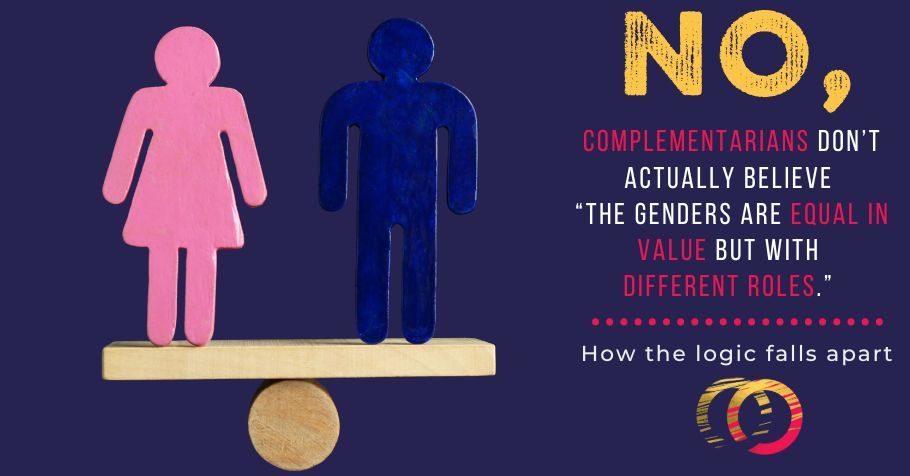
God made the genders totally equal in value, but with different roles.
Keith and I debunked this claim in last week’s podcast on complementarianism in a nutshell, but today I’d like to take a look specifically at that claim, and show how both sides of it—that the genders are equal, and that complementarianism is just about different gender roles—don’t stand up to scrutiny.
Let’s start with the last one first.
1. Do complementarians believe in different gender roles?
That’s the claim—that God created men and women for different things.
But here’s the problem: If there were honestly different gender roles, then there would be things that men can do that women can’t, and things that women can do that men can’t.
But there aren’t. In complementarianism, there are only things that men can do that women can’t (pastor, lead groups of both genders, have authority in marriage). There’s nothing that men are excluded from doing, only things that women are excluded from doing.
In Brandon Sanderson’s Way of Kings novels, the men are the warriors and the leaders, and the women are the only ones who read and write, so they are the philosophers, historians, and scientists. That’s what different gender roles would look like.
But in complementarianism, we don’t see things that women do that men are forbidden from doing; only the opposite. So complementarianism is not about different gender roles; it’s about restricting women.
People often push back with “But women give birth!” Yes, women do. But that’s a biological function, not a gender role. You can’t say “women give birth, so men pastor” because that’s saying, “because she has this biological function, she’s excluded from this social role.” That’s comparing apples to oranges. For that analogy to work, pastoring would have to be a biological role, too, which means men would have to pastor with their penises. Which is horrifying.
I also hear people say, “But God designed men to lead and protect, and women to nurture and serve.”
Except that, as Dorothy Littell Greco shows in her new book For the Love of Women,
Statistics show that companies with more women in their leadership tend to be more successful across many metrics, including innovation, creativity, lower turnover, and higher productivity. A 2016 study found that increased gender diversity in the highest corporate offices led to a 15 percent increase in profits. When the International Monetary Fund conducted a study of more than two million private and public companies, they found that “on average, replacing just one man with one woman in management or on the board led to a 3 to 8 percent increase in profitability.
(And she has citations to peer reviewed studies for all of these claims too, because she’s a journalist who wrote this book the right way!)
In other words, women make great leaders.
And men make great nurturers, too! In fact, we need men to nurture. The two times the Greek word for “nurture” is used in the New Testament it’s directed at men—in Ephesians 6:4 to fathers and in 1 Timothy 4:6 to Timothy.
Though women give birth, there is nothing stopping men from caring for babies and toddlers and children, and we need men to do this! By teaching that nurturing is a feminine thing, which the Bible never does, we cut men off from an important part of themselves, and end up hurting everyone in the process.
But besides this, the argument “men lead and women nurture” doesn’t even hold up to scrutiny, because while women are forbidden to lead, even the staunchest patriarchalists don’t forbid men from nurturing.
Again, it’s not about different gender roles; it’s merely about restricting women.
Just released!
For the Love of Women: Uprooting and Healing Misogyny in America
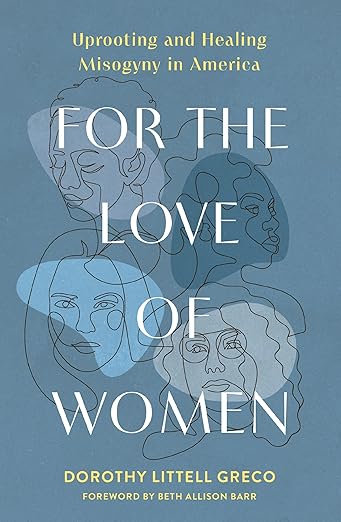
If you've ever been told, "sexism is a thing of the past; women are equal now. Stop complaining!", then you need this book!
Dorothy Greco goes over how misogyny is present in health care, business, the media, our relationships, and of course the church. She puts words to our experiences, and points the way forward.
Now let’s look at the other part of the equation:
2. Complementarians don’t believe women are equal in essence
The argument they make is that while the roles may be hierarchy based, women are still equal in essence. So while men are superior and women are subordinate in terms of roles, in terms of value men and women are equal.
They often use the example of a boss and an employee, or a pilot and co-pilot, or a lieutenant in the army and a captain. Even though one is subordinate to the other and one is superior, they are both still equal, right?
Well, sure, but this analogy doesn’t hold up. The reason a boss or pilot or captain are superior to the employee, co-pilot or lieutenant is because of a function that is true at a moment in time. An employee may one day be a boss; every captain started out as a lieutenant, and a co-pilot may be a pilot.
But a woman may only ever be a woman. She is subordinate because of something she cannot change—her very essence.
You cannot say “the genders are equal in essence,” but then make one superior and one inferior on the account of their essence.
If she is unequal because of her essence, then her essence, by definition, is subordinate and inferior.
Here’s how Rebecca Groothuis explained it in her wonderful essay Equal in Being–Unequal in Function: The Gender Hierarchy Argument:
In female subordination, the criterion for who is subordinate to whom has nothing to do with expediency or the abilities of individuals to perform particular functions. Rather, it is determined entirely on the basis of an innate, unchangeable aspect of a woman’s being, namely, her female sexuality. Her inferior status follows solely from her essential nature as a woman. Regardless of how traditionalists try to explain the situation, the idea that women are equal in their being, yet unequal by virtue of their being, simply makes no sense. If you cannot help but be what you are, and if inferiority in function follows necessarily and exclusively from what you are, then you are inferior in your essential being.
Complementarians use pretty language to obscure what they believe
Saying “equal but with different roles”—which is awfully similar to the racist discredited “separate but equal”—sounds much better than “we believe women are inferior to men and so we restrict them because of that.” And yet that is exactly what they believe, and what they do, even if they won’t admit it. The logic to their argument just doesn’t hold up.
And so it shouldn’t be surprising that complementarianism bears bad fruit in practice too. Women who attend complementarian churches lose the health benefits of religiosity, while men do fine.
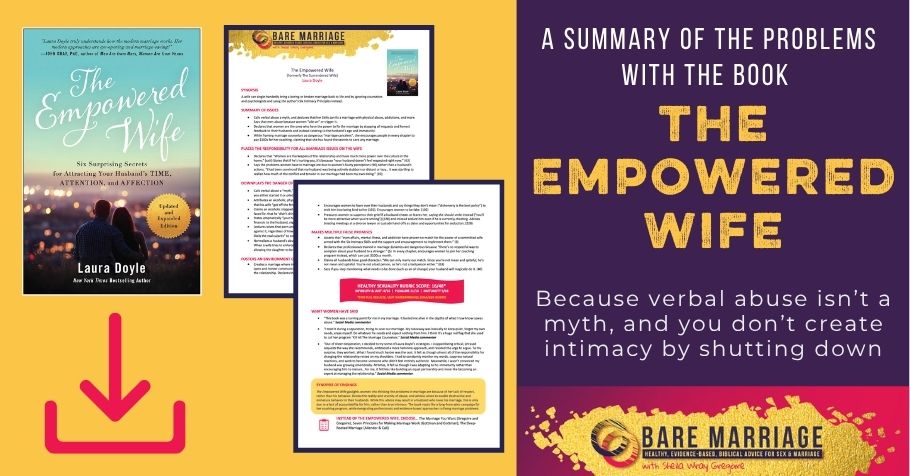
We found in our survey of 7000 people for our new book The Marriage You Want, couples who function with hierarchy, believing that the man is in authority and should make the final decision, have lower marital satisfaction, and higher markers of emotional immaturity.
We need to stop letting complementarians pretend that their doctrine sounds fair and pretty, when it obscures something quite ugly, and bears bad fruit. Now, to be fair, I don’t think most complementarians realize they’re doing this. I think they want to believe they’re the good guys. But when you actually examine it, it’s quite ugly.
This isn’t of Jesus, and it’s okay to push back and say, “it’s wrong to believe that women are inferior to men.”
Watch our quick video from our Good Fruit Faith initiative on the problems with complementarianism!
Or watch last week’s Bare Marriage podcast, episode 305, for more on the way complementarians obscure what they really believe!
What do you think? Does the “equal in value but with different roles” fail logical muster to you? Let’s talk in the comments!





I was told the ” equal but different” is explained in I Corinthians 12 with “many parts form one body.” Unsurprisingly each time it was explained, the men gravitated towards referring to themselves as the heads, hands, or hearts, and the women as the feet, elbows, necks, etc. I honestly think most of them had no idea they were assuming the (seemingly) “higher value” parts. The assumption they represent a higher-respected part comes across much like those who try to defend slavery- they assume they would hold the position of owner and not slave.
That’s a really interesting observation!
“The assumption they represent a higher-respected part comes across much like those who try to defend slavery- they assume they would hold the position of owner and not slave.”
As an encounter with a neo-Nazi type many-many years ago taught me, “When someone divides people into a Master Race and Subhumans, guess which category he always puts himself into?”
>> There’s nothing that men are excluded from doing
The closest thing to this is in some churches, men are forbidden from being in charge of young children’s groups, sometimes due to fears of sexual assault.
Which is horrifying, because that means women are protecting children from men…and I thought they insist men are supposed to be the protectors? Also, the converse would be that women shouldn’t be pastors because they might sexually assault the men 🙄
“Which is horrifying, because that means women are protecting children from men…”
How unsubmissive…
But then there’s always that “Every Man’s Problem”(?) book that’s come under scrutiny on this blog, and the whole “More Totally Depraved Than Thou” one-upmanship you see among today’s disciples of Calvin, so who knows?
I don’t know about that. I wouldn’t lump all of them together. Many Calvinist denominations ordain female pastors.
I grew up in churches which taught that men and women had different roles because God had ordained that. And while it seemed odd to me to give someone a role based purely on their gender, I could go along with the argument that ‘human beings can’t understand God’s ways’. But when they started to say ‘God designed it this way because men are — and women are —, the argument fell apart. Because as soon as you get into “well, men are designed to…” or “women naturally…” you hit the problem that not all men and women fit into those stereotypes. For example, if God designed men to lead because they are physically stronger than women, then how come the comps still expect a physically frail or disabled man to lead when his wife has so much more physical strength? If men are ‘designed to lead’ because they are more logical than women, then any time you find a woman who is more logical than the men around her, then she should be leading them. Same with any other supposed ‘male’ characteristic which equips them to lead.
The other argument that I’ve often heard applied to this whole area is that God gave us these distinct roles to promote our spiritual growth – this school of thought argues that men find it hardest to lead and women find it hardest to submit, so we have been given roles that go directly against our natural, sinful desires. But the same problem applies – if this argument is true, then any proud, arrogant, bossy man should be a follower and any diffident, shy, retiring woman should be a leader. They really should have stopped at “because God says so” and not tried to come up with reasons for it, because the reasons just don’t hold up.
That’s a really interesting thought, Angharad, and I’ve never articulated it quite that way. But you’re exactly right!
This is so well explained! I have found the same. Whenever you ask, “But why are men the leaders? What about their design makes them suited to lead, and women to follow (if you say women aren’t inferior to men)?” And they never have any gokd answers, if they even try. “The mystery of God’s design.” 😂
To be honest, “because God made us and He sets the rules” IS the only answer that makes sense if you are going to argue for that position. If someone tells me that, then fair enough – “I believe this is what the Bible says, but I have no idea why” is honest. But any attempt to justify it on the basis of supposed male and female characteristics falls at the first fence because there are no characteristics that are purely male or female.
And don’t get me started on the really dumb examples such as that presented recently by TTW, who claimed that because a fictional female character in a film kept making unwise decisions and her equally fictional husband made sensible ones, it was proof that men were created to lead…
Yep, so true. I do appreciate it as a more honest response as well. But when I hear reasonable people making that argument (who should know better) I push them a little further: “But we’re talking about half of the human race, here. Is that a good enough reason to subordinate and hold back half of humanity?” Especially since God always has good reasons for what He does and what He commands us to do. There’s ALWAYS a “why” for practical commands, and I believe God wants us to ask, seek and knock. He told us all of the treasures of wisdom and knowledge are hidden in Him, and He is a generous God. So where is the wisdom in this command to subordinate women? I have asked, and I believe He has answered!
Exactly, but I think ultimately they’re okay with a God who is capricious, as long as He’s capricious for a system that they like and benefit from.
“And don’t get me started on the really dumb examples such as that presented recently by TTW, who claimed that because a fictional female character in a film kept making unwise decisions and her equally fictional husband made sensible ones, it was proof that men were created to lead…”
This reminds me that when my ex-husband I would watch some movie or tv show and a female character did something dumb, my ex-husband would say things like “isn’t that just like a woman!”. I would say, “You do know that this isn’t real right? Just because a fictional woman. a character and a story line written by mostly male writers in Hollywood, does something foolish, it isn’t analogous to real females? You do realize that, don’t you?”… My ex husband would get defensive, and we would end up in an argument. It was so infuriating that he would buy into that crap without thinking that this kind of stuff was a mostly male creation or fantasy. We were only in our 20s at the time, but it really left a bitter taste in my mouth toward this kind of stuff. It’s even more disturbing that TTW can’t tell the difference between a fictional female character, created by a male fantasy, and the actions of real women. No thought process there!
Yes, I totally agree. If people would just admit they believe that God is arbitrary and can’t be understood, then that would be one thing. But they don’t.
The problem might also be that men wrote the Bible and men translated it. I don’t care much for going against scripture, but it surely was not written (in any portion) by women.
The real question is whether we would have the same Bible if it had been written and translated by women. I think not.
“Mystery of GOD’s Design” or “I’ve Got a D*ck, So There!”?
(I turned 70 yesterday, and have long lost all patience for such a-holes…)
Wow! Happy birthday! Your comments always read like you are someone in your 30s so I had no idea! Not that it is a bad thing, I am glad you are still young at heart!
Comes from my background.
I was a Cold War Kid Genius and got the “emotional/social retardation” side effect BAD.
There’s a”Conservation of Neurological Energy” in play where the more your mental (IQ) age runs ahead of your chronological age, the more the rest of your personality age lags behind. Compounded by the isolation of “living in ‘Idiocracy'” with your brain running at full throttle ahead of everyone else, “Growing Up Martian” seeing and understanding things differently, and grown-ups looking at you and seeing only a giant brain floating in mid-air.
Nobody seems to realize there’s a body attached to that giant brain, an overwhelmed scared kid attached to that gigantic IQ.
Oh happy birthday!
I am convinced the doctrine that says if you’re bad at it, then that’s what God wants you to do is false and was made to manipulate people into doing what a leader wants. I’m not saying everyone who uses it is malicious or intentionally manipulative, but the logic just doesn’t hold up when compared to Jesus talking about us using what we are given (assuming a figurative meaning to the money-mangers parable) and that following him is an easy burden.
The God-calls-you-to-what-you’re-bad-at doctrine boils down to: “God loves you, which is why God wants you to do everything that you’re bad at and that makes you miserable and not do the things you have talent for and that make you happy. Doesn’t it make you want to just bask in how wonderful and loving God is?”
Angharad’s comment somehow made me think my comment was related to the complementarian problem, but I’ve lost it now. 🤔
I was told I had to learn to “push my comfort zone,” when in reality my comfort zone was so far behind me in what I was asked to do that it has taken me years to try to sort myself back out. And it really was, as you said, a way to manipulate believers into doing what the head pastor et al wanted.
My brain just popped over to this- if we began calling “church” positions by what they actually are, e.g. “leaders” become “manipulators,” it would be so much easier to identify the problems. More of that pretty language I suppose.
I remember now what I was thinking with Angharad’s comment. If God calls us to the things we’re bad at, then by complementarian logic, men should never be leaders because it’s what they’re innately good at (by complementarian beliefs).
I think that ‘do it because you’re bad at it’ argument was from those who realised that many women had natural leadership abilities and many men didn’t – so if the ‘men lead and women submit because that’s what they’re best at’ argument didn’t work, you had to flip it around to ‘men lead and women submit because they need to practice what they’re bad at’!!!
Like all bad arguments, it has a grain of truth in it. God often does challenge our areas of spiritual weakness and help us to grow stronger in them (e.g. helping us become more patient, caring, faithful, trusting). But that is very different from giving someone a role that doesn’t fit their natural abilities. Gifts like teaching, music, administration are given to individuals and are very different to the spiritual gifts of love, joy, peace, patience, gentleness etc which we are ALL supposed to be developing
Yes, so true!
” if you’re bad at it, then that’s what God wants you to do”
Blogger Christian Monist grew up in a church like that. They deliberately would assign the worst possible, least qualified person to the job “So God Would Be Glorified”- that said incompetent would have to Trust God and Do the Job in the Spirit instead of his Flesh as a Witness to the Heathen.
Needless to say, THIS NEVER ENDED WELL.
I think the part where companies that hire more women in the upper positions make more money than companies who don’t interesting. I would like to see the statistics for other minorities like POC and disabled people too. It really flips the phrase “Go woke or go broke” floating around on its head in that respect.
The phrase should be “Go woke AND go broke” , my bad
I’m curious if you guys can help me figure out how Levites fit into this. Ive been reading Ezra and just hit Ch. 8 where he notices that there are no Levites among the group. He sets out to correct that rather than assign non-Levites to fill the roles. I was thinking about how the Levites are equal to the other Isrealites, but have a specific, God-given role based solely on their lineage. They can’t change who their parents are and we know some were not good at the job (Eli’s sons!). I was trying to figure out if the equal value different role showed here was different and if so how.
I think the thing about the Levites is that in the New Testament we are all called high priests. There no longer is any hierarchy or any mediator between us and God. It’s a great question, but the point of the priesthood is that it was temporary to teach us something, but it was clearly not what God actually wanted for reconciliation with us.
Great question, and I find the social structures of Mosaic laws really fascinating. The tribe of Levi (the kin of Moses) was given no land inheritance. They needed to live as functionaries of the worship of Yahweh. They were fed, clothed, and housed by the offerings and donations to the tabernacle and later the temple. In the social exchange they then served as priesthood, scribes, teachers of law and administrators of beneficence. They weren’t meant to be able to be rich and powerful according to the plan, but still be influential and cared for by society. So there is a structural reason to seek out Levites for Ezra’s purpose. He was attempting to recreate the ancient orders and having heritage Levites meant that the social contract of a non-landed priesthood was recreated. Perhaps it does foreshadow a little of the Christian Kingdom of Heaven being unmoored from belonging to geographical place. The home and business of the Levites was the Temple, no more and no less.
Men could never be a mother … hard as they try. Women cannot be a father … hard as they try. If a spouse is lost, one can attempt, by the grace of God, to fill that purpose but it will never be done as well as designed. This is because men and women are called to different roles. It’s quite obvious. Futhermore, it seems to me that the man is called to be responsible to provide for his wife (as in financially). This is not to say the wife cannot work but she is not the one “responsible” to provide for him. The man is given a responsibility that is according to scripture which is why Paul put the burden of the fall on man. Though the woman was decieved and ate first, sin entered the world by one man (Adam). He was responsible to protect his wife (even from deception – since he was there) and He failed!
Throughout scripture, the Lord puts an emphasis on assisting widows but does not give that same attention to “widowers” – implication – men are called to be providers. You make complementarianism out to be a heresy or at least a gross evil. Though I realize there is a split among many believers which way this should go, I do not think heresy or gross evil is fair treatment at all. Many wonderful, loving homes which produced respectable, godly children were brought up under this system. That is simply a fact.
And countless women have been abused by men who have taken full advantage of the patriarchy societies have long allowed to fester. It is not 100 BC and we do not live, act, speak, dress, work, play or anything else the way we once did. We don’t worship separately either though the Old Testament reuired us to. Still putting stock in complimentary roles when you don’t adhere to any of the other tenets I mentioned above is preposterous and SOLELY benefits the MEN.
“Equal but Different Roles”
How does that differ from “Separate but Equal” in the Former Confederate States/Jim Crow South?
(Remember the famous pic of the “White” and “Colored” drinking fountains side-by-side?
The one reproduced in the first scene of “Mississippi Burning”?)
It really is pretty much the same thing. But then, the SBC’s roots are in slavery, so perhaps we shouldn’t be surprised.
I don’t understand the point here at all. There are no Biblical roles for “skin colors”, there are Biblical roles for “husband/wife; mother/father”. I’m not SBC nor do I justify any part of slavery that took place in our country. I’m not sure that your comment was even a response to my comment, I just wondered?
Incorrect. The Bible specifically tells slaves to obey their masters. Skin color was not a factor but social status surely was.
I’m interested in the egalitarian/complementarian discussion, but I don’t think this is a fair framing:
“If there were honestly different gender roles, then there would be things that men can do that women can’t, and things that women can do that men can’t.”
Most careful complementarians don’t define “roles” as exclusive abilities. They define roles as covenantal responsibilities and accountability (e.g., husbandly headship as a particular burden of responsibility; wifely submission/respect as a particular direction of honor), within a marriage where many virtues and actions are shared (both love, serve, sacrifice, and practice mutual deference in the general Christian sense).
So requiring “exclusive tasks” to prove role-difference misrepresents what complementarianism actually claims, and it sets an unnecessary standard for what “different roles” would mean.
Yes, that’s how complementarians define it. It also doesn’t change the fact that there are things men can do that women can’t, but nothing the other way around. Just because they don’t like framing it that way doesn’t mean it’s untrue.
Also, if having the burden of responsibility is such a big deal and so difficult, then we would expect that in relationships where men held that burden, men would do worse than women. But that’s not true at all. Women fare far worse in these marriages than men do. The fruit is rotten.
However, in marriages where both partners make decisions together, and no one bears the burden of responsibility and it’s shared, then marriages do so much better.
Complementarians can dress things up in nice language, but it doesn’t change the reality on the ground: When husbands make the final decisions, and when husbands take on the responsibility for the marriage, the marriage fares far worse than when couples approach it as equal partners.
Oh, Heaven forbid we should give the male the “burden” of making all the decisions, hence controlling everything.
At the moment I’m attending a Southern Baptist church because and my husband’s family have been members forever, and I’m becoming more frustrated because what they preach (and the pastor REALLY harps on it) is complementarianism. I was raised Nazarene and we’ve always ordained female pastors. My husband loves his daughter and does not share the complimentarian view either. Attending this church is more so due to the fact that our friends and families all do. The thing is, I am submissive to no man (except Jesus) and HE appeared to Mary FIRST and specifically told her to share the news of his resurrection with the male disciples. If solely men are to be in the lead in pastorship, then why did Jesus specifically command her to take the lead in this instance; the MOST important event in human history? Jesus could have appeared to ANYONE first, but he specifically CHOSE Mary. Separate is never equal and to be subordinate is inherently beneath, as that is precisely what it means. Men KNOW exactly what they’re doing in these denominations. They’re intentionally grasping at dwindling religious power and influence. I’m so disappointed in my fellow women around the world for allowing this church and others with the same doctrinal beliefs to continue to grow with our missionary work and sacrifice, all to continue to expand the hateful tentacles of gender inequality. Also, they cherry pick to a sickening degree. We don’t stone adulterers (of either gender), men don’t have to uncover their heads before prayer and women don’t have to cover theirs. We don’t have to remain silent in church nor ask our men about something we do not understand (fat chance of us being more likely to fail to comprehend anything ) and we don’t have to pray separately. They choose whatever benefits males in the Old Testament, decline to acknowledge the fact that Jesus was very clear about the equal value of women, instructed Mary Magdelene to witness to the males, and much more. Utlize an incorrect translation of the Greek for “helper” and refuse to admit that men are there to be “‘helpful” to women as well, simply because the scripture does not specifically state that. Should we then assume that men are not helpful to women? Christianity is not Islam but this backwards complimentarianism junk smacks of the Islamic oppression of women.
If anyone tells you that you are equal while also telling you that you have to remain subordinate, hand him a freaking dictionary because he clearly needs to read more than just his Bible.