
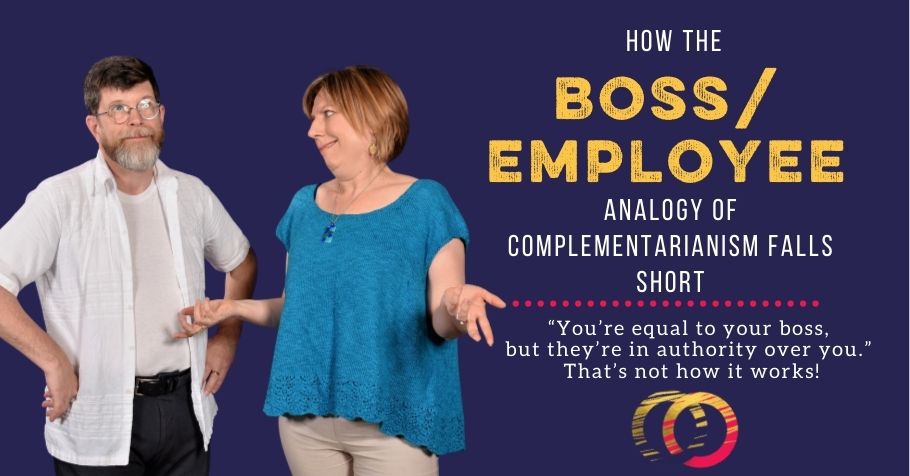


Thank you to Zondervan and the book To Heal or Harm for sponsoring this post.
My husband Keith and I talk a lot behind the scenes about the theology of complementarianism.
It really bothers him that so much of the theology and arguments holding complementarianism up are basically logical fallacies.
Complementarianism, of course, is the belief that men are in hierarchy over women, in the home and/or the church. It’s the idea that he leads and she submits, and he holds the final decision-making power.
And much of their arguments don’t hold water. He’s talked about it before in the podcast and on the blog, but he had something specific he wanted to write about today–and this is likely the first in a three part series! So here’s Keith:
Imagine someone is telling you about a trip they recently took to London, England.
In the middle of the conversation they tell you the highlight of the trip was seeing the Eiffel Tower. “Wow,” you say, “So you got a chance to do a side trip to Paris as well?”
They look at you like you are crazy and say, “Aren’t you listening? I was in London. I specifically said London. Don’t put words in my mouth!”
Looking past the defensiveness, you gently ask if perhaps they were mistaking the landmark. Did they mean the Tower of London? Perhaps the London Eye? Or maybe Big Ben?
And you are shocked when they retort, “I know what the Eiffel Tower is and that’s what I saw! There’s no point in talking to you!”
This is what it feels like for me to talk with people who push complementarian theology on-line.
Complementarianism teaching on marriage asserts that:
(1) the husband and the wife are completely equal; and
(2) the husband is in authority over the wife.
(1) I was in London; and
(2) I was looking at the Eiffel Tower.
But when I explain this, the response I get rarely includes acknowledgment of what at the very least must be labelled an apparent contradiction. The standard response I get – delivered with a subtext of “how stupid are you anyway?” – is “Well, your boss is in authority over you. Are you not equal to your boss?”
Is the boss/husband analogy valid?
I’d like to talk about why that analogy is far from the mic drop they think it is.
But first, let me say that despite my critics describing me as “intentionally misrepresenting”, “spreading lies about” or even “slandering” complementarianism, I actually do understand why people hold on to this theology. There was a point in my life where that was what I was being taught and I briefly bought into at least some of it. And while I am regularly accused of “refusing to admit that complementarians believe men and women are equal”, the fact is that, with the exception of some truly misogynistic characters, I do think the average complementarian in the pew does want to believe that men and women are equal. Ironically, my theory is that their desire to see women as equal is the very cause of their defensiveness.
For example, a common teaching in complementarianism is that the husband is the tie breaker and has 51% of the power in the relationship. If I point out that 51% is effectively 100% because only one of the two can be outvoted, I get indignation, “How can you say that 51% is the same as 100%? Don’t you know basic math? You’re just trying to make men look power hungry!”.
Yet at no point in criticizing my assertion that 51% and 100% are EFFECTIVELY equal, does the penny drop that they are asserting that 51% and 49% are ACTUALLY equal.
And I get it. Because they can’t.
Most complementarians want to believe that men and women are equal
They honestly do want to believe men and women are equal, but they have also been taught hierarchy from a young age, that the husband being in charge of the wife is “God’s beautiful plan” and that this is the only way to interpret Scripture faithfully.
If it’s true that equality and hierarchy are mutually exclusive, then one must go, but they are unwilling to let either go, so must somehow hold onto both.
And the more clearly someone points out they are mutually contradictory, the greater the cognitive dissonance and psychological strain, so the greater the defensiveness.
The official attempt at resolution of this problem doesn’t resolve the tension either. Complementarian teaching is that wives are equal to their husbands in who they are, but subordinate to their husbands based on their “role”. But giving a person a permanent subordinate role that can never change can in no way be considered equality. If we follow the logic through to its conclusion, we have to admit, as Rebecca Groothius put it:
“Well, your boss is in authority over you. Are you not equal to your boss?” is a great release valve.
It basically says “here’s a clear example of how someone can be equal yet under the authority of another, so go away and stop making me rethink my self-contradictory theology!”
By concretizing the official doctrine of “equal in being, different in role”, it shifts the discussion from the realm of the philosophical where the self-contradiction between equality and hierarchy is obvious to the practical where hierarchy and equality seem to coexist without any problem.
Since everybody can relate to the idea of being under the authority of your boss, but not feeling inferior to your boss, it must be possible to be equal but under authority!
I can understand why they think this is compelling.
But is the boss-employee relationship an accurate analogy for what is going on in the complementarian version of what marriage is supposed to be?
Obviously not, for many reasons. But let’s just take four.
1. If the boss-employee relationship accurately represents what it means to be a wife, then the work hours are atrocious!
Some jobs expect you to work long hours. Some jobs have a hard time staying within the hours you are supposedly hired for (For example, you need to come in before work to get ready and then often are still there late finishing up). Some combine both into a one-two punch! Believe me, as a physician who trained as a resident before many of the current regulations limiting shift length came into place, I know.
Now, if you think comparing being a wife to a job with a literal job description that requires 24-7-365 work hours with no vacation and minimal sick days is ridiculous, then guess what, I agree with you! But given that this analogy is necessary for us to put the square peg of hierarchy into the round hole of equality, we need to look at it straight on.
The idea of being equal to your boss even though he is in authority over you seems natural, but what if your boss felt they had a right not only to your Monday to Friday, but your Saturdays and Sundays, too? And your evenings. And your nights. In fact, every waking moment. Now add to that, that your job description is all encompassing and involves every aspect of your life being under his authority. And the cherry on top is that your boss, outside of literally commanding you to sin, has absolutely no problem with the idea that he alone is allowed to decide what your job description does and does not include. In fact, he feels it is his entitlement. Still feel like you are equal to your boss?
Get the book that shows how Scripture has been misused–and how to use it to heal instead!

For all too many of us, Scripture has been used to make us accept abuse. To tell us we can’t defend ourselves. To let others control us.
But what if that stems from an improper use of Scripture?
Dr. Tracy’s book teaches how to interpret Scripture in ways that heal, not in ways that poison. And he points out the typical texts that have been weaponized against victims, and shows how they can heal instead!
For those who need to know what Scripture says, or who desperately want their pastor, their father, their sister to hear them–check out this clarifying and life-giving book!
2. Unlike a job, there is absolutely no opportunity for advancement.
Yes, you can be equal to your boss who is in authority over you, but part of that equality is equality of opportunity. Theoretically, if you work hard and perform well, the company’s owner might promote you. You could eventually become a boss yourself. In fact, if your boss performs poorly, the owner of the company might even demote them and make them one of your employees!
But the idea of a wife and husband changing places where she leads and he submits is anathema in the complementarian mindset. No matter how bad a boss he is and no matter how skilled an employee she is, they must never switch places. This is the chief reason why the teaching of unilateral submission should be rejected out of hand – the obvious injustice of it.
I have no problem with the idea of submission, nor does Sheila who has written about it as well. As Christians, we are all called to submit to each other. But the idea that wives are supposed to submit to husbands in a way that is completely different and not returned to them is simply unjust. When complementarians say, “Well, that’s what the Bible says” it is fair to answer them back, “Well, either you are wrong in your interpretation or God is sexist.” The boss-employee idea itself demonstrates this.
It is not inherently sexist or unjust to have women working under men’s authority. But imagine a company where the official policy is that only men can be bosses and they can never be employees and women can only ever be employees and can never become bosses? Isn’t that the very definition of a sexist workplace? But that is what is being prescribed when we say that all wives must be under all husbands.
Complementarians may insist that theirs is the only way to interpret Scripture, but when it makes it look like God is sexist, I can’t help but think they got it wrong somewhere. Especially when good Scriptural support exists for the alternative idea: husband and wife working together as a team of equals under God without hierarchy.
3. If you are in a job where you feel you are being treated unfairly, you can always leave.
At work, that’s called quitting. In a marriage it is called divorce. Now I’m not making any argument here about when divorce is or is not justified, but the only way for the boss-employee analogy to work is if you can quit (i.e. divorce), which they don’t allow. Far from it, in fact. These are the very people most likely to outlaw divorce in every circumstance, including abuse, as Sheila has discussed here and here. This should give us pause. For the suggestion that the asymmetry of power in a complementarian marriage is still fair because “it’s just like a job” (just one that you can never leave) leads us to a shocking and grotesque conclusion.
If your boss has the ability to prevent you from leaving your job to seek employment elsewhere, you’re not being employed; you’re being trafficked. And I sincerely hope that egalitarian and complementarian alike can agree that as an analogy for marriage that is completely horrific.
The boss-employee analogy completely fails to explain away the inherently contradictory idea that someone can be simultaneously equal to someone else and also under their authority. Plus, it’s just awful as an analogy for marriage in general. Yet I have met so many people online who see it not simply as an analogy, but who really do think that’s what marriage is supposed to be like. I find that incredibly sad.
A comment that came up when this was first published on Sheila’s substack is that I should have had a 4th point – that sex is not allowed between a boss and an employee, because you can’t have true consent when there is a power imbalance. I didn’t cover that, because that’s what my next blogpost is going to cover. Since Complementarian theology makes people comfortable with the idea of the husband being the boss, what does that do to your idea of intimacy?
Spoiler alert: nothing good.
Have you heard the boss/employee analogy before? Or a variation on it? What do you think? Let’s talk in the comments!








I don’t think I have ever felt equal to my boss back when I worked. I laughed at that point that in theory you can be promoted if you worked hard but as a disabled person you are often seen as a liability and you aren’t often considered for promotions so in practice you never get promoted and it is hard to prove discrimination in such cases. That is probably why I prefer to date and marry other disabled people like me because I never truly feel equal otherwise. I have dated neurotypical, non disabled men before I met my husband and they end up treating me like a child and infantilizing me and it gets really creepy really fast!
This analogy is really common in the UK. Hierarchical complementarians feel that it’s a perfect analogy. I suspect that because workers have plenty of rights in the UK (due to our Socialist history) it’s viewed even more favourably.
I hadn’t thought of that aspect! Yes, it’s even scarier that the American church uses it where there aren’t worker protections!
That’s an analogy that makes me think these people haven’t spent all that much time in the corporate world.
I’m paid to put up with my boss. These people are asking women to stay at home and forgo remunerative careers to put up with their husbands. Those are not remotely the same thing.
Just want to point out that at least in the boss-employee relationship, the employee GETS PAID.
Very true!
“Well, either you are wrong in your interpretation or God is sexist.”
I love this and I think I may have said that last part before.
Not long after I first accepted salvation when I was a teenager, the pastor talked about how the husband is the head of his household and that he’s in charge. I was turned off by church and didn’t want to have anything to do with organized religion. I even thought God was a male chauvinist.
Many years later, I’m still trying to break free from that teaching and I just wish others around me would realize the harm complementarianism causes to many believers.
I was talking about that this week with a friend. Like churches that are complementarian–who are they going to attract? People who don’t care about women’s personhood. Who are they going to repel? People who care about justice and compassion.
So what kinds of churches are we growing? And as society gets more and more sure that women are equal, it will be virtually impossible for the church to reach the world now, because they are so far morally backward from the world. It’s crazy making.
This is part of why “excited” is not my default when a church grows and part of why I think church growth is not an indicator that other churches should follow that church’s practices. I want to know what the lived outcomes are in the lives of people at that church because if the church is hundreds of people who think Jesus said it is their god-given right to rule over others, that’s not a church that’s preaching what Jesus taught. I’m not celebrating the growth of a church when that growth is based on a teaching opposite to what Jesus taught just because the people in it are generally good-willed, but deceived, and the church teaches other things that are supported by the full testimony of scripture. There are enough truthful communities of Christians that we don’t have to think well of an organization just because they use the label “church.”
“(1) the husband and the wife are completely equal; and
(2) the husband is in authority over the wife.”
doublethink, comrades, doubleplusdoublethink.
“To know and not to know, to be conscious of complete truthfulness while telling carefully constructed lies, to hold simultaneously two opinions which cancelled out, knowing them to be contradictory and believing in both of them, to use logic against logic, to repudiate morality while laying claim to it, to believe that democracy was impossible and that the Party was the guardian of democracy, to forget whatever it was necessary to forget, then to draw it back into memory again at the moment when it was needed, and then promptly to forget it again, and above all, to apply the same process to the process itself—that was the ultimate subtlety: consciously to induce unconsciousness, and then, once again, to become unconscious of the act of hypnosis you had just performed. Even to understand the word—doublethink—involved the use of doublethink.”
— George Orwell, Nineteen Eighty-Four
“equal in being, different in role”
That anything like “Separate but Equal” in the days of Jim Crow?
I think of that often! It’s the exact same thing.
Also, I don’t really think of a boss as being “in authority over” the employees. An employee has a contract, it says what their job responsibilities are, and their salary, and the employee will decide if they want to agree to this contract or not- if they want the job or not. The boss in charge of the employee’s behavior in the area of their work tasks, but is not “in authority” over them in a general sense.
I used to have a model of the world where I’m supposed to be good and follow the rules, I’m supposed to do what the authority figures in my life (God, parents, teachers, boss) tell me to do- but I think this is not a good mindset to have in the “real world” of adulthood. Better advice would be, you only have to do what the boss says if you think the pay and the way they treat you is acceptable- otherwise you should quit and find a different job. And yes, your options are constrained by a lot of factors, it’s not like everyone’s going to have a magical perfect job where they’re happy all the time- but at least the overall framework should be, making choices based on what’s in your own best interest, not “I need to be good and obey.”
‘not “I need to be good and obey.”’
This reminds me of a job application I once received. The person didn’t have any of the necessary skills, but their cover letter informed me that they were “obedient.” I felt so bad for the woman who had only worked in childcare and clearly had no one in other industries to help her write to professional norms.
You should never, ever be “obedient” to your boss and your boss should never, ever “punish” you. These dynamics do happen in the workplace, but they are recognized as problematic. A more functional mindset is for the employee and employer to think of themselves as a team. The boss has the roles of giving directions and holding people to standards of professional and organizational norms and the employee has the role of doing tasks within their job description. Both have the role of ensuring a workplace where everyone can work without harassment or undue discomfort. Both have the role of working towards the organization’s mission. In the best cases, the boss welcomes corrective input from the employee – there’s nothing “obedient” about that dynamic.
I once applied for a job that sent me, without warning, a long “test” to complete with a strict deadline. I told them that it was not appropriate to assume that I had or would make the time when they weren’t paying me. They pulled the application. I’m like, okay, bullet dodged.
That’s how things work on the professional world.
Yes! I hate that when jobs do that.
Keith, your statement “If your boss has the ability to prevent you from leaving your job to seek employment elsewhere, you’re not being employed; you’re being trafficked” is absolute fire.
#NailedIt
Yes, being trafficked is the appropriate description for a complementarian marriage. A wife in this scenario is no different than a prostitute under a pimp. That was a mic drop that could be heard around the world.
When I hear comps argue that the husband ‘has’ to be in authority because you ‘have’ to have someone making the final decision, I always wonder…what are their churches like?
We are a UK Baptist church, and in the UK, that means each congregation is ‘self governing’. Everyone in the local congregation has an equal say and no one person’s voice is worth more than any other person’s – including those of the pastor and the leadership team. If we have an issue we need to make a decision on, we pray and discuss until we reach agreement.
If these guys can’t imagine TWO people working together like this to reach agreement, I doubt they can visualise an entire church doing the same thing. Which raises questions about what kind of dictatorship their ‘church’ really is.
I know! It makes no sense.
I think when complementarians say boss/employee dynamic, they really mean iMain Character and Sidekick. Husband is Batman, wife is Robin. Husband is Lone Ranger, wife is Tonto. She’s not a paid employee, she’s a loyal, adoring assistant who always looks to the Main Character to call the shots, and she never drives the Batmobile, she always rides in the sidecar. Of course, the Main Character always knows what to do and his decisions always turn out right in the end.