
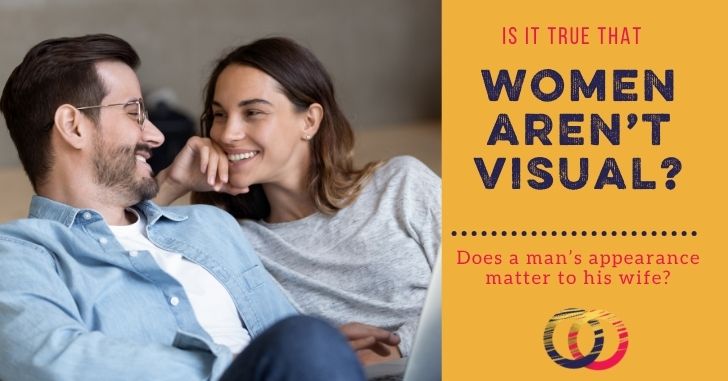

Are women visually oriented?
What we usually hear in the church is that God made men to be visual (the Every Man’s Battle authors say that God made men to receive sexual gratification through the eyes).
Women, on the other hand, just aren’t. We aren’t visual at all. We don’t care about appearance.
But are either of these claims true? Or rather, is the dichotomy true–that men care about women’s appearance but women don’t care about men’s?
Last week on the Bare Marriage podcast we talked about mental load and sex–how women bore the weight of having to keep up their appearance in order to be sexually attractive to their husbands, but men don’t even need to properly groom, at least according to the emphasis in our evangelical best-sellers. And I want to challenge this assumption and look at the implications of it.
What do evangelical books say about appearance?
When we wrote our book The Great Sex Rescue, we read 15 of evangelicalism’s best-sellers on marriage and sex, and scored them on a 12-point rubric (it’s free and you can download it here!). One of those points was whether the book put equal emphasis on both people’s appearance, or whether they only stressed that she had to keep up her appearance (we also looked at whether they talked about men’s hygiene).
Across all the books, the average score was 1.92/5–so that’s pretty bad. Love & Respect, Power of a Praying Wife, Every Man’s Battle, His Needs Her Needs, The Act of Marriage, and Intended for Pleasure did especially badly. They emphasized the woman’s need to stay attractive for her husband, without even saying that men needed to do the bare minimum (brush their teeth and pay attention to hygiene).
His Needs, Her Needs even said that one of the 5 emotional needs of a man in marriage was to have an attractive spouse. And they called a man married to a woman who had gained weight “enduring a prison sentence” in his marriage. Gaining weight after marriage is apparently not allowed.
Yet as much as these books say that a woman must keep up her appearance, they also don’t say much about men. Apparently women don’t care if men gain a ton of weight, or if they come to bed dressed in clothes with holes in them or wear ratty underwear. It doesn’t matter to women, you see!
In the podcast, we played the clip of the rather rotund Missouri pastor saying from the pulpit that women needed to be trophy wives, and talking about how a friend of his had a “divorce weight”, where if his wife got passed that he could divorce her. That clip went viral. But the juxtaposition of what he looked like while lecturing women on how they had to look like Melania Trump was wild.
What does research say about appearance?
So many studies have been done about how men and women judge a mate’s appearance, and it’s quite nuanced. But in general, we know this: people of similar attractiveness tend to marry each other. It’s not that beautiful women marry men who are unattractive. Women, though, tend to be more attracted to guys with “average” looks than stunning men with chiselled jaws, for instance, because they’re less likely to cheat (so the theory goes). And women tend to value things like emotional availability and stability. So women care about more than appearance, but appearance does matter (and grooming and clothing choices often matter more than simple physical looks).
There are too many studies to link here, but maybe one day Rebecca and I will do a podcast about it! But the idea that women absolutely don’t care about looks is simply and categorically untrue.
There’s a difference between choosing a mate and stoking sexual flames once married
Most research on appearance focuses on how people choose a mate (either short-term or long-term). But that’s not what Christian books tend to be talking about. They’re talking about keeping a mate’s sexual interest, and on this the assumption is that men need their interest kept, but women don’t.
This is a rather strange assumption, because we know that evangelical men have much higher desire levels for sex than women. If anyone’s sexual interest needs to be fostered, it’s hers, not his! Yet the advice given is that it’s women who need to cater to the men (and His Needs, Her Needs even frames this that if they don’t, he is vulnerable to an affair).
Yet whenever I talk about the importance of a man’s hygiene when it comes to sex, my comment floodgates open. So many women report that they hate sex because of their husband’s BO or his poor oral hygiene. He has horrible breath, or he stinks, and she doesn’t know what to do about it (just tell him that you won’t have sex with him until he cleans up! It’s not rude; he’s the one being rude to you!).
Often men aren’t doing the bare minimum, yet women are expected to stay beauty queens.
And let’s face it–it’s a lot more important for sex for people to be showered and to have brushed their teeth than for the wife to have lost 10 pounds. And even when it comes to the physical act of sex, his excess weight actually makes intercourse much more difficult than her excess weight does. It’s his weight that makes sex almost impossible, while her weight can often be compensated for much more easily. The double standard here is immense.
Why do evangelical books and pastors put such demands on women and not on men?
Here’s something that I want all of us to understand: when you’re trying to figure out why a group of people promote something that is simply not true, it’s best to ask “who benefits from this?”
We know that it’s women’s fires that need to be stoked, not men’s. We know that women are about appearance too. We know that men’s lack of hygiene is currently playing a big role in many women’s low libido, and we know that men’s excess weight has an outsized effect (pardon the pun) on the physical aspects of intercourse.
Yet it is women who are told that they need to stay beautiful, stay thin, and make sure they give their husband something to look at. So who benefits?
- By telling women that men will only be attracted to them if they look similar to when they married, and if they put a lot of work into their appearance, women remain insecure and thus are more reliant on their husbands.
- By telling women they must put a lot of work into their appearance, women have more work placed on them, so they become more docile and less likely to demand more of men.
- By telling women that women aren’t visually attracted, they make women who are visually oriented feel like freaks.
- By telling women they aren’t visual, they can pressure women into marrying men who have put very little care into their appearance, so that men have to do less work
- By promoting the false dichotomy that men care about appearance while women don’t, they can create a burden of work on women while men are excused from this work. And men now get attractive wives while the men have to do very little.
- By promoting the idea that if they don’t stay attractive their husband will stray, they create rivalries and jealousies among women as women vie to protect their relationships.
These teachings make women insecure and add labour to women’s lives that men don’t have to do, making women busier and more exhausted, and thus easier to control while men have more leisure time. And they create a situation where women blame other women for being too pretty or trying to steal their men, so that women are busy fighting each other rather than challenging the underlying premise.
It all works great–women are insecure, exhausted, and fighting amongst themselves, while men have to do very little and get attractive, complaint wives.

Is this actually great for men?
I hope you’ve all seen now that this isn’t actually beneficial for men who want to be emotionally healthy. As we talked about in our podcast for His Needs, Her Needs, it’s so interesting that all of the needs that Harley named “feminine” actually result in emotionally mature, healthy relationships, while the needs he named “masculine” result in men feeling connected without having to do any actual work of connection or vulnerability.
It’s a false intimacy rather than a real one.
What women “need” in these books are the universal needs for intimacy. What men “need” are the trappings that let them feel important without having to emotionally connect.
That’s not a healthy marriage at all. That’s a shell of a marriage.
What’s a healthy way to teach about appearance?
I think all of us should endeavour to honour ourselves and our spouses by making sure that we care for our hygiene and that we put some effort into looking after our external appearance. Get a manageable and attractive haircut. Buy clothes that fit you and flatter you. Find a “beauty” routine that is manageable, realistic, and that you can stick to. And all of those tips pertain to men and women alike!
Some women will be makeup people; some will not. But everyone should wear clean clothes that fit and flatter (both men and women!). Some men will want beards, some will not (but they should be kept trimmed!). And shaving? That’s up to everyone’s preference, with the understanding that keeping hair-free in different areas of the body takes work fighting ingrown hairs.
Some people will love being able to relax together in sweats, and that’s great. That can be part of intimacy–to be more casual with each other than you are with anyone else. It’s the meaning that clothes give to each of you individually that shows how you should treat them. But regardless, everyone should care about hygiene!
But we should not have a gender-based teaching on appearance at all. We should teach our sons not to be sloppy as well as our daughters. Everyone should know how to dress up for a night out. And absolutely everyone, men and women alike, should know what proper oral hygiene is and how to make sure we don’t have BO.
The purpose to all marriage advice should be building an intimate connection.
We should be striving to feel close to one another, valued, and able to fully enjoy each other. That’s what we get when we teach about appearance and hygiene equally–the emphasis is on caring for each other.
But when it’s one-sided, the emphasis is not on intimate connection. The emphasis is on men’s entitlement to women’s work (on her own appearance) while men get to do less of it. That’s not intimate; that’s a using of her for his own gain.
And it needs to stop! So let’s stop buying the books that claim that men are visual while women aren’t. Let’s challenge the advice that says that women need to keep their husband’s attention. And let’s not put up with any of this anymore!
Listen to last week’s podcast for more–it was a great discussion!
Have you seen the double standard when it comes to appearance? What have you heard? Let’s talk in the comments!






Thankfully my evangelical husband thinks I’m sexy even though I weigh 100 lbs more than when we got married, don’t wear much makeup anymore and even when I’m wearing mismatched loungewear. It boggles my mind that he thinks that because the message we’ve been given is quite the opposite.
I find appearance stuff odd but I am on the spectrum and more often than not i find that people find me charming in my sincerity. Appearance to me is odd because I see people who take things to extremes. Clavicular is the male example that comes to mind. This guy smashes his face with a hammer to try and get the supposed gigachad jawline and cheekbones. I look at that and think this man’s vanity could kill him and I am certain others have died following his ideas. I also find appearance odd in that I dont know a lot of the time why I find things attractive. More often than not if I luke a thing or a person it is because something about said thing or person spoke to me. I do think people should I ld try to be healthy both physically and emotionally and mentally. It is surreal when you can look at yourself and think maybe I am handsome.
“Clavicular is the male example that comes to mind. This guy smashes his face with a hammer to try and get the supposed gigachad jawline and cheekbones.”
Clavicular (who makes $1.2 million a year as a Looksmaxxing Livestream Influencer and has a net worth of less than that) has also been shooting Testosterone since he was 14 (to the point his testicles literally can’t produce it) and brags about medical-grade Meth as his Ozempic of choice. Last time he got in the news was when he was clubbing with two of his fanboys and was flying so high he couldn’t say a coherent sentence.
Before that he was in the news for running someone over in his Tesla Cybertruck. (I thought Lambos were THE wheels for Big Name Influencers.)
Before that, sneake-out footage of him in a luxury party bus with other Alpha Male Influencers Andrew Tate, Andrew Tate’s brother, Andrew Tate’s fanboy Sneako, and some celebrity known as “Ye”, all of them saluting from the shoulder screaming “Heil Hitler!” to the Ultimate Dominating Alpha Male Chad. (Sneako & “Ye” are both black, by the way.)
Clavicular’s goal in life seems to be Get Rich, Live Fast, Die Young, and leave the Best-Looking Corpse in all history.
I took Clavicular’s name in vain, so this snarky video about him showed up in my inbox:
https://www.youtube.com/watch?v=7BR4eFYYSCk
40 minutes long, but it’s hilarious and goes into the whole Looksmaxxing trip.
Except for Squidward (from Spongebob Squarepants), all the Looksmaxxed faces you see are REAL and unretouched.
THIS. IS. CLAV.
I often heard the “men are more visual than women” message in church circles but never saw the evidence of this. I would comment that I have eyes and I see. Does this make me shallow if I care about appearance?
In my single days, well-meaning people would try to fix me up and it would often be with men who were closer to my father’s age or were very unattractive to me, and I didn’t want to accept a date with them. I felt like I was just being shallow and too picky. Ironically, I read this in a Christian book called Woman at the Well by Shannon Etheridge many years ago. She said this which I’m paraphrasing, “If you cannot see yourself going to bed with this man, then you shouldn’t get involved with him.” However, she said this after saying some of these other things about how his character is more important than what he looks like and his walk with the Lord. Physical appearance should be the last thing that matters in a relationship. Yet, there’s always an emphasis on how men are more visual than women so we must care about how we look.
Several years before I met my husband, I almost married a man I was not physically attracted to. I loved him but I was not in love with him as I had bought into the whole mindset that his character was more important than his appearance. People kept telling me that’s looks aren’t everything. Well, I had remembered what that author said and I knew I could not marry him.
Being told by well-meaning people that women aren’t visual like men put a guilt trip on me and made me feel like I was just a shallow person because I wanted not only a kind hearted, caring Christian man, but I wanted to find him attractive. He didn’t have to look like a movie star for crying out loud. I wasn’t asking for too much, was I?
In some of these Christian dating books, I’ve seen advice along these lines that if you want someone attractive, then you need to work on your appearance. This also applies to other areas in life like finances.
I’m thinking of a meme I’ve seen on social media: Men, if you want a Victoria secret model, then you need to look like a GQ model.
I find this response fascinating. See i do think appearance to some degree must matter. However, I believe that appearance is subservient to vibe and character. If I meet somebody that is very attractive but they seem off I actually feel my body tense up because I think to myself this person may very well be manipulative.
Your lack of physical attraction is a sign that you two wouldn’t produce healthy children. The studies on MHC are fascinating.
“Men, if you want a Victoria secret model, then you need to look like a GQ model.”
Use a shot of Clavicular for the visual.
Or one of those other Looksmaxxers who have gone more overboard on plastic surgery than Michael Jackson to get the Ultimate GigaChad Face. You’ll know them because they no longer look human. At all.
I’m basing this on what I see and what I’ve read. Most women aren’t as visual as men though. You’ll see women say this all the time and that they prefer more covered clothes on men than what men like seeing on women. There are more varied preferences women have in what attracts them most to men than men’s taste in women, like what features are most attractive to men compared to women. Most women have responsive desire, needing something besides visual stimulation to feel aroused because they don’t feel sex desire as frequently as men, which is spontaneous desire.
A man must be pleasant to look at, touch, smell and taste.
My ex husband use to chew tobacco, and would try to french kiss me after chewing that stuff all day. He would get mad when I refused like what the heck did he think I wanted that taste in my mouth. Disgusting!
When I started dating again after divorce, good personal hygiene and the ability to dress neatly were among my non negotiables. And just last week, my husband wanted to spend some time with me, and I said “you need to brush your teeth,” and he immediately went and brushed his teeth. Didn’t even hesitate. And I would do the same. But (ironically?) He seems to be a lot less picky than I am!
Thank you for bringing this to light! One double standard that I find frustrating is that women are seemingly expected to dye their hair until they’re retired and beyond but when men grey early, they’re “distinguished.”
Great point!
Don’t know about calling it “distinguished”.
I refer to my hair going from Baratheon to Targeryen over the past 10 years.
The “women are not visual” posts are always hilarious to me. Those sort of writers have clearly never even glanced at game/anime/fiction fan forums or seen the plethora of “husbando” posts by female fans. Yeah, female characters tend to get more “mainstream” attention and merchandise. But a handsome male character nets plenty of female attention.🤣
oh yeah, I am on an otome game Discord and there are a ton of people into that one mobile game Love and Deeps Space (conveniently abbreviated as LADS) where you fight aliens with a cast of hot guys. The women into it spend so much money on trying to get the best stuff for the games, that it rivals other gacha games with mostly male fanbases.
Let me guess… Downloading and getting into basic LAPS is freeware?
As for all the in-game merch and upgrades for RL money for a little click or swipe?
Every heroin/crack/crystal meth dealer knows the “starting out is free” sales angle.
“Roses are red,
Violets are blue;
If the service is free
The Product is YOU!”
ALL HUMANS ARE VISUAL.
ALL PRIMATES ARE VISUALLY-ORIENTED.
SIGHT IS OUR PRIMARY SENSE, WITH HEARING A DISTANT SECOND.
Yes, women care about men’s appearance! You can still dress like a manual laborer or mountain man or make sportswear your signature style, but have your clothes been clean and learn how to make an outfit. Intentionality is more important than being fashionable. And grooming and hygiene are absolute dealbreakers. Brush your teeth and go to the dentist!
I remember as a teenager seeing older teens where the boy was in baggy jeans and sneakers and the girl was in a tight dress and heels. I thought it was weird that the boy could just be himself but the girl had to dress up. I decided that I would always dress to the level of the boy. If he can wear comfortable clothes and shoes, so could I!
I didn’t realize then that some men go so far into “comfortable” that I will never follow them there. The general principle holds, though. I refuse to be cold or in pain just so that I meet some man’s definition of attractiveness while he’s over there warm and not hobbled by painful feet. Now that I’m older, I dress in a way that makes me happy and comfortable, full stop.
I think that’s a great rule! I’ve stopped wearing heels myself too. Just too painful!
There is so much research now about the harm that conventional footwear causes the whole body by throwing it out of alignment and constricting bones and muscles in the feet. Check out barefoot shoes – they are soooooooo comfy!
Now that I had joint fusion surgery on my left big toe, I can never wear heels again. Well, being that I’m 5’6, I hardly ever wore heels anyway. I prefer comfort over fashion any day. Thankfully my husband feels the same.
I’ve always dressed the way I felt comfortable and I think everyone should. If your idea of ‘dressing smart’ is clean jeans and a jumper with no holes in, then that’s what you should wear. Dressing in a way that doesn’t feel right for you, especially when dating, means you’re either condemned to dress uncomfortably for the rest of your life or else your partner feels cheated when you change how you look post marriage.
“My friend has a divorce weight” yeah pastor? Your friend? You sure you don’t mean you?? I can’t imagine how his wife and the women in his congregation felt listening to that. This obsession with women staying thin is absurd. Sir, you think your wife should have five babies, be their primary parent, manage your household, cook, clean, plan super hot sex for you on a regular basis, pray and study the Bible daily, be “hospitable” for church folks to come over, and “volunteer” at your church. Plus if your church is small and can’t pay you a lot she might also have paid work. When, in the name of sanity, does she have time for daily vigorous exercise or detailed meal planning? Losing weight in a healthy way is hard, sustained work for most people, and takes a lot of time and support. And sometimes people realistically just can’t do it, or don’t want to, and that is ok! Talking about women’s body size like this is ignorant and cruel. That “friend” with his divorce weight better hope his wife doesn’t beat him to the punch, because she probably should.
“When, in the name of sanity, does she have time for daily vigorous exercise or detailed meal planning?”
Answer (in dumb-ass voice:) “BUT IN PORN…”
“That “friend” with his divorce weight better hope his wife doesn’t beat him to the punch, because she probably should.”
That’s why pastor preaches about the SIN of Divorce over and over, invoking the Wrath of GOD.
Because otherwise his widdle winsome wifey would leave him in an instant.
Please do a whole podcast on it with all the research! I remember from my Psychology major college days that it was Elaine Hatfield who did the first ever study in the 1960s at the University of Minnesota where she showed women were just as visual as men. This finding has been replicated ever since, but research has also found that women are less likely to admit that a man’s looks are important to them, whereas men have a sense of entitlement about that when they talk about the kind of woman they want. One of my friends is a psychologist who has replicated this research and when people push back on him, usually by saying “But look at the average couple! Isn’t the women usually the better-looking one?”, he says “Sure, but that doesn’t mean women are less visual, it just means they’re more forgiving.” 🙂 🙂 🙂
I think women are also more logical and analytical when it comes to relationships because we have to be. We have to think about stability and safety in a way that a man doesn’t because women are naturally more vulnerable. And so even though we are visual, we allow other things to take precedence.
Help me out here. Women aren’t allowed to divorce if their husbands abuse them, sexually assault them, cheat on them, or treat them abominably. But men are allowed to divorce if their wives gain weight after pregnancy.
This reminds me of what I’ve read about 1st-century Jewish culture where men could divorce their wives for nearly any reason, including that he no longer thought she was pretty, but the allowed reasons for a woman to divorce were much stricter. When Jesus indicated that God put stronger limits on men’s options, the disciples exclaimed that it was better to not get married. I wonder what the women who were disciples thought but either didn’t say or their reaction didn’t get recorded.
I’m a strong proponent of biblical literacy that includes academic literacy on biblical topics, but when I read things like the divorce customs, I get scared about what someone will do with that knowledge under the guise of “it’s biblical.”
“But men are allowed to divorce if their wives gain weight after pregnancy.”
Didn’t Pat Robertson say something similar on the air?
I definitely agree with the sentiment of this post! I care about my FH’s physical appearance!
However, I will say that what you said about “His Needs, Her Needs,” is not completely correct. The book continuously states that the need for physical attractiveness can be EITHER a wife’s need, OR a husband’s need. It can be both! The book DEFINITELY and EXPLICITLY states that there are wives that care about their husbands physical appearance, INCLUDING HYGIENE, SPECIFICALLY. In the “Physical appearance” section, the book gives an example of a wife that was fed up with her farmer husband and refused to have sex with him due to his lack of hygiene. After counseling, he agreed to keep himself clean, and their relationship thrived again.
I use caps because I’m passionate. Not yelling or being mean. 🙂
It also puts physical appearance as a man’s need. And those changes were made to the newer edition after so many years of not acknowledging the other. He only did it because of the outrage (and because of what we wrote in The Great Sex Rescue; he emailed me about it).