



Our approach to the marriage passages about Scripture shows us how we view God.
Do we try to find justification for hierarchy and power, or do we look at the bigger picture?
My husband Keith spends a lot of his free time engaging on Threads and Facebook with super sexist men who take verses out of context (he has the patience of a saint). From doing that, he came up with a series that he wanted to write for me on how Christians should approach the marriage passages.
We’ll start with the idea of metanarrative–and then we’ll continue in the next few posts! So grateful for him.
Enjoy.
Do you feel traumatized by Ephesians 5?
One of the things that really bothers me is when people take the beauty of Scripture and turn it into something ugly. Especially when passages that could be used to comfort and to give a sense of purpose are co-opted and used to oppress or control.
The passages discussing marriage, such as Ephesians 5, have the potential to be seen as liberating, beautiful and a source of deep theological meditation. But, unfortunately, for many Christians they are anything but that because of the way they have been handled by people who not only interpret them in ways that run against the grain of Christ’s teachings as a whole, but who even go so far as to proclaim that anyone who doesn’t interpret them the same way is being unfaithful to Scripture and the God whom it reveals.
That is why it is such a breath of fresh air to hear sermons about this topic from churches where they have a healthy view of marriage.
I had the opportunity to hear such a pastor unpack Ephesians 5 recently and it was so incredibly revitalizing.
Remember the “Metanarrative of Scripture”
Any worries I had about how he would handle the passage were assuaged at the very beginning when he reminded everyone that when we come to the Bible, we must always keep in mind what he called “the metanarrative of Scripture”. He explained what I have seen happen too often – sometimes people, ignoring what the Bible is saying as a whole and coming with their unchallenged assumptions, end up taking verses on their own and using them to teach what is unhealthy.
This pastor explained that too many people come to Ephesians 5 wanting it to answer the question of “who is in charge in marriage” and – refreshingly! – he reminded everyone that if the question you are bringing is “who is in charge” you are already on the wrong track.
“Being Biblical” Doesn’t Mean Ripping Verses Out of Context
Unfortunately, the idea of re-evaluating Bible passages that on the surface look oppressive or unjust in light of the whole of Scripture seems to have gone out of vogue these days and has been replaced with a literalist “chapter and verse” mindset.
If you can’t show me a verse that specifically sums up your view , but I can find one for mine, then you simply aren’t Biblical like I am.
As a result, tragically – but not unexpectedly – when a strict literal interpretation of a verse leads to a horrible, oppressive view of God and a horrible, oppressive attitude toward fellow human beings, no alarm bells go off because “God said it. I believe it. That settles it.”
But I am old enough to remember when “proof texting” was a bad thing and getting past that to understand the overall themes of Scripture was seen as a sign of spiritual maturity. In my early days as a Christian in the 80s and 90s, seeing the Bible as a collection of rules to follow and ignoring the Spirit was considered “legalism”, something to grow out of, not to lean into. Yet for many people these days, appealing to overarching themes of Scripture is immediately viewed with suspicion and denounced as the first step in undermining the text rather than an honest attempt to wrestle with it.
Jesus Himself Looked at the Big Picture
Yet this idea of a “metanarrative” is clearly the way Jesus Himself interpreted the Scripture. When people tried to pin him down by quoting chapter and verse, he didn’t respond in kind. At times he would completely side-step and (I expect with frustration in his voice) say things like “You do not know the Scripture or the power of God”.
In other words, “I’m not going to answer that question because the fact that you are even asking it shows you are already on the wrong track.”
When pressed about the resurrection, he didn’t just quote Scripture as proof itself but used Scripture to appeal to an idea: “God is the God of the living”. The better option was always to look at the big picture rather than holding a laser sharp focus on the specific verse. When people tried to convince Jesus to sign off on divorce, they brought chapter and verse from Moses to prove their point. Jesus didn’t counter with other verses, he just said “Moses gave that to you because your hearts were hard” and pointed them back to the beginning, what God’s intention was. In other words, he told them to look at the metanarrative.


We Need to Approach the Passages about Marriage with a Metanarrative
Those of us who argue for mutual submission in marriage are regularly criticized by people who fail to see (or refuse to see) the metanarrative of Scripture. “The wife submits to the husband, not the other way around!” they cry.
When I have tried to point out that submission is the call of every Christian, so submission in marriage is mutual, they just point to Ephesians 5:22 and say “God agrees with me”. And when I explain that 5:21 (submit to each other) and 22 (wives submit) actually share the same verb, I have been accused of “twisting the word of God to fit my feminism”. Mutual submission is seen as ungodly, a dangerous teaching that needs to be combatted at every turn.
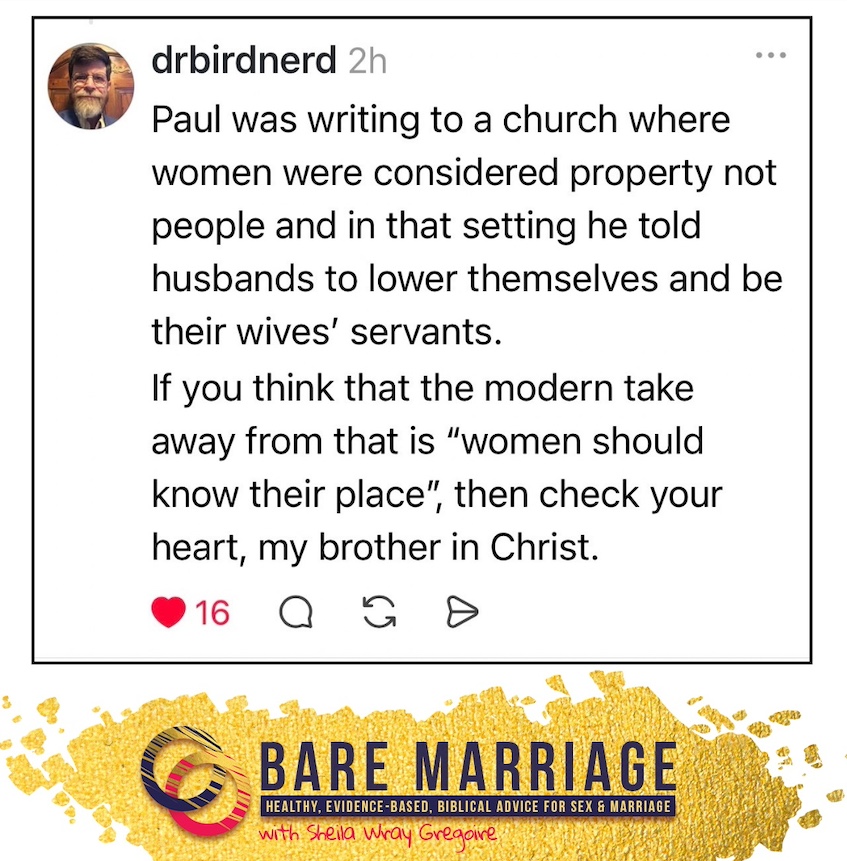
Meanwhile, when wolves like Brian Sauve, Joel Webbon and Doug Wilson preach the overt subjugation of women, they remain ominously silent. I find it completely surreal to be called a heretic by such people.
Just like the religious leaders at the time of Jesus,many are intentionally committed to missing the point.
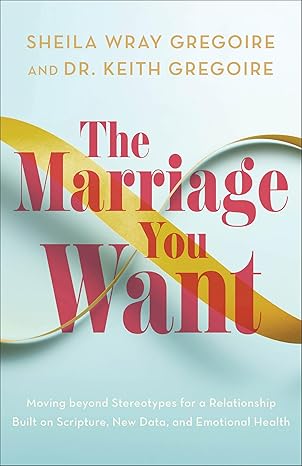
The whole of Scripture and the example of Jesus Himself is about giving, not about taking. So why are we men fussing over ensuring we have the highest place? The response that “the husband’s authority is only for the wife’s benefit” is frankly nonsense, and, as Sheila has repeatedly shown, results in WORSE marital outcomes for wives when practiced, not better (see our book The Marriage You Want for more), but even if it weren’t, the fact remains that this clearly goes against the teaching of Jesus to intentionally take a place lower than we think we deserve. In this regard, the metanarrative of Scripture seems consistent to me. Jesus, our model, told us He came “not to be served, but to serve”. So how did we ever get it in our head that God’s priority for marriage was to make sure everyone accepts their proper place in the hierarchy? How can we read “the last shall be first and the first shall be last” and hear “It is extremely important that husbands and wives know where they sit in the pecking order”? How do we not see that we are on the wrong track even thinking about such things?
I try to read Scripture through the lens of Jesus.
And what is the heart of Jesus?
Do we really think it is for people to know their proper place in the hierarchy?
For men to openly take power upon themselves and for women to accept subordination with a smile?
Or is it for both of us, husbands and wives alike, to take His yoke upon us, to learn from him and, in gentleness and humility of heart seek, to serve rather than to be served?
These apologists for unilateral wifely submission bring proof text after proof text but to me they just sound like the people Jesus rebuked for not understanding the heart of the Scriptures. If I may paraphrase the gospel of Mark:
They have a fine way of rejecting the words of Jesus in order to keep their tradition. For Jesus said, ‘Do unto others as you would have them do unto you.’ But they say ‘Because I am the husband and you are the wife, what I want you to do unto me I will not do unto you for that would forsake our proper roles.’ Likewise, Jesus said ‘Love your neighbour as yourself’, but they say the husband and wife must love each other in completely different ways in order to be “Biblical”. Thus they nullify the words of Jesus through their tradition that they have handed on. And they do many things like this.
Egalitarians are constantly accused of “not obeying the Bible’s commands” and frankly I am tired of it.
The Bible commands women to submit to their husbands (though, interestingly, not in Ephesians 5 where the Greek form of the verb is not in the imperative). It also commands all Christians to submit to one another.
The egalitarian view of marriage allows for obedience to both commands, because both submit.
The complementarian view, on the other hand, by insisting that for all intents and purposes, it is only the wife who submits, only accomplishes half as much. And the idea that the husband submits through “servant leadership”, so they both technically submit, simply doesn’t cut it.
And anyone who interprets the Bible in such a way that the very same word means one thing for a woman and another thing so vastly different that it is basically the polar opposite for a man, is in no position to criticize how others interpret Scripture.
We have some quick videos that address some of the talking points of complementarianism that you can share! Subscribe to Good Fruit Faith for more!
What do you think? Has your experience been people approaching Ephesians 5 in good faith? Let’s talk in the comments!









Questions:
For someone who did not grow up learning about Christ, how do you (Keith, other commenters) suggest achieving that overview of Christ in order to develop a Christ-like lens or metanarrative? It is not realistic for new believers to read the entire Bible in a short span of time to develop that metanarrative so what has worked for y’all?
I wonder, especially in our fast-paced world, if verses feel like a better, broader overview because you grab one from Ephesians, from Genesis, from 1 Peter, from Titus, etc., and get a wide sampling of God?
Don’t read the verse without reading at least the entire chapter, and if it’s near the beginning or the end, the preceding or following chapter. That way you have some chance of getting the context. The classic anti-proof text example in my youth (think I am half a generation older than the Gregoires) is:
Judas went out and hanged himself.
Go thou and do likewise
I recommend starting with just reading the gospels in order to understand the character an example of Jesus. Observe how he treats people, and how he rebukes those who claim spiritual authority. The more we know Jesus, God incarnate, the lover of our souls, the better we are able to identify abuses of scripture that are counter to his character and example.
What Esther and Karena said. Then, when you read other parts, read with the question, “Is this reflecting the character and message of Jesus-God or is it simply reporting what happened/how people thought back then?” I like to read a gospel, then another book, then go back to a gospel. Or alternate chapters from each book, if you’re the type who is able to read two books at the same time.
It also helps to start dabbling in history, cultural exploration, and literary styles. Use secular and religious sources with the questions: When secular sources give a different reason/perspective, what background theology might be influencing the religious sources to have their perspective? Where do religious sources disagree? What beliefs might be leading people to different conclusions?
Of course, all sources have a bias, but it seems like religious sources get more of a pass on saying things without evidence even when there is evidence to the contrary. If that sounds like too much work, that’s why it’s called Bible *study.* Forget what people claim about reading the Bible being so joyful and restful. If that happens, great. There’s nothing wrong with reading for devotional purposes, but devotional reading is not the same as study reading. Study is, by nature, work, so don’t be concerned if Bible study is hard and sometimes boring. And I don’t mean Bible study as in a booklet with fill-in-the-blanks and application questions. I mean study as in the way you “study” a hobby that is deeply interesting to you. You spend a lot of time with the topic and topics related to it.
If that’s too much to take on right now, read the gospels. Luke is my favorite for showing the character of Jesus/God. John is good if you like puzzling through dense theology. Mark is good for an overview without much detail. Matthew is good if you want a bit of each style.
Good post.
Don’t read the verse without reading at least the entire chapter, and if it’s near the beginning or the end, the preceding or following chapter. That way you have some chance of getting the context. The classic anti-proof text example in my youth (think I am half a generation older than the Gregoires) is:
Judas went out and hanged himself.
Go thou and do likewise
Good post. Thank you, Keith.
I think it’s really important for us to remember that the actual wording, in the original Greek, of verses 21-22 is “Submit to one another out of reverence for Christ, wives to your own husbands as to the Lord.” It is all one sentence. There is no separate sentence addressed to wives. If it feels odd to you that the Greek doesn’t repeat the verb — we have to kind of just keep it in our mind and mentally insert it into the second half of the sentence — we do it in English, too, although not as often as they did it in Greek. Imagine that several of you came to my house, and I said, “Everyone sit down, Sheila on the couch, Keith over here . . .” You would understand what I meant without my having to repeat “sit down” each time. But not repeating the verb makes that second half of the sentence kind of parenthetical, and when I read these verses, I hear them like this: “Submit to one another out of reverence for Christ (wives, to your OWN husbands as to the Lord).”
I recall reading, years ago, an explanation of Romans 6:1-2 (“Shall we go on sinning that grace may increase? By no means!”) which said that some unscrupulous men were using this argument to seduce women, kind of like, “Hey, baby, hop into bed with me so that by sinning, we can increase God’s grace in the world.” I have no idea whether or not this is historically accurate or whether it’s one of those myths that circulate through the church without any real foundation, but it would make sense, given that this entire chapter is one long, cohesive warning against sexual immorality (even the warning against getting drunk, in verse 18, is because it “leads to debauchery”). Paul begins this section (Ephesians 5:3) with a warning that “among you there must not be even a hint of sexual immorality”, continues with “Let no one deceive you with empty words, for because of such things God’s wrath comes on those who are disobedient. Therefore do not be partners with them” (5:6-7) and “Be very careful, then, how you live . . . do not be foolish,” (5:15, 17) and then, when he moves straight into a discussion of submission, he includes the word “OWN” in verse 22. Is his purpose here actually to protect women rather than to oppress them? Is he saying, I want every Christian to submit to every other Christian, but by the way, women, I don’t want anyone to take advantage of you, so let me clarify that although you are obligated under the laws of Rome to submit to your husband (so yes, you should do that), don’t let any other men use my words to convince you to submit to them, especially in ways that are not “as to the Lord”?
That is how I read it.
It is also REALLY important to remember that “submit” is not a perfect translation of the Greek verb *hupotasso*. It is literal in that *hupotasso* is a compound word made up of two words meaning “under” and “set/arrange/deploy”, and so is “submit” (“sub” meaning “under” and “mit” being from the Latin word for “send”.) So both words literally mean “send or deploy yourself under,” which technically makes “submit” a good translation of *hupotasso*, but unfortunately, they have very different connotations. Nowadays, we hear the word “submit” as “obey.” This is not what the Greek word means, as I understand it. It is a military term, and has to do with deploying or setting yourself up to support or provide reinforcements to someone else (like the cavalry that comes riding over the hill in so many old Western movies). (The best articles I have seen on this are by Stant Litore, at https://stantlitore.com/2018/06/25/misleading-translation-wives-submit/ and https://stantlitore.com/2018/09/04/a-military-metaphor-in-the-new-testament-and-where-our-translation-goes-wrong/. He has studied Koine Greek, so he can speak on this with some authority.)
Putting yourself under someone else doesn’t have to mean making yourself subject to them or obeying them. It can, and I think it does, mean getting underneath them to lift them up, to support them or defend them. It also means lifting them above yourself in the way Paul talks about in Philippians 2:3 when he says, “Rather, in humility, consider others more important than yourselves.” In fact, it’s ridiculous to understand “submit” as “obey.” How would that work in the context of Ephesians 5:21? We all have to obey each other? Your husband has to obey you AND you have to obey him? Your children have to obey you AND you have to obey your children? Your pastor has to obey you . . .? If the word that is usually translated as “submit” really means “obey,” then Paul’s command to us to all submit to one another is complete nonsense. But if we understand it to mean, “Each of you, put the other one first; lift up and defend one another; wives, support your husbands — and husbands, love your wives,” then it all makes perfect sense and is in line with Jesus’ teachings.
If I seem to be contradicting my first point — why would Paul warn wives against submitting to men other than their own husbands if “submit” did not mean “obey” — consider how easily a selfish and unscrupulous man could pressure a woman by telling her, “Paul says you’re supposed to consider me as more important than yourself. That means doing what I want you to do.” I think that Paul is leaning into the military meaning of the word *hupotasso* but is also aware that its meaning of lifting others above yourself could easily be twisted into “obey,” and he wants to protect vulnerable women from being abused in this way.
Paul’s use of this military metaphor (an unheard of thing when applied to women!) is telling wives NOT to say, “Yes, dear” but “I’ve got your back, dear.” And I like that.
Thank you, Keith!
I really for the life of me can’t understand why being in charge is such a big deal to men. With two major exceptions my wife and I have discussed every important decision arrived at an answer together.
The first situation was the result of some poor choices my wife made. A perfect storm of events made those choices look a lot worse than they were. I told her that these are the changes that were making to make sure that nothing like this ever happens again.
The second situation occurred over several years and gradually got worse. I attempted three serious conversations to solve the problem to no avail. The dynamic shifted when my youngest graduated high school. I told my wife that if we were going to stay married these were the changes that were going to occur. I really gave her a choice. I decided what I wasn’t going to put up with any more.