
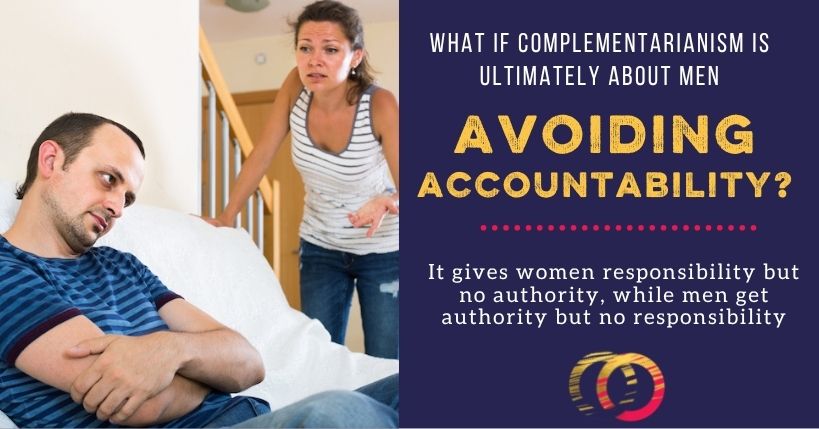


Is the aim of complementarianism to give men leadership over women?
Most complementarians would eventually say yes, even if reluctantly. They would say that God calls men to headship over women, which means that men have to be willing to lead their wives–which is a burden of responsibility. They’re willing to take on that burden on behalf of women.
That’s the rhetoric and the justification for putting men in authority over women.
But practically, when we look at the advice actually given to men and women, is the aim that men lead wives? Or is something else going on?
One way to figure this out is to ask:
If the aim really is for men to lead sacrificially, then what would be the primary teaching that we hear in the evangelical church about gender roles?
If this were the aim, the primary teaching would be:
- How men should adopt responsibility for the well-being of the family, including carrying mental load
- What sacrifice looks like, and how men should ensure that women have time off while men care for children and familiarize themselves with the needs of the family
- Maintaining moral and sexual integrity, including avoiding pornography, and serving their wives sexually instead of seeing sex as an entitlement
- How to hold other men accountable when you see a man not living up to his responsibilities
And so on. I’m sure you would add your own! In other words, the emphasis would be on how men both (1) sacrifice their own time and desires for the sake of their families and (2) take the hands-on responsibility for their families.
That’s what it would look like if they were serious about men leading.
So here’s my question:
Is the teaching that we hear in church encouraging men towards this kind of leading?
And I believe that the answer is an unresounding ABSOLUTELY NOT. If you haven’t already, please listen in to last week’s Bare Marriage podcast (episode 335) where Keith and I looked at how women were being encouraged to “draw a map” for the men in their lives and to lead the men in their lives towards better and more responsible behavior. As Kevin Leman said, you can’t expect men to get it, because men are just “4-year-olds who shave.”
Instead of teaching that men should be sacrificing for their wives in specific ways, evangelical advice, as we have covered repeatedly in the podcast and in our books, revolves around ensuring that men stay at the top without being questioned.
Evangelical advice, instead of moving men towards action, shields men from accountability, while putting all the “action” onto their wives.
Just think about what we are repeatedly told:
- It’s wrong to ask your husband directly for something, because that would be disrespectful, and we have to remember that men have the most fragile egos on the planet (from Love & Respect). So you can only say 2-3 sentences every 10-20 days if you want something.
- Men have an insatiable need for sex, so if they don’t get sex, they’ll turn to porn or affairs.
- If you’re a teenager or in a dating situation while older, remember that men can’t control their sexual urges the way you can, so you have to be the gatekeeper and make sure it doesn’t go too far. But also remember that you can inflame him by what you wear or how you act, and he will treat you accordingly.
- Men aren’t made to emotionally connect the way women are, and so you will naturally feel more connection to your children. Remember that this is a fragile time for your husband, and so make sure that you pour out your affection on him and don’t make him feel displaced.
- Men need to feel like you respect them and think they’re amazing. So call out the good that you see. Give him a crown and he’ll become a king! (remember Josh Howerton saying this?)
- Men need unconditional respect, which includes you going ahead with what he decides, and letting him make the final decisions.
When messages are given that men need to lead, a greater proportion of that time is spent telling women what that looks like–and it tends to mean not challenging him.
I have so many examples of this in my upcoming book Fawn: How a Trauma Response Became Biblical Womanhood, and How Women Can Reclaim their Agency (you can preorder now!), but one of the big things we’re showing is that the aim of much evangelical teaching is not to help men take on responsibility, but rather to maintain power dynamics that give men power and keep women vulnerable, in order that men avoid accountability.
It really is that simple.
If you look at all the things that go into teaching what it means that men are in leadership over women, they boil down to one thing:
Men get to avoid accountability.
- If he sexually assaults her, it’s because of what she was wearing.
- If he wants to play video games all day, she can’t say anything.
- If he’s avoiding sharing the responsibilities of parenthood, she can’t question it. She has to accept it and step into the gap.
- If he’s watching porn, it’s because she’s not performing her duty.
- If she feels distant and unhappy in marriage, it’s because she’s not submitting enough.
- If she wants him to emotionally connect with her, it’s because she doesn’t realize that God made men and women to be different, and she’s asking too much. He has to remain emotionally disconnected so that he can lead properly, after all.
In all of these things, and countless more, the aim is to shield men from having to change or do hard work in the relationship, and ensuring that the hard work falls on women.


Men also get to avoid doing jobs they don’t want to do
The other benefit of men being in power is that they get to fob off the things they don’t like doing onto women, while claiming that they are doing so under the mantle of leadership.
John Piper famously said:
Mature masculinity accepts the burden of the final say in disagreements between husband and wife, but does not presume to use it in every instance.
He’s portraying having the final say in decision-making as a burden. If it were a burden, we would expect to find that in couples that practice this, men do worse than women do. Men would experience more stress, have less free time, and have lower marital satisfaction than the women who apparently benefit from this.
Instead we find the opposite. The men who most escape responsibility for the family are those who practice having the final say in decision-making. According to our surveys for our book The Marriage You Want, the men who most adopt the burden of the family and show up to help the home run and to care for the kids are not those who take power for themselves, but those who share power with their wives, as Christ modelled in Matthew 20:25-28.
While men like Piper justify men having authority as a “burden” to make it seem as if the hardship is equally spread out, nothing could be further from the truth.
Teaching that men are in authority over women in the church and the home means that men are able to say that they are taking on a burden and doing these important tasks of leadership while actually distancing themselves from the jobs that are the hardest, most monotonous, and never ending.
Just look at who volunteers for what in church. Who actually does the real service of keeping everything running, versus who gets to sit in meetings and get yearly retreats to “vision cast”?
Or at home, who does the monotonous work, and who gets the most free time?
Those who do the leading are not actually those who make the decisions.
As we showed in Thursday’s podcast definitively, evangelical advice actually makes WOMEN the leaders by saying that we can’t expect men to act responsibly and to become Christ-like without women’s help. Women are already responsible and mature; men won’t get that way without women intervening.
And then it’s women who set the tone of the house and who get the work done. It’s women who keep the churches running.
Even if men are making the decisions, it’s actually women who are leading and accomplishing.
And I suggest that this is the main goal.
Complementarianism ultimately allows men to escape accountability, expectations, and unwanted work while pushing responsibility to women.
Men get all the authority but no responsibility, while women get all the responsibility but no authority.
And all along, we’re told we can’t expect men to do anything more than that, because they’re men. They weren’t made like women. They don’t understand emotions. They weren’t made to care for children. They just don’t see what needs to be done the way women do!
I know this sounds awful, and I’m not even claiming that it’s deliberate, like a conspiracy plotted from on high. I think instead that people really like privilege, and once they have it, they don’t want to give it up, so they will find ways to solidify it and justify it so that they keep it. And they’ll do this even without specifically thinking about it.
That’s the fruit of complementarianism: Women keep the churches and families running, at the expense of themselves, while men get more leisure time, escape accountability and expectations, and get to choose what to do rather than having jobs delegated to them.
It’s not about men taking responsibility for the family. It’s about men being able to escape responsibility by claiming authority.
This is why Jesus told us not to seek authority over people
The modern evangelical church is so concerned with the right people being in authority over others, and the right order of things, yet Jesus was adamant that the church was not supposed to be a place where certain groups had authority over other groups. He told us that if we wanted to follow Him, we had to focus on serving, not authority.
The Pipers of this world try to get around this by claiming that by having authority, they are serving. But it’s all word salad. Practically, that’s not what happens, and we all know it.
The most exhausted and depressed women are those in churches and marriages where their husbands exercise authority.
And it’s time that instead of hiding behind words that complementarians use to make all of this sound good, that we show it for the rot that it is.
Jesus called us to serve, not to exercise power. So let’s get back to relationships oriented around serving, not oriented around authority.








Where does the “4 year olds who shave?” comment come from? That makes me so angry, but I’d like to read it in context before I get too carried away.
I’ve heard that comment now and again, but I’m not sure of its origin. Based on my life experience, I will say that this does indeed apply to some men.
Lotsa arrested development cases out there, walking around in allegedly-adult bodies.
The video clip is in the podcast from last week! It’s a quote from Kevin Leman.
Thanks, I’ll look it up. It absolutely does apply to some people but notmalising/excusing it is not ok (if that’s what he was doing – I’ll watch it in context)
For anyone else who’s interested, as Sheila says it’s here, at about 43.5 min: https://baremarriage.com/2026/08/podcast-if-men-are-leaders-why-do-they-need-women-to-fix-them/
I didn’t think the context made it any better. Obviously it’s a joke, but still so infantilising. If said as part of a stand up comedy show, the underlying message would obviously be that the behavior and attitudes he’s attributing to men are childish and pathetic. But somehow in that context he makes it a joke about how women just need to accept ‘men’ who have never reached adulthood.
If he really believes that about men, why is he not using all his time and energy and profile to help them grow up, instead of telling wives how to manage (but not change) a parent-child dynamic in their marriage?
Exactly. And we women need to push back, too, and say, “You’re wrong. That’s not what real men are like.” I am insulted on behalf of the men I love and admire.
This comment really bothered me as well. Lehman isn’t the only one who says stuff like this. It’s like people heard the term “inner child” and ran with it, not bothering to understand what the concept is actually for. That is, yes, we all have parts of ourselves that respond like the child we used to be, but as grown adults we have to learn to care for those parts OURSELVES, not push that responsibility onto someone else. Other people can support that, but it’s not anybody’s job to take on “parenting” another adult. It’s kinda gross.
“If he sexually assaults her, it’s because of what she was wearing.
If he wants to play video games all day, she can’t say anything.
If he’s avoiding sharing the responsibilities of parenthood, she can’t question it. She has to accept it and step into the gap.
If he’s watching porn, it’s because she’s not performing her duty.
If she feels distant and unhappy in marriage, it’s because she’s not submitting enough.
If she wants him to emotionally connect with her, it’s because she doesn’t realize that God made men and women to be different, and she’s asking too much. He has to remain emotionally disconnected so that he can lead properly, after all.”
This checklist DOES sound like a wet dream for a “four-year-old in an adult body” who’s also packing his brains below his belt.
Mixed with that 1960s Excedrin radio ad “Excedrin Headache Number 135”:
“Me Man. Me Want Supper.
You Woman. You Shut Up.”
I spent a number of years in complementarian churches, and even before learning the concept of “mental load” was able to see the undue burden it was placing on mothers in particular: https://whyhavewefasted.substack.com/p/pastor-compliained-about-wife-from-pulpit
I’m wary of pastors who complain about other people from behind the pulpit. It’s always a red flag.
I agree, complementarians know what they’re doing is wrong–maybe not all individuals, but definitely the group as a whole, and especially the men at the top. Have you heard of POSIWID? It stands for, “The purpose of a system is what it does.” If a system claims to support healthy marriages, but it actually enables abuse, then the abuse is a feature, not a bug. Most complemetarians I know are gainfully employed with a wide social network. Many hold college degrees. I have a hard time believing that the consequences of their behavior elude them when they’re smart and successful in every other way.
I completely agree!