


We know that the evangelical church has taught horrible things about sex.
We know those things have had a horrible impact. And so, how could it be possible that Christians still seem to have better sex than the general population?
Over the last few days I’ve been dissecting the recent IFS study claiming that Christians had better sex. I had a big article on it on Monday (and Friday on my Substack), and we talked about it in last Friday’s video round-up.
One of the big categorical mistakes people were making was claiming that because this study shows that Christians have better sex, then evangeicals must have better sex! The video, and that article, showed why that conclusion was faulty.
But there’s another mistake that people were making in the comments, and it makes the same claim from the opposite starting point:
Because evangelicals have taught so badly about sex and hurt people, there’s no way Christians have better sex.
Last weekend, for our weekly email, Rebecca wrote up her own thoughts that addressed that second faulty conclusion. And I’d like to run it today as a post.
Our email list is a great way to keep up with what’s happening at Bare Marriage. You’ll hear when our launch team for Fawn is open, or when you can get your pre-order bonuses. You’ll hear if we’re ever speaking in your area, or if something big goes on sale. And you’ll hear some behind-the-scenes news!
So if you’re not subscribed, please do! We won’t spam you. But it’s a great way to make sure you don’t miss anything important.
Here’s Rebecca!
Are you having enough sex to own the atheists?
We’ve been hearing from people on social media that a huge study came out that found that, actually, the Bare Marriage data is wrong! Christians DO have amazing sex, so our findings about the orgasm gap must be false!
This is based on findings from the recent IFS study celebrating how Christians seemed to have skipped the “sex recession” because they had more sex than their secular counterparts.
The IFS study has, as far as we can tell, good data.
However, it fundamentally did not study the same topics that we did in our research.
It was just studying a different topic. But the fact remains there were no questions on orgasm, sexual pain, libido, confidence in arousal, or anything of the like.
And yet, this is being touted against us as a huge ground-breaking result that “disproves our data” despite the fact that it doesn’t address a single one of the issues we found in our research. It’s been kind of funny to watch comp men keep coming at us with this study in a way that sounds like they’re saying, “See? It’s OK my wife doesn’t orgasm because the IFS says I have more sex than atheists!”
It’s not quite as much of a “gotcha” as they’d like to think, and I want to spell out a few reasons why.
However, my mother did a much longer, well-written breakdown of it on her substack (that we ran here on Monday!) so if you haven’t seen that yet, go read it—or watch my parents talk about it in this week’s Friday round-up.
But there’s another group of people who are angry about this study—people who were harmed by sexist church spaces.
It’s always interesting to me when we’re facing anger from both sides—the conservatives are saying, “See! Religion helps marriages, you’re wrong, our churches are great!” And people who left the church because of serious hurt are saying, “How can you say church is beneficial when it hurt me so badly?”
And interestingly enough, both sides are committing the same error—they are assuming that they are “the mean.”
So let’s talk about an evidence-based approach to research like this, and where we can fall into bias traps.
1: We fail to look at WHAT was measured, but rely on assumptions instead.
The recent IFS study asked, as far as we can tell, around four questions on sexual and marital satisfaction. They were:
- How often the respondent was having sex
- How the respondent felt about his/her sex life
- How the respondent felt about his/her marriage
- Whether you felt in the last twelve months like your marriage might not last
And that’s it.
Nothing about orgasm is found in their 62 page report. Nothing about sexual pain. Nothing about whether you feel emotionally close during sex. Nothing about trust.
Now, I’m not going to get into the weeds of what we found because, as I said, my mom did a fantastic breakdown of it (again, read it here) but here’s what I want you to understand:
If two studies measured different things, they cannot in good faith be compared at face value.
You cannot take the IFS’s report on “how do you feel about your sex life?” and compare it to our findings on libido levels, confidence in arousal achievement, orgasm rates, and sexual pain. Those are fundamentally different questions, measuring fundamentally different things. It would be like if a study of pet owners asked, “How do you feel about your pet?”, the respondents overwhelmingly said “good”, and then that study was used to conclude that Yorkies never pee in the house. Friend, they didn’t ask that. You’re just extrapolating based on your assumptions of what it means to feel “good” about your pet. We have to look at what was actually asked and—sometimes even more importantly—what wasn’t.
2: When we assume we are the mean, we see the world through a biased lens.
“Mean” in stats language just means average. We tend to assume subconsciously that our experiences are “normal.”
But here’s the thing: you might not be normal.
And no, that’s not gaslighting. It’s just data.
The evangelical complementarian mindset is present in a subgroup (complementarian) of a subgroup (evangelical) of a subgroup (Protestant) of Christians. But what’s happening is that complementarians are seeing the population-wide statistics (that religious folks have better marriages) and assuming that it also applies to their sub-group. But what if their subgroup is an outlier?
Here’s an image to show what I mean:
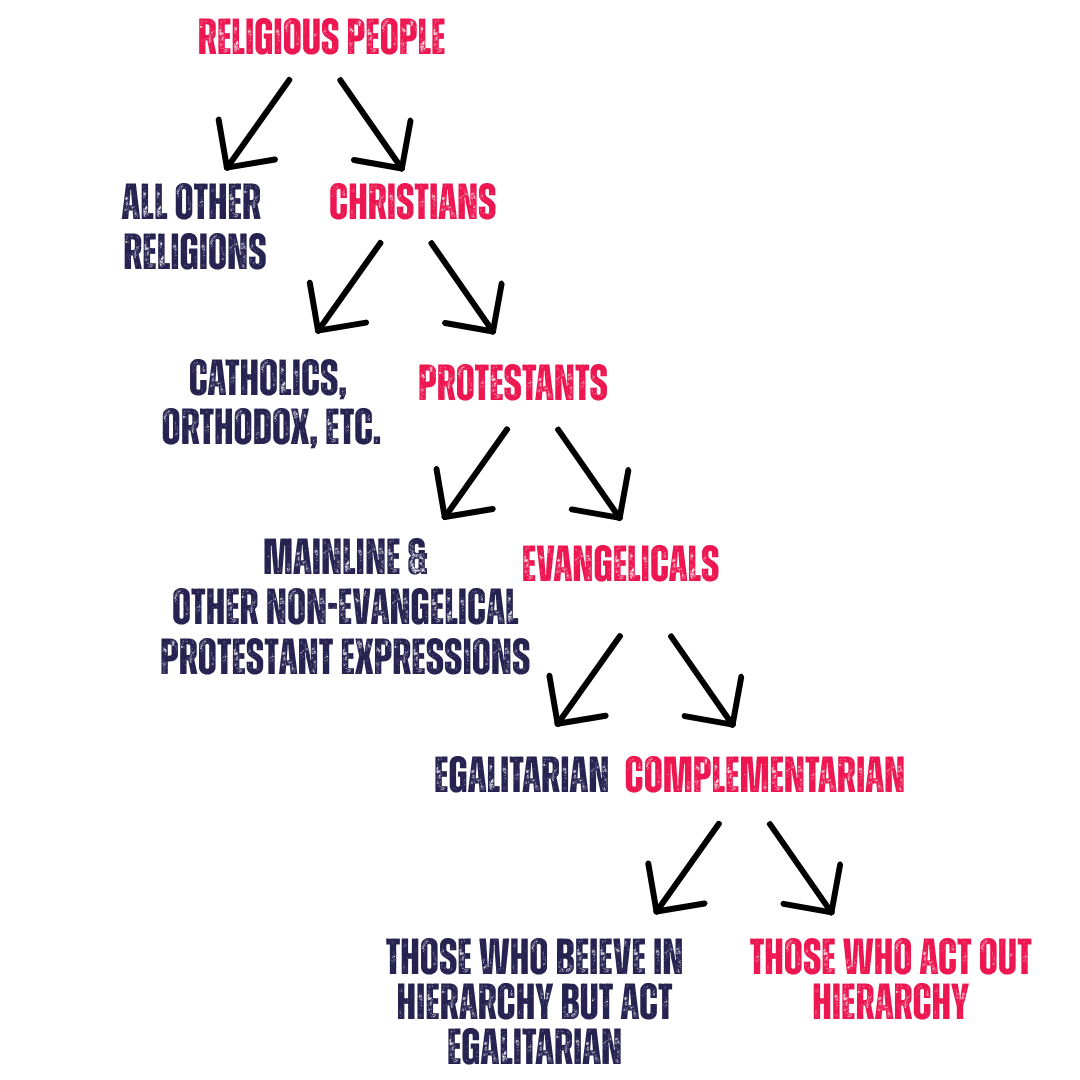
Our study found that religiosity is beneficial. But people who follow comp teachings do worse than people who do not.
In other words, they’re that kid in the group project who isn’t pulling their weight and only got an A in biology because they happened to be lumped in with the high-achievers in class. It is technically true that they got an A, but it wasn’t because they did a good job—it was because the people around them did.
But this goes the other way, too.
If you’re someone who was harmed by the church, it feels “wrong” to hear that religiosity is beneficial.
But the fact of the matter is that the evidence repeatedly says that religiosity is good for us. It does something good to our psyches:
- (a) to believe that there is a greater being out there who loves us,
- (b) to be held accountable to show up for others in our community,
- (c) to surround our children with a “village” of multiple generations who will watch out for them and love them,
- (d) to be connected to others in a way that is meaningful,
- (e) to have routine in our lives and have to manage our time and money in a way that we otherwise might not if there were not external factors encouraging us to be good stewards, and
- (f) feel that there is fundamentally a purpose for our lives, that we matter, and that we were put on this planet to help and love one another.
When you were hurt by a specific group of Christians, it can feel like you were hurt by “religion” writ large. And I don’t say that to say the stupid platitudes people hear all the time about “Jesus didn’t hurt you, people did, and people are imperfect.” I have no time for that—we are the ambassadors of Christ, and it’s a cop-out to pretend that people should be expected to separate the harm done in the name of Christ from the person of Christ himself.
But what I am saying is that an evidence-based approach to this is to recognize that if you were harmed by a complementarian, fundamentalist church—that does not erase the fact that overall, religion is widely beneficial. An evidence-based understanding of your experience can both (1) hold the validity of your feelings while (2) recognizing that you were an outlier in the grand scheme of things because you were involved in a harmful sub-group of a larger beneficial movement.
The fact that there are churches pulling down the average also means that there are many churches pulling that average up.
An evidence-based approach does not and cannot ignore that fact even if it does not fit with one’s personal experience.
We can both say “your experience was real and valid” and also say “it is not indicative of the normal experience in religious spaces.” But I simply cannot, from an evidence-based stance, say that all Christianity is harmful, or that religiosity is not supremely beneficial. It is. And that research is what kept me and other members of our team motivated to find non-evangelical spaces to worship at when we were feeling incredibly disillusioned by what we were finding with every new stat we ran about common evangelical teachings.
Any time we extrapolate our personal experiences with a subgroup of a population to the population as a whole we are allowing our bias to colour our worldview. It doesn’t matter if you’re doing it from the right, from the left, or from a central position—it’s still bias.

3: Too often we go to data for coddling rather than direction.
To be an evidence-based person, your life has to change based on the data you find. Point blank. If you’re not changing your mind, I struggle to think you’re really grappling with findings on a regular basis.
I’ve changed my mind this year alone on four different things I can think of right now. Is it fun to realize, “Ooh, I was wrong about that”? No! But it’s necessary.
But what happens with studies like this IFS one that came out is peoples’ responses to it show that they’re just looking to see what they want to see, and not following their own assertions to the logical conclusions that don’t look on them as favourably.
For example, with this IFS study a lot of the comp men on social media are saying, “See? Since we have better marriages and sex lives than the atheists that means we’re doing it right!”
But that study found that the group of Christians doing the best were…church-going Catholics.
By their own logic, these complementarians should be converting to Catholicism if the way that you know you’re “right” is by owning the Athiests the most!
And yet that’s never the conclusion they draw from this. They’re happy to say that because they are doing better than non-Christians, that means that they’re doing what God wants but then aren’t willing to follow that logic to its natural conclusion—which is that they should convert to the type of Christianity that is doing the best if they want to be the closest to God’s desire!
Now, I don’t believe that our belief system should be based on who an IFS study says has the most sex. I differ from our comp friends in that regard. But what I do believe is that if we take an honest approach to data we shouldn’t always be met with affirmation. We should sometimes be challenged, too.
If you’re using research to supplement your already formed opinion rather than forming your opinion with research—which means it should change and develop over time as we learn more and more—that’s a sign that you’re using research to soothe your existing biases rather than seeking truth.
If you’re looking for research that shows that church is harmful, you’re probably going to find it.
If you’re looking for research that shows that religiosity is beneficial, you’re going to be able to find it.
But if you look at the overall data in the literature about religiosity you’re going to find something more nuanced.
You’re going to find that religiosity is supremely beneficial—unless you’re in a religious setting that is about keeping power in the hands of some and out of the hands of others. Unless you’re in a religious setting that teaches women a different set of rules than it does men. Unless you’re in a religious setting that enables one group of people and heaps heavy burdens on another.
And that’s a lot messier than, “We have more sex than the secular world, boo yah.”
Download Our Marriage Survey
Join 40,00 others and let's change the evangelical conversation about sex





I just want to reiterate that secular sociologists attribute the recent sex recession to women feeling more empowered to say “no” to sex they don’t want (whether they’re married or not) in the wake of the #MeToo movement. So let’s just remember that church is the one place they’ll be discouraged from refusing sex with their husbands, and even told it is a sin.
It is also worth noting that the sex recession is affecting straight people only. That’s because straight women are the ones having the worst quality sex (canned ravioli – IYKYK) and are, therefore, the most motivated to turn it down. But Brad Wilcox isn’t ready to deal with that reality. I mean, if we’re going to use frequency as a measure of good sex, then gay men are the ones who are knocking it out of the park!
Very, very true.
Sorry to keep commenting, but I’m still processing: imagine running a study on sexual satisfaction that does not include orgasm as a measure. Imagine taking seriously a study on sexual satisfaction that does not include orgasm as a measure!
I know! It’s crazy.
I appreciated last week’s email. I am part of the second group you mentioned (harmed by the church). I’m aware that I’m bias towards attending/being a part of church…or was I actually aware of my bias…? You’ve got me thinking about how maybe I’m not giving enough thought to that bias; that it’s a certain group…not religion as a whole. I’ll be honest, this is the first time in a very long time that I’ve felt challenged on this subject. The hurt runs really deep and therefore, I can be pretty adamant about church not being beneficial. So I wanted to thank you for this write up. It’s got me thinking, curious even that maybe I can change my mind on this.
Oh, that’s so good to hear, Brittany! NUANCE is the name of the game here. Some religious groups seriously do a lot of harm. But in our data, it’s so clear that belief and church are positive forces. It’s just really hard to find those good places!
(Other nuance: going to the toxic churches is still good for you as long as you don’t internalize the toxic stuff–and many people don’t. That’s why a lot of people in these toxic churches actually do do well. It’s really complicated! But some people do internalize the toxicity, and that means we have to fight against it!).
“(a) to believe that there is a greater being out there who loves us,”
Whereas if you’re taught that that greater being out there hates your guts and can’t wait to come back and destroy the world (“It’s All Gonna Burn”), you’re already starting off in crazyland.
“But that study found that the group of Christians doing the best were…church-going Catholics.”
You know? Those Romish Papists with their Counterfeit “church” and Satanic Death Cookies?
(I’m a moderately-practicing Catholic in Calvary Chapel-land; that’s not much exaggeration. Beware Thou of the Christians(TM).)
“Now, I don’t believe that our belief system should be based on who an IFS study says has the most sex.”
How does that differ from “I GET LAID MORE THAN YOU! HAW! HAW! HAW!”?
(Something I have experienced as an InCel in the original definition of the term.)
Your comment about being able to find research showing opposites reminds me of the time a company was seeking planning permission for a windfarm in our village. The group campaigning against the windfarm surveyed every household and discovered that “over 90% were against the windfarm”. The group seeking to build the windfarm also surveyed every household and discovered that “over 90% were in favour of the windfarm.”
Problem was, neither survey actually asked “do you want this windfarm to be built?” Instead, the anti-windfarm survey asked how much villagers valued the peace of their location and the beautiful countryside – of course, the majority placed a high value on these things, and since they would be spoiled by the windfarm, the survey compilers took that to mean they would be against the windfarm. Meanwhile, the pro-windfarm survey asked people to rate how concerned they were for the environment, how much they worried about their children or grandchildren’s future etc – because wind power is a ‘green’ energy, they assumed that anyone who expressed concern in these areas was pro windfarm!
Of course, the reality was far more nuanced. But nuance doesn’t impress those who have an agenda to fulfil!
Reality is just so nuanced! We found so much nuance in our data. Like, church is GOOD for you. Toxic teachings are not. But we can’t say religiosity is bad even if we’ve had bad experiences in church.