


The Institute for Family Studies, a conservative think talk, just published an article claiming that religious people have better and more frequent sex.
They published an article in the Atlantic explaining their findings, and a larger 62-page report on their website.
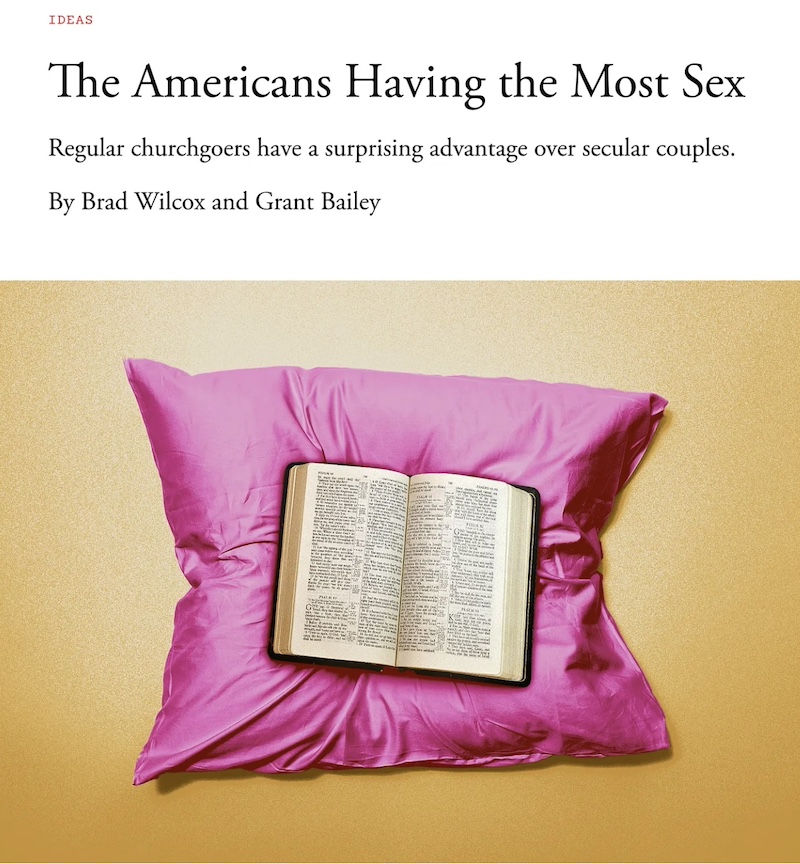
They were commissioned to do this by a Catholic group, and they do report their findings in terms of religious people overall, and then break it down by Catholic and Protestant specifically later.
Apparently on right wing social media, people are using this article to call our Bare Marriage findings into question.
In our survey of 20,000 women for our book The Great Sex Rescue, we found that women who internalized toxic teachings about sex (the obligation sex message; that all men struggle with lust; that wives should have sex to keep their husbands from watching porn, etc.) have worse sex lives than people who don’t believe these things.
A follow-up survey of thousands of men for our book The Good Guy’s Guide to Great Sex found the same toxic teachings hurt men too. And our matched pair survey for The Marriage You Want confirmed our findings.
I’ll also point out that the IFS section of the study looking specifically at faith was based on a survey of 3,125 married individuals, including 1,243 Protestants. This is far smaller even than our smallest surveys.
But here’s the thing: Our message all along has been consistent, and quite in line with this IFS study:
Religious people tend to have better sex and better marriage than non-religious people.
Absolutely! We agree. And this has been found by countless other studies too. It’s one of those things that is widely known in the literature, and it’s expressed in scientific terms like this: religiosity is a protective factor.
So I’m not surprised by these findings at all.
But…just because religious people do well as a group does not tell us how the subgroups do.
And this is where the rubber hits the road, and this is what we were trying to tease out in our studies:
Yes, religious people do well as a whole. But what happens to the subgroup of religious people that believe toxic messages? What happens to the subgroup that act out male hierarchy in marriage?
Then we see a whole different picture.
I’m going to explain what’s wrong with how people are looking at this study in this article, which also appeared last Friday on my Substack.
But if you’d rather watch/listen, Keith and I sum up this article in last week’s Friday Round-Up here:
Let’s jump in to the nitty gritty of dissecting this study!
The problem with saying, “Religious people do better,” is that if you’re religious, you’re inclined to say, “Well, I’m religious, so I must be doing better!” But in a large group, you may actually be bringing the average down, not up.
Imagine a classroom of 30 kids. 25 of those kids have super involved parents. Their parents pay money for tutors. They read to their kids for two hours a day. Kids have limited screen time. They go to museums on summer break.
Five of those kids, though, spend their lives on screens, and don’t talk to their parents much.
That classroom may have the highest standardized scores in the district. But just because that classroom does better as a whole does not mean that those five students can claim, “see, we’re the smartest kids in the district!” They just happened to be lumped in with the really smart ones, and they’re coasting on the reputation of those other kids—a reputation that they didn’t earn, and that they even worked against.
So let’s break it down:
Religious people = anyone who believes in any religion and attends a religious service on a regular basis
Christians = Catholics, mainline Protestants, Pentecostals, fundamentalists, evangelicals, Reformed Christians, and Orthodox (and Mormon, depending on the classification)
Protestants = Mainline Protestants, Pentecostals, fundamentalists, evangelicals, Reformed Christians.
Evangelicals = Egalitarians and Complementarians.
Complementarians = those who believe in male headship and act out male hierarchy and those who believe in male hierarchy but do not act out male hierarchy, and make decisions together (this latter group is much bigger than the first group)
Here’s what I mean in graphic form. When you follow this all the way down, you can see what a small subset “complementarian evangelicals” are of Christians in general, let alone religious people in general.
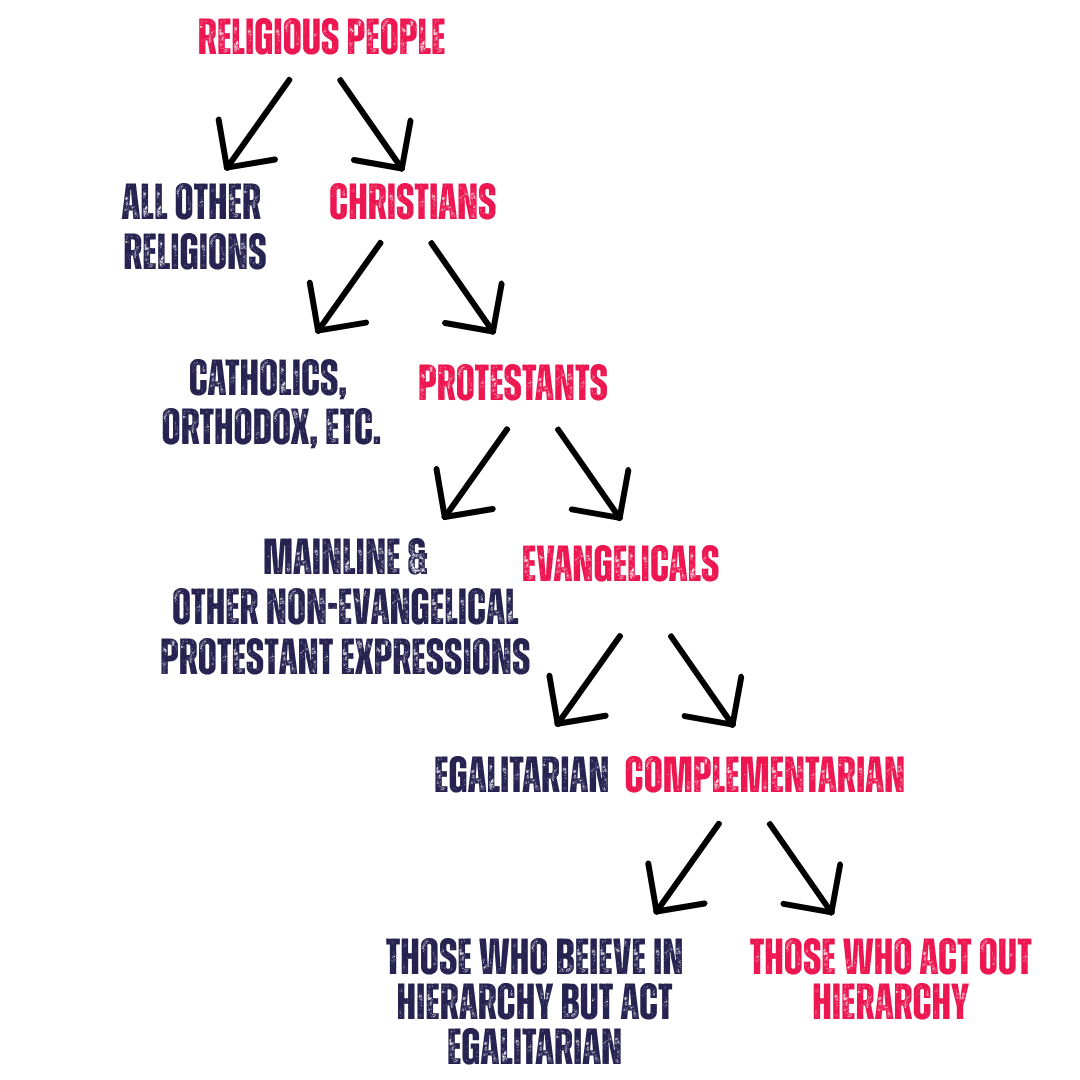
To claim that because “religious people do better”, or even “Christians do better”, or even “Protestants do better” than secular people does not mean that you can claim that “evangelicals who believe in male headship and who act it out do better”. And the latter is what we’ve measured definitively.
Most studies measuring whether Christians do better than the general population do not compare subgroups of Christians. Our study did, and that’s what makes our study different.
I can completely believe and agree that Christians as a whole do better than the general population, because this is what we have loudly said for years, and what our stats have showed too.
But this doesn’t mean that those who have internalized toxic messages, and who act out hierarchy in their relationships, do better. To know that, you’d have to measure that specifically. And we did. They don’t do better at all.
Okay, that’s where I agree with the overall message of the IFS study. Now I’d like to note some areas where I have some concerns.
Having more frequent sex is not necessarily something to brag about.
This study was framed in social media and in the Atlantic as “Christians avoided the sex recession.” So Christians were having more sex, and this was seen as a good thing.
And, in general, marital satisfaction does travel with sexual frequency. More sex tends to mean higher marital satisfaction.
But if you drill down (which we have), you find that this only applies in certain cases. For some couples, more sex makes marriage worse.
The only thing frequency of sex tells you is whether or not the man was reaching orgasm.
That’s it. Men pretty much always orgasm during sex, but other than that, nothing is guaranteed.
She may not be reaching orgasm (evangelicals have a 47 point orgasm gap, where 95% of men report orgasming almost always or always compared with just 48% of women).
She may be feeling distant or not emotionally connected during sex. She may even feel used (as 18% of our respondents reported). And if she’s feeling used after sex, her marital satisfaction would improve by NOT having sex.
When we look at the group of women who don’t reach orgasm and don’t feel emotionally connected, their marital satisfaction doesn’t improve by having more sex.
Frequency is not the point; the quality of sex and the marriage is the point.


Beware the Rose Coloured Glasses phenomenon!
The IFS has actually warned about this before in their own studies. In their World Map 2019, they said:
It is possible that simply being married is more important to highly religious women, which may raise their satisfaction ratings. They may be more likely to look at their relationship through a rose-colored lens.
In other words, many religious women have been told that marriage is the point and pinnacle of life, and so marriage is a larger part of their identity than it is for non-religious women. If you ask women, then, “how satisfied are you with your marriage?”, they may be more likely to report that they are highly satisfied.
In this most recent IFS study, they said they measured marital quality by simply asking how happy they were with their marriage. But they didn’t say if they drilled down any further, and I can’t find any evidence that they did (so even though they’re aware of the rose-coloured glasses problem, they’re not trying to tease it out).
In the Marriage You Want, we used FOUR different previously validated question sets to measure marital satisfaction—the Trust in Close Relationships Scale; the Kansas City Marital Conflict Scale; the Relationship Flourishing Scale; and the Couple’s Satisfaction Index. Together these were dozens of questions measuring all kinds of aspects of marriage, including things like:
-
I feel as if I can share my weaknesses with my spouse
-
My spouse understands my point of view when we’re in arguments
-
I have shared hobbies with my spouse
-
My spouse initiates repair when there is a rift in our relationship
Etc. etc. etc. In other words, we didn’t just ask, “are you happy?” We asked a whole bunch of questions that researchers have already found are correlated with marital satisfaction.
We’ve actually found some evidence for the rose-coloured glasses phenomenon in our dataset. We’ve described this in a previous article for Baptist News when we were critiquing Nancy Pearcey’s claim that complementarian men make the best husbands. Here’s what we said:
We contrasted those who strongly agreed that marriage should not have a hierarchy (egalitarian) and those who strongly disagreed (complementarian). Complementarian beliefs were correlated with 33% higher odds of having above average global marital satisfaction but also correlated with 35% higher odds of having below average specific marital satisfaction. While complementarian women were more likely to rate their overall satisfaction highly, when you asked them about individual markers of satisfaction, things didn’t look as rosy.
Those rose-colored glasses are present in the bedroom, too. When we look only at women who never reach orgasm, for instance, they are 22% more likely to say they’re satisfied with their orgasm frequency if they also believe in hierarchy in marriage compared with women who believe marriage should be equal.
Basically, complementarian women are MORE likely to say, “Yes, I’m happy,” when asked broad questions, but when asked about specifics, they’re actually LESS likely to be happy than those who don’t act out complementarianism.
We need more concrete measures of sexual satisfaction.
There are studies that show that women judge their sexual satisfaction on what the man is experiencing. If he is happy, then their sex life is happy, because the sex life is not about what she feels, but about something that he needs. So if she’s doing her duty and he’s happy, then their sex life is good.
One study summed up the findings this way:
Several qualitative studies found that in women’s definitions of sexual pleasure, having an orgasm played a minor role as compared to other themes like emotional intimacy or partner satisfaction.
So she’s more likely to judge her own sexual satisfaction on her partner’s satisfaction. And this would be even more true in subgroups that have stressed men’s desperate “need” for sex while downplaying women’s sexuality completely (again, Emerson Eggerichs, in his chapter on sex, never once mentioned that women can feel pleasure too, and made the fact that sex takes such a short amount of time a bonus for women).
To truly judge sexual satisfaction, we need to know orgasm rates; how emotionally connected she felt during sex; and how emotionally connected she felt after sex. We also need to know if coercion was present, and if sexual pain was present.
From the IFS report, though, these are the only two questions that were asked:
-
“About how often did you have sex during the past 12 months?”
-
“How would you rate your overall sex life these days?”
That doesn’t give us a complete picture.
“Owning the Libs” is not necessarily something to brag about
Finally, just because religious groups do better than secular groups doesn’t mean that we should pat ourselves on the back.
Think about the benefits from religiosity. Being involved in a faith community means you’re less isolated. You have ready-made friends. You have people who will jump in if you’re in the hospital; if you have a baby; if someone you love dies or is sick. You have people who can baby-sit. You have ready made events for your kids. You have a network of people to help you find a job or mentor you.
Religious people have a leg up!
But also, think about the kinds of people who are able to attend church services several times a month. Unless you live in a city with good transportation, it means you have to have a car. You can’t have super chaotic work schedules. So you’re likely in a higher socioeconomic group.
You’re less likely to have major addiction issues or mental health issues or chronic health issues, since those keep people from church.
And those are the benefits without even considering the impact of having a relationship with God; with having a purpose for your life; with having a ready-made way to feel peace.
So of course religious people should be doing better! The question is not do religious people do better; it’s how much better do religious people do.
A fourth grader bragging about beating a first grader in a race would be silly. Of course they should win! They’re bigger. The real issue is how much did they win by? Here is the IFS chart:
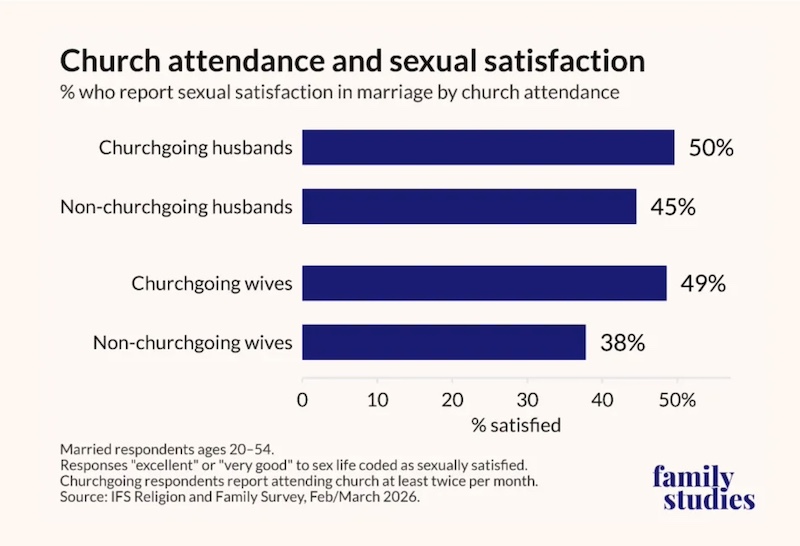
Again, this is pretty in line with what we also found. But is this something to brag about?
Rather than owning the libs, we need to ask what actually brings health and wholeness.
Let’s stop bragging about doing better than secular couples, and start looking at whether the things that we’re teaching about sex actually lead to flourishing or not.
Yes, of course religious people do better! But if we’re simultaneously teaching things that make things worse, than rather than bragging about doing better, we’re missing out on the flourishing God has for us.
By continuing to brag about how much better we’re doing, instead of confronting the fact that we should be doing even better, we’re missing the point entirely.
What do you think of the study? What’s your initial reaction? Let’s talk in the comments!







I can not help but find the “owning the lins” aspect of this weird. I say that because I am sitting here going ok what exactly are you trying to prove?
If you want to show that marriage is good for society there are plenty of case studies on that. Nit just individual studies but studies of studies.
If they are trying to be like see the stereotype isnt true that church goers cant enjoy sex well i just sit here going your research said the same thing.
It also said though that hey demanding wives hive sex directly can lead to vaginismus.
That saying all men are feral animals who need women to effectively sedate them using sex is not only horrific for women but it treats men like they are subhuman.
I find it baffling. If they are wanting to see if you will show that hedonism is a bad idea well again you can just look at the testimonies of folks who leave poen or folks who can be like I lived that way here is why I stopped.
I find more and more I sit here going I can walk and chew gum. I can be like Sheila is mathematically correct about her research while also going I can disagree about immigration or whatever and so so respectfully.
And if anything I find myself just going if not for these people I would still be believing Every Man’s Battle.
So thank you Sheila and Joanna and all.
This study has pitted secular couples against church-going ones, but can I just say that as a single woman watching the fallout, neither one of those group’s numbers are making me feel like I’m missing out on anything. Both groups rate their satisfaction at below 50%, including the one in which marriage is supposed to symbolize Christ’s great love for the Church!
More importantly, though, I hope everyone knows that the Institute of Family Studies has ties to the Heritage Foundation. Brad Wilcox has co-authored background policy reports for them and his research forms the foundation for their social policy guides. He is the director of the Get Married Initiative, which doesn’t seem to be doing so great, given the numbers they’re producing. (I have to say, though, I do admire him for not fudging the numbers for the sake of the Gospel or whatever.) Young women are showing very little interest (that’s why those studies are being done!), and Wilcox’ stats won’t do anything to encourage them.
Another thought: 62% have sex at least once a week, but only 49% of wives are satisfied with their sex lives? Does that mean 13% are having unsatisfying sex? So the sex recession has not affected church-goers, but other sociologists attribute the secular sex recession to women’s increased confidence to say “no,” whether they’re married or not, thanks largely to the #MeToo movement. Ignoring the element of coercion, especially with all that we know today, is just professional negligence. But does not surprise me coming from IFS.
It’s got to be more than 13%, because presumably at least some of those satisfied women are in the groups that are having sex less often.
Yes, absolutely it means a lot are having unsatisfying sex!
That’s what I noticed too! Like that is seriously nothing to brag about.
I’m curious whether the authors of the article are Protestants or not. If they are, I’m not sure what they have to be excited about. This sample is not very representative of Christians in the US. About a third of all US Christians are Catholic, almost all the rest are Protestant (1% or less are some flavor of Orthodox). But in this sample the proportion of Catholics to Protestants is flipped compared to the US population overall. So all the many varieties of Protestant are represented by only about 1000 people, and without more information who knows how representative they are of all the many denominations and orientations toward sexuality within Protestantism? Also, I notice the survey was of married individuals, not couples. I wonder if they tracked which participants were married to each other, and if there were roughly equal numbers of men and women?
I’ve wondered about this too. What’s their range of Protestant? Did they go as far left as Episcopalians? Unitarians?! I assume the Southern Baptists were included, since they’re the largest Protestant denomination in the country, but did they go as far right as the IFB? Regarding the IFB, I cannot imagine Michelle Duggar rating her sexual satisfaction as anything less than 10/10. I also can’t imagine her having any clue about how women’s orgasms work or that men can actually stop, even in the middle of sex, without any negative health consequences for their testicles, or or or… and that’s the problem with self-reports.
Actually, I’d expect Mama Duggar to rate her sexual satisfaction as 11/10, MINIMUM.
(Delivered in her six-year-old Fundy Baby Voice. Fundy Baby Voices and sex surveys just do NOT go together.)
I would assume that they included them all, but I have no way of knowing.
Why does this study remind me of Grinning Ed Young and his Seven-Day CHRISTIAN Sex Challenge?
“Several qualitative studies found that in women’s definitions of sexual pleasure, having an orgasm played a minor role as compared to other themes like emotional intimacy or partner satisfaction.”
Non-orgasmic sex is a humiliation ritual. It’s awful and my life is so much better without sex.
I truly cannot understand how anyone can gaslight herself into putting up with it.
That reminds me of a new word I learned from my Gen Z students: humiliationship.
What I think is going on here is, the study says religious people have more/better sex, and then conservative/complementarian Christians believe “we are the ones doing religion the RIGHT way, and everyone else is fake, so that means *we* are the ones having more/better sex.” In my experience in evangelical spaces, there’s definitely a belief that we are the real Christians, and many churches are full of fake Christians. The definition of who does or doesn’t “count” as a “real” Christian can change depending on what point they’re trying to make.
So really, if we want to put this in language that would make sense to people in that ideology, it’s like: the study says that people *who you think are being “fake” in their religion* have more/better sex. The people who go to church and get the benefits of having a supportive community, but haven’t really dedicated their lives to doing the really hard stuff that the bible calls us to, like restricting women and telling wives they are required to have sex.
I know this is such an obvious point, but the idea that number of sexual encounters = quality of sex is SUCH a male-centric take. Yes, men can say that they have “bad” sex or it isn’t as fulfilling as they would like. As I have said before, most men would prefer “bad” sex to no sex, because their “bad” sex is still painless and orgasmic.
One of my biggest problems with the modern conservative movement is the absence of women’s voices. I doubt that many women would design a study that conflates frequency id intercourse with quality of intercourse. Yet here we are, and these people are shocked Pikachu face when most of the English speaking world tunes them out.
“I doubt that many women would design a study that conflates frequency id intercourse with quality of intercourse.”
Under that definition, PJ and Mica Miller had the best-quality intercourse in all history.
Yes, exactly!
There is a researcher called Sara McClelland who runs the Intimate Justice project, and she has compared how men and women describe “bad sex.” It is very different! Men will describe bad sex as “she was boring, she just lay there” or “I couldn’t get hard,” whereas for women it means vaginal bruising, anal tearing, psychological degradation, etc. This research got some media attention when #MeToo started and some men, both accused and their defenders, responded by saying that women were just complaining about bad sex. Then Sara McClelland showed them just what falls under that category for women.
Yes, I read a study about that a while ago–that for women bad sex is painful, nonconsensual, degrading, dehumanizing, etc.
The part about socioeconomic is not true of everyone. We are lower income but still go to church when we can. However, I’m a dissatisfied with our current church so we have not been back in a while. I’m more liberal and not in agreement with many of their views. Also haven’t been because of physical health reasons.
Think of it on a population wide scale: it isn’t that poor people don’t go to church or that rich people all do. It’s that AS A WHOLE, those who do go to church will be slightly better off than those who do not, simply because there will be fewer barriers to getting to church, that’s all!
A big part of the problem many of us experienced is that when you’re steeped in a world of evangelical sex messaging (ie my pastor encouraged us to read Driscoll’s marriage book *after* Driscoll was outed for being terrible), it’s almost impossible to feel like you can say the sex isn’t good. Of course it’s “good,” it’s the perfect godly design of marriage! You husband had a good time and you feel good that he feels good. You are being a godly wife, isn’t that so satisfying? And if you’ve never had truly satisfying sex, then you might feel like regular sex that your husband feels good about and that results in renewed care and attention from him is the best sex *can* be.
Just the other day I heard that an acquaintance who is an elder’s wife at a reformed non-denom church counseled other women at church that they all deserve terrible husbands because they deserve nothing good according to Total Depravity. If you believe you don’t deserve a partner that can hear critiques and work on improving your experience during sexual encounters, then you’re unlikely to say you aren’t satisfied.
Oh my goodness, what horrible theology that she would say that to women! I thin you’re on to something.