
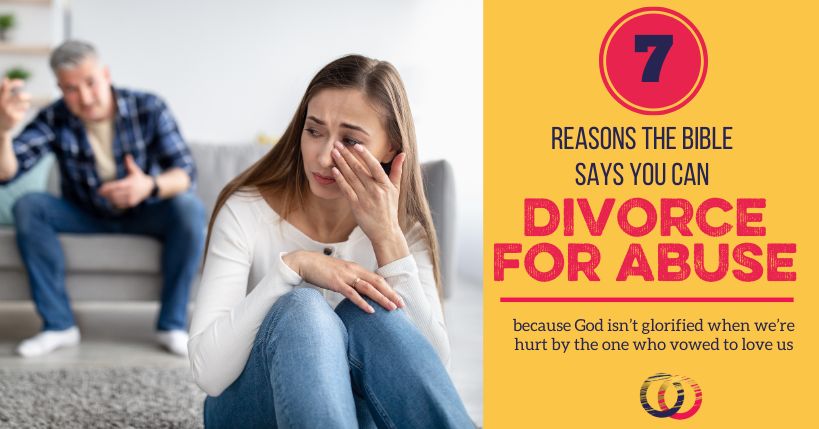


Thank you to Zondervan and the book For the Love of Women for sponsoring this post
God isn’t glorified when women stay in marriages where they’re abused
Too many women have sat across from church leaders, bruised and broken, only to be told they must “bear their cross” and return to their abuser. Too many have heard that leaving would be disobedience, that their suffering has spiritual purpose, that divorce is never God’s will. But what if everything they’ve been taught about suffering, submission, and divorce has been taken dangerously out of context? What if the very scriptures being used to trap abuse victims were never meant to apply to their situations at all?
Something interesting has been happening on social media lately, where I keep getting posts sent to me where others accuse me of being “pro-divorce”, and talk about how I’m training women to divorce husbands. That’s quite laughable, considering my whole point here is to help people have healthy marriages!
But here’s the thing: when the marriage is destructive (and at least 25% of evangelical marriages are), then leaving is actually better for everyone. And the Bible makes room for this, because God didn’t create us for marriage; He created marriage for us. His first concern is for our well-being, not just that the marriage stay intact.
When people complain about me being pro-divorce, what they’re actually upset about is that I’m pro-accountability for abusive spouses. They want to be able to have power and do whatever they want in their marriage without accountability; and I’m here saying that’s not of Jesus.
But you know what? What I say isn’t even that important.
Let’s look today at what the Bible says about divorce for abuse.
The refrain we hear constantly from the “marriage at all costs” camp is that since Jesus sufered, we should suffer too.
But when church leaders quote passages about enduring suffering, they’re often referencing scriptures written about persecution from the Roman Empire—not spousal abuse.
This distinction matters. When Jesus and the apostles spoke about suffering, they were facing martyrdom. They were not counseling victims to endure domestic violence or any kind of abuse from their spouse.
They weren’t sitting comfortably in positions of safety, telling vulnerable people to suffer while they themselves remained protected.
Yet today, these passages are routinely twisted to trap abuse victims in dangerous marriages.
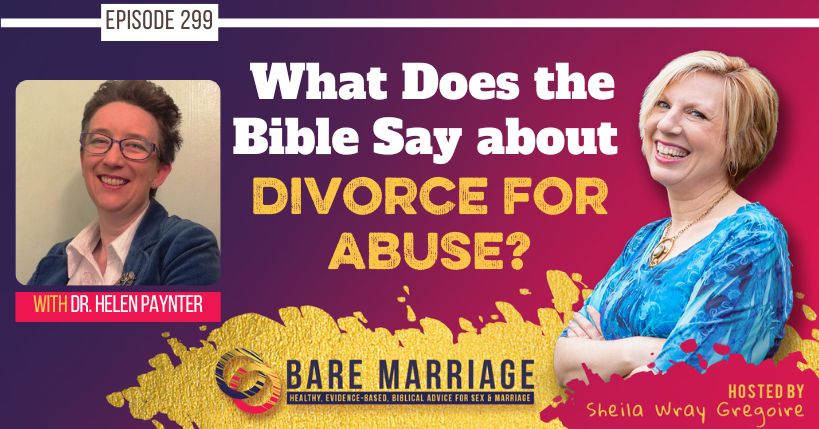
This is a topic I recently dove into on episode 299 of The Bare Marriage Podcast. Dr. Helen Paynter, author of the book The Bible Doesn’t Tell Me So, and I sat down to discuss what the Bible really says about divorce from an abuser.
Spoiler: it’s not what so many evangelical church leaders talk about.
Here are seven reasons why it is Biblical to divorce over abuse:
1. The Suffering Passages In Scripture Are About Persecution From The Empire, Not Spousal Abuse
When Jesus and the apostles talked about suffering, they were all martyred. They weren’t sitting comfortably telling others to suffer while they remained safe.
When Jesus and the apostles talked about suffering, they meant suffering at the hand of the empire—not at the hand of your spouse!
Many pastors telling women to suffer aren’t walking the walk!
2. The Old Testament Explicitly Permits Divorce For Neglect
If a husband deprives his wife of food, clothing, or marital rights, she can go free.
10 If he marries another woman, he must not deprive the first one of her food, clothing and marital rights. 11 If he does not provide her with these three things, she is to go free, without any payment of money.
Now, this passage was written in the context of polygamy, but commentators for millennia have believed that it applied to any marriage–that if she’s neglected, then divorce is permitted. And since neglect is a form of abuse, abuse is clearly grounds for divorce.
3. Jesus Never Overturned The Old Testament Divorce Permissions
When Jesus said divorce was allowed “because of hardness of heart,” he was talking about the abuser’s hardness of heart, not the victim’s. When He addressed divorce, He did so from the point of view of protecting the one who was being hurt and who often had less power–aka the woman.
We have to remember that in the Old Testament, it was men who were allowed to divorce, not women (which is why that allowance in Exodus 21 is so important). When Jesus was questioned about divorce, He was being asked to weigh in on the idea that a man could divorce a woman for any reason that He wanted, a perspective that was commonly taught in His day.
And since in those days women could not support themselves, when men divorced them women were desperate and destitute. They often had no other recourse except prostitution, or get into a relationship with a very bad man (and I do wonder if that was the Samaritan woman’s story). Jesus corrected that, saying, essentially, no, you cannot just abandon women for no reason.
Do you get that distinction? He wasn’t addressing divorce to tell the one who is being abused you cannot ever leave; he was addressing the problem where men were hurting their wives by leaving them destitute. And yet we have used these passages to do the exact opposite.


4. Passages From Both The Old AND New Testament Have Been Twisted To Enable Abusive Spouses
Church leaders are taking Bible passages about persecution and suffering out of their context and weaponizing one-dimensional interpretations to keep women trapped in marriages that God never intended them to endure.
For instance, one of the most commonly misquoted verses is Malachi 2:16, which is often quoted as “God hates divorce.” Here’s the actual passage in the NIV:
Another thing you do: You flood the Lord’s altar with tears. You weep and wail because he no longer looks with favor on your offerings or accepts them with pleasure from your hands. 14 You ask, “Why?” It is because the Lord is the witness between you and the wife of your youth. You have been unfaithful to her, though she is your partner, the wife of your marriage covenant.
15 Has not the one God made you? You belong to him in body and spirit. And what does the one God seek? Godly offspring. So be on your guard, and do not be unfaithful to the wife of your youth.
16 “The man who hates and divorces his wife,” says the Lord, the God of Israel, “does violence to the one he should protect,”[e] says the Lord Almighty.
So be on your guard, and do not be unfaithful.
Now, the translation of verse 16 is tricky. But you can see from the wider context that God is addressing a situation where men are being unfaithful to their wives and leaving them and sending them away. And these women have no recourse, and thus their husbands are “doing violence” to them.
These verses are being used to tell the victims of domestic violence that they cannot divorce, when the original verses were actual written to the perpetrators of domestic violence to tell them to treat their wives well. We have completely turned these verses upside down, when God’s heart was to protect those who were being mistreated.
5. Abuse is covenant breach
Just as adultery breaks the marriage covenant, so does abuse. A woman divorcing an abusive husband isn’t breaking the covenant—her husband already broke it through his abuse.
Divorce is merely making apparent and public what the abuser has already done in private.
The one who divorces the abusive spouse does not end the marriage; the abuser already did.
6. Separation without divorce is dangerous and ineffective
It maintains financial, legal, and social entanglement. Often you are still responsible for your spouse’s debts. Custody arrangements are trickier. And it means that you cannot remarry, even if you find a wonderful partner who will love you and your children (I always weep whenever I hear Brad Paisley’s song to a stepdad–”I hope that I’m half the man you didn’t have to be.”)
Focus on the Family doesn’t condone divorce for abuse, and tells women that they must separate with the goal of reconciliation (though divorce is allowed if the husband ends hte marriage). But this leaves women in terrible, dangerous limbo.
7. Harmful Doctrine On Divorce And Marriage Are Pulling Abused Women Away From God
When pastors teach abused women that they must stay with their abusive spouse AND that God intends for them to endure unimaginable harm in their marriage, the church is placing an obstacle between that woman and God. Now God, who is supposed to be her safe place, is the one who demands her continued suffering.
How can she serve and get comfort from a God who is ignoring her pain, and even cheering on the abuse?
Just released!
For the Love of Women: Uprooting and Healing Misogyny in America
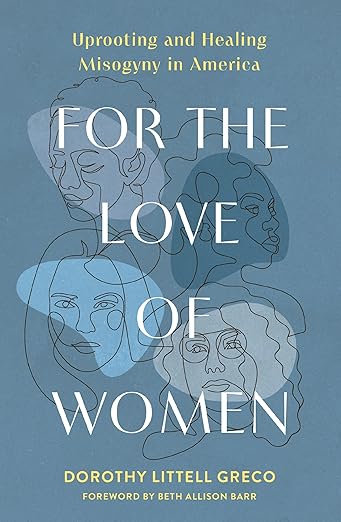
If you've ever been told, "sexism is a thing of the past; women are equal now. Stop complaining!", then you need this book!
Dorothy Greco goes over how misogyny is present in health care, business, the media, our relationships, and of course the church. She puts words to our experiences, and points the way forward.
The Bible does not require anyone to stay in an abusive marriage.
This harmful teaching is built on a foundation of misinterpreted scriptures, passages ripped from their contexts, and a selective reading that ignores what God’s word actually says about protection, justice, and covenant breach.
If you are in an abusive relationship, please know: leaving is not sin. Protecting yourself and your children is not hardness of heart. You are not the one breaking the covenant: abuse already broke it. God does not call you to be a martyr in your own home.
And to church leaders: every time you counsel an abuse victim to stay, you are not representing Christ. You are representing the abuser. The Jesus who overturned tables in righteous anger, who called out religious leaders for placing heavy burdens on people, who consistently protected the vulnerable: that Jesus would never send a woman back into harm’s way while calling it faithfulness.
It’s time we got this right. Lives depend on it.
Learn more about what the Bible has to say about divorce in cases of abuse on the podcast:
What do you think? Are people’s minds changing? Do you think the church is understanding that divorce for abuse is often necessary? Let’s talk in the comments!





I do believe God hates divorce, yes, but I believe he hates abuse even more. I believe God hates divorce in the same way any sensible doctor hates amputation but he performs it anyway if that’s needed to save the patient’s life. Or the same way a dentist hates extracting teeth or performing root canals. They are nasty things to do. Not nice. Not pretty. Not enjoyable at all. But if it has to be done, it has to be done, and the dentist or the doctor will perform the unpleasant procedure as a professional.
In the same way, God hates divorce. It does not give him any joy. But sometimes it must happen, or things will get even worse. And God knows it.
Divorce is never pleasant for anyone even if it is the right thing to do and I think people need to realize that sometimes choosing the right thing to do isn’t always going to be a happy decision. Ending a relationship is hard for anyone even if it is ultimately the right decision and there is a lot of aftermath to deal with as your way of life changes.
I also think that even churches who say adultery is acceptable for divorce will still guilt you into staying. That happened to my aunt when my uncle cheated on her at her old church before she joined mine who had clergy which were more accepting of her situation. It has been over 20 years since that happened and while she still hasn’t found anyone new (she is super picky and rightfully so!) and money has been tight for her (partly due to the fact her ADHD makes it hard to maintain jobs at least until she learned it was okay to ask for accommodations) she has been happier and my cousin who was six when it happened also grew up into a wonderful young man with a job in sales that he is very good at and a long term girlfriend that he is considering proposing to in the near future when she feels ready and had my aunt stayed with my uncle I am sure my cousin wouldn’t have truly learned the importance of being faithful in a relationship and never to take your partner for granted and his romantic relationships would have suffered.
I like that!
I would say that God grieves for divorce, but does not necessarily hate it.
>> They want to be able to have power and do whatever they want in their marriage without accountability; and I’m here saying that’s not of Jesus.
I believe that this is a very key part of the entire matter. It’s part of larger pattern of the philosophy that men should be able to do ANYTHING THEY WANT, with no accountability of any kind, except maybe to quote a bible verse or two every once in a while to get back into the good graces of God and the church.
And I have never gotten a “pro divorce” vibe from this site. This site (and the people involved) want us all to build healthy and happy marriages for ALL people (husbands and wives).
Amen! Nathan, I applaud your suggestion that “God grieves for divorce” is more accurate than “God hates divorce.” After all, God Himself divorced Israel (Jeremiah 3:8), so no one can say that divorce is always a sin. But I think it can rightly be a cause for grief.
And Emmy, your analogy of amputation is perfect! It is never ideal, never a cause for celebration, but it may still be the right thing to do, so let the church comfort and support those who are going through this, instead of condemning.
Thanks, Nathan!
Also, I’m no biblical languages expert, but I don’t think the common interpretation of the passage in Matthew 5 being about infidelity is correct. E.g. the NLT (with my emphasis) says:
“But I say that a man who divorces his wife, *unless she has been unfaithful*, causes her to commit adultery. And anyone who marries a divorced woman also commits adultery.” (Mat 5:32)
But the Greek word for the phrase I’ve emphasized is ‘porneia’, which according to my Bible dictionary means “harlotry (including adultery and incest); figuratively, idolatry:–fornication.” So it would certainly include infidelity, but basically I understand it’s a catch all term for any sexually behaviour outside the biblical standard. It’s pretty hard to imagine that having sex with someone that you’re also deliberately hurting wouldn’t be considered ‘porneia’.
For all it’s flaws, the esv (and a few other translations) seems to get this right:
“But I say to you that everyone who divorces his wife, *except on the ground of sexual immorality*, makes her commit adultery, and whoever marries a divorced woman commits adultery.”
If there are any Greek geeks reading, I’d love to know your perspective/any further reading on what ‘porneia’ does and doesn’t include.
This is a good post, and there are people who are in a place where they really need to hear this. But also, I wish we could move beyond this way of thinking, where we have to obey the bible, and so we’re only allowed to be compassionate toward abuse victims if we do a lot of study of ancient Greek words and ancient near east culture, and come up with an interpretation that says yes we can support abuse victims in their choice to get a divorce.
Yes, this kind of study/interpretation is an important step, but I wish Christians could just *see* that some types of ideology are harmful to real people, and reject those beliefs solely for that reason. As Jesus said, “Can a good tree bear bad fruit?” Instead of being bound to doing what the bible says, I wish we could just look at the real-world effects and know what’s right and wrong based on that.
I totally know what you’re saying. It should be enough that we can just say, “we know this hurts people, so it can’t be of God.”
But so many people don’t want to lose their churches, and are honestly afraid of what God will do to them if they disobey Him.
You should check out NehemiasWall.com. Dr Nehemia Gordon is a Jewish scholar, fluent in OT Hebrew. There’s a post on “Does God Command Divorce?” where he points out that Hebrew doesn’t use indirect quotes — only direct ones.
***
Direct quote: “She said, ‘I read Persuasion last week.'”
Indirect quote: “She said she read Persuasion last week.”
Direct quote: “Thus says the Lord, ‘Let My people go.”
Indirect quote: “The Lord says you must let His people go.”
***
Now, Malachi 2:16, which transliterates to “For he hates divorce says Yahweh” in Hebrew, has been translated as if it’s an indirect quote, when according to Nehemia Gordon it actually should be translated as a direct quote, like this:
“For he hates divorce” says Yahweh, God of Israel, “And he has covered violence with his garment” etc.
See the difference? God is talking about a man who hates divorce, and isn’t setting his wife free even though he is treating her so badly that he owes it to her.
https://www.nehemiaswall.com/does-god-command-divorce-part-1
So interesting!
I’m fully convinced that divorcing my abusive husbands at the time, (ex now), was right, although I took way too long and children complicated the process. I should have divorced him when I had a restraining order against him.
But I’m trying to figure out if remarrying is allowed when he’s still living.
As we made vows; till death do us part.
Plus in 1 Cor 7,
10 But to the married I give instructions, not I, but the Lord, that the wife is not to leave her husband 11 (but if she does leave, she must remain unmarried, or else be reconciled to her husband), and that the husband is not to divorce his wife.
And
39 A wife is bound as long as her husband lives; but if her husband dies, she is free to be married to whom she wishes, only in the Lord.
I just don’t see where it says: if you’re divorced, you can remarry.
Where is that communicated?
Thanks for any Scriptural insights
Given the Roman context these verses were written in and that culture’s norms around marriage, I suspect these passages do not mean what they seem to mean in English translation and it warrants further study.
As for vows, again, I haven’t studied this, but my gut instinct is that you vowed to something different than what you got, so you are released from that vow. An analogy could be someone vowing to care for a puppy if it is given to them, then they are gifted a snake. You wouldn’t turn around and say that they have to keep the snake because they vowed to care for a pet. The giver didn’t keep their end of the bargain, which made the receiver’s vow about something different than the giver enacted.
You are absolutely correct in saying no spouse should be required to stay in an abusive marriage. To try to compel someone to do so only aggravates the cruelty. The question then becomes when an aggrieved spouse is free to remarry someone else. 1 Corinthians 7 says that if they separate, they are required to either reconcile or remain celibate. Jesus put up one exception for adultery in Matthew. Do you have any articles on the permissibility of remarriage after divorce?
“You are NOT representing Christ, you are representing the abuser”
And referring to the fuller and correct translation in Malachi.
Right on Sheila. You may save the well being, if not the life of more than one woman. 🙏
30 + years ago I wrestled with God about leaving an abusive marriage. I had no support from my church. Mal. 2:16 actually showed me that God hated the violence. I’m grateful that women today have you and not just Focus on the Family like I had back then.
Feeling so grateful for this message today.
This week I decided to leave my marriage of 23 years (I can’t until the end of year due to circumstances but I am preparing) and it’s laid so heavy on my heart. All those years of coercive sexual control and 5 children later I have realised I can’t heal with him in the house. I am terrified, what this will do to my children, to my extended family, to my children’s future marriages is all plaguing my mind (which is probably why it has taken me 23 years to make this decision).
However, it is the overwhelming sense of failure and ‘quitting’ that is weighing heavy, that I could have prayed a bit more, submitted a bit more, waited a bit longer for God to ‘rescue’ me from this situation that this kind of message really helps with.
I am praying my children will not hate me, that they will not lose their faith, that they will forgive me, that their father and I can co-parent amicably (I don’t hate him, I just can’t heal or live in peace or freedom with him). I am praying that they can do better than I did in their relationships and that when I come to the other side of all of this I will see that it was the right thing to do.
Thank you Sheila for reminding me that my life matters too and my God cares about me but that he also gave us the power to make changes and step out from under ‘coverings’ that aren’t covering and leadership that isn’t leading.