


What if complementarians are biased when they read the Bible?
We’re in the middle of a series my husband Keith has been writing, inspired by the convos he gets into on social media with complementarian and misogynist men about the Bible. He finds they use the same arguments all the time that don’t actually hold water, and he has wanted to respond.
Here’s Part 1 — on the problem with ripping verses out of context and ignoring the metanarrative of Scripture
Here’s Part 2 — on the accusation that egalitarians are “just following culture”, when it’s actually complementarians who are doing that.
And now we have our third instalment, on how complementarians choose to read their biases into the Bible.
Buckle up because it’s a wild ride!
When complementarians demand a verse!
There is an interesting thing I encounter when I debate people online who want to limit women within the home and the church: they always espouse a “Bible only” mentality.
For instance, I recently had a run-in with a fellow over women pastors. He started with “the Bible is clear” and I pointed out that the accusation that egalitarians are “reading into” the Bible cuts both ways because he was also reading into the text. After repeatedly showing him how illogical everything he was saying was, he ended by saying, “You are making a lot of fine sounding worldly arguments, but they are not based on the word of God, so they mean nothing.”
The only proof he would accept is if I could show him a specific Bible verse that said “women can be pastors.”
There is a reason for this need to make everything about Bible verses and throw logic out the window: It’s because in every other sphere the battle is effectively over.
The egalitarian argument has won everywhere else
Philosophically, women’s equality is a “done deal”. So much so, that even complementarians, forsaking the historic view of the church that women are the inferior sex, have had to invent a strange new doctrine where women are fully equal to men, but remain subordinate to men and aren’t allowed to do things that men do. This “all animals are equal, but some are more equal than others” framing might soothe the cognitive dissonance for some, but cold logic cannot miss the internal contradiction. The only philosophically consistent position is egalitarianism.
Historically, the battle is also lost for those who wish to use religion to limit women. Works like “The Making of Biblical Womanhood” and “Live, Laugh, Love” peel back the curtain to show how modern complementarian ideas do not derive from Scripture, but from a confluence of historic events and societal trends (in other words, from “culture”, the very thing they accuse egalitarians of caving to!)
Sociologically, it’s all bad news for them as well. Scientific studies, including the research done by Bare Marriage prove that making marriage a hierarchy instead of a team of equals results in poorer outcomes all around. Thus, if one believes that God’s plan for marriage requires hierarchy, it puts one in the awkward position of having to believe God doesn’t want us to have good marriages.
And psychologically, studies have shown that going to church brings tremendous benefits, but those benefits evaporate for women if the church doesn’t allow women in leadership. So, again, we are left with the problem that “God’s plan” of complementarianism (which they loudly protest is not against women, but for their benefit) is worse for women than if they went to one of those egalitarian churches that “don’t really believe the Bible.”
So I’m not at all surprised when I see posts like this:
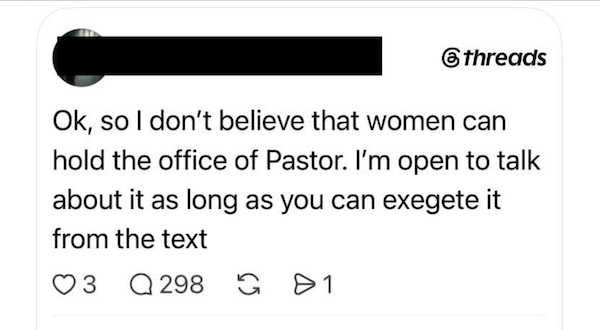
The demand for “just the Bible” is actually an argument from a weak position
I am sure guys like this convince themselves that limiting discussion to “just the Bible” is pious, but I can’t help but see it as a strategic retreat to the only place where it is still possible for them to cobble together a defense. And even here they fail, because they can’t be consistent in their arguments. For example, here’s how the argument went with this fellow.
Him: Only men can be pastors
Me: The word “poimēn” (pastor) appears only once in the New Testament and it doesn’t mention gender there.
Him: Paul says pastors must be the “husband of one wife”.
Me: No, those verses say that overseers, elders and deacons must be the husband of one wife. Those verses don’t use the word pastor.
Him: In Acts, elders are told to shepherd (pastor) the flock, so they are pastors. And they have to be men because they have to be “husband of one wife”.
Enter the first inconsistency: “Husband of one wife” equals “men”.
First of all, let’s take some time to see what is already trying to slip by unnoticed:
- The assumption that a “pastor” in the first century church is in any way analogous to a modern pastor
- The assumption that the use of the verb “ to shepherd” about some elders in Acts means that qualifications for elders in Timothy apply to all modern day pastors
- That “husband of one wife” is meant to be taken as a literal gender requirement.
Clearly there is a large amount of motivated reasoning required from the beginning of their argument. My experience, however, if I point this out, is that they are completely blind to these background assumptions. They are not objective enough to see them and just accuse me of “not seeing the obvious.”
But it gets worse at two more levels.


1. “Husband of one wife” does not mean what they think it means.
Consider that in the Greek it literally says “one woman’s man” (since husband/man and wife/woman are the same word in Greek). Egalitarians interpret this as a requirement for sexual faithfulness. They argue that in a list of requirements that focus on character, this is the most likely meaning and seeing a gender requirement is needlessly literal. Furthermore, there are examples in history of women having this designation, so there is real world proof that this is the way it was understood at the time.
But the guys I argue with will have none of that. “It says husband so it must be a man!” and reprove me again for denying the clear meaning of the text.
But that’s where the inconsistencies start showing their ugly heads. Because, if they are right, how could Phoebe have been a deacon (Romans 16:1), since the same phrase applies to deacons as well? Here my online opponents split into multiple pathways with the only common theme being “we have to explain this away while somehow keeping the requirement that an elder be a literal man.”
The most common response is the ESV solution: Phoebe wasn’t actually a deacon, she was a servant.
You see, the title “deacon” is literally the Greek word “servant.” So if we just sub in that meaning in the case of Phoebe, it solves the problem – as long as you are willing to assume that the exact same Greek word means an ecclesiastical position when used for a man and a totally different thing when used for a woman. Again, if you are motivated to believe that only men can be in leadership, that may work for you, but to any unbiased observer, it is severely lacking. So, let me get this straight…because a group of (you assume) men called “elders” do the verb of “shepherding”, therefore they hold the ecclesiastical title of a “shepherd (pastor)”. But a woman who is described by the literal title deacon, is not really a deacon, but just one who “serves”? You simply can’t say such things and expect to be taken seriously.
Some have even crazier arguments to explain Phoebe away. They are all much more convoluted than just admitting that “one woman’s man” was meant to be about sexual faithfulness and not a literal gender requirement. Plus, we all know that none of those arguments would have ever seen daylight if Paul had said, “I commend to you, Fred, a deacon of the church in Cenchreae”. Let’s not kid ourselves, they reject the view that “one woman man” is about character not gender not out of desire to be true to the text, but for one reason only: it might challenge the underlying assumptions that their theology is based on.
2. They don’t interpret the text literally either.
This second level of inconsistency proves my point further. If “husband of one wife” means the person must be a husband, then logically the pastorate cannot be open to men who are unmarried or no longer married. If we took their reading to heart, no single man, no divorced man and no widower would be allowed behind the pulpit.
Can you imagine a church telling a new theology grad that they are refusing to ordain him until after he gets married to his fiancée next summer? Can you imagine the head of the elder’s board coming to pastor Bob, who has led their small church for 14 years the day after his wife is tragically killed in a motor vehicle accident to ensure he understands he is “biblically no longer qualified to pastor”?
Clearly these are callous, hard-hearted, overly literal interpretations – but I would argue no more so than excluding women based on their sex. Yet somehow they insist that the “man” part is literal and inarguable, while the “of one wife” is fuzzier. I see only one explanation for this type of inconsistent hermeneutic: that the point isn’t to interpret the text literally, but to interpret it just literally enough to validate their sexist assumptions.
All the other clobber verses have the same issues
For instance, somehow the plain reading of “Women shouldn’t speak in church” is that women should not be allowed to give a talk from behind the pulpit except on Mother’s Day. And “I do not permit a woman to teach or have authority over a man” means that women are
- allowed to teach and have whatever authority roles over men they want outside the church
- can teach and have authority over teenage boys (who would have been considered men at the time the New Testament was written) and
- can teach men through media and in small groups and a variety of other ways except from behind a pulpit (again, except on Mother’s Day).
Don’t get me wrong, I don’t want to interpret these verses completely literally either! In fact, the idea terrifies me. I’m just saying that when people use these verses to limit women in the church, they are being inconsistent and arbitrary. While they say they are “just following the clear meaning of the text”, they are in fact are showing a very selective literalism that always lines up such that they interpret the verses just literally enough to keep women out of positions they want to preserve for men, but not literally enough for it to adversely affect men in any way.
You can miss me on that style of Biblical interpretation, please. And while you’re at it, don’t dare ever accuse me again of reading into the text.






Thank you so much for this!
I had been one of those “strictly Biblical” people most of my whole adult life . I had even bought the ESV for myself and my family members when it came out. I had appreciated how they handled Malachi 3:16.
When my pastor started to teach some things from Genesis 3 that I had never heard before, I was stunned. I had found it to be true that we really want our husbands to love us, but then we are admonished that it was our own sinful attitudes that were wishing for expression of love. The recent “You be Jesus.” story reminded me of this. So weird to hear later that we were actually naturally trying to be controlling. It just didn’t make sense to me. Where did this teaching come from? Later, when I found out the translators had purposely chosen that rendering of the verse I was very discouraged.
Since then (thanks to Bare Marraige inviting guests in!) I have discovered many scholars who are examining these verses and explaining these things, but these attitudes go very deep. I had to laugh at myself that I was very much into the NRSV years ago and the complaint was that it was pushing the other way when translating words related to gender. (Too bad I don’t have that Bible anymore!)
Thank you for fighting the good fight!