
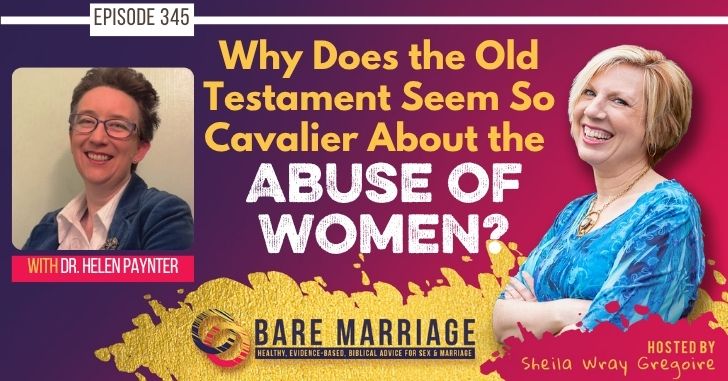

Have you ever felt uncomfortable with the treatment of women in the Old Testament?
I was recently sent a note from a woman that said this:
I’ve been really seriously struggling as I’ve been leaving the evangelical church recently and what has spurred a lot of this on has been, frankly, the really violating experience of reading the Bible, taking it literally as God’s word, and noticing how abusively it talks about women’s bodies. I’ve been extremely tormented by this over the last couple of years feeling like I’ve found out a close friend of mine (God) is okay with or even complicit in the rape of Biblical characters, or that he promotes an idea of women that is deeply horrifying (that the primary quality for choosing a good wife is often virginity??). I have a history of experiencing sexual violence and I feel like reading the Bible was kind of a lowercase t traumatic event for me and added to existing sexual trauma as I kind of realized that the Bible isn’t as clearly pro rape victim as I was lead to believe it would be. Im not sure what my question is exactly, have y’all written anything on this topic? How can I ever begin to forgive God for being complicit in abuse? How can I ever take the Bible seriously again when it has damaged my idea of my body and sex so much more deeply and seriously than any porn or dark romance ever could??
Can you relate to her? I think many of us can!
And so today I called in an expert–Dr. Helen Paynter, who runs the Centre for the Study of the Bible and Violence. She’s been on the podcast before to talk about how the Bible sees divorce for abuse, and she’s written a lot about the story of Lot’s wife from Judges 19, and I knew she’d have lots to say on this subject! So here we go:
Or, as always, you can watch on YouTube:
Timeline of the Podcast
00:00 Intro: Why Are Some Bible Passages So Hard?
02:04 Listener Letter – When Scripture Feels Harmful to Women
05:01 Welcoming Dr. Helen Paynter: Reading Violence in the Old Testament
08:01 Seeing God & the Old Testament Through the Lens of Jesus
10:22 The Horrifying Story of the Levite’s Concubine
16:17 Whose Suffering Matters to God? Questions About Grievability
20:09 Samson, Jephthah & Questionable Heroes in the Bible
27:11 Reading Difficult Stories with Survivors in Mind
31:36 What Do Old Testament Laws About Rape Mean?
38:43 How Jesus Moves the Conversation Forward
40:13 Difficult Questions About Women & Childbirth
42:47 Conclusion: Finding Hope in Jesus & Reexamining Scripture
Key Talking Points
1. We can take difficult questions about the Bible seriously.
When we encounter passages that seem to portray God as indifferent to sexual violence or the mistreatment of women, our first instinct might be to defend Scripture. But I think we need to listen to those concerns rather than dismiss them. Taking these questions seriously doesn’t mean abandoning our faith; it can be an important part of finding a way through difficult texts and towards Jesus.
2. Describing violence isn’t the same as endorsing it.
Dr. Helen Paynter makes an important distinction between violence that the Bible describes and violence that God explicitly commands. The distinction matters because we can easily read a disturbing biblical story and assume that God approves of everything that happens in it. The story of the Levite’s concubine in Judges 19, for example, is framed by the refrain that everyone was doing what was right in their own eyes. Rather than presenting a model for how people should behave, the story exposes the moral collapse of a society that has abandoned the protection of the vulnerable.
3. The stories of abused and overlooked women matter to God.
One of the most moving insights from this conversation is that the unnamed woman in Judges 19 matters, even when the men around her treat her as disposable. Paynter suggests that the very presence of her story in Scripture is significant: her suffering is recorded rather than erased or forgotten. For survivors of sexual violence, these passages can offer a powerful reminder that God sees what others ignore and that their stories, too, matter.
4. Biblical characters aren’t automatically role models.
We often assume that if someone appears in the Bible, their actions must somehow be approved by God. But Paynter encourages us to read biblical narratives with the same critical attention we bring to other stories. Samson, for example, repeatedly claims to be acting reasonably, yet his actions reveal disproportionate vengeance and harm to others. Likewise, the story of Jephthah’s daughter doesn’t tell us that God wanted her sacrificed; reading it alongside the prohibition against human sacrifice and other biblical passages challenges the assumption that God approved of her father’s actions.
5. Old Testament laws need to be understood in their historical context.
Some biblical laws about sexual violence can be deeply troubling to modern readers, particularly those that appear to require a victim to marry her assailant. Paynter suggests asking what worse outcome a law might have been intended to prevent in its original social setting. In a world where a woman who had lost her virginity could face destitution, a requirement that a man provide for her could offer a measure of protection and hold him accountable. That doesn’t make the law an ideal solution by today’s standards, but it helps us understand its historical purpose without pretending that every ancient legal provision represents the final word on justice.
6. God’s work of justice unfolds through a movement toward greater care for the vulnerable.
Paynter argues that Old Testament laws should be read as part of a broader movement toward protecting people, even as they reflect the limitations of their historical setting. The laws are not necessarily a final statement about how women should be treated or how allegations of sexual violence should be handled. The prophets repeatedly condemn abuse and injustice, while Jesus pushes people toward a deeper understanding of what love and faithfulness require. This perspective invites us to see Scripture as a story that calls people forward rather than treating every ancient practice as the ideal.
7. When the Bible feels painful, start with Jesus.
Paynter’s closing advice is especially important for anyone whose experiences in church have made the Bible difficult to read: don’t feel that you have to begin with the hardest Old Testament passages. Start with Jesus and notice how he treats women, including those who are isolated, stigmatized, or vulnerable. His example provides the central lens through which we can wrestle with difficult texts. We don’t have to pretend that every question has an easy answer, and we don’t have to be afraid of asking God those hard questions.


Things Mentioned in the Podcast
BARE MARRIAGE ANNOUNCEMENTS
Preorder Fawn, Sheila’s New Book
Our Spanish Site is live!
TO SUPPORT US:
- Join our Patreon for as little as $5 a month to support our work (and get access to the book club!)
- And check out our Merch, or any of our courses!
- Give to the Good Fruit Faith Initiative of the Bosko Foundation
- Join our email list!
LINKS MENTIONED:
- Journal for the Study of Bible & Violence
- Rev. Dr. Helen Paynter’s bio
- Dr. Helen’s book on Judges 19
- Dr. Helen’s blog post on Judges 19
- Bare Marriage Podcast Episode 299 with Dr. Helen Paynter
- The Miss.Judged study on marginalized women of the Bible
What do you think? Has the Old Testament ever left you uncomfortable about the treatment of women? Let’s talk in the comments!
Transcript
00:00:12:10 – 00:00:40:22
Sheila
Welcome to the Bare Marriage podcast I’m Sheila Wray Gregoire from Baremarriage.com where we like to talk about healthy, evidence based biblical advice for your sex life and your marriage. And one of the things that I am often asked about in all of the work that we do is how do we handle some of the difficult passages in Scripture where it seems like God just doesn’t like women very much, where there’s violence against women and God doesn’t say, hey, I wasn’t okay with that explicitly.
00:00:40:24 – 00:00:59:21
Sheila
And how are we supposed to deal with that? So I have a great conversation with Doctor Helen Paynter coming up around that. Before we get to that, just a special thank you to our patrons and everyone who donates through the good Faith initiative of the Bosco Foundation. Your your support helps us with our peer reviewed papers that we write with our translation efforts.
00:00:59:21 – 00:01:20:01
Sheila
And we have our new Spanish site up and running. We have a Spanish landing page on our main, our main site, and we have social media and we have a bunch of podcasts translated into Spanish and some courses. And there’s A Good Girl’s Guide to Great Sex is in Spanish. So take a look at that. Tell all your Spanish speaking friends about it.
00:01:20:03 – 00:01:52:02
Sheila
We’re sort of doing an experiment just for a month to see if we can get people following our social media, and we also just want it out there. So that if people are ever looking that they can find things. And so, yeah, go tell your friends, let’s get some healthy information into the hands of Spanish speakers too, because often the books that go really, really big in North America, evangelicalism, like love and respect, like power for praying with all of these books that actually have quite harmful messages in them, go really, really big in Latin America too.
00:01:52:04 – 00:02:14:22
Sheila
And so if we can get some of our voice, heard in that, in that space as well, then hopefully we can help women find the truth about what God really thinks to them. So do tell all of your Spanish speaking friends. Now, speaking of helping people understand the truth of how God sees them. I want to read to you a letter that I got that prompted me to want to do this podcast today.
00:02:14:24 – 00:02:37:19
Sheila
So a woman wrote and she said this, I have been really, seriously struggling as I’ve been leaving the evangelical church recently. My parents work for crew, and so does a lot of my my family. And what has spurred a lot of this on has been, frankly, the really violating experiences of reading the Bible. Taking it literally as God’s Word and noticing how abusively it talks about women’s bodies.
00:02:37:21 – 00:03:03:00
Sheila
I’ve been extremely tormented by this over the last few years, feeling like I found out that a close friend of mine, God, is okay with, or even complicit in the rape of biblical characters, or that he promotes an idea of women that is deeply horrifying, that the primary equality for choosing a good wife is often virginity. It’s a really hard, long topic, and I have a Google talk detailing a lot of it, although I’m constantly adding new verses where I feel like God is abusive, it is just really hard.
00:03:03:02 – 00:03:22:02
Sheila
I have a history of experiencing sexual violence, and I feel like reading the Bible was kind of a lowercase t traumatic event for me, and added to existing sexual trauma, as I kind of realized that the Bible wasn’t as clearly pro rape victim as I was led to believe it would be. I’m not sure what my question is exactly, but have you all written anything on this topic?
00:03:22:02 – 00:03:43:23
Sheila
Or how can I ever begin to forgive God for being complicit in abuse? How can I take the Bible seriously again when it has damaged my idea of my body and sex so much more deeply and seriously than any porn or dark romance ever could? You know, that’s a hard question, isn’t it? And probably a lot of you have like your back up already saying, no, no wait.
00:03:43:24 – 00:04:12:08
Sheila
God is wonderful. God is great. God, God loves women. And I think when someone starts to question God’s character based on what they read in Scripture, a lot of us, our first instinct is to defend the Bible. But what if we can actually listen to what she’s saying? Because I think defending the Bible and saying that, oh no, everything’s all peachy keen without realizing that there are actually some issues.
00:04:12:10 – 00:04:23:04
Sheila
And maybe if we treat those issues seriously, we can find a way through them to Jesus. And so that’s what I invite us to do this morning. I have a great guest, Doctor Helen Paynter.
00:04:23:06 – 00:04:49:16
Sheila
who is head of the center for the study of the Bible and Violence. And she was on our podcast earlier talking about how God sees abuse and how God, is perfectly fine with divorce for abuse. God actually really cares for abuse victims. And I loved that podcast episode. I felt like Doctor Paynter was just so pastoral, and I thought that she would be the best one to handle this question, because this is literally what she does.
00:04:49:18 – 00:05:01:07
Sheila
So, without further ado, let’s invite Doctor Helen Paynter on to talk about. Yeah, what do we do with the Bible pastors about God and women, especially in the Old Testament?
00:05:01:09 – 00:05:06:10
Sheila
Well, Doctor Paynter, thank you for coming back on the podcast. And so good to see you.
00:05:06:12 – 00:05:08:06
Dr. Helen Paynter
Thank you for having me again.
00:05:08:07 – 00:05:20:13
Sheila
Yes. So you have written a lot about how we can understand the violence in the Old Testament. In fact, you, you run the center for. I’m going to forget the name. What is it? The center for the.
00:05:20:14 – 00:05:23:01
Dr. Helen Paynter
Center for the Study of Bible and Violence.
00:05:23:01 – 00:05:49:22
Sheila
Right. Which I think is so interesting. Just help us get a different perspective on some of the things we read, because I think I know when I was younger, Christian and I would read the Old Testament and I would think, this doesn’t look anything like Jesus, but somehow there must be a reason that they were supposed to kill all the babies like there must be a reason that God was happy about that, and it never sat right with me.
00:05:49:22 – 00:05:53:05
Sheila
And so I’m really excited to jump into this conversation.
00:05:53:07 – 00:06:00:12
Dr. Helen Paynter
Well, let me, let me expectation management. I’m not going to make all the problems go away. But the most important things we can say. So I’ll do my best.
00:06:00:18 – 00:06:06:00
Sheila
Yes. Okay. So to start off with, I’ve read a number of the things that you’ve written on this topic.
00:06:06:00 – 00:06:14:15
Sheila
And one of the things that you talk about quite a bit is the difference between violence being described and violence being prescribed.
00:06:14:17 – 00:06:15:16
Dr. Helen Paynter
Yes.
00:06:15:18 – 00:06:17:23
Sheila
Can you tell us what that is?
00:06:18:00 – 00:06:39:23
Dr. Helen Paynter
Yes. Of course. And it’s something that we do instinctively with almost everything we read. But for some reason we don’t do it with violence. I can talk about maybe what that reason is in a minute, but I guess if I, if I gave you an example, if you opened your newspaper and you read, a report of something, there’s an atrocity that’s taken place in the in the newspaper.
00:06:40:00 – 00:07:03:19
Dr. Helen Paynter
We wouldn’t assume that that newspaper is commending that is is some saying this is this is a great thing. It’s reporting it. Now, what we need to distinguish in the Bible between violence, between moments when God says to people, go and do something violent, and those exist. And I think often the book of Joshua is a go to place for such things.
00:07:03:21 – 00:07:27:20
Dr. Helen Paynter
But there’s lots of other violence in the Old Testament. That is where God is not doing that. And we’ve got the text reporting, violence that took place. And one of the, one of the very easiest, I think, steps we can take, when we when we encounter violence in the Old Testament is ask ourselves which of these is going on because we need to look at them entirely differently.
00:07:28:01 – 00:07:50:19
Dr. Helen Paynter
So violence that God commends, is is a it’s an interpretive problem. It a challenge. It’s something I think a lot about. I think I’m very happy to discuss that. But the texts of sexual violence that I think you want to discuss today, don’t fall into that category. They fall into the other category. Of of, described violence.
00:07:50:21 – 00:08:01:08
Dr. Helen Paynter
And there are some laws that you might want to talk about as well, about the treatment of women, which don’t fall into the category. That’s a separate thing again, but it’s really important that we do distinguish those.
00:08:01:10 – 00:08:19:04
Sheila
And, and another, interpretive lens that you say that we should be using when we look at the Old Testament is that we have to see the Old Testament through the lens of Jesus so that Jesus is the primary focus, the primary way that we see God. Like he even said that, right? Whoever has seen me has seen the father.
00:08:19:04 – 00:08:31:02
Sheila
So if we want to know what God is like, we learn what Jesus is like. So Jesus is our interpretive lens. How does that impact how we read the Old Testament?
00:08:31:04 – 00:09:02:04
Dr. Helen Paynter
Yeah, it’s a great question, and it requires more than a few sentences on it, which is what it said. You, what I would say is the fullest, as you just said, the fullest revelation of the character of God is seen in Jesus Christ and in particular, Jesus Christ on the cross. Now, as best we can grasp, the character of God and then from from what we read and what we understand there, we need to use that as a, as a kind of yardstick to, to hold up against texts, that, that we find problematic.
00:09:02:04 – 00:09:28:06
Dr. Helen Paynter
And when we find repugnant, when we think we are discovering a representation of God that is, there is less than Jesus on the cross, then then, well, what we do with that will depend to some extent on our, whether we’re evangelical, whether we’re progressive, how we how we view the text. For me, as a, as an evangelical, as a term that I’m nervous about using, especially into a North American context.
00:09:28:06 – 00:09:49:16
Dr. Helen Paynter
But I am an evangelical. I’m not going to give it up. Right. So for me, as an evangelical, if not, then when I read a text that feels like the God it’s describing doesn’t feel like the God that I see in Jesus Christ, then I have to wrestle. Then I ask questions and try and try and discover, try and find the goodness of God in the text.
00:09:49:16 – 00:10:11:18
Dr. Helen Paynter
And I have to say, I’m not pretending that all problems go away with that wrestling. But I have to say that some of the the thorniest, most painful texts, if we do do that wrestling, we can discover the goodness of God in them. Surprisingly so. Yeah, not wanting to be simplistic about this, but I really do believe, so the one I’ve done most work on, maybe we’ll talk about it in in minutes.
00:10:11:18 – 00:10:22:17
Dr. Helen Paynter
Judge is 19. It’s a horrible, horrible text. I’ve preached on that text. I’ve preached the goodness of God from that text. And I and I believe it works. I believe people heard that. Received it.
00:10:22:19 – 00:10:34:05
Sheila
Yeah, well, maybe we should just jump to that now because that that is a great, lead in to this. So judges nine, it’s a longer story. I think it spans three chapters, doesn’t it? Justice 19 to 21 that we see the whole.
00:10:34:07 – 00:10:34:24
Dr. Helen Paynter
That’s right. Yes.
00:10:34:24 – 00:10:42:11
Sheila
Outworking of this. But, well, why don’t you why don’t you tell us the story about the Levites and the concubine?
00:10:42:15 – 00:11:08:10
Dr. Helen Paynter
Yeah. So I need to kind of give a content warning because it’s a and I won’t get too graphic, but it is a terrible story. So it’s a story of a second wife. I mean, technically, we could call her concubine. The reason I try not to is because in interpretations of this story, it has her status as a concubine, has been used to kind of victim blame or even kind of, dare I say, slut shame,
00:11:08:12 – 00:11:27:21
Dr. Helen Paynter
Right. In a way, that is, it seems to kind of completely misunderstand the power dynamic puts a woman in that position in the ancient world. So I personally prefer to speak about her as a second wife. But anyway, she she leaves her husband for a reason. That is unclear. And and even might have their Bibles open and say it’s perfectly clear.
00:11:27:21 – 00:11:50:18
Dr. Helen Paynter
Actually, it isn’t clear. It isn’t clear in the Hebrew. And the Greek differs again. So she leaves her husband, went back to her father, her husband comes after her. And there’s this kind of slightly odd, prolonged scene where her father won’t let him leave with her. And there’s this kind of exaggerated hospitality thing going on. And eventually he’s he’s on her way, his way home with her and and his his servant.
00:11:50:20 – 00:12:14:16
Dr. Helen Paynter
And as they’re traveling, they come to a town, of the Canaanites. It’s getting towards dark. And the servant says, you know, so should we go and take shelter here? Because it’s going to be dark soon. He says, no, no, we’re press on to the next town because it’s an Israelite town, and we’ll be safe there. So they get to this Israelite town, and they come to the town square where they they think they might be safe.
00:12:14:18 – 00:12:32:23
Dr. Helen Paynter
So where they would hope to be. So he adopted, you know, received into a family of hospitality, ancient code of hospitality there. And actually, the town’s quite slow to offer hospitality. But eventually this old man who’s who himself is a is a stranger, is a kind of foreigner in the town, takes him in, takes them in, I should say.
00:12:33:00 – 00:12:56:00
Dr. Helen Paynter
And they’re having a meal. And suddenly that there’s pounding on the door, and the men of the town have come and are demanding that this traveler, this Levite, be sent out to them for them to rape. And there’s I would say there’s an owner shame thing going on. Owner shame is very strong in this passage. And they want to humiliate this stranger.
00:12:56:00 – 00:13:21:16
Dr. Helen Paynter
They want to assert their dominance over him and the the host. And indeed the Levite kind of try and remonstrate with them. And they’re not having it. So in the end, somebody it’s not entirely clear, but it’s called the the Levite himself takes this, this poor woman and throws her out to the baying mob. She locked the door on her and they they gang rape her and torture her all night.
00:13:21:18 – 00:13:39:17
Dr. Helen Paynter
And as Dawn arrives, she crawls back to the house and she follows with her hands on the threshold. And we’re not sure at this point if she’s dead or alive. Come the morning the Levite gets night, wants to continue on his journey. He opens the door, and there she is. And he says two words to her in Hebrew.
00:13:39:19 – 00:14:01:23
Dr. Helen Paynter
I can’t condense into two English words, but it’s up. Let’s go. And and she doesn’t respond, so he slings over his donkey. We still don’t know if she’s alive or dead. Takes her home, and then when he gets there, he just members her and he sends her body parts out as a, as an attempt to to muster the armies of Israel in indignation.
00:14:02:00 – 00:14:27:17
Dr. Helen Paynter
And indeed, that is that is what happens. They do arise in indignation, although the way he tells the story, he absolutely massages what happens. And it’s all about his injured pride, and his injured honor. And they do respond. And there’s a civil war that breaks out, really. But it culminates quite complicated with back and forth. But it culminates with the marriage by capture of another of hundreds more women.
00:14:27:17 – 00:14:49:12
Dr. Helen Paynter
So there’s this, this nation, which seems to be so indignant about the treatment of this dreadful treatment of this woman. Actually, the action proves to be nothing about women at all, because a further six, 400 plus women, it’s it’s called marriage by capture. But it’s a it’s it’s rape right now. It’s really. Yeah. And so yeah.
00:14:49:12 – 00:14:51:03
Dr. Helen Paynter
And that’s the end of the book of judges.
00:14:51:05 – 00:14:52:20
Sheila
Yeah. Is this an awful story?
00:14:52:20 – 00:15:16:20
Dr. Helen Paynter
Yes, it’s a horrible story, but it begins and ends with a refrain. And this is really important. The refrain is, in those days there was no king in Israel, and everyone did what was right in his own eyes. This is the this is the controlling, frame within which we have to read this. So this is a classic example of described violence.
00:15:16:22 – 00:15:22:02
Dr. Helen Paynter
And we must not make the mistake of imagining that in any way that God is endorsing this.
00:15:22:04 – 00:15:23:13
Sheila
Right.
00:15:23:15 – 00:15:25:03
Sheila
You know what, Becca?
00:15:25:05 – 00:15:27:08
Dr. Helen Paynter
The internet can sometimes be a really, really terrible place.
00:15:27:10 – 00:15:27:23
Rebecca
Absolutely.
00:15:27:23 – 00:15:28:24
Sheila
I have a happy place.
00:15:28:24 – 00:15:29:18
Rebecca
We do.
00:15:29:20 – 00:15:42:09
Sheila
That is our patron group on Facebook. It’s the place where I go where you some encouragement. Where I just need to bounce something off of people to see if I’m crazy or not. And also where I get the best ideas for our podcasts and our blog posts.
00:15:42:12 – 00:15:56:22
Rebecca
Absolutely. And we also have a lot of fun there too. We’ve created a fantastic community where we, you know, share funny memes that we’ve seen throughout the week, and we talk about the terrible takes that we saw on Instagram. And you can go somewhere and know that you don’t have to defend your belief that women should have rights.
00:15:56:22 – 00:16:12:00
Rebecca
So if you are looking for a way to support this podcast, if you love what we do and you want to give us a tangible step up, you can join our Patreon for as little as $5 a month and get access to our Facebook group, where you’ll get to join in the fun and know that you’re supporting a fantastic cause.
00:16:12:05 – 00:16:17:15
Sheila
to join our Patreon! It’s just Patreon.com slash Bare merch, or take a look at the link in the podcast notes.
00:16:17:17 – 00:16:28:09
Sheila
And so when we look at that, how do we see Jesus? You said that you you know, in this thorny passage you can see God where,
00:16:28:11 – 00:16:53:24
Dr. Helen Paynter
Well, so I want to, appeal to an idea called believability. And it’s from a cement theorist who has nothing to do with Scripture at all or doesn’t have any interest in Scripture. But she has a really interesting idea. It’s called believability. And this idea is whose life is reasonable. And you can tell a lot about a society by noticing whom whose deaths they grief and whose death they don’t grieve.
00:16:54:01 – 00:17:19:05
Dr. Helen Paynter
So we could think, as a kind of example of the probable thing that, you know, the atrocity that happened to 911 and the grief that arose and the appropriately coarse. But of course, equal numbers of those people die of of preventable diseases and starvation. Every, every couple of days. And, and those names are not grieved in the same way.
00:17:19:05 – 00:17:54:03
Dr. Helen Paynter
So that’s a perhaps a clumsy example, but that’s an example of grief ability. So the Book of Judges is a, it’s, it’s it’s an indictment. It’s a, it’s stacking up the, it’s showing the moral decline of Israel, and it’s kind of stacking up the atrocities that, that take place in Israel before the monarchy. When everyone does what is in their own eyes and when they are not paying attention to the laws for protection of the weak, of the vulnerable, and which God has already very clearly given.
00:17:54:05 – 00:18:28:13
Dr. Helen Paynter
And so and so the writer is, if you like, building this case against, against Israel. And this this final story is, is, is the kind of climax of that case or the, the nadir of the, of the, the decline, depending on which way you like to express it. Now, it’s interesting to me that he he concludes with this story because in the deeply patriarchal world in which this text emerged, we would expect an atrocity against a man would be a far greater significance than something that happens against a woman.
00:18:28:15 – 00:18:54:05
Dr. Helen Paynter
And this isn’t any old woman. This is a low status woman. As we’ve already said. And extraordinarily, this woman’s life is livable. This woman’s life mattered and death mattered enough. Mattered enough to our narrator to write it down, mattered enough to God that it makes its way into Scripture. So what? I do a number of things when I preach on this.
00:18:54:07 – 00:19:25:04
Dr. Helen Paynter
And one of the things is I draw attention to contemporary situations of violence and oppression, use of a human shield, silencing of people, harming women in order to try and harm men, and if behind them, if there’s a number of themes we see in this passage which touch very pertinently, very tenderly to contemporary situations, and so I make those links when I preach it, and I tend to I use the riff, not a sparrow falls that the Lord sees it.
00:19:25:06 – 00:19:50:16
Dr. Helen Paynter
And this woman’s life, which is considered of no value at all to her husband and to the men around her, and yet and yet on a writer notices, and more importantly, God notices. God records. It gives us the story so that people who have experienced horrible things like that find their story there and know that their story matters to God and is precious to God, right?
00:19:50:18 – 00:20:13:10
Sheila
Yeah. That’s lovely. And I do think when we are reading judges what you said too, about how everyone did what was right in his own eyes, I think we forget that because we read these stories, and we think that this is how life was supposed to be, or somehow God endorsed it. And even another story that appears in judges is Samson.
00:20:13:12 – 00:20:32:17
Sheila
And you talk about how Samson shows, shows that the narrator himself, assuming this of him, is trying to show that Samson was not a paragon of virtue. Yeah. So I’m sorry, I just as an aside, I’m going to keep muting myself. I have a horrible cold and I just need to keep. But, So let’s see.
00:20:32:19 – 00:20:42:04
Sheila
I will just not be in the a lot of the video. But anyway. Awesome. Sorry. Okay, that’s kind of.
00:20:42:06 – 00:21:07:06
Dr. Helen Paynter
Yes. So one of the things again, this is something that we do, probably automatically when we read, novels, for example. And I’m not wanting to say judges is a is a novel, but it’s, it’s narrative in the same way this novel is. And one of the things we do when we read novels, or indeed when we read newspapers, is we don’t assume that with reported speech is necessarily truthful or accurate.
00:21:07:08 – 00:21:33:13
Dr. Helen Paynter
So we know that people lie, people, most people exaggerate, people, manipulate. They express their anxieties when they speak and when those things may not be, closely related to actual reality right now. So when we read, we automatically do that, that kind of critical work of is this, you know, is this the story or is this, is this what they’re saying about it for some reason?
00:21:33:13 – 00:22:01:14
Dr. Helen Paynter
Again, we we sometimes don’t do that with Scripture. So Samson makes a number of claims in the course of, of that, those three chapters, and one of the things he says, more than once in different ways is I’m just being I’m just being reasonable. I’m just responding moderately and proportionately. In fact, he the language he uses, makes a direct appeal to the law of an eye for an eye and tooth for a tooth.
00:22:01:16 – 00:22:29:07
Dr. Helen Paynter
And the thing about that law is that, it means that punishment exactly matches the original crime, and it’s only exercised on the person who did the crime, not on their friends and family. And it’s done within the kind of community of, of Israel. So in a kind of big kind of legal ish setting. And Samson kind of makes this claim or I’m only doing to them what they did to me, which is basically saying I’m just doing an eye for an eye.
00:22:29:09 – 00:22:53:09
Dr. Helen Paynter
But what we need to do and what the narrator wants us to do is to to tally that against actually what we’ve read, that he’s done. And if we do that, then we realize that every single time in response to something that the Philistines do to him, he comes back with massively inflated force. And he doesn’t just and he and he takes the vengeance on other people.
00:22:53:11 – 00:23:28:09
Dr. Helen Paynter
And there’s no sense in which this is in some countable way within the community. This is, you know, this is just him off on his own. He’s a he’s a loose cannon in the worst sense of the word. Really. So, so the narrator is giving us these hints because they say, and he said this. Well, actually, he did this, but for some reason, I think because it’s Scripture and we we think, you know, I do I do trust every word of it, but I, we need to understand which what we’re reading at the time when, when people speak in narratives, what we need to do is, is understand that it’s telling us about their
00:23:28:09 – 00:23:33:19
Dr. Helen Paynter
character more than it is necessarily telling us about events. The narrator will tell us about events.
00:23:33:21 – 00:23:58:15
Sheila
Right? Right. I think, to when we look at some of these problematic passages like, the Levi. Well, there’s another one which is, Jeff’s daughter, which comes up a lot now, for those of you who don’t know. So, Jeff Thorne made a vow, that the next thing that. What is it? The first thing that comes out of his house or something he will sacrifice to the Lord?
00:23:58:17 – 00:24:20:18
Sheila
Yeah, and, and then his daughter comes out of the house, and so he sacrifices her to keep the vow. And when I read that, I remember reading it as a teenager, and I thought, I guess that was the right thing to do, because God must take vows really seriously. But I don’t see how God was happy with that and trying to make sense of that.
00:24:20:18 – 00:24:32:01
Sheila
Like, how could a God be happy with that? But there’s nothing in that story that says that God was happy with it.
00:24:32:03 – 00:24:54:04
Dr. Helen Paynter
Indeed. And we need to read it in the context of the law, which is very clearly said, no human sacrifice. And indeed of this refrain which keeps cropping up in judges in those days there was no king in Israel. Everyone was dead right in their own eyes. To God does take them seriously. And there were a number of text in the Old Testament which speak about the importance of keeping vows.
00:24:54:06 – 00:25:22:02
Dr. Helen Paynter
But there are other things that God takes seriously too, right? Like like caring for others and not sacrificing them to him and so on. So there’s an interesting parallel story or story with some parallels in the book of Samuel where Saul makes a vow, makes a foolish vow, as Jepson made a foolish found in Saul’s vow. It’s very bizarre because they’re about to go on a military campaign, and he says, none of my soldiers will eat or drink until we’ve won this battle, which seems crazy to me.
00:25:22:04 – 00:25:39:10
Dr. Helen Paynter
But anyway, leaving aside the kind of military tactics of that, his son Jonathan doesn’t hear that he’s made that vow. And they come across a bird’s nest and he has some honey. And Saul is is furious when he finds out and he is going to kill. Oh, sorry. On pain of death. Yeah. Let’s just say that if if anyone breaks the vow, they have to die.
00:25:39:12 – 00:25:57:01
Dr. Helen Paynter
And so he’s furious when he finds out he’s going to kill his son because he thinks he has to keep the vow. But interestingly, when it’s the crown prince of Israel, the powerful man around comes to Saul and they say, oh, come on, Your Majesty. You know, think about think again about this. You know, you don’t need to kill your son.
00:25:57:07 – 00:26:16:00
Dr. Helen Paynter
Go to God will be okay with it. And he doesn’t. But Jepsen’s daughter has nobody to plead for her because she’s not important enough. And so I think we invite you to read those against one another. But again, this. We really mustn’t imagine that God is wanting this to happen. I mean, we can track this sort of idea through to the new Testament.
00:26:16:00 – 00:26:34:05
Dr. Helen Paynter
So Jesus says, if this is one of the times he’s kind of speaking to the Pharisees, if I a correctly and he says, you know, you say, oh, the money that I might have cared for my parents with, I’ve, I vowed to the Lord it’s Corban, which means it’s a vow, you know, and and and so I can’t so tough, you know.
00:26:34:05 – 00:26:57:08
Dr. Helen Paynter
Sorry. I can’t have my parents. And he says, you know, you’ve got a funny way of setting aside that the instruction of honor your father and mother, because you want to make some some vow of devotion to God that Jesus really clearly, says, I mean, I think he he absolutely says vows matter, but they they don’t Trump everything else when when there is real harm at stake.
00:26:57:10 – 00:27:11:02
Sheila
Right. I think it’s important what you said about how, it mattered when it was the crown prince. It didn’t matter when it was this defenseless girl. And it reminds me of a passage that you that I read that you said.
00:27:11:02 – 00:27:31:10
Sheila
And you wrote this. You said in 2018 I gave a touring public lecture exploring the question of how we read the Old Testament texts of violence ethically. And as part of this lecture, I suggested that reading the stories of sexual violence in our churches might allow those who have suffered such crimes to feel heard and to give voice to their pain.
00:27:31:12 – 00:27:52:22
Sheila
And that story of Jeff, I think that’s interesting because or even the story of, the the Concubine where there’s this horrible injustice done. And then to fix it, they end up cap kidnaping and and raping hundreds of women.
00:27:52:24 – 00:28:16:01
Sheila
And I think the fact that God notices when these injustices are done and notes them, but that they’re still done, right, like, we we still we still see these injustices. How does sexual assault survivors take that? Like when you when when you give that perspective, is that something that’s helpful that you found sometimes?
00:28:16:01 – 00:28:36:24
Dr. Helen Paynter
Yes. I mean, I think it’s really important. I think it’s important to preach on these texts. It’s also important to do it really carefully. It’s not the sort of thing I would well, I have been invited into contexts in order to preach on it, but that’s because somebody in pastoral charge of the church and, you know, has prepared the church and says, this is the moment, and we’ll get somebody in who who thinks about these things a lot.
00:28:37:01 – 00:28:52:11
Dr. Helen Paynter
So I might do that, but I would never, of course, as a kind of just if I was invited to a church on a particularly Sunday, would ambush a church with that would be dreadful thing to do. Yeah. So we need to think really carefully about the right way to do it. And, and I think we need to give, you know, a trauma sensitivity warning.
00:28:52:12 – 00:29:12:05
Dr. Helen Paynter
We need to give you know, content warnings and be trauma sensitive as we preach these things. So real wisdom and pastoral care is needed. And then we need to have follow up as well. Available. So I want to say all of that alongside saying we need to give space to these. But I have had people I’ve had people make disclosures to me afterwards.
00:29:12:07 – 00:29:40:07
Dr. Helen Paynter
That was when I was in preaching a church. I was a pastoral, charge of, time when I was brought in, to, to preach on on judges 19, I had somebody write to me years later, saying that unlocked something and I’m going to tell you about a situation I was still trying to heal some, when I, when I heard that, and it was really hard to hear, but actually it helped me to understand it, I think, because on my side.
00:29:40:07 – 00:29:53:04
Dr. Helen Paynter
So I don’t assume that every, not everyone is going to respond the same way, of course. And people are at different stages in their journey as well. Yes. But I do believe that it can be helpful, if it’s, if it’s done well.
00:29:53:06 – 00:30:17:13
Sheila
Right. Yeah. And I think one of the, one of the struggles that people have is when you read Jeffrey’s daughter or the Levites concubine or, you know, some of these other stories, we just want Scripture to say this wasn’t okay. But Scripture doesn’t just say that often. Now, like you said, there’s these parallels and you need to look broader.
00:30:17:15 – 00:30:23:03
Sheila
But it is it’s hard when Scripture doesn’t say, God, God wasn’t happy with this.
00:30:23:05 – 00:30:38:23
Dr. Helen Paynter
Yeah, I mean, it it is hard. And it would be really nice if every time we saw such a thing, there was an immediate kind of narrator’s comment. But we need to remember that the old Testament law has set up how you treat your wives, how you treat your children, how you live together. You know, it’s set up.
00:30:38:23 – 00:31:00:10
Dr. Helen Paynter
It’s set up a a way of being which is intended to protect people and, and everything we read after that is intended to be read against the law and with the law as a comparator. So people don’t like reading the laws. That but it’s important not to forget them because and this is the sort of thing that the prophets were, were raging about.
00:31:00:10 – 00:31:33:24
Dr. Helen Paynter
So it read Amos, which feels remarkably, relevant to today. Remarkably modern sounding, really. But it talks about situations, domestic abuse. It says, you know, father and son go into the same girl. I mean, that’s horrible, isn’t it? That’s that’s, you know, this is almost is talking about, you know, the maid in the household and, you know, this is horrible abusive stuff and the prophets, because God is prompting this to the prophets and raging at such things, because God has already said this is not okay.
00:31:34:01 – 00:31:56:21
Sheila
Right? Right. Well, let’s talk about the laws for a minute, because there are some and I get a lot of questions about, especially the ones about rape, in Deuteronomy, how, you know, in Deuteronomy 22, it talks about how a rapist, if a man is, you know, takes advantage of a virgin, how he has to marry her.
00:31:56:23 – 00:32:18:05
Sheila
And I read, a really interesting story out of Italy, I think it was in the 1960s where there was a similar, law where the rape was, I don’t know if it was actually on the books, but it was the custom that if a girl was raped, the rapist would marry her. And so a lot of times people would rape a girl just so that they could have her.
00:32:18:07 – 00:32:37:13
Sheila
And this girl refused to get married and everybody was all upset at her, but she refused. And it changed the law. But I think her reticence to marry him is something that most of us could relate to. So is there is. How should we look at that law?
00:32:37:15 – 00:33:04:09
Dr. Helen Paynter
Thank you. Well, my my friend and colleague, actually, Hibbett, has what I now call the Hibbert rule. So, for reading old Testament law. One is this when we find something in the law that makes us, you know, uncomfortable, makes us shudder, ask the question, what is the worse alternative? Which is is preventing. We need to remember that this law is not given into the 21st century, which is which in most cultures has been deeply shaped actually by Scripture.
00:33:04:11 – 00:33:31:13
Dr. Helen Paynter
Old and New Testament. So the reasons that we find these things uncomfortable because the work of the church has, has progressed our, our more our moral understanding. And this is a very ancient world, very different world. But we need to ask the question, what is the worse alternative, which is is preventing. So in the culture in which we are speaking, a woman who is not a virgin, is regarded as, marriageable.
00:33:31:15 – 00:33:51:11
Dr. Helen Paynter
Nobody’s going to want to marry her, but possibly somebody might marry a widow, I guess. But a woman who is not a virgin for any other reason, is unmanageable. And whether that is of her own choice or whether that is not of her own choice, her status remains the same as it were, and a woman who is unmanageable is going to really struggle to survive.
00:33:51:13 – 00:34:11:05
Dr. Helen Paynter
Her father might continue to care for him, provide for her. He might not, because he would have felt shamed by this. What’s happened? But he’s not going to live forever. And at some point, at least, this woman is going to be cast on her own resources. And women couldn’t go out to work. There was, you know, that wasn’t the kind of social Security systems that we enjoy.
00:34:11:07 – 00:34:35:07
Dr. Helen Paynter
For a woman who is in that condition. Is is is resort. It has two options destitution or prostitution. Now, what we need to understand then, is that when this dreadful thing has happened, what this law is, it’s the law is not saying she must marry him. The law is saying he must take responsibility for what he has done right.
00:34:35:08 – 00:34:45:18
Dr. Helen Paynter
He must do that by taking him into his household and caring for her. And he can never divorce her. Okay, so it is. It feels.
00:34:45:20 – 00:35:11:14
Dr. Helen Paynter
Painful. I know it feels painful to talk to women who is sick themselves into that situation, but it is the better alternative in that culture. Because he has to provide for her for the rest of his life, the rest of her life, and he has to face up to what he has done. So, yeah, it’s better than the alternative, but it is not the best, which we would say, which we would now think, you know, we have a better understanding of.
00:35:11:16 – 00:35:23:08
Sheila
So what I often hear then is, well, yes, it was better than the alternative and it isn’t the best. But if God’s making all of these laws for Israel, why didn’t he just make the best of that?
00:35:23:10 – 00:35:39:21
Dr. Helen Paynter
Well, I think that’s we’ll have to take that up with God. But I mean, I notice this is part of a much bigger question. It’s just why God is so patient and he deals with this gently bit at a time, and he does that with us individually. You know, it’s things I’m working on right now that God didn’t show me when I was 20.
00:35:39:23 – 00:35:59:11
Dr. Helen Paynter
And they were there. But by his grace, he didn’t show me all at once, all that, all the things that needed to be corrected in order to become more like Jesus. And he does that for us as a society as well. I think now why he chooses to do that. I don’t presume to guess, but I want to notice the way that he works gradually.
00:35:59:13 – 00:36:23:14
Dr. Helen Paynter
And I suppose I suppose I would say that inasmuch as inasmuch as we are better as a society than those societies back then, and I think sometimes our sense of moral superiority is a bit misguided, actually, because, like you said earlier, actually, there’s some horrible, dreadful things that still go on today, but inasmuch as we have progressed morally from them, can you imagine if we might try to make that change instantaneously?
00:36:23:14 – 00:36:45:18
Dr. Helen Paynter
Actually, I think the whole of society which would collapse is a bit like the argument about slavery in the New Testament. The Roman Empire was was built on slavery. It was an abomination, but it was built on slavery. And instant, instant dismantling of that structure would, of course, you know, civil war and anarchy, which probably would also have been plentiful.
00:36:45:18 – 00:36:49:19
Dr. Helen Paynter
So I’m not trying to pretend to give easy answers, but I think that might be part of it.
00:36:49:21 – 00:37:19:03
Sheila
Right. Okay. Here’s a here’s another one. The the order that if a woman is, if she is raped when she’s in the wilderness, then the man will prosecute. But if she’s raped in a city, then she and she hasn’t cried out, then she is held guilty as well. So you have to cry out. And given what we know of the phrase trauma response, many women just don’t cry out.
00:37:19:05 – 00:37:47:09
Dr. Helen Paynter
Yeah. And again, you know, we know a lot more about trauma, than original writers knew a lot. Well, I mean, you need to read the word trauma. We can kind of we can not imagine trauma vacuum. We can see spots of trauma. As as contemporary readers who understand something about trauma responses. But we’re noticing things that I think our writers didn’t know how to how to find words for.
00:37:47:11 – 00:38:20:15
Dr. Helen Paynter
So with that, and again, it’s I think it’s better than the alternative, but it’s not the best. And I would say rather than comparing it with, rather than comparing it with, with today’s sort of things, we might say today, compare it with the alternative. So so it’s not it’s not we will believe women but when they are but when they’re in a city, we won’t believe them in a culture actually where we we won’t be believed.
00:38:20:17 – 00:38:39:20
Dr. Helen Paynter
They’re saying if a woman was out of earshot, you believe her, you believe her accusation. So that’s the kind of surprising moment is, is, is the fact that women might be believed on a single testimony? The surprising moment is not is not the city one? The city one is more kind of what we might expect in the culture.
00:38:39:20 – 00:38:41:18
Dr. Helen Paynter
Does that does that kind of make sense?
00:38:41:20 – 00:38:55:00
Sheila
So does this mean that when we read the laws of the Old Testament, we shouldn’t necessarily see them as this is exactly how God wanted it to be, but rather this is how the writers understood what God wanted.
00:38:55:02 – 00:39:13:13
Dr. Helen Paynter
Well, I think what we’re seeing is we’re seeing we we’re hearing human voices. But I think we’re hearing the divine voice as well. But what we’re seeing is human voice, humans who can only write in the frame of understanding that they have. So they can’t talk about trauma because they don’t know about trauma. If you to me.
00:39:13:15 – 00:39:38:15
Dr. Helen Paynter
But I do think we’re hearing God’s voice as well. But what we’re not seeing is a final ethic. We’re not seeing this is definitively how women should be treated or definitively how rape allegations should be handled. But always the law is tugging the people forward onwards compared to where they instinctively would be, and compared to where the cultures around them often were.
00:39:38:17 – 00:39:40:11
Dr. Helen Paynter
It’s always tugging and forwards.
00:39:40:13 – 00:39:54:21
Sheila
And when you think of Jesus, how he talked about the Old Testament, how many times he said, you have heard that it was said, but I say to you, so he you know, he wasn’t negating the past, but he was adding to it. He was saying, it’s it’s more than that.
00:39:54:23 – 00:40:12:23
Dr. Helen Paynter
Exactly. Yeah, exactly. So but but it critically he wasn’t contradicting it. He wasn’t saying, well Moses had it wrong. I’m going to tell you something different. He’s saying, okay, Moses. Or you know, the law moved things on, but I now I’m going to move things further. Right. And that’s what he’s doing all the time. Yes. Right.
00:40:13:00 – 00:40:31:02
Sheila
Okay. I’m just going to quiz you on another one. Now, what about the fact that after a woman has given birth, she’s unclean for twice as long? If it’s a girl and I’ve heard some great I’ve heard some great interpretations of this that make me actually quite happy. But I’m curious what you would say about it. Or I could go first if you want.
00:40:31:02 – 00:40:32:13
Sheila
I don’t know.
00:40:32:15 – 00:40:40:10
Dr. Helen Paynter
Well, I didn’t prep for this one. Okay, so I haven’t, what I know I don’t think I’ve got a good answer of this off the cuff for this one. I’m sorry.
00:40:40:12 – 00:40:55:21
Sheila
What? I’ve heard, which I think makes me happy, is that, because boys were so valued, if a woman had a girl, the husband would be jumping to get her pregnant again. And so.
00:40:55:23 – 00:40:56:17
Dr. Helen Paynter
That’s.
00:40:56:19 – 00:41:25:05
Sheila
By keeping her unclean for longer, that girl was more likely to get good breast milk to get protected to, you know, to to grow up stronger. Because if, if she got pregnant, you know, 40 days later or however, then that girl is not going to be as strong because the mum is going to be, you know, having to to have another baby, that her body is growing at the same time she’s trying to nurse this little girl.
00:41:25:05 – 00:41:45:13
Dr. Helen Paynter
That’s a really interesting possibility, actually, I like that. And what I would say, just with regard to the idea of being unclean in general after childbirth, because people often find that kind of fun, that troubling is I think it connects very clearly with what you just said. It’s it’s actually a time of protection. Yeah.
00:41:45:15 – 00:42:03:02
Sheila
I think a lot of us would really like that. I like I know, in Korea, I was reading something on social media last night. How they have this place that you go for, for, you basically check yourself in for a few weeks where they take care of you completely. It’s like, yeah, sign me up. You know?
00:42:03:02 – 00:42:03:09
Sheila
Yeah.
00:42:03:13 – 00:42:05:18
Dr. Helen Paynter
Absolutely. Yeah.
00:42:05:20 – 00:42:23:14
Sheila
So I yeah, I thought that was a, I thought that was the answer that I, that I hadn’t thought of that I’ve also read things about how girls have baby girls can have sort of like a first period. Not all girls have it, but where there’s a smear of blood on the diaper. And and therefore they’re unclean because of that.
00:42:23:14 – 00:42:39:05
Sheila
But, I mean, whatever the reasoning might be, I, I like to see it as God protecting that little girl and her mom that she’s not going to get pregnant right away again. Whereas with the boy. Whereas with the boy, there’s not the need to get pregnant right away because you have the boy, right? Yeah.
00:42:39:06 – 00:42:43:11
Dr. Helen Paynter
So yeah. And I think that that is there’s good plausibility there. I would say.
00:42:43:11 – 00:43:12:21
Sheila
Yeah, I like that. So one of the things that you are really passionate about is helping people see, you know, the heart of God throughout Scripture, even in these hard passages. And like, what would you say to someone who they’ve just found the church a very difficult place for women. And now they read the Old Testament and it just seems like page after page after page is again a difficult place for women.
00:43:12:23 – 00:43:16:02
Sheila
Do you have any words of wisdom or comfort for her?
00:43:16:04 – 00:43:40:07
Dr. Helen Paynter
Well, first of all, I’m really sorry. I’m really sorry for the way that, the church has treated you and the way that you’ve been harmed. I would say. I mean, I hope that maybe some of the things we’ve said might help you to see these texts differently and to see that actually, I think each one of these texts does reflect God’s desire to protect women.
00:43:40:09 – 00:43:59:09
Dr. Helen Paynter
I would say don’t start with the Old Testament, though. Look at look at Jesus. Look at the way he treats women. Look at the way he is. The I like to say he’s the ultimate nontoxic man. The way women are safe around him. Women who’ve been traumatized are safe around him. Women who are alone are safer around him.
00:43:59:11 – 00:44:25:21
Dr. Helen Paynter
Women who are stigmatized as safe around him. Something really beautiful there. Start there. Sit there, fall in love with him again, and then maybe, you know, when you feel ready to go back and have a look at these passages, perhaps using some of the some of the ideas that we’ve perhaps tried to discuss today. And maybe I’ll ask God to show you his tenderness for you that these passages are trying to communicate.
00:44:25:21 – 00:44:30:21
Dr. Helen Paynter
They are not they’re not concealing, but actually are revealing. Ask him to show you that.
00:44:30:23 – 00:44:48:07
Sheila
Yeah. That’s lovely. When I was perusing your website and looking at all your materials, and those of your center, as I was getting ready, I found this amazing curriculum. The misjudged curriculum. Yes. I assess period. Judged. So mis judged curriculum. Can you tell us about that?
00:44:48:09 – 00:45:11:10
Dr. Helen Paynter
Yeah. Well, I’m delighted to pick this up because I had nothing to do with at all. This is from my colleagues, at the center for the Study of Bible and Violence. Peter King, led it. And a number of other colleagues, Carrie and Kristin and Ashley, all contributed. It was a collaborative project, and they wanted to read the some of these stories of women who had been treated, were treated very badly by men, with with a kind of imaginative empathy.
00:45:11:12 – 00:45:34:16
Dr. Helen Paynter
So it’s an opportunity to reexamine these stories, to use the power of story and narrative, to invite the reader to to reassess these. And here he is, and hear the beauty in them, hear the hear the empathy, of the of the text and of God. For these women. Yeah. I commend it to, I commend it to to readers.
00:45:34:18 – 00:45:52:16
Dr. Helen Paynter
Can I just mentioned another resource that might be of interest as well. And to readers, I commend its listeners. I’m sorry. If I could mention another resource as well. So I’m the sermon that I preached on judges 19, I wrote up as a blog post, and I made some tweaks to make it kind of work as a blog post.
00:45:52:18 – 00:46:12:08
Dr. Helen Paynter
And I actually sent the link through to you earlier, Sheila. So maybe you could put the pop the link on there, because I’ve heard it said that it’s helpful. And it might be I try to to handle it really tenderly and gently, and I hope that the, the love and grace of God comes through. So it might be of use.
00:46:12:10 – 00:46:32:00
Sheila
Yes. Yeah. We will put those links to the podcast notes. I want the misjudged curriculum. I mean, it’s free. I managed to get the whole thing. Yeah, yeah. It’s great. Yes. It’s just a really neat you can do as a group study. You can you can do it as a devotional for yourself. But really neat questions and, and prompts and takes you through a lot of these difficult passages.
00:46:32:00 – 00:46:51:01
Sheila
I really like that. And then I’ve read your article too. Really really helpful. So I will put both of those links as well as a link to thank you, your center, and thank you. You’ve written a number of books. You were on our podcast before, talking about abuse and how the Bible doesn’t tell you so and, and so we’ll put links to, to those as well.
00:46:51:01 – 00:46:54:14
Sheila
So thank you, Helen. I always appreciate your time.
00:46:54:16 – 00:46:56:16
Dr. Helen Paynter
Thank you very much for having me. Yeah.
00:46:56:18 – 00:47:21:00
Sheila
So grateful for Doctor Paynter’s wisdom. And just for all the work that she’s done on this, she’s written an entire book, actually, on on judges 19. She didn’t mention it, but I will put a link to that book as well. And, Yeah, I just want people to know that God is not upset by our questions, but God is not upset by that letter writer who prompted this podcast episode in the first place.
00:47:21:00 – 00:47:47:08
Sheila
You know God, God sees us and our turmoil and our fight against injustice. And I believe that God is right there fighting against injustice, too. And I think that as we learn to read the Bible in a different way, and to see perhaps that it’s the story of people moving closer and closer to God, but not quite getting it until Jesus shows up that that can help us understand a lot of this other stuff too.
00:47:47:09 – 00:47:56:12
Sheila
So I hope this podcast was helpful. Check out all the links in the podcast notes. And yeah, we’ll see you again next week on the Bad Marriage podcast. Bye bye.







Interesting. This reminds me of a great book on the subject. Is God a Moral Monster by one Paul Copan.