
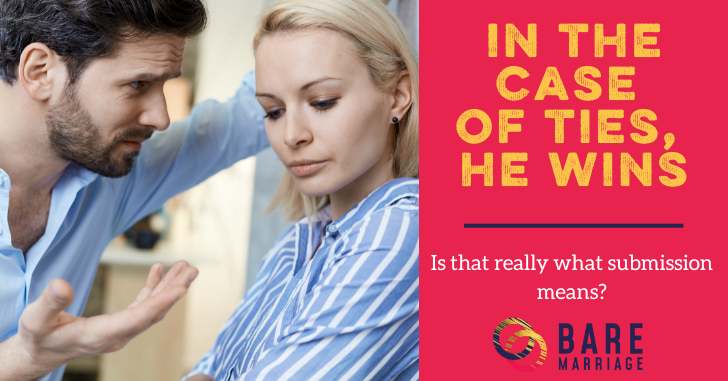


If I were to ask you what it means to submit to your husband, what would you say?
When I’ve asked that question at marriage groups, people hem and haw and then eventually come up with something like this:
When we’re disagreeing about something, the husband gets the final say.
That seems like a rather anemic definition, and I’ll get to what I think submission actually means in a later post. But because this is the most common definition that I hear, I’d like to work it through today.
So let’s start with where this idea came from.
Ephesians 5:21-22 says this:
Submit to one another out of reverence for Christ. Wives, submit yourselves to your own husbands as you do to the Lord.
Those two verses form one complete thought. In fact, in Greek, the verb “submit” doesn’t even appear in verse 22, because it’s inferred from verse 21. Many of our Bibles put a big paragraph break and a heading between those two verses, which inadvertently makes it look like they are separate thoughts. But they’re not.
Here, for instance, is the ESV:
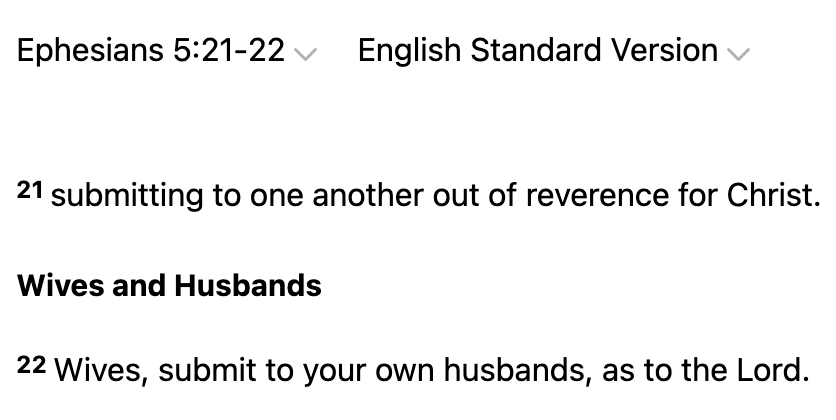
The section is split up, so you’d never know that was a complete thought. Thankfully, the NIV does this better (as do some others):

Since this is a complete thought, with the verb only appearing in verse 21, then submission can’t mean one thing in verse 21, then, and another thing in verse 22.
If we believe that submission means “letting him make the decisions”, then what does it mean in verse 21? How do we all let everyone else make decisions?


Let me suggest that submission is not about decision-making as much as it is about our attitude towards one another.
It literally is about putting oneself “under” someone else. It’s the same thought that Paul used in Philippians 2:4, when he said,
Let each of you look not only to his own interests, but also to the interests of others.
And then in Philippians 2 Paul goes on to explain what that looks like–we adopt the mind of Christ so that we become each other’s servants. That’s the message of the gospel. That’s the main thrust of Paul’s letters. We are to serve.
I am going to look at this more next week, but today I want to ask this question:
“What effect does assuming that the husband will have to break disagreements have on people’s expectations of marriage?”
If one believes that the main thing that God wants for a marriage is that the husband makes the decisions when the couple disagrees, then there’s an underlying assumption about marriage that we need to confront.
We assume that marriage will be full of disagreements.
If, on the other hand, we assume that the main thing that God wants for a marriage is that the couple will faithfully serve each other and follow God, then there’s another underlying assumption about marriage.
We assume that unity is the norm for marriage.
Do you see the difference? If the main thing that women must do in marriage is to let her husband break disagreements, then that’s assuming disagreements are normal. If your underlying belief about marriage is that it’s about serving one another and serving God, though, then you assume unity is normal.
And after four different surveys, of just about 40,000 primarily evangelical respondents, looking into their marital and sexual quality, I can tell you very strongly that these different expectations have real-world consequences.
When the husband makes the final decision, even if he consults with his wife first, the divorce rate increases 7.4 times. (John Gottman found a divorce rate of 81% in this case).
When we looked more closely at this dynamic for our book The Marriage You Want, we found that the husband making the final decision is highly correlated with emotional immaturity in marriage. When you don’t work towards unity, but instead assume disagreement, they have worse problem solving skills, less intimacy, and more anger outbursts and passive aggressive behaviour.
Here’s one of our charts from The Marriage You Want that shows the negative effects of this “in the case of ties he wins” dynamics. It has negative effects on every aspect of your marriage—especially for her, and especially if she’s the one who believes it.
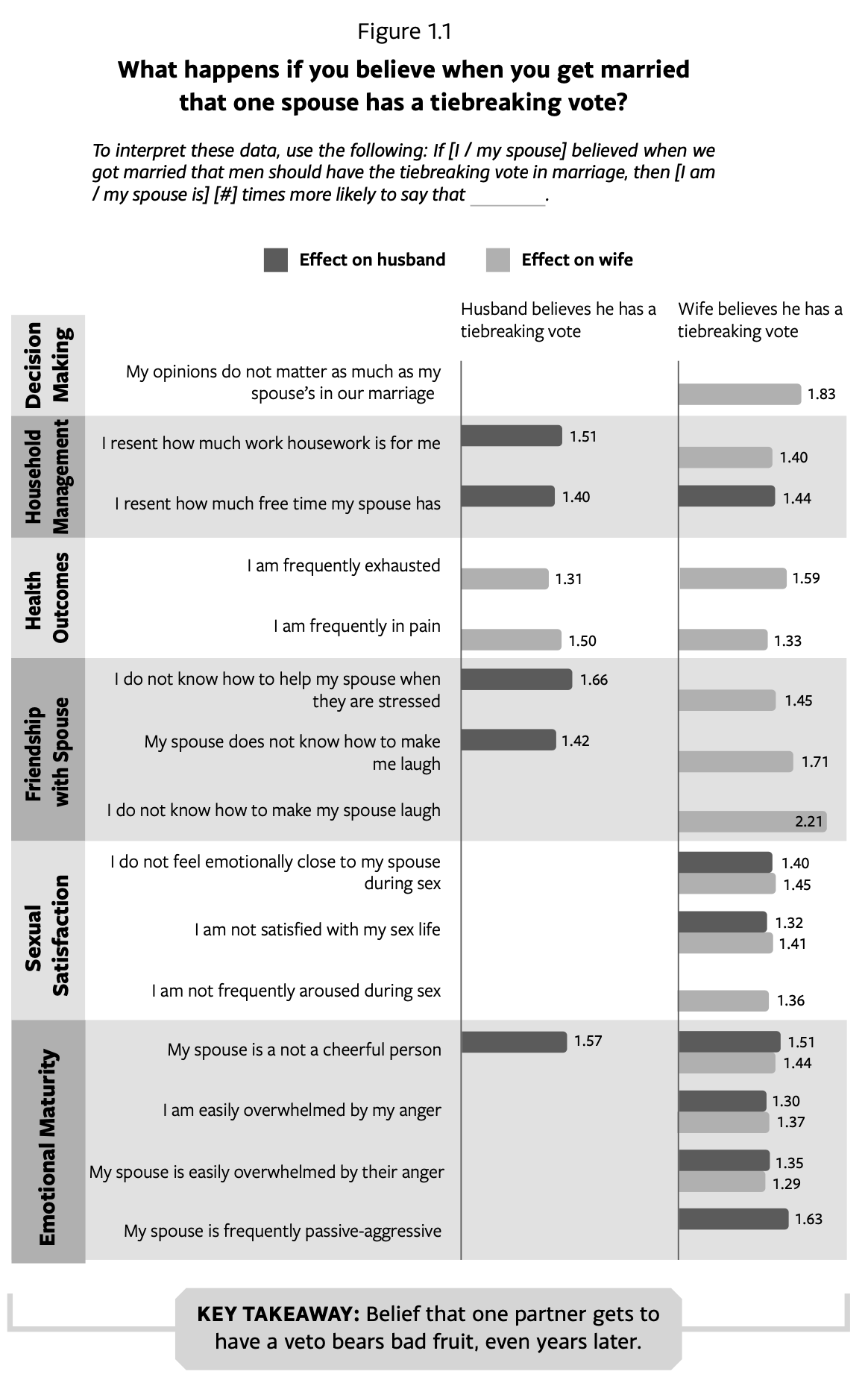
One of the more interesting results, to me, is that when people believe he has the tie breaking vote, men are more likely to say that they resent doing housework and resent if their wife has free time! This impacts his level of entitlement in marriage.
Also important—this affects her physical health. When he believes he has the tie breaking vote, she’s 50% more likely to say she’s frequently in pain. She she believes it, she’s 33% more likely to say it. Our bodies keep the score, and this score is bad.
The Marriage You Want is HERE!
It's time for HEALTHY and SAFE marriage advice!
It's time for a marriage book that doesn't leave you defeated or guilty--but instead leaves you empowered, hopeful, and excited.
It's evidence-based. It's got tons of charts! And it's fun.
Available in audio, ebook, or paperback, with an accompanying study guide, let's talk about the things that actually go into making a great marriage, rather than the things that evangelicals have tended to stress that all too often harm.
Together, we can change the evangelical conversation about marriage!
That’s what happens on the ground. Now let’s look more closely at WHY this dynamic is so bad in marriage.
What happens when you assume disagreements are normal?
Let’s picture your average couple who grows up believing that a wife’s role is to defer to her husband when they disagree. She vows this in her wedding vows. She looks forward to having a man to shepherd her. She knows that they will often be at odds, because that seems to be the nature of marriage, but she knows that she can keep the peace by deferring to him.
That’s what she’s expecting she will do in marriage.
So this young couple gets married, and soon she finds that she feels very unloved. Maybe they don’t talk enough. Maybe he doesn’t do much housework. Maybe he wants sex all the time, but it doesn’t feel very good for her, and he doesn’t seem concerned.
Whatever the issue is, what does she do? She may decide that she can’t really make an issue out of the fact that sex doesn’t feel very good. If she wants more date nights, but he doesn’t, then she figures that she needs to stop hoping for something that won’t happen. If he doesn’t do housework, she doesn’t want to bring it up or “nag” him because that’s not her role.
And so she learns not to speak her mind, not to share her heart.
Things that are simply normal adjustments to marriage, or different personalities or love languages, are framed as moral issues where she must “submit”–aka let him have his way. Simple communication issues, which otherwise could be dealt with quite quickly, are framed as issues of submission. And opportunities to grow together and increase intimacy are lost.
What if, instead, the couple believes that unity will be the norm in marriage?
Then, when sex doesn’t feel very good for her but he wants it all the time, they can sit down and have a difficult conversation, knowing that what they both want is to feel close. They can talk about how to make sex feel better.
If she feels as if they don’t connect enough, but he feels everything is fine, they can talk about love languages or about setting up some daily routines so that she feels listened to, but he has time to unwind, too.
They assume that compromise is necessary, but also that it isn’t all that hard.
What I have seen over and over again as I write and speak is that all too often women feel as if they can’t raise entirely legitimate issues–like sex not feeling very good–because to do so would somehow mean that they are not submitting to their husbands.
Because disagreements are assumed to be the norm, then there isn’t that same push to “make” peace. There’s only the onus, usually placed on her, to “keep” peace. If she raises a legitimate issue, or pushes too much, then she isn’t being biblical.
I’ve raised this issue before, and people have said to me, “why do you assume that you can’t have unity by her submitting to his decisions? Isn’t that the best way to unity?”
And to that I’d say–No. It isn’t. Because unity is about two people forming a new whole; it isn’t about one person disappearing so that the other gets all of his wishes met.
I find it very strange that throughout the Bible, the assumption about Christian relationships will be that there will be unity and a lack of disagreement, but then we turn around and interpret the marriage passages to be about breaking disagreements.
It’s like we believe unity is possible everywhere but marriage–and that’s why God told us to submit.
To which I reply, “Why?”
If Christianity is about having unity in our relationships, then why, when it comes to marriage, do we think that we need the husband to make the final decision?
When Keith and I disagree on something, we work it out. We talk about it. We pray about it. We wait on it. We seek counsel from others. And then we end up making good decisions together.
If two people have the Holy Spirit in them, then they already have the power for unity. They don’t need one person to break the tie; they simply both need to submit to God.
Download Our Marriage Survey
Join 40,00 others and let's change the evangelical conversation about sex
And that’s what 78.9% of couples do—even the majority who believe that the husband can make the final decision. Most couples who believe this don’t even act it out, because they know instinctively it’s wrong to do. But so many who do act it out can’t even picture doing it any other way, because they’ve never grown their conflict resolution skills and never learned how to achieve unity. And they don’t even realize they’re the ones who are the outliers.
They don’t know that when they say, “well, obviously you need a tie-breaker,” they’re telling on themselves!
I hope we can change the way we talk about marriage so that we’re not expecting disagreements as much as we are expecting unity.
If we assume that marriage will be about unity, then when we had disagreements, we’d work to honestly solve them, rather than just paper over them because they’re inevitable. And that’s what we found leads to much healthier relationships.
What do you think? Why do we cling to the idea that submission is about him making the final decision? How have you seen that play out in your relationships, or in those of those around you? Let’s talk in the comments!
You may also enjoy:
-
Our podcast further delving into this data about how teamwork works better than hierarchy in marriage
-
Chapter 1 especially in The Marriage You Want (plus chapter 7 on how to resolve conflict and build intimacy through conflict!)
-
Our Danvers Statement series looking at the four ways complementarianism can go wrong
-
My podcast with Marg Mowczko on what Ephesians 5 is really saying
Our Submission Series
- What does it mean to obey like Sarah?
- Does the way we talk about submission make marriage into an idol?
- In the case of ties, he wins--Is that what submission means?
- Are you following God or your husband?
- What does submission really mean?
You may also enjoy other posts on submission:
- The Marriage You Want--about the kind of marriages that thrive
- Keith's series on the Danvers Statement (the statement defending complementarianism)
- PODCAST: Are we making a strawman out of complementarianism?
- PODCAST: We sum up the Danvers Statement's issues!
- And don't miss our Starter Pack of podcasts on complementarianism!
Check out our book The Marriage You Want on how to do marriage a HEALTHY way!








Even though the year is 2025, we are still in a patriarchal obsessed society, especially in the American church. They still want men to be in power.
It really is crazy. The church is the only place in society that openly brags about doing this too.
The church insists that we cannot be like the world which in the US, this sexist behavior won’t fly in the workplace. And by allowing women to have the same opportunities that men have always had is considered “worldly” according to a lot of Christians, at least some of the ones in my circle. I feel like we’re going backwards in the US thanks to the heavy influence of Doug Wilson who has ties with US politicians like Hegseth.
What do you do when one of you(me) has been slowly changing how they believe? I had to change churches a few years back and my husband did join me over a year later. But lots of what I believe has changed. He hasn’t. We are in our 50’s, so we’ve been doing things the same way for 30 years. Some times it drives me nuts! And yes there are times where I disagree and then he makes a decision and I am so sad about it.
One thing that rarely gets mentioned in this conversation is that spouses have possess different areas of personal expertise. My wife has an MBA in healthcare administration. She was no. 2 at a 350 bed hospital when I met her. It would be really stupid of me to insist on my being allowed to make any healthcare or health insurance decision. I’m a lawyer and raise cattle. It doesn’t make sense for my wife to wrestle with decisions involving legalities when I do it every day
We’re a team. if we can’t agree on something, which is rare, we just don’t do it. Situations can change and we may agree later on. I’m just not worried about breaking ties.
Exactly, Boone! Why would you not want to take advantage of your relative strengths? It’s so silly.
Yes!
Tangent: there is such a difference in attitude between men who marry smart women and those who don’t see their wives’ talents as remotely applicable to anything.
Got it! I copy. Unity. 😃
If you need a tiebreaker just flip a coin. No bias there.
So, then who gets to be heads or tails?
I dont know. I just know that is dumb to be like oh we need a tiebreaker and I’m always the tiebreaker.
It would probably be a heads I win, tails you lose situation! lol
It is crazy. That’s why it is introduced to kids so early on – because then it becomes foundational to the way they think of marriage before they get old enough to be thinking about marriage for themselves. I remember being told that submission meant the husband has the tiebreaker when I was maybe 12-13. At the time, it was presented as “in most groups, you go with the majority vote, but in a marriage, there are only the two of you voting, so if you can’t agree, you need someone to hold the tiebreaker or you would get stuck and never be able to make a decision. That person is the husband because God has designed men to be more logical and less emotional, so if he makes the wrong decision, he won’t get as upset as a woman would if she made the wrong decision.”
At the time, it seemed logical. Only later did I wonder a)why two people who were both seeking God’s will would not be told the same thing 2) why it mattered if the person who made the wrong decision got ‘less upset’ than the other person, since both of them would be impacted by the wrong decision and 3) why these people always taught that men and women fitted into set stereotypes when I knew so many men and women who weren’t like that.
But even though my head told me this idea was nonsense, some of that teaching still lodged internally and was much harder to shift.
Honestly, I see little discussion of “peace keeping” vs “peace making” in general in churches, at least in my denomination. It seems like people just assume no conflict = peace, regardless of how you get there. It seems like people just either politely avoid conflict, or let the “loudest” parties just ramble themselves out rather than confronting in any form.
This! People don’t have an understanding of what peace is beyond “lack of conflict.” They don’t know how to resolve conflict beyond “mommy and daddy get the final say” which transfers to “the person in charge (husband) gets the final say.”
Like a 12-year-old Andrew Tate fanboy screaming at his schoolteacher “FEMALE! DO AS I SAY! I! AM! THE! ALPHA! HERE!”
It might also be useful if you have kids to let them help you with making decisions especially if it is going to affect them. Obviously make sure the decisions are age appropriate else you will have your kids wanting cake every night for dinner (in that case have them pick between a menu of possible meals), but allowing your children to voice their opinions allows them to feel part of the family and lets them know they matter.
I remember CS Lewis making the ‘tiebreaker’ argument (I think in Mere Christianity but could be wrong). I’m curious if it comes from there or goes further back. Does anyone know?
I maintain that it leads to divorce because the result is always known ahead of time: he wins, she loses.
It screws up his incentives; the more obstinate and callous he is, the more he wins.
It has no concept of whose lane is whose. I wouldn’t want to tie-break a decision wherein it affects his life profoundly and doesn’t affect mine much at all. I would be furious at the reverse.
It doesn’t contemplate who has greater knowledge or wisdom in this particular area. Imagine a man being a “tie breaker” when it comes to what kinds of period products their daughters can use. (Actually, don’t; I don’t want to give these people ideas.)
In no other time in life do we have a pre-designated tiebreaker who is *also* a party to the dispute. That’s like having a prosecutor and a defendant fight it out, and if they can’t agree, the prosecutor also gets to be the judge.
I really appreciate this perspective on submission. I have struggled with this concept my entire marriage and evangelical interpretations of submission have been weaponized against me and caused so much hurt in my marriage. It has been used as “proof” of how I have been in the wrong for asking for emotional intelligence in our marriage, it has been used against me — a dietitian — when I objected to punitive measures against our children for refusing to eat dinner, it has been used against me when the house wasn’t cleaned to his standards or when I object and stand my ground on any issue. I’m left feeling like I don’t matter and I’m
not important.
And evangelicals would say I chose poorly and need to deal with the consequences now that I’m
stuck. But I chose a man who was active in the church, involved in church planting, and had a strong spiritual life of scripture, prayer and worship. I think the problem is that we are taught wrong, and the roots of this are in patriarchal thinking, not God and His will.
I do want to ask how Genesis 3:16 fits in here where God tells Eve that her desire will be to her husband and he will rule over her? This scripture has been used by the church to reinforce the submission teachings.
Hi SE! I’m so sorry for what you’re going through! I’d say that Genesis 3:16 was God foretelling what would happen because of the fall. It wasn’t what He wanted to happen; it was just the result of the fall. And why would the church be trying to live out a fallen state? That’s ridiculous!