
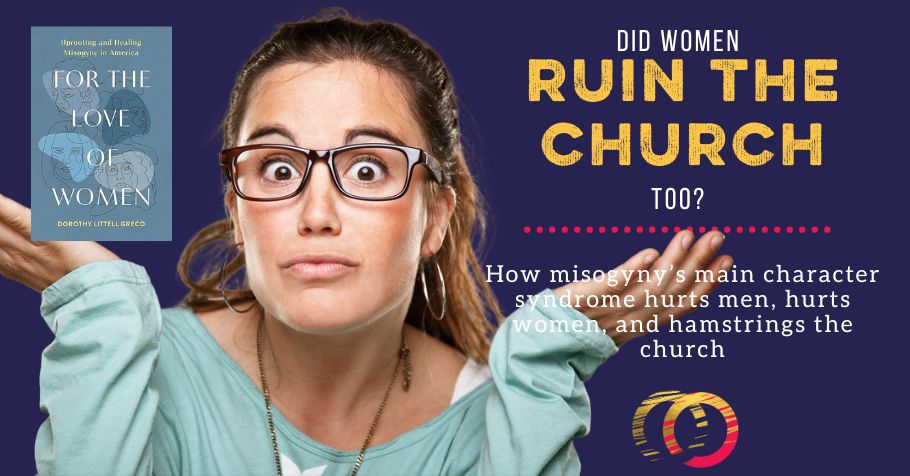


Thank you to Zondervan and For the Love of Women for sponsoring this post!
Last week, The New York Times had a ridiculous headline asking if women ruined the workplace.
I bet that Dorothy Greco, who wrote the book For the Love of Women that we talked about on a recent podcast, wishes that this had happened a year ago, because it would have made an awesome opening to her book!
As The New York Times reels from all the people unsubscribing, and social media explodes with women documenting all the other things they’ve “ruined”, the whole episode reminded me of something that Dorothy Greco said.
For the Love of Women details the presence of misogyny in all areas of American culture today–the church, business, government, health care, the media–and then shows what we can do about it, because God truly does love women. He doesn’t hate us.
And one of the themes that Greco keeps returning to in her book is entitlement–how entitlement is the root of misogyny. She writes:
I want to talk about what entitlement has to do with that New York Times headline, and what it says about our Christian culture too.
Here’s what it comes down to:
The New York Times was presenting men as the default.
The insinuation in that headline was that the workplace was good before women entered it, and now that they are here it is ruined. But ruined for whom? For women? No, for men. Basically, women’s presence ruined men’s experience of the workplace.
So men’s experience is taken as the default, and women are the supporting characters, whose actions impact the main characters–the men.
The New York Times tried to weasel out of their entirely self-made predicament by changing the headline several times (“Did Liberal Feminism Ruin the Workplace?” or “Did Feminine Vices Ruin the Workplace”), but that original headline rattled, because it told a truth out loud: men are the main characters, and women are only the supporting ones.
That’s what Dorothy Greco shows, over and over again, in her book. Just a few things I didn’t know that I learned from reading the book!
- “Personal Protective Equipment, often referred to as PPE (for example, the gear worn by doctors and nurses while treating COVID19 patients), is similarly engineered to fit the average American and European male, even though more than 70 percent of frontline healthcare workers are female.”
- “More than two decades ago, car manufacturers engineered a crash dummy that supposedly approximated the female physique more closely. In reality, they simply followed the “shrink it and pink it” approach and left it in the dryer too long, because at four feet eleven and 108 pounds, Hybrid III is significantly smaller than the average American woman. The female dummies are also more likely to be placed in the passenger’s versus the driver’s seat when being tested. By not factoring in these key details, women continue to die at a higher rate and suffer more serious injuries in frontal car accidents than men.”
- AI has been trained with men as the default, and this has implications for asking AI to choose the best qualified candidate, to ask AI to do facial recognition, and more.
- In media, the Bechdel test shows that all too many movies have women solely as secondary characters, existing only to further the plot for the men. In many blockbusters, women don’t show up as three-dimensional characters.
Men are the default, the main character; women are secondary to the story.
Entitlement is the root to main character syndrome
When our culture teaches men that they are entitled to be the main character, then any movement that tries to argue for women also mattering will be seen as an assault on manhood.
One thing I’ve been surprised by as I start to talk about Dorothy Greco’s book on social media is the number of women warning me about how bad men have it in our society today too thanks to “radical feminism” (when you ask them to define radical feminism, they usually can’t). Yet men tend to be upset not because they’re objectively doing worse than women, but because in many spheres they’re right to do better is being taken away. They see the loss of privileged status as analagous to being oppressed–even though it’s not.
None of this means that men aren’t legitimately hurting.
In For the Love of Women, Dorothy Greco makes a strong case that men lose under patriarchy too.
We do see men undergoing deep psychological and emotional stress in today’s society–they’re more likely to commit suicide; more likely to be lonely; more likely to be isolated. They don’t do as well academically. But none of this is due to feminism. It’s due to the patriarchal mindset that teaches that to be a man means to dominate others and have power over others and to hide your emotions. That doesn’t lead to a healthy emotional state, and it certainly doesn’t lead to peace and well-being.
The solution to all of this is not to give men back the power over women, but instead to invite men to fully enter into community and emotional life as Jesus offers and invites them, and to invite men to be fully themselves. Greco says:
Just released!
For the Love of Women: Uprooting and Healing Misogyny in America
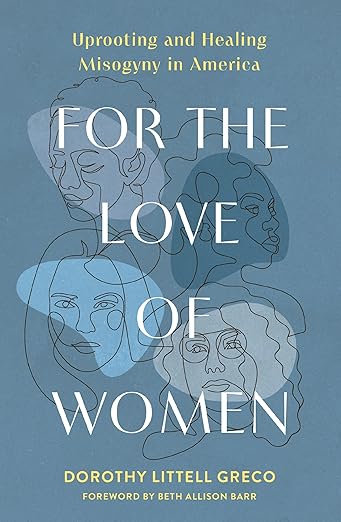
If you've ever been told, "sexism is a thing of the past; women are equal now. Stop complaining!", then you need this book!
Dorothy Greco goes over how misogyny is present in health care, business, the media, our relationships, and of course the church. She puts words to our experiences, and points the way forward.
Christian feminists are so pro-man.
We don’t hate men; we believe that men are amazing! We don’t believe that men are emotionally stunted. We don’t believe, as Every Man’s Battle claims, that men sin naturally “simply by being male,” as if God made a mistake. We don’t believe that men are incapable of being fully involved parents.
We think men can be fully human, in the same way that women can be fully human. And we want to see a world where this is the case.
And that involves letting go of main character syndrome.
In the church, main character syndrome has meant that men tend to run things, and women are left vulnerable.
Main character syndrome hurts all of us, but even though every now and then something radical happens and misogyny is blown out in the open in wider society, misogyny is on full display in churches across the world every single Sunday, because in complementarian churches misogyny is baked in. In the wider society it usually has to hide (which is why the outcry at The Times was so great), but in churches it doesn’t. The church is really the last bastion of society where you can openly discriminate against women and say so proudly and loudly.
It’s the last place that mediocre men can ensure that they can’t be challenged by capable women.
But as Greco says, this infantilizes men. It hurts women. And it stops the gospel from spreading. Greco invites us to wonder how much money and time and effort the evangelical church has put into keeping women subordinated over the last forty years, instead of doing the actual work of spreading the gospel and loving people.
Last week, in Canada, there was a glimmer of hope.
The Fellowship Baptist Churches did not manage to enshrine in their denomination that women could not be pastors or elders. It’s a long story (and I disagree with that website a lot but it’s the only place I can see the whole ordeal explained), but in 1997 the motion passed with 83% support. This year it only had 56%, short of the 67% needed to make it binding. Essentially, in 1997 they adopted a position paper that said that only men could serve as pastors, but the Canadian churches in the Pacific region took that to mean that while women couldn’t be senior pastors, they could serve as pastors or elders in other capacities. Other churches were upset about that, and wanted to make it clear they couldn’t be anything at all.
And they didn’t get the 67%.
They still had over half–but 56% is less than 83%.
People are starting to say, “hey, maybe God isn’t really this misogynistic.”
Maybe God really might love women.
Maybe God wouldn’t treat women this badly.
Maybe God doesn’t consider women secondary characters in a man’s story.
And maybe we shouldn’t either.
Change starts when we understand the problems we face.
And so I invite everyone to read For the Love of Women. It’s so well-researched, it’s very easy to read with lots of engaging stories and studies, and it will show you both what women have faced, and what’s possible when we decide to change.
It’s time. Women haven’t ruined the workplace, or the church, or the world. Women tend to make things better–because we need BOTH men and women. So let’s understand the times, and then move towards something better.
All of us, for the love of Jesus, and for the love of women.







I’m intrigued by what examples people give when they talk about life being hard for men because of radical feminism. I think that’s a bizarre thing to say!
Also, here’s the NYT transcript if anyone else is interested.
https://www.nytimes.com/2025/11/06/opinion/women-workplace-feminism-conservative.html?unlocked_article_code=1.zE8.FS5V.iVH4LdLGO_Jc&smid=url-share
Now retitled as ‘did liberal feminism ruin the workplace?’ I don’t think any of those titles are a very accurate reflection of what they discussed. Clearly whoever wrote the headline was trying to make it sound spicy and controversial and it sounds like they’ve reaped what they sowed.
The issue is have as a man is when people want to blame me as an individual for things I either have no control over such as the fact that I am male
I want a more just world because that helps everyone.
Being told that you are behind systems that have hurt people has a way of making people feel like they dont care about you as a person that you are a statistic or a link in a chain.
I do not think it is fair to mock women and what they love. I also dont think it is fair to mock men if they find that they are drawn to certain traits describe as masculine such as a kind of stoicism. Not being unemotional but realizing when and how it is appropriate to process emotion. I actually agree heavily that emotionally stunting people hurts everyone.
I also grow annoyed with cynical ideas that can sometimes feel anti human that treat people as parasitic instead of being wonderful.
Let me explain it this way. I am a white woman. White people have benefitted from the oppression of minorities. Being in a society that still carries the dynamics of our shared past, I have a job to see this clearly and work to dismantle those structures so we can all live with greater freedom and justice. I am not going to complain that the truth of our past and present makes me feel bad. It is not my fault, but it is my responsibility.
I like that, “it’s not my fault, but it is my responsibility.” That’s how I see it too.
It’s like Gloria Steinem says, “The point of feminism is not for women to do to men what men have done to women, the point is to humanize both genders.” She’s a radical feminist, by the way.
Yes, so true! That’s a great quote.
I think the thing that’s hard to figure out how to deal with is when truly helping and “humanizing” men is seen by them as threatening to them and even dehumanizing. It’s like a doctor telling their patient they have cancer and will need treatment and the patient interprets that help and advice as harm instead.
“My doctor must hate me!”
“No, they’re trying to help you, but the solution to your pain may not be exactly what you want to hear.”
How do you help such a person get well if they refuse to see or admit they might be sick, or they turn to “treatment” that will only make them sicker in the long run? This is my big question I keep coming back to.
I guess Jesus knows all to well how that feels… 😂
Women have been part of the workplace for centuries and part of the church since its beginning. So if you feel like they have ‘ruined’ either, then it was ruined long before you were born.
Well, there’s certainly one way to.make sure women can’t possibly ruin “church”:
https://www.gutenberg.org/files/24874/24874-h/24874-h.htm#The_Strike_at_Putney
What say, ladies? I’m in.
My favourite short story ever!
“The church is really the last bastion of society where you can openly discriminate against women and say so proudly and loudly. ”
This is a very good point!