

Ever felt like God was your pimp?
I know that’s an inflammatory statement, but I’ve heard this sentiment from so many evangelical women that we’ve interviewed in our research, or from comments and DMs. When sex is something that is degrading, painful, or makes you feel used, AND AT THE SAME TIME you are taught that God will be angry at you if you don’t have sex with your husband, then it’s hard to see God as anything other than a pimp. He coerces you to have sex that you don’t want, which feels dehumanizing and objectifying.
I want to tell you about some of these stories today, but first, a bit of history.
In our survey of 20,000 women for The Great Sex Rescue, we had two big types of questions: specific ones that had answers we could code numerically, so that we could run stats on them (that’s where you get numbers like women who believe the obligation sex message have sexual pain rates analagous to if they had been abused); and long-form questions, where we invited women to just type out anything else they wanted us to know.
We had THOUSANDS of people fill out those long-form answers. Some people left essays–2000 words long; others left paragraphs or pages, and many were heart wrenching.
But when you have thousands of long-form answers like that, it’s really hard to analyze them. You have to run code to look for specific themes, etc. It’s called qualitative analysis, and what we’ve tended to do is quantitative analysis. Both have their roles in research. Quantitative analysis can give us a snapshot of what is happening, but it can’t tell us how people make sense of what is happening, or the meaning that they assign to these things. That’s where qualitative analysis comes in!
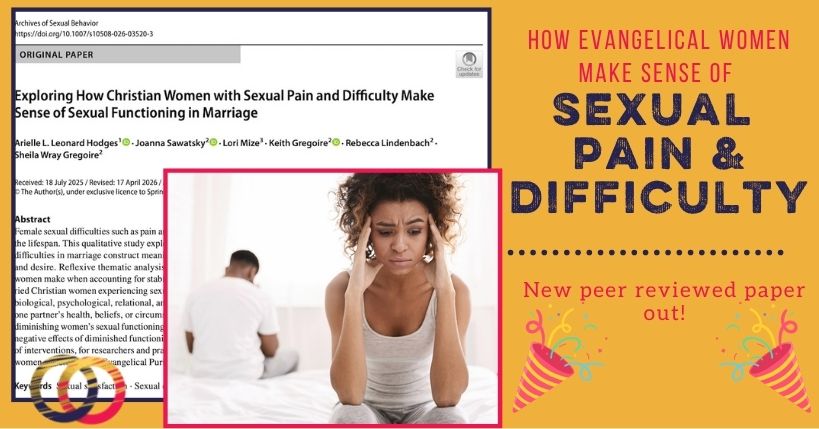
And I am pleased to announce that our first qualitative paper has been published!
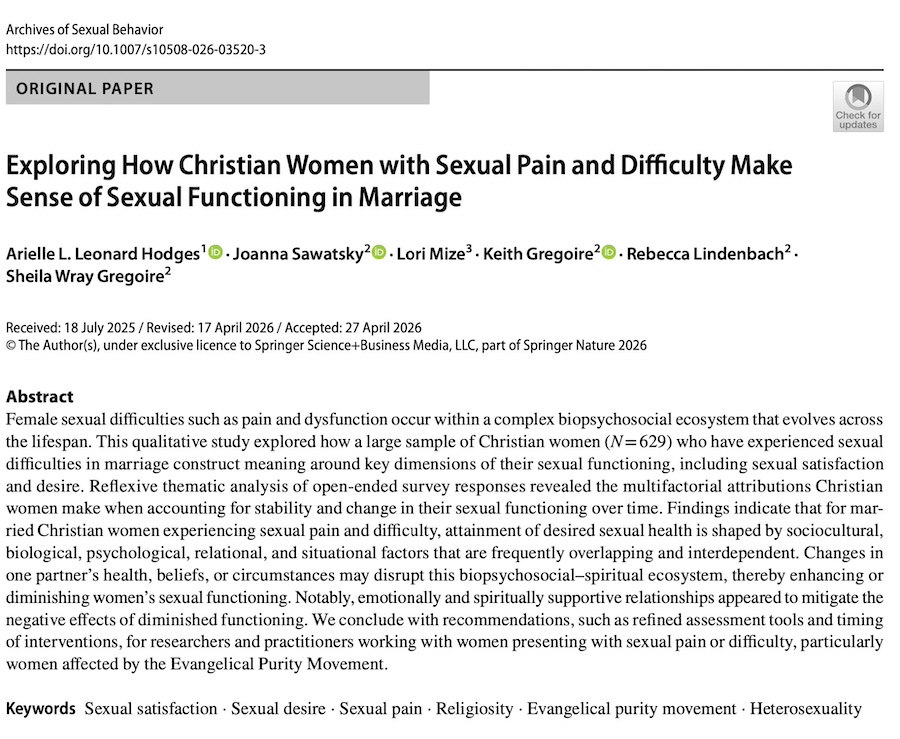
(for clarity, the sample size of 600 women doesn’t mean there were only 600 women who did our survey, but rather 600 women in this particular data subset who filled out the long answer forms and mentioned sexual pain).
Arielle Hodges is a researcher who has been helping Joanna with many of the papers we’ve been writing, and she took the lead on the qualitative analysis of the American subset of our dataset, which is up at the ARDA and available for other researchers to use. With money from donations from people like you to our Patreon and through the Good Fruit Faith Initiative of the Bosko Foundation (it’s tax receiptable within the United States!), we are able to fund partnering with other researchers to get more papers written.
Arielle (I’ll call her Arielle because that’s what our team calls her, rather than the more formal “Hodges” or Ms. Hodges”) has an interest in sexual pain disorders and evangelical women, and so she combed through the long-from answers to look for those that reference sexual pain, and then managed to identify different themes in how evangelical women make sense of it.
Here is just one story that broke my heart–that I think many can identify with:
I’ve been married for nearly 25 years. I was super excited to be married and very excited about sex. But when sex was painful for me and I couldn’t find relief, I felt like I had no choices. … So, I had painful sex, again and again and again. I kept reciting verses to myself, “Do nothing out of selfish ambition or vain conceit.” “Do not deprive your spouse except for a time of prayer.” And so I prayed and prayed, Lord, please take the pain away and help me to love my husband. And God started to feel like a pimp. Without knowing it, I started to believe that God cared more about my husband’s sexual needs than the pain I was experiencing. More than anything in the world, I wish I could whisper to the 22 year old version of myself, You matter to God. Your pain matters. God sees you. He wants to help you and your husband figure out a better way.
(White Woman, 40s, First Marriage)
That story is the perfect encapsulation of why qualitative research is so important. We can tell you the numbers on how many evangelical women experience sexual pain, or on what contributes to sexual pain rates (believing the modesty message as a teenager; believing the obligation sex message; believing you have to have sex to keep your husband from watching porn; having sex for the first time on your wedding night while unaroused; etc), but it’s these stories that fill in women’s experiences and help us understand what women feel.
She was told her whole life that she was supposed to suffer, and that if she didn’t obey God she’d be in big trouble. And part of obedience was having sex, even if you didn’t want it–and remember your pain doesn’t matter.
No wonder she felt like God was her pimp!
Thankfully she’s on the other side of it now, but this story shows us how all of these different threads of Christianity–about how God wants us holy not happy; about how God is basically punitive; about how sex is an obligation–all mix up together and make it so difficult to get over sexual pain disorders. And this is likely one of the big reasons that evangelical women are the main patients that pelvic floor physiotherapists see here in North America!
Arielle looked at stories like this and classified them by themes of how women made sense of pain
- Sociocultural attributions
- Biological and physical attributions
- Psychological attributions
- Relational attributions
- Situational attributions
She then identified subthemes in each of these, and shared some of the stories. Writing about how many of these women were contending with unhealthy views of sex, Arielle says:
Many women attributed their negative views around sex and resulting difficulties to unhealthy religious/spiritual, familial, or cultural socialization (i.e., through secular media), noting how it took time to recognize that their sexual desire—especially as a woman—was God-given and not something to be ashamed of. To elaborate, many women experienced cognitive dissonance, mental blocks, and feelings of shame, guilt, fear, and disgust during their marital sexual encounters. Getting married was the event that often brought these experiences to the fore…
Here are a few stories that may resonate with you:
For the first 5 years of our marriage, I could count the amount of times I had non-painful sex on both hands. I owe this to my evangelical upbringing and the battle it took to overcome that. We both (but I carried the load) worked really hard to get to the place we are now—having a fun experience for both of us.
(30s, White, Evangelical, Married/First Marriage)
(30s, White, Evangelical, Married/First Marriage)

(Note: if you can relate to this story, please see a pelvic floor physiotherapist! Doctors aren’t trained in how to treat this, and you really need a physiotherapist. Also, the more you have intercourse that hurts, without treating the pain, the more you reinforce that pain!)
This is a completely different kind of research article than we’ve done before!
And I find it fascinating. I’m especially grateful that we were able to bring Arielle on board to do justice to the many long-form answers we received. I hope we can write other qualitative papers that focus on things other than sexual pain–perhaps abuse, or purity culture, or obligation sex, etc. I am honoured that so many women spent so long filling out our surveys and letting us know their stories, and I want to do them justice.
I especially appreciated the research implications section of this article, at the very end. Arielle makes some great points about how we need a nuanced look at the role religion plays in women’s sexuality. This one paragraph especially made me laugh:
women were identified as helpful by others. Given that the internalization and agreement with messages received from such sources have been linked to sexual and relational difficulties (Sawatsky et al., 2025) and, as the data in this study suggest, may result in women remaining in abusive relationships, future qualitative studies should deliberately explore how women make meaning of this documented discrepancy and their perceptions of the relational or spiritual benefits of such Evangelical content.
To translate from Academic-ese, in other words, many women said that certain evangelical resources helped them, even though we know that these resources are associated with more abuse and with negative outcomes. So why do women think that resources that have been shown to harm are actually helpful? What does that say about these religious spaces? And I agree–I certainly think that’s worth further research!
(And I’d also say that one particular answer could simply be that evangelical women have such few resources to choose from, and at the time of this survey in 2020, almost all the sex resources in evangelicalism were uniformly harmful. But women had no way of knowing that, or of knowing that there was another way to view things).
Our goal is to change the conversation about sex in evangelical circles
By publishing papers like these, we show the academic community how the evangelical approach to sex affects women, and that can influence how pastors, counselors, lay leaders, and others are trained. It can influence what people say in future books. Even in the last five years since The Great Sex Rescue was published I’ve seen an increased understanding that the obligation sex message and the every man’s battle message are both really harmful, and when someone spreads the message on social media, I’m seeing a lot more pushback from regular people than I ever saw before.
We’ve now had four papers in the literature about the harms of so many evangelical messages about sex, and I pray that seminaries will start to grapple with this as they train future pastors.
I hope we’ll have more papers to share with you soon!
We have a number in the works in various stages of submission, including more on sexual pain disorders which was our particular area of interest, and hopefully those will be out soon. And Joanna has also been a peer reviewer on several different papers for different journals lately, so the academic community is recognizing the expertise of our team when it comes to religiosity, sexuality, and purity culture!
Grateful again to everyone who has supported our work, and a reminder that you can do so too! Donations help fund these research initiatives, as well as our translation efforts (our Spanish language initiative launches next week!), and our docuseries like the Love & Respect one that Rebecca and Joanna did earlier this year. You can get a tax-deductible receipt within the United States by donating to the Good Fruit Faith Initiative of the Bosko Foundation, and we’re especially looking for monthly donors, even just $10 a month. If everyone who reads the blog did that, we’d have the largest religious research initiative!
And, of course, you can always become a Patreon supporter! No tax receipt, but you get access to our private Facebook group, and at different tiers you get Joanna’s book club and her course starting this winter on how to develop a sexual ethic.
Do you think our research is making a difference? Let’s talk in the comments!


Congratulations!!!
Look, God chose to make sex absolutely sucky and painful for women, while being mind-blowing and amazing for men. Men can get off when they don’t care about us, coerce us, ignore us. Allegedly it can be good for women (albeit not orgasmic) of the stars align and he actually cares about her.
It is a deeply sick system.