



One of the most common pieces of marriage advice you’ll hear in evangelical circles is “your husband comes before the kids.”
It’s constant, and we’re always reminded that one day the kids will leave home, but your husband will still be there. He needs to be the priority.
You know what we don’t hear?
“Husbands, your wife has just given birth, and her body has gone through more trauma that it likely ever will again, except when she has more children. Her hormones have dropped precipitously. She isn’t sleeping. Her milk is regulating. She is getting used to being a mom. Now is the time to step up and be a fully engaged partner, taking shifts at night as much as possible so you both can sleep, caring for her during the day, and making sure meals are made.”
I wrote about this in my Substack article on Friday, and I wanted to post it here too to update some older posts I’ve written about the postpartum era.
Instead of healthy advice telling us to prioritize those who really need support, we get advice like this, from Gary Thomas’ best-selling book A Lifelong Love:
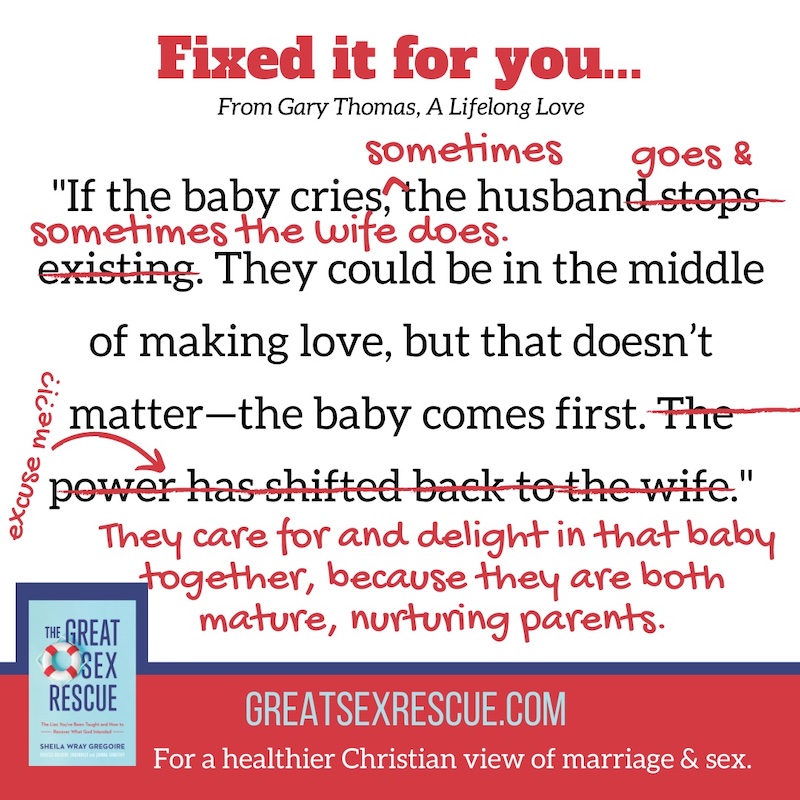
Notice what he is saying: If the wife tends to a helpless infant’s cries, she is neglecting her husband, and she has power over her husband.
There is no talk about how the husband can help too. There is no talk about how the baby SHOULD come first–because it’s a baby.
There is only guilt trips thrown at a woman for wanting to tend to her helpless infant in distress, because somehow this is taking away from her husband’s sex life.
What kind of man feels jealous of a baby? What kind of man sees a baby as a threat, rather than as someone to nurture and love? This boggles my mind.
And in the chapter where this quote appears, Gary is talking about power shifts in marriage, and how the power rests with the one who is the least invested in the marriage. He points to different times this can happen, when power shifts back and forth.
But what he is saying is that caring for your infant means you’re less invested in the marriage.
Who says that? Why are evangelical resources pitting husbands and kids up as if they’re in competition with each other? This frames husbands as kids that women need to care for while they are at their weakest, rather than as partners they can rely on to share the load and care for them.
Most evangelical men aren’t like this
Most dads actually are involved dads! Most dads don’t resent their kids. Most marriages are happy, and about 50% of evangelical marriages function as healthy partnerships! It’s not that evangelicals don’t ever get this right.
It’s instead that our advice gets it so totally backwards, because evangelical marriage advice tends to center the man, rather than looking at what leads to the best outcomes and best reflects the heart of Christ.


This month we’ve been reminded of how much women are ignored postpartum
Like many of you, I’ve been glued to the Lindsay Clancy case, where a mother allegedly killed her three children due to postpartum psychosis. There is much speculation about many aspects of the case, but one of the important cultural moments is the wider discussion of how much the postpartum period consumes a woman and the toll it has on her.
I’ve read countless studies over the last week about how one of the biggest predictors of postpartum depression (PPD) is the amount of support a woman has at home. Having a husband who picks up his share of the load lets her feel that she is safe and she’s less likely to develop PPD.
The postpartum period is absolutely crucial for the mother and baby. It can’t get more crucial. And yet what do evangelical marriage books say about this time?
- Kevin Leman in Sheet Music insists that you should give hand jobs and oral sex, since “faithfulness is a two-person job.”
- Gary Thomas talks in Married Sex about how much men like hand jobs during this period, because he loves seeing you so excited as you give them (note to Gary: she’s moaning to get it over with faster, not because she’s excited. In our focus groups women told us that they often moaned when giving sexual favours they were guilted into to speed up the process. And the “wetness between her thighs” that you say excite you so much is not her sexual lubrication when she’s postpartum or on her period; it’s blood. Yes, a large minority of women enjoy doing this postpartum, and more power to them! But if you have to write a book convincing women to do this, these aren’t the women who already want to do it).
- Intended for Pleasure says that when you can’t have intercourse after giving birth, you should give manual stimulation to the same frequency as you had sex before you gave birth, so that he will not be jealous of the baby and his needs will be met.
Thomas later writes that women should approach the sexual relationship in the same way that a mother gets up in the middle of the night to feed her baby. The husband needs his num nums too? Does he realize he’s comparing himself to a literal newborn?
I am so done. I am so disgusted.
Watch the podcast that Rebecca and I recorded when she was a few weeks postpartum where we discussed all of this!
Here’s a clip of us from a podcast taking on Josh Howerton saying something similar. I’m just gobsmacked at how evangelical pastors and authors see women who are run ragged with children, and feeling distant from their spouses, and the answer is always, “women, you need to save your best energy for your husbands, so try harder at night,” rather than “men, if your wife is exhausted, it means you’re not doing enough. Jump in. They’re your kids too!” (We talked about this dynamic quite a bit when we looked at Jimmy Evans’ book Marriage on the Rock as well.)
Much of this advice stems from a misreading of the stats
Yes, divorces do spike once kids leave home. But our matched pair study of 7000 people for The Marriage You Want found that this wasn’t because people had nothing in common once the kids were gone. Instead, it was that women had been putting up with deeply unfair dynamics in a number of areas for years, and you can only put up with that for about 20 years before you break.
Women can have sex without orgasming for about 5 years without it bothering them too much, but at 10 years they start to get upset, at 15 years they’re really mad, and at 20 they’ve had it.
Women can do the vast majority of the housework, even if they work outside the home, for about 5 years and it doesn’t bother them that much, but at 10 years it registers. At 15 they’re mad, and at 20 they’ve had it.
We call this the unfairness threshold, and we showed several examples of it in The Marriage You Want. When she’s the main one to initiate repair after conflict; the main one to make all the medical and dental appointments; the main one doing all the kin keeping for your own side of the family, but also your own. When too much of the burden falls on her, and she isn’t cared for equally, the marriage suffers.
Those divorces that happen after the kids leave home, then, aren’t primarily because the couple has nothing in common anymore. It’s that the husband has been treating the wife unfairly for decades, and when the kids leave, she finally feels that she’s able to leave too.
And that unfairness actually stems from this evangelical marriage advice.
When they teach that the main priority on the birth of a child is that the husband still ejaculates, rather than that the wife gets support and sleep, that sets up the dynamics that will lead to divorce.
When they teach that the problem in a marriage where she is carrying the mental load and emotional labour for the family, and that she is doing most of the hands-on housework and childcare, is that she isn’t saving her best energy for her husband at night, they train couples to ignore the inherent unfairness of all of that labour being put on the wife.
The very evangelical advice that teaches people to put the marriage before the kids actually destroys the marriage.
If, instead, they taught people to be partners and care for children together, that marriage would grow and would likely last, because she would feel valued, less tired, and part of a team.
The Lindsay Clancy case is showing us how desperately important it is to support new moms. The evangelical church instead decides that new moms need guilt trips about their husbands’ sex lives.
Wake up, church.
Our Friday Round Up zeroed in on the Unfairness Stats and Divorce!
Rebecca and I talked about this phenomenon and why it happens on last week’s Friday round-up video too:
Do these evangelical authors realize they’re equating themselves with babies? Why do they pit husbands against babies like this? Let’s talk in the comments!







“Allegedly” what do you mean allegedly she admitted to murdering her kids and then tried to off herself?
I’m not Sheila, but:
1. It is common to use “allegedly” when referring to criminal proceedings before a verdict has been rendered; and
2. Murder involves a level of mens rea that is the subject of dispute in this case.
I don’t deny that she was going through some stuff mentally. I also look at it though and go she sent the husband away and killed her own children and now you have folks going um but muh astrology muh true crime brain and I go this is absurd but no that is actually happening.
My pastor likes to say “spouses, put each other first, kids second”, but even in the case where people say this, it likely implies that wives should their husbands first.
And my own interpretation of the exhausted not doing enough model is “If one of you is exhausted and the other isn’t, one of you isn’t doing enough”. This ties in nicely with Sheila’s comment that in a marriage, each person should have an equal amount of down time
Their reasoning for putting your spouse first before the kids because “kids will eventually leave the nest” is really stupid because it is becoming more normal for intergenerational households to exist out of financial necessity as it housing is very expensive these days in most developed countries.
Also, what if your child is special needs? They are there with you forever unless you manage to shove them off to a group home which good luck with the waiting lists on them.
Plus, don’t you want a relationship with your kids when they are adults? How you treat them when they were kids will determine how they treat you as adults and they will be less willing to want to take care of you when you are older if you don’t prioritize them.
Another scenario that happens is instead of the husband stepping up the older daughters (usually) will usually end up caring for the kids especially if you have more than three kids. I don’t mind children helping out as long as you pay them and make sure they have their own lives and want to do it rather than being voluntold, but most of the time the husband doesn’t want to step up so these daughters end up doing what the mom can’t do because she has her hands full.
“How you treat them when they were kids will determine how they treat you as adults and they will be less willing to want to take care of you when you are older if you don’t prioritize them.”
“Cats in the Cradle” by Harry Chapin.
“it is becoming more normal for intergenerational households to exist out of financial necessity as it housing is very expensive these days in most developed countries.”
More like returning to an earlier normal.
Before World War Two, intergenerational households were the norm in most developed countries, especially outside of major cities.
From the OP – “But what he is saying is that caring for your infant means you’re less invested in the marriage.”
The one who is less invested in the marriage is the one who is obsessing over who has the most power.
It makes me wonder how many of these men actually even truly put thought into wanting kids as much as women do. Like I feel like there is an obligation to have kids in addition to an obligation to have sex in the church and you are treated as wrong to question it even if you can’t reasonably afford kids or are like me and have health issues like bipolar which makes me prone to postpartum psychosis even if I choose to adopt. I feel like women think about this decision more than men do because we are expected to take care of them more and I feel like a lot of evangelical men are just going through the motions and then when they realize children are a lot of work and money, then they get really upset.
My husband wanted kids until I hit him with the reality that our kids would likely have autism and reminded him how much of a tough childhood and adolescence he had and I had and would he be able to be there for that and be able to address said behavioral issues. Ever since then he has accepted that he couldn’t handle it but until then he never really thought about it and I think a lot of men don’t really think about what they are getting into with parenting
Fits in with their theory that men are four year olds on the inside. Jealousy, clinginess and regressive behavior to try to monopolize mom’s attention are typical toddler behavior when a new baby arrives.
Reminds me when I read “Power of a Praying Wife” for the first time. The similarities between her husband and my toddler were undeniable.
Lotsa arrested development cases walking around in allegedly-adult bodies.
“Kevin Leman in Sheet Music insists that you should give hand jobs and oral sex, since “faithfulness is a two-person job.”
Gary Thomas talks in Married Sex about how much men like hand jobs during this period, because he loves seeing you so excited as you give them”
Once again, we get to know more about Leman & Thomas’s sexual appetites than we ever wanted to know.
Yep.
It’s also a mentality that arises straight from birth control and the sexual revolution.
It is absolutely insane on every level to demand sex while the natural result of sex – a baby – needs to be cared for, or to demand sex when a woman is postpartum, ie, recovering from sex.
I agree. If there’s a baby or young child involved both parents jump in with both feet. There’s no excuse for not immediately meeting the needs of a child. There’s trick is to balance. It doesn’t take long for ten years to slip away with the husband relegated to the background. He’ll screw up his courage and attempt have a conversation about the situation. It won’t go as he hoped. He might be stupid enough to to try to that same conversation at a later date. It won’t go any better. If he’s God’s own idiot he’ll try a third time with similar results.
After that he’ll just eat it and keep showing up. The bills will still get paid early. The oil will still get changed and he’ll still get up every morning and go to a job where he’s treated like dirt.
Ten more years slip away. The youngest child is now off to college. The sex doesn’t get any better. He’s still invisible because it’s now habit and it’s not going to change so he comes to see me. He figures that he’s no better off being married than it is being single with half the stress and more time to fish.
Yes, Boone, but that’s a HIM problem, not a HER problem. He’s relegated to the background because he didn’t hep with the kids, AND THEN instead of apologizing for that and jumping in with the kids, he tried to talk about how they don’t have sex anymore.
That’s the issue, though. He caused it. He created that sex life he hates by abandoning her when she most needed it, and showing himself as unreliable. And she learned she can function fine alone.
“He figures that he’s no better off being married than it is being single with half the stress and more time to fish.”
There’s a Manosphere proverb that’s been showing up recently in my YouTube feeds:
“Know Woman, No Peace.
No Woman, Know Peace.”
Most of this stuff goes down as “duh”.
While I appreciate the fact that lots of so called-Christian media indeed downplays some of these issues and seems to favor men, one only needs to go look at basically any secular community IRL or online to see how these issues are not only taken very seriously but that men are demonized to an insane degree and have their needs seen as totally irrelevant and chastised. It’s a shame we can’t seem to find any middle ground solution where the onus isn’t completely put on one or the other partner. This reads exactly like a feminist handbook that women all over Reddit fawn over while they have hundreds of replies trashing their husbands.
And with all due respect, I find this dismissal of the magnitude of that societal view to be a bit irritating, and I also find it a bit unsettling to see your glossing over of Lindsay Clancy’s crimes. I do not doubt that PPD is a very serious condition that deserves attention, but it’s not an excuse for committing such wicked and graphic acts.
I don’t think you are a bad person or even a bad blogger, but I do wish you would consider that outside this community men are subject to endless ridicule over these very things, and that shaming them in this manner is unlikely to make them change their ways.
(FTR I don’t have anything in this, I’m disabled and have no chance of a romantic relationship, and if I did I would have myself sterilized for a number of reasons)
In good faith, and God bless.
Hi JL! Just a note that Lindsay hasn’t been found guilty, and the defence was forced to plead guilty because the judge wouldn’t do two trials–one to determine guilt, and one to determine mental culpability. We don’t know what the outcome of this trial will be, because right now much of the evidence points to someone other than Lindsay, and the timeline and her injuries don’t add up. It’s a really, really confusing case. Patrick said she confessed to him at a point in time when she wasn’t capable of speech. Her heart rate at the time she was supposed to be killing the kids was 57. The blood splatter doesn’t line up. And the state didn’t test major areas of the crime scene until 6 months later. So we shouldn’t be assuming she did it until the whole thing plays out.
Also, as for the societal view, the Bible tells us that we’re to judge those inside the church, not outside. So that’s what I do. I judge those inside the church, and the things written by evangelicals. Because as Christians, we have a responsibility to not be doing further harm.
Man, THIS!!!! I feel like I could comment on almost everything in here. Gary Thomas is a [redacted]. While I’m fairly certain we should not be name calling on here, this stuff just makes me so angry. And I know why but I can’t say so publicly. Anyhow, thank you for this read and for your work.