

In 2019 I started critiquing Christian marriage books.
Until then, I had been writing and speaking in evangelical spaces, but I hadn’t read a lot of Christian marriage books. I figured, they love Jesus, I love Jesus, we’re all saying the same thing!
But in January of 2019, I had had a headache and I was procrastinating, and people on Twitter were debating whether they needed love or respect (referring to Emerson Eggerichs’ best-selling book by that title). I realized—I have that book! I should read it. That’s an awesome way to procrastinate!
And the rest is history.
Reading that was like a nuclear bomb going off in my living room. It was simply so toxic, and I had had no idea that this is what was being taught.
I shared this story over on Substack last Friday, but I want to post it here too for those of you who mostly read the blog! And because I write so much day-to-day on the blog I rarely take the bird’s eye view and tell the whole story. Keith and I talked about much of this in a podcast a few months ago, but I’m constantly asked for a summary of that podcast. So I’d like to take the opportunity to do that today.
That Friday afternoon started our journey to shift our ministry entirely. We conducted the largest survey of evangelical women’s marital and sexual satisfaction ever done, looking specifically at how teachings about marriage and sex affected women. As you all know, that became our book The Great Sex Rescue.
Since then we’ve done three more surveys, including for our latest book The Marriage You Want (and you can read about how, in that survey, we were finally able to debunk the whole Love & Respect thesis!).


In doing our research, I’ve read dozens of Christian marriage books.
And they all say virtually the same thing. They may have a gimmick (“His Needs, Her Needs”, “The 5 Love Languages”). They may be more theological (“The Meaning of Marriage”, “Sacred Marriage”). They may be geared more to women (“Power of a Praying Wife”). But they all repeat pretty much all the same talking points.
And I end up critiquing pretty much all of them.
This really bugs some people. They’ll say to me, “So you just have decided to hate everything, so that you can crap all over other people’s books and make your books sell better.”
And I can see how they think that way.
But that’s actually not the problem.
The problem is this:
If the books are based on the same faulty foundation, then the books will tend to give the same advice, and bear the same bad fruit.
And that’s what’s happened.
In evangelicalism, there are two main goals when it comes to marriage:
- Make sure that husbands are in authority over their wives;
- Make sure that nobody divorces.
But what if these goals actually result in bad fruit? What if these are actually not the things that we’re supposed to be aiming for in order to have a good marriage?
Here’s what I’ve found when reading these books: They start from the same faulty foundation (that men are in authority over women), and then, if they want their goal of marriages staying together at all costs, this inevitably leads them to teach four other things that actually make marriages unhealthy—because that’s the only way to accomplish their goal of keeping marriages together, when those marriages are, in fact, unhappy.
That sounds complicated, so let me show you the 5-point faulty foundation that these books are based on, and the logic that makes them flow together:
Point 1: Husbands are in authority over wives
Most evangelical marriage books take this as their starting point: ultimately men are in authority over women, and so husbands have the responsibility of making the final decision when there are disagreements.
Some take it further, saying that to even question what a man is saying or wants to do would be disrespectful (think Love & Respect), which inevitably leads to very bad communication patterns.
But this simply can’t result in healthy marriages, because a healthy marriage is based on intimacy, and you can’t have true intimacy if one person’s opinions matter more than the other person’s opinions. Then one person is told that she shouldn’t even really suggest things, or even have thoughts in some areas, because that’s for him to decide. And she ends up shrinking, while he all too often ends up entitled.
That’s what our data shows. In The Great Sex Rescue, we found that couples who act out the husband making the final decisions, even if he consults with his wife first, have a 7.4 times higher divorce rate. John Gottman, the world’s premier marriage researcher, found a divorce rate of 81% in these cases.
I’ve shared this chart before from chapter 1 of The Marriage You Want, but it’s relevant here.
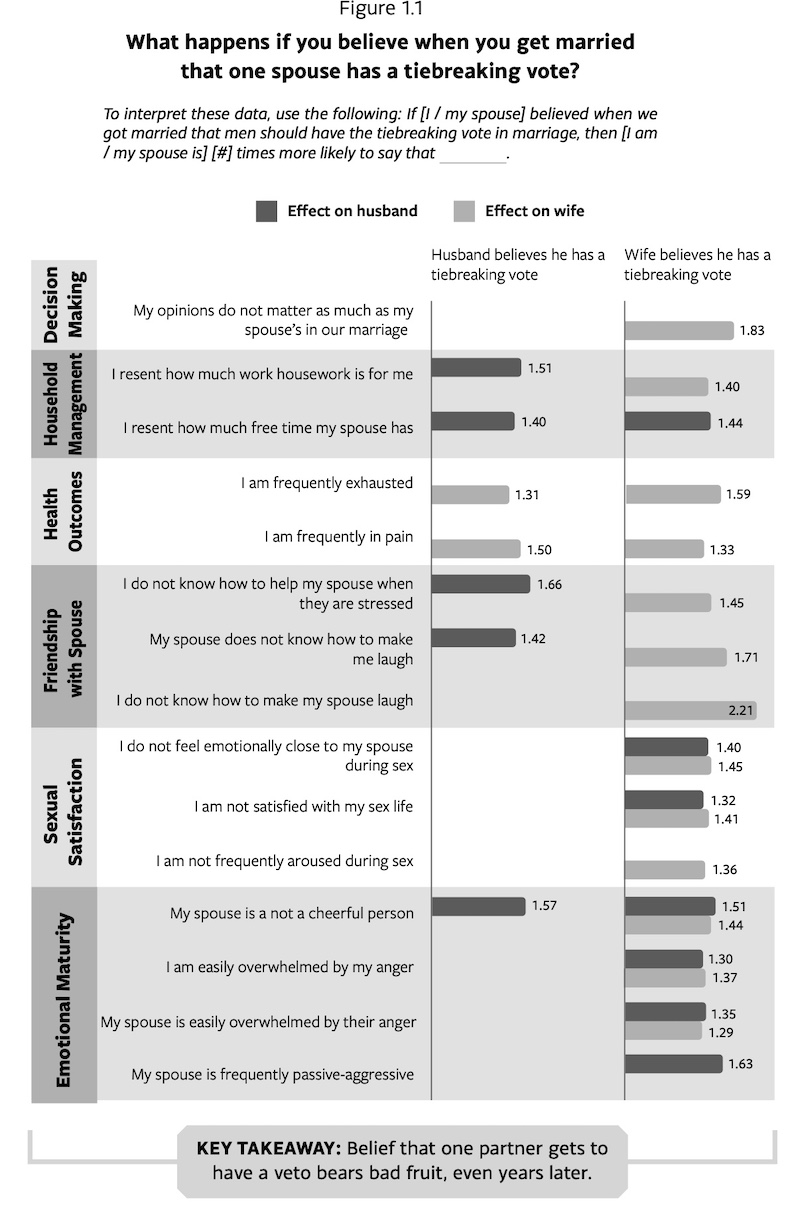
Incidentally, this chart also applies to people who believe he has the tie breaking vote, but actually function as equals (which most who believe this do). So the belief itself, even if you don’t act it out, still hurts marriage.
But if you’re going to teach that men are in authority over women, there has to be a reason—because that’s a hard sell otherwise. Why did God put men over women? And this leads us to:
Point 2: Men and Women are Different Species
Most evangelical books revolve around the idea that men and women are completely different, and have different wants and needs. Think of how many of our best-sellers are like that:
- His Needs, Her Needs
- For Women Only/For Men Only
- Love & Respect
- Men Are Like Waffles, Women Are Like Spaghetti
Certainly some books in the secular realm also take this approach (think Men Are from Mars, Women Are from Venus), but those books tend to be older and have largely been debunked and aren’t read now. In evangelicalism, these are still our best-sellers.
But here’s the thing: most characteristics in human populations that exist on a spectrum fall under the concept of overlapping bell curves when it comes to the genders, like this:
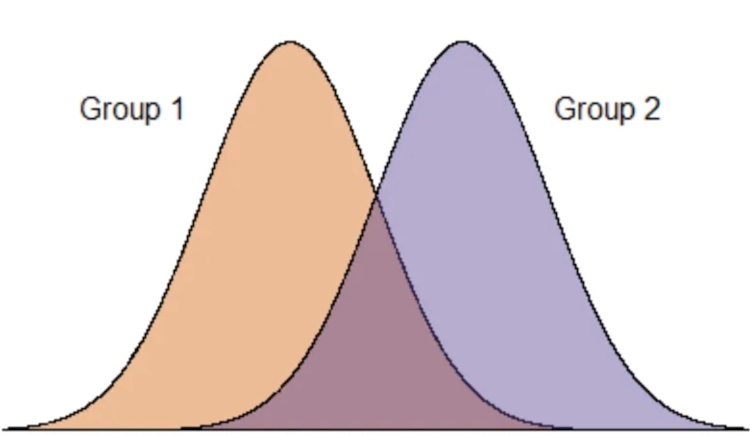
We instinctively understand this when it comes to height: Men tend to be taller than women, but some women are taller than some men (that’s the overlapping part). And often the difference between the average women and the average man is LESS than the difference between two standard deviations on either side within men and within women (I hope that makes sense!).
When we say, then, that men are visual and women aren’t; men want sex and women want emotional connection; men are logical and women are emotional—much of this doesn’t apply to many couples.
Here’s what we said in The Marriage You Want to explain why this is a faulty way of seeing the world:
Consider the idea that men’s orientation to the world around them is based on thinking, while women’s is based on emotion. One of the four scales on the Myers-Briggs Type Indicator (MBTI) measures people’s preference for feeling versus thinking. A compilation of 58,000 people’s results on this inventory found that 56.4% of women scored as “feelers,” while 73.3% of men scored as “thinkers.” In both cases, the MBTI results support the stereotype. But let’s go back to middle school math for a second. If you know the chance of A happening, and you know the chance of B happening, how do you find the chance that A and B will both occur at the same time? You multiply them together! For any given couple, then, the chance that he’s a thinker and she’s a feeler is 73.3% multiplied by 56.4%, which is only 41.3%.
Think about that for a moment: Every single sermon, marriage talk, or marriage book you’ve ever encountered that assumed the wife is emotion-oriented and the husband is logic-oriented does not apply to 58.7% of couples. And even if a majority of couples did fit the stereotype, it would still be more helpful to simply talk about the value of understanding each perspective. Attaching male and female labels doesn’t provide any additional help when the stereotypes fit and adds tremendous confusion when they don’t.
So the gender stereotype idea adds a lot of confusion, and doesn’t actually help couples. What do you do when couples still have issues from the entitlement, lack of intimacy, and confusion that male authority causes? They pull the first tool out of their toolbox to quell the dissatisfaction:
Point 3: Your expectations are the problem
If you’re upset in your marriage, it’s because you’re expecting too much. You can’t expect your spouse to fill your needs for love or belonging, because only God can do that. The reason you’re upset is because of your expectations.
Now, to a certain extent that’s true: we can have unrealistic expectations. But so often in evangelical spaces they say that ALL expectations are unrealistic. Think about things like this:
- You can’t expect him to stay faithful if you’re not giving him enough sex
- You can’t expect him to know how to play with the children; he wasn’t wired that way
- You can’t expect him to want to talk to you; that’s not how he’s built
We’re told that the basic things that we actually vowed to during the wedding we can’t expect our spouse (and this advice is usually directed at women) to fulfill.
Telling people they need to get their happiness and peace from God can work for a time. Unhappy women especially pour themselves out into Bible studies and growing their faith, but marriage doesn’t improve.
So now we have:
Point 4: Marriage is hard
Remember that marriage is supposed to be hard! It’s supposed to make you holy, not happy, because God is more concerned with your holiness.
This idea that “marriage is hard” is preached far more in evangelical circles than secular ones, and I have yet to read a secular book where this is a central premise—though it is for many evangelical books.
When you tell people marriage is hard, then when there are genuine toxic things in marriage, they can assume this is normal, and do nothing about it. But when you tell people, “you should feel safe and seen in your marriage”, then when there is something wrong, they will think, “this isn’t normal. We’ve got to figure this out.”
Evangelicals have normalized having problems, and disincentivized working on them.
I like to see it this way instead: Life is hard, and marriage brings an extra layer of complications. There’s a whole other person, and another set of family members, who could lose jobs, become sick, or have accidents. Children, or even conceiving children, can bring a huge layer of stress. But marriage should be your safe space to navigate all of this. Marriage should be your safe space in the storm; it should not be the reason for the storm.
The Marriage You Want is HERE!
It's time for HEALTHY and SAFE marriage advice!
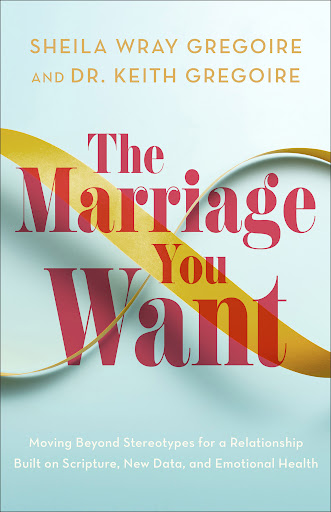
It's time for a marriage book that doesn't leave you defeated or guilty--but instead leaves you empowered, hopeful, and excited.
It's evidence-based. It's got tons of charts! And it's fun.
Available in audio, ebook, or paperback, with an accompanying study guide, let's talk about the things that actually go into making a great marriage, rather than the things that evangelicals have tended to stress that all too often harm.
Together, we can change the evangelical conversation about marriage!
But they tell people marriage is hard, because when you create a system where men can be entitled, and then tell people that they can’t expect even basic human decency in their marriage, then marriage will be hard.
And that may keep people plugging on for a while. But ultimately they’ll need the big guns to keep people in marriages:
Point 5: You can’t divorce, but you’ll get your reward in heaven
I’m astounded at how many Christian marriage books preach about how, if you stay married to someone who is treated you badly, you’ll get extra reward in heaven. Francis and Lisa Chan said it; Gary Thomas has based whole books on it; Emerson Eggerichs said in Love & Respect that when a woman respects a harsh man, a billion angels celebrate.
But over and over again, we’re told that marriage is meant to refine us, that it is permanent, and that we can’t divorce—but don’t worry, because when we’re dead God will make up for it.
Can you see how Christian marriage books based on this don’t lead to good fruit?
Yet over and over again, this is what our evangelical marriage books are based on, because if you’re going to hold to the two beliefs that men are in authority and that the goal is never to divorce, you’re really left with no other option.
This is the corner that the white American evangelical church has painted itself into.
It’s time for something different
I’m on a mission to change the way the evangelical church talks about sex and marriage to be something healthy, evidence-based, and biblical.
That’s why we wrote The Marriage You Want—to show what actually does work (and guess what? It’s partnership, not hierarchy!). And we want to make it as easy as possible to use this new resource for counseling couples or growing marriages in a healthy way.
So this week, our 8-week video series for small groups launches, and I’m so proud of it! Here’s the trailer:
- The paperback and ebook of The Marriage You Want
- The study guide, with questions for premarital couples and premarital counseling; couples; or small groups
- And now the 8-week video series!
We want to become a one-stop shop for healthy marriage teaching, so that books like the ones I’ve mentioned won’t push couples off track anymore!

The video series is only available through Baker Book House—and they have discounts when you buy bundles of the other books too!
If your spouse doesn’t want to read or listen to the Marriage You Want, pick up the video series to go along with the book and study guide. You can stream it or download it directly from your computer, and then you can have these important conversations after just watching 20 minutes for each module.
Or use it at your church to dispel a lot of the bad stuff we’ve believed.
Together, we can change the conversation—and make marriages in the church thrive!
Do you see these 5 points in most Christian marriage books? Which one is most destructive to you? Let’s talk in the comments!





I hate the one about men being logical and women being emotional, as if everyone isn’t (or should be) both. Being an “MBTI feeler doesn’t mean you’re illogical, being a thinker doesn’t mean you have no feelings. With a growing number of men dragging this old chestnut out and saying women are too irrational to vote, this is a particularly dangerous stereotype.
That thing you mention is another example of evangelicals not keeping up with research. It was back in the nineties, when brain research first exploded, that Antonio Damasio (the biggest name in neuroscience at the time) showed how separating thinking from feeling is not a sign of maturity, but trauma. And a lot men get traumatized into cutting off their feelings at a young age. Carol Gilligan, another prominent psychologist, found that both boys and girls start saying “I don’t….” a lot around middle school age, but girls complete their saying with “I don’t know” whereas boys say “I don’t care.” Probably the best example of how girls get taught to doubt themselves while boys get taught to suppress their feelings. Back to brain research though, consider the white and gray matter, the first associated with emotion and the second with rational reasoning, and how the white matter lies underneath the gray. Psychologists say that we use emotion for information, it first registers in the white matter, then the gray matter processes it. Separating the two is, in the worst case scenario, a sign of traumatic brain injury, and in the best and most common case, insufficient neural communication between the two parts, which happens to boys, who are actively discouraged from developing those neural pathways.
P.S. If anyone is interested in the work of these psychologists in accessible form written for the popular public, Antonio Damasio has a book called “Descartes’ Error” and Carol Gilligan has one called “Why Patriarchy Persists.”
Sheila, will you do a podcast on brain research, please, pretty please? My knowledge is cursory and, as you can see, dates back to the nineties, when I was a psychology major in college. I’m sure Rebecca would have updated information and I’m wondering if familiarizing people with God’s design for the brain might have some persuasive power against the entrenched rhetoric of absolute gender differences.
We did one on neuroscience just ages ago, but this may be a good way in again! Thank you!
Since Christian books often lag several decades behind secular ones in terms of research/understanding, I guess we shouldn’t be surprised at the way they keep trying to split things up by gender.
I’m currently reading a book of essays by male gardeners on how they designed and created their gardens, which was published in the UK in 1982. So this is a secular book, by a mainstream publisher, and yet it has a forward by a female gardener saying that she doesn’t feel she has the ‘right’ to write a forward on a book about her ‘lords and masters’, and an introduction by two other female gardeners, stating that male gardeners are more practical than women, that they were more likely to garden without help, to plan their designs in advance and be less spontaneous. The funny thing is that the essays written by the men nearly all contradict these ‘facts’ – many of them had help from their families or paid gardeners, several said that they didn’t bother with a plan, they just let the garden develop spontaneously and nearly every man who was married stated that his wife not only gardened, but was far more practical than he was!
So if a secular book published just over 40 years ago can be spouting gendered divisions (in clear contradiction to the actual evidence presented in the same book!!!), it’s unsurprising that Christian authors are still talking about male and female stereotypes.
Yep. Exactly. (Also, what a strange foreword!)
It was very odd! Rest of the book is good though, so I’m glad I didn’t chuck it in the bin halfway through the intro!
Men are like waffles, women are like spaghetti, is that a real tittle of an evangelical marriage book? Can’t believe my eyes.
I always joked that I was a lava cake as a woman with ADHD because I can’t multitask and have to focus on one thing at once otherwise I fall apart much like how the chocolate sauce spills out when you stick your fork in the cake. It seems to be based on a misunderstanding of mental load that analogy.
Still that and the author’s (I forgot his name) other book Red Hot Monogamy would be a good one. The suggestions in that marriage book on how to spice up the marriage are mind boggling and are pointless if you don’t get the basics of good sex for women down also it kind of low key shames people who are more vanilla saying that if you aren’t trying to be spicy then your sex life is lackluster.
Oh yeah and there is like two pages of it telling women that if you don’t give your husbands sex or agree to do sex acts outside your boundaries, then he will get really, really grumpy and maybe even cheat or look at porn.
But seriously a lot of the suggestions for the sexual activities on the huge list in the book reads like this is the authors barely disguised fetishes. Some of the suggestions include illegal things like sex in public places which could get you on a registry in some places.
“But seriously a lot of the suggestions for the sexual activities on the huge list in the book reads like this is the authors barely disguised fetishes.”
Wouldn’t be the first time we all got a forced tour of a ManaGAWD’s sexual kinks.
Remember Deep Throat Driscoll and his THAANG about both ends of the alimentary canal?
Wow. Really?
“if you don’t get the basics of good sex for women down also it kind of low key shames people who are more vanilla saying that if you aren’t trying to be spicy then your sex life is lackluster.”
Is “Spicy” another word for “Kinky”?
I’ve never read Red Hot Monogamy but maybe I should!
Definitely! It is one of the books I read when I first got married and I remember some of the suggestions in that book left me and my husband flabbergasted.
Most likely it’s for real. It’s too insane to be fake. In an Age of Extremes like today, as crazy as you can imagine, there WILL be True Believers out there twice as crazy and Dead Serious. (“The Crazy is Strong in this one, Padawan.”)
As well as sounding like a “See How Clever I Am” knockoff of somebody else’s title — something you see only in Porn and Christianese. (And you know something? The Porn Titles are funnier. The 1984 Meese Commission Report had two whole pages of Porn titles in their bibliography and a lot of them were real hoots. In even this, Christian Counterfeits are just lame.)
Emmy? You spelled “title” with an extra “t” in just the right place.
English is not my first language and the extra t was completely unintentional, but I’m glad to hear it may have given you folks some pleasure. 😀
English might not be your first language, but you’re understandable to this native-speaker and that’s what’s important.
(And besides which, a lot of Internet humor comes from funny unintentional typoes.)
Yep! It’s actually not as bad as the rest.
It isn’t? I’m glad to hear it. The title (with just one t) still sounds like Veggie Tales for Married Couples or something on that level. 😀
Dumb knockoff titles are part of Christianese.
I am currently reading the Meaning of Marriage and I haven’t found any fault there, the authors even stress the idea that the roles in the marriage are fluid and ajustable to each couples context. I am curious about which were the red flags there?
They came down quite hard on the husband being in authority over the woman, and also their sex chapter was quite problematic, because they talked about things they obviously didn’t know about. They gave an anecdote where it sounds like it’s normal to be in pain during intercourse and not speak up, when they obviously don’t realize that 23% of evangelical women suffer from sexual pain disorders. And they advocate stopping trying to get her to reach orgasm, which is fine advice if she does 60% of the time and you’re both stressed out, but not if she never has. It’s just a problem. It scored neutral on our rubric of healthy sexuality, but there are several anecdotes that are quite problematic, and the authors obviously didn’t realize it was problematic, but when it was brought to their attention they doubled down.
Point 3, expectations, was most destructive to me because most others radiated outward from it.
If I thought I should have an equal voice, I needed to learn to adjust my expectations and align them more “biblically” with “God’s Word.”
If I thought my husband should try to understand me as much as I tried to understand him and his “needs,” I needed to surrender my expectations and give sacrificially.
Flipped script though- I *should* expect marriage to be hard. That way, anytime it wasn’t as hard as my expectations, it would seem better.
I was told I had a “critical spirit.” I was told that I should have little/no expectations in marriage because I was married to an imperfect person, just as my husband was married to an imperfect person- yet my husband could expect me to forgive him and pretend he did nothing wrong. So… why bother having marriage vows if there are no expectations allowed on the woman’s side at least?
Yes, that’s exactly it. They’re basically saying the vows mean nothing.
It say”We’re told that the basic things that we actually vowed to during the wedding we can’t expect our spouse (and this advice is usually directed at women) to fulfill.”
Can you help understand for me?
Vows are not same for man and woman?
Hi AnnaT,
Vows are supposed to be the same for a man and a woman getting married. Marriage vows should be equally important because they are a promise to your new spouse. Both the husband and the wife are making a promise to love, honor, and be faithful to their spouse.
However in many Christian marriage books, the authors pressure women to forgive and submit but they don’t pressure men to do the same. If a wife cheats, only the wife is blamed. If a husband cheats, these books often say or imply the wife is also to be blamed.
If a husband and wife said the same vows, it should be equal. I hope this helps.
The teaching that “marriage is hard” is really harmful- I had heard that ever since I was little, growing up in the church, and it gave me the expectation that it’s just not possible to marry someone that you’re genuinely happy to be with, over the long-term, someone who really makes your life better rather than causing a bunch of new problems. People who believe in this teaching will think it’s totally normal if their spouse is constantly criticizing them, or being jealous and controlling, etc. They will feel like yeah even though it’s hard, overall it’s worth it because they love their spouse, and they assume everyone’s marriage has these kinds of constant conflicts.
I wonder if that teaching might also contribute to women choosing to marry a man who didn’t treat them well while dating? They may figure it doesn’t matter who they choose as a marriage partner because marriage is going to be hard no matter what.
That’s exactly it! It teaches you to ignore red flags.
Most evangelical books have two main goals…
>> Make sure that husbands are in authority over their wives;
>> Make sure that nobody divorces.
I might add a third goal of theirs: Make sure that when problems arise, it’s always the wife’s fault.
Ha!
The “marriage is hard” message is also for the (entitled) husband. He also isn’t getting his (unhealthy or harmful) needs or demands met. But he too is being told “divorce is not an option”.
How does this play out in situations where the wife becomes seriously ill or incapacitated, or who for whatever reason not meeting his (e.g. sexual) needs?
In secular marriages, it is well known that men divorce wives when she’s diagnosed with cancer for example .
In evangelical marriages , is the “divorce is not an option ‘ / ” marriage is hard” message possibly stopping this abandonment?
I can’t recall if it was a post on this blog, the comments section here, or a link to other info, but iirc there was a surprising number of men in evangelical spaces that actually do leave their spouses for those reasons. I think the root was that for so long evangelicals placed such a heavy weight upon marriage being how a man got his sexual “needs” met that they believed *she* was the one breaking the marriage vows.
I wish I could recall what/when/exactly where it was but I don’t have enough free time these days to look.
The man always “getting his needs met” at all costs is straight out of Pornography.
My first attempts at replying They were too long!
———-
Yes there is a prevailing view that that men abandon and divorce their wives after she’s been diagnosed with a serious or life threatening illness (usually cancer). However evidence to support the claim is inconclusive.
The vast majority of studies don’t assess faith at all; one that did – a US study of 2,701 marriages by Karrakar et al. (2015) – did not find Catholic identity to be predictive of divorce. [1]
Large scale statistical analyses do not show massive increases in divorce or risks of divorce across the board, after women are diagnosed with illnesses including cancer. A recent systematic review by Fugmann et al. (2022) found that “cancer is associated with a slightly DECREASED divorce rate, except for cervical cancer, which seems to be associated with an increased divorce rate”. [2]
The cervical cancer evidence came from two studies:
Syse and Kravdal (2007) found an odds ratio for divorce after a cancer diagnosis of 1.36 (95% CI 1.26–1.47) [3] ;
Kirchhoff et al. (2012) found an increased risk of divorce after a cervical cancer diagnosis showing a risk ratio of 2.04 (95% CI 1.29–3.26) [4].
It was consistent with findings of an earlier large Danish study by Carlsen et al. (2007) [5].
Multiple reasons for this increase were proposed, including that the populations were demographically very different to other cancer survivors (younger, early sexual intercourse and number of sexual partners), experienecd impacts on sexual function and / or infertility distress, methodological issues and biases with the studies, and even that the finding might be a spurious correlation.
Karrakar et al.’s study of 2,701 marriages (2015, included in the systematic review above) found that while wife’s illness onset was positively associated with 1% higher probability of subsequent divorce compared with remaining married (i.e. probability of divorce slightly increased), marriages in their sample were much more likely to end by widowhood than divorce.
They also found poor baseline marital satisfaction is positively associated with subsequent divorce – so it’s possible the marriage would’ve ended without either spouse falling ill. [1]
The systematic review itself described some very important limitations in analysing only divorce statistics.
One, the outcome (i.e. statistics) of ‘divorce’ alone “… is too general to differentiate between specific positive and negative effects of a cancer diagnosis on a partnership”. In other words, relationship quality is impacted and it matters.
Two, and I quote : “We must be cautious to interpret a divorce always as negative. For some couples it could be part of a developmental process. The negative impact of a stressful relationship should not be underestimated.” [1]
One very recent recent example is a small qualitative study of 18 Israeli women (2025). It found surviving breast cancer was a catalyst for women to realise dissatisfaction with marital or intimate relationships, to prioritise themselves, and to end those relationships as part of their overall recovery. Far from being abandoned, women report gaining agency and becoming empowered to put themselves first. One quite literally summarised it as, “I coped with cancer, I can handle divorce”. [6]
And this brings us to the BareMarriage post in Nov 2023, “Are 70% of Divorces Really Caused by Women Divorcing Frivolously?” [ https://baremarriage.com/2023/11/are-70-of-divorces-really-caused-by-women-divorcing-frivolously/ ].
BareMarriage wrote:
“Illness
This original study [the one erroneously referenced as 70% of divorces are frivolous] found that health problems factored in to 27.8% of divorces. Back in 2009, there was another ground-breaking study that looked at how gender affected divorce rates post-diagnosis of a major life-altering illness, such as multiple sclerosis or cancer [7]. Here’s what it concluded:
‘There was, however, a greater than 6-fold increase in risk after diagnosis when the affected spouse was the woman (20.8% vs 2.9%; P < .001). Female gender was found to be the strongest predictor of separation or divorce in each cohort.' [2]
Let that sink in: When women are diagnosed with a life-altering illness, one in five of them will be left by their husbands. When men are diagnosed with a life-threatening illness, only 2.9% will be left. "
A few observations:
– BareMarriage is citing a 2009 study that analysed demographic data on 515 patients (53% women), with diagnoses of malignent malignant primary brain tumor, a solid tumor with no nervous system involvement, or multiple sclerosis, and who were married at the time of diagnoses. It’s a tiny and non-representative study, whereas the systematic review identified studies involving tens of thousands of patients.
– The study utilised only demographic data. It didn’t investigate relationship quality and therefore has the exact limitations identified in the systematic review.
– The study ASSUMED divorce or permanent separation was the result of “partner abandonment”, i.e. that the healthy partner left the ill partner, and their reason for leaving was the diagnosis. To be clear, this was an assumption by the authors. It was NOT investigated in the study. The authors found a correlation, but collected NO data that could establish causation for the divorce.
– The findings are simply not generalisable to a broader population. The “let that sink in…” statement, that one-in-five women WILL be left by their husbands, is completely unsupported by the evidence or the findings. And it’s not supported by the volumes of higher quality evidence published since 2009.
“How does this play out in situations where the wife becomes seriously ill or incapacitated, or who for whatever reason not meeting his (e.g. sexual) needs?
“In secular marriages, it is well known that men divorce wives when she’s diagnosed with cancer for example .”
Didn’t Pat Robertson once endorse just that for that situation?
Meh, I don’t follow Pat.
But I did find a lovely study today that interviewed breast cancer survivors. The flipped the presumed script and ended marriages and intimate relationships on their own terms:
“I coped with cancer, I can handle divorce”!
Litvak-Hirsch, T., Harel, A., & Daphna-Tekoah, S. (2025). “What Doesn’t Kill You Makes You Stronger”: The Intersection of Breast Cancer Survival and Divorce. Women & Therapy, 48(2), 187–205. https://doi.org/10.1080/02703149.2024.2446841
Numbers 1 and 4 were the most harmful to me. The thought of men getting to be in authority over their wives definitely makes marriage hard for women. If you’re married to a great man, he will not want to be in authority over his wife.
My first marriage was hard because my ex believed he had authority over me. After I had been divorced and single a long time, a number of women would tell me how hard marriage is. I wanted to ask them, “Why bother getting married then?” It made me feel like maybe I should just remain single. I asked my mom if she thought her marriage was hard. She told me parenting was harder.
Well, I’ve been in my second marriage for over a year now and this time around, marriage is not hard. My husband believes in a partnership, we have realistic expectations of each other that we expect to be treated like human beings should be treated, and we are committed to each other. Yes, we have our differences which I don’t think has anything to do with what is between our legs. Maybe when it comes to me going through change, he will never understand it.
I’m so glad you’re doing well, Laura!