
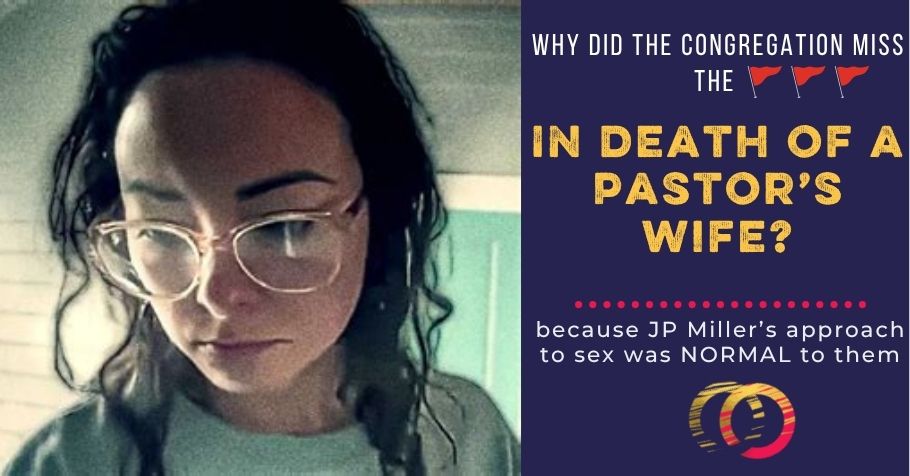


The strangest thing about watching Netflix’s Death of a Pastor’s Wife is how familiar it all feels.
Our family has been attending an Anglican Church since COVID ended. We haven’t been in a typical evangelical church for over 7 years. We left because of trauma and grief about how the church has ignored the injustice of the way women have been treated.
Yet I felt, watching the documentary, that Hollywood had learned the secret language that evangelicals share. They had uncovered what makes us feel safe, and what makes us stay, even in churches that are toxic under the surface.
It’s the fact that in a church of just a few hundred, there will be enough musical talent that you will feel like you’re at this amazing concert.
It’s little children running around after the service and crawling on the stage and playing with the drums.
It’s the row of ladies lining up beside the serving tables and the coffee urns to receive their thanks for volunteering at the ladies’ tea.
It’s that you can call your pastor when there’s a medical emergency, and someone will come.
It’s feeling like you are truly, honestly, worshiping Jesus together with the people who matter most to you.
It’s all the things that make you feel like a family.
And I still mourn and grieve so many of these elements.
Yet I can never go back, and the Netflix documentary Death of a Pastor’s Wife shows why.
I renewed my Netflix subscriptionjust to watch Death of a Pastor’s Wife. So many people were tagging me in posts about it and sending me questions about it, I thought I had better watch, even though I’m not on the Netflix part of my yearly roster right now (I subscribe to streaming services one at a time, watch everything I want, and then move on to the next one so I’m not paying for everything all at once. Right now is Apple TV, not Netflix!)
I’d like to share a few thoughts I’ve had
I shared this first on Substack last Friday, but I want it here for posterity too!
I remember when Mica Miller died two years ago. I watched the clips of JP Miller’s sermons, talking about how women owe their husbands sex, with horror. I read about how he deliberately leaked her nude photos online, and about how she had posted videos about the abuse she was suffering from. I read about how he groomed her since she was thirteen years old.
None of that was a surprise. But what emotionally hits is two things I want to talk about: (1) the dangerous intersection of Every Man’s Battle theology, and (2) the evangelical reliance on charisma.
Every Man’s Battle redefined battling with lust as being of good character
Every Man’s Battle hit Christian bookstores in 2000, and sold like wildfire. The book turned into a franchise that has sold more than 4,000,000 copies. It was based on one simple premise: all men struggle with lust, and they do so because that is the way God made them.
And the solution that is offered to lust? Men “bounce their eyes” from women (which is still objectifying, because whether you’re lusting after her or deliberately refusing to look at her, you’re still seeing her as a collection of body parts rather than a person), or you treat your wife like a “merciful vial of methadone” (their words) and transfer all your sexual energy to her, going to her for “10 bowls of sexual gratification a week.” (they never define what a bowl of sexual gratification is. Perhaps we should be grateful.)
Every Man’s Battle was written by Fred Stoeker and Steve Arterburn, two men who have absolutely no credentials to be writing about sexual struggles or getting over such struggles. They are not counselors or psychologists. They are not social scientists. And they have ZERO citations in their book.
Their only qualifications are simple: They are both self-proclaimed former sex addicts.
That’s it.
And the evangelical church allowed them to speak for “all men.”
I have written at length on the problems with Every Man’s Battle, and its offshot Every Young Man’s Battle (which is infinitely worse, and left me in tears). It features prominently in our book The Great Sex Rescue. You can download a one-page info sheet on the problems with it here.
But what this book did was it turned men talking about their struggles with lust into something that we should applaud, not judge.
It turned using your wife as methadone for your lusts as something moral, a sign of good character, rather than a sign that you hadn’t discipled your sexuality and that you were not renewed, and showed no fruits of the Spirit.
It turned your wife into a sin management tool, and if she refused to be used as a masturbatory aid to slake his lusts, she was the one sinning against God.
The expectation that a man could see a woman as a whole person and respect her as such was simply erased from popular consciousness. Any man who said he could do this was lying, as Mark Driscoll recently said in a reel. Growing in self-control so that you saw women as sisters in Christ was suspect; getting up in the pulpit and announcing you lusted after everything that moved and had a hard time when 12-year-olds wore tight sweaters became a sign that you were in touch with the Holy Spirit.


Enter JP Miller
Mica Miller’s husband JP was a charismatic, attractive pastor that, from Mica’s accounts, degraded her sexually, pressuring her to take testosterone to keep up with his sex drive; giving homeless people money to use his wife sexually while he watched; demanding she have sex with him four or five times a day, and refusing to let her sleep if she didn’t.
The congregation didn’t know this part of their life.
What they did know was that JP Miller “had an affair” (it was actually clergy sexual abuse) with Mica while he was still married to his first wife. They knew there was a 15-year age gap, and that Mica was barely in her 20s, and that the Pastor had been close to her since her early teens.
They knew he then married Mica.
And they knew that his favourite thing to preach about was how wives had to satisfy their husband’s sexual urges.
The creepiest part of the documentary is listening to this man’s disgusting sermons, and watching the backs of the heads of the congregation members just sitting there as he misquotes 1 Corinthians 7. Repeatedy he claims that 1 Corinthians 7:3 says “do not refuse your spouse”, even though it does not. It says “do not deprive,” and those are not the same thing.
In his sermons, he completely eliminates the idea of consent in marriage, giving the most blatant examples of what we have deemed the “obligation sex message” that I have ever heard. When we measured this obligation sex message in our survey of 20,000 women for The Great Sex Rescue, we found this to be one of the most destructive messages. It lowered women’s libidos, orgasm rates, and marital satisfaction, but most importantly it’s one of the big contributors to the fact that evangelical women suffer sexual pain disorders at twice the rate of the general population.
What was so sad was hearing Mica’s friends who were interviewed in the documentary speaking as if what JP taught was biblical, he just took it too far. They didn’t even realize, even now after all that has happened, that JP was not teaching what was biblical at all. They still think he was actually right about the Bible, just wrong about how he treated Mica. They don’t see how the one leads to the other.
How did JP manage to hoodwink so many?
One of the saddest parts of the first two episodes is when JP announces that his wife has left him and is undergoing a psychotic episode, but that he wouldn’t allow this to derail what Jesus is doing in the church—and the church gives him a standing ovation.
That church was filled with people who knew Mica. She had been front and centre leading worship for years. She had been active in women’s ministry; she had welcomed newcomers and taken time to get to know them; she had invested in people’s lives in a way that JP never did. But when he announces that she has left him, instead of questioning why, they all applaud him. Hundreds of people stood up to give this degraded, disgusting abuser a standing ovation.
How did this happen? I think it is something inherent in evangelical churches that I’m not sure can be fixed. I think it’s one of the reasons that liturgical churches are growing because they are not as prone to this. But it comes down to this:
Evangelicalism rewards charisma over character
The story of JP Miller’s church is one of rewarding those with charisma and talent over those with maturity and character.
JP played piano incredibly well, and he announces at a young age that he wants to preach. And so the church lets him, and he becomes their pastor at a very young age. But there is no consideration whether he actually has the character for this. There is only the fact that he can mesmerize a crowd.
Even Mica, as lovely and in love with Jesus as she is, should never have been given the roles she had at the tender age of 16. Sure she could sing, but why is she actually leading the praise team? Why is she not being mentored, discipled, cared for, rather than thrust into the position as if she is a mature believer?
Why did the church stay with JP after he admitted to the “affair” (clergy sex abuse) with Mica when he was still married to his first wife?
Because charisma was more important than character, and Every Man’s Battle had turned public confessions of battles with lust into a sign of good character.
Why did the church stay with JP after Mica left him?
Because charisma was more important than character.
Evangelical churches tend to revolve around a pastor. When you can find a charismatic, relatively young, good looking pastor, it can make it seem like your church is “hip.” Like it’s somewhere that everybody should want to be. And so the church starts to grow.
But character is missing. And I don’t know how we can bring back character when the church service itself so relies on charisma to keep people coming through the door.
I think it’s why we need a return to liturgy, more of a focus on Scripture, and less on a sermon.
Cultural evangelicalism has eroded character.
And it’s done it at the expense of women.
Every man’s battle swayed an entire generation to think that when a man complains that he’s finding a 14-year-old’s sweater distracting during a service, that man is being righteous, rather than that man is showing serious predatory vibes and we need to keep him away from children.
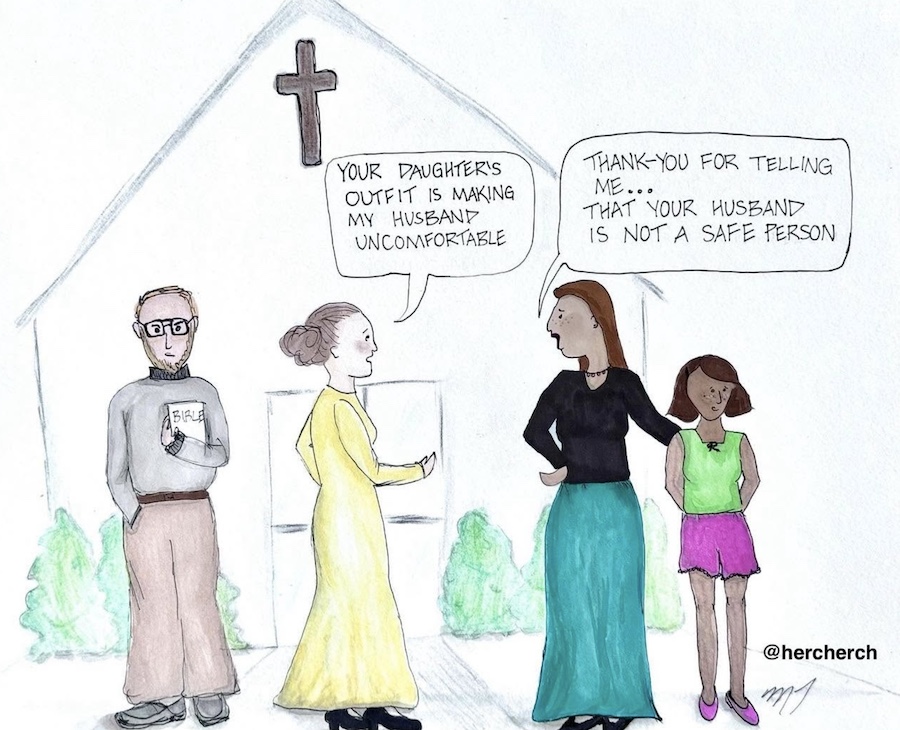
Every man’s battle taught us that the way men defeat lust is that women do their part, and if a man falls, it’s because a woman, somewhere, messed up. Either a woman dressed too immodestly, or a wife didn’t give enough oral sex (Remember Mark Driscoll telling women they should get on their knees and repent of not giving oral sex?)
Every man’s battle taught us that we as women can’t expect to be treated with respect, because God wired men to visually lust after women.
Every man’s battle taught us that while women love God, women should never expect to be safe in church. And we need to just realize that God wired men to be unsafe.
And then, when predators like Miller start giving all the signs that they are dangerous, we don’t pick up on them, because they’ve all been so normalized.
We’ve forgotten what true character is.
And so we don’t even notice abuse and sexual degradation when it’s right under our noses.
I pray that one day Mica Miller gets justice, and I hope this documentary is the beginning of that. Everyone should watch it just to see how these ideas from Every Man’s Battle have become so pervasive in the church that they don’t even set off red flags anymore.
But I also know that until we confront the lies beneath the every man’s battle idea, we will continue to disciple a new generation into sexual harm, where consent in marriage is eroded, dehumanizing and degrading your wife is normalized, and no woman is truly safe.
Have you watched the documentary yet? What were your takeaways? I’ve been amazed at how surprised the outside world is, when it’s all just so normal to me!






It is really disturbing uow even with books like Outgrow Porn and Surfing for God and Desire and Boundaries for the Soul that the Every Man’s Battle book are still the default.
I think it’s a combination of relying on charisma, and an unwillingness to “rock the boat” unless it is unavoidable. My evangelical church had a lot of underhandedness toward a new children’s director we got, that to my knowledge the pastor never confronted. To be fair, the children’s director has issues herself that I’m not sure if anyone has talked to her about. Plus, our church library had to be moved to a smaller room, forcing us to get rid of books. Sunday school classes shifted locations and the only equally sized room belonged to an elderly class with only 3 people. No one wanted to deal with suggesting the small class move, even if the smaller room was on the same floor and equivalent to their current room other than smaller. I’ve never understood it. I know you will always have some friction whenever you put enough people together in one place. But it’s like things get avoided or ignored until they can’t be anymore.
Your comment about Charisma being more important than character is so true. The church I attended ( not sure if we will be going back) had a pastor who started his position in 2023 when our former pastor retired and moved away. He was young, good looking and full of charisma. The church grew a lot so much so that they had to add extra services. I really think it was because of him. Then this past December he admitted to having an affair with a married woman. He was dismissed and he is now doing something outside of the church. It’s good that they didn’t put him on a leave and let him back. The church stopped growing and I think some left. Goes to show it was about him and his charisma is why it grew. The way the church communicated what happened with the affair was not ok. They didn’t post it anywhere or send an email or anything. We weren’t there during the service when they announced it. So unless you were a member, they’re didn’t let you know. I had to ask about it. It felt like they swept it under the rug . They didn’t talk about it after that and said you could ask questions but felt like you couldn’t. They didn’t want gossip. 🙄 More like they didn’t want to be more transparent and open about it. Hated that and that’s why I haven’t been back much. They did take time getting a new pastor on board but they ended up having the youth pastor become the pastor. They said they were not wanting someone with charisma and they would be focusing on other things which is good.
I watched this entire documentary and not at all shocked by this. Now, when I was reading the comments on a Facebook account I follow, commenters were saying they have never heard sermons like this. Well, I haven’t heard pastors in any of my churches preach sermons like JP, but I’ve heard these teachings in women’s Bible studies and read the Christian books on marriage and sex that spouted these harmful teachings. I lived out this harm in my first marriage and thankfully, got out before it could get any worse.
What puzzles me is JP’s third wife. How could she be so clueless? She is not young like Mica. She is probably around the same age as JP. Suzy was the one who was married to a man who was paralyzed from the neck down and had been his physical therapist before they got married in 2004. They had twins 3 years later. From what I could find out about their marriage, I believe she and JP were having an affair around 2019 then he drowned in 2021. That’s another story I want to learn more about. I wonder if there’s more to this drowning and if JP or Suzy were somehow behind it.
The fact she was his physical therapist before they were married is very unprofessional, but yeah that does seem suspicious. A lot of deaths of disabled people tend to go overlooked as accidents or inevitable because there is this expectation they will live shorter or something and if they are murdered by their caregivers or killed from neglect, most people tend to be more sympathetic to the killers. That does seem suspicious.
I’m kind of scared to ask, but what exactly did Mark Driscoll say?
Tim,
Some of those sermon clips of JP’s sounded like Driscoll’s and also the fact that both refused to be held accountable to a board of elders.
Thanks Laura.
I just realised there are two references to Driscoll in the article though, so my question would have been unclear. I was meaning in relation to this bit:
“The expectation that a man could see a woman as a whole person and respect her as such was simply erased from popular consciousness. Any man who said he could do this was lying, as Mark Driscoll recently said in a reel. “
I pegged Deep Throat Driscoll as being a male nymphomaniac long ago.
If it’s any consolation, JP’s famous now.
Local morning talk radio (KFI 640 AM) covered JP & Mina’s story today for “True Crime Tuesday” and its also going viral on YouTube.
“Mica Miller’s husband JP was a charismatic, attractive pastor that, from Mica’s accounts, degraded her sexually…”
Like Deep Throat Driscoll (with his fixation on both ends of the alimentary canal) and Chuckles Mahaney (forcing himself on wifey while she was puking from morning sickness).
“…giving homeless people money to use his wife sexually while he watched…”
Shades of Jerry Falwell Junior and Pool Boy.
“…demanding she have sex with him four or five times a day, and refusing to let her sleep if she didn’t.”
Male Nymphomaniac like Deep Throat Driscoll.
“And I don’t know how we can bring back character when the church service itself so relies on charisma to keep people coming through the door.”
If it’s any consolation, Personality Cults rarely survive the death or departure of their Personality.
Few Joseph Smiths are succeeded by a Brigham Young that can turn a personality cult into a self-sustaining system.
“Hundreds of people stood up to give this degraded, disgusting abuser a standing ovation.”
“But there is no consideration whether he actually has the character for this. There is only the fact that he can mesmerize a crowd.”
“SEE HIS FACE! HEAR HIS VOICE! FUEHRER! FUEHRER! FUEHRER!”
— Leon Uris, “Armageddon: A Novel of Berlin”, describing a Nuremberg Rally revival meeting
Brit here, and I’m gobsmacked that this couple were even in leadership in the first place. Over here, having an affair with a member of your congregation would get you booted out immediately AND have safeguarding involved. Do American churches not do safeguarding? It’s crazy. Over here, even if they’d both been single and a similar age, he’d still have been subject to some scrutiny to check that he wasn’t taking advantage of his position. But an affair with someone so young and vulnerable? He’d have been out of leadership permanently.
Is “safeguarding” an official term? What does that look like practically/logistically speaking?
I live in the eastern USA and have attended several denominations and am unfamiliar with that terminology though I think it’s a brilliant idea.
It’s difficult to explain briefly, but I’ll have a go! Safeguarding is the protection of an individual’s health, wellbeing and human rights, so it’s very holistic in outlook. It’s widespread in the UK and pretty much every church, organization, school etc will have a safeguarding policy which sets out potential risks and how to protect people from those risks. These policies are available to anyone to read. Examples of things in a church policy would be: ensuring that there are always at least two unrelated helpers with any group of vulnerable people (e.g. children or adults with special needs) and that all helpers have had a criminal record check to ensure they have no criminal convictions; people in leadership should not form romantic attachments with vulnerable people; there should be no emotional appeals for money that might pressure people into giving; as far as possible, one-to-one meetings should be in a public area and if not, then an unrelated person should be aware that the meeting is taking place; physical contact should always be initiated by the vulnerable person unless necessary for safety (e.g. they’re falling downstairs!). We also have training in recognising the signs that someone might be being abused/coerced, so that we can offer help or alert the authorities if necessary. We have posters up in our entrance hall and in all the toilets, giving our safeguarding policy and explaining what someone needs to do if they are worried about themselves or someone else. The contact details of our safeguarding representatives are included, and we also have contact details for an independent safeguarding body – so if someone had a concern about the behaviour of a member of the church, but felt awkward raising it with someone else from the church, they can speak to the independent body. The safeguarding policy also gives examples of when you should contact a safeguarding rep and when you should go straight to the police. It sounds quite complex, but it’s basically all about every member of the church taking responsibility for making the church a safe space for all and where those who are concerned about abuse can find out how to get help. If it’s followed, there should be minimal risk of anyone in a position of authority being able to use that authority to coerce, groom, manipulate or otherwise abuse under the guise of their role.
Thanks for the summary. The churches I have been at had that in place for kids’ ministries in which training happened yearly. However other areas were more of an implied “honor system” by way of “holy spirit conviction” that really had no structure. *Read: if the lead pastor/elder wanted to control you, scripture was cited-often in a twisted way- but if you were not a threat to their positions, carry on. Anything aimed at the pastor’s actions was easily brushed off as critical spiritedness and “he who is without sin cast first stone,” “God alone judges me, and he does so more harshly because he has burdened me with teaching you, yet he hasn’t convicted me of this” et al.
I believe some denominations have something like that technically at a higher level, but no real intention of enforcing it other than letting individual churches deal how they like.
Having boxes to check off does not make one have a good heart, but if those checking the boxes have a good heart, I see a lot of good coming from that structure.
Thanks again for taking the time to answer, Angharad.
I don’t know what it’s like in other denominations over here, but in ours, not only do concerns raised against the pastor have to be investigated but they HAVE to be reported to the independent external safeguarding contact, even if the original concern was raised direct with the church – and even if you know it is untrue. Not only does this take a lot of pressure off church members/other members of the leadership team, but it also means that those who might wish to don’t have the opportunity of suppressing the concern. (And if the safeguarding concern is regarding something potentially criminal, e.g. sexual assault, physical abuse, then it bypasses the safeguarding contact completely and goes direct to the police. No ifs. No buts. No excuses.)
In my experience, churches in the US are opposed to the UK concept of safeguarding. The details vary among denominations, of course. In my experience at a small church that was part of a denomination where churches are independent and the denom has minimal input, I was seen as causing trouble for suggesting that all persons working with youth have a background check and not be the only person, regardless of how few volunteers there were. It is also not unheard of for a boy to turn 18 and be assigned as the youth pastor to his friends who were his peers last month (because otherwise, there would be no youth pastor and therefore, no youth group). If a husband and wife wanted to serve in children’s ministry, that would be praised because they are serving together and because it makes scheduling easier if you want two adults for each class. I once read the sexual accusation section of a denomination’s governing rules and it bluntly stated that all accusations were to be first handled by the denomination and local authorities would only be alerted if the denom determined that was necessary. There’s so much messed up about how churches think about power and vulnerability. It’s enough to make you abandon the faith for a belief system where people actually care about keeping people safe and healthy. I haven’t, but I understand why someone might.
I don’t know how accurately Britbox shows reflect actual safeguarding practices, but based on what happens there, if even half of it is true, then Brits are insanely protective compared to US standards.
I think in any country or denomination there will be churches that are better and churches that are worse. I’m sure there are some in the UK that have put zero thought into safeguarding at all. But from what I’ve seen overall, I do think the UK has a more robust attitude toward protecting the vulnerable compared to the US.
Recently, I saw someone post a question on social media asking if it was fair that their church expected every member of the congregation to go on the rota for children’s work. The person posing the question was in the US, but comments were coming from all over the world. International comments were mostly along the lines of “bad idea because it will be detrimental to the kids to have people working with them who don’t want to be there” or “how on earth is the church going to run criminal records checks and provide safeguarding to every single adult in the church?” US comments were mostly “everyone in a family helps with raising kids and we’re all church family so yes, that’s right” or “only parents should have to go on the rota because it’s unfair to expect people without kids to babysit other people’s children”. There didn’t seem to be any awareness of the potential risks to children from this policy, apart from one mother who said she wouldn’t want to leave her own kids with people she didn’t know and trust.
Yes, we have it in Canada too. There are specific regulations every church needs to follow, including background checks, how children will be supervised, etc. And specific regulations around what pastors can do. And you go through training for it, and church insurance is dependent on being compliant.
There really isn’t safeguarding in the same way at all in a lot of these non-denominational churches. Some big denominations have good safeguarding (at least in Canada), but even so it’s rough. And a lot of churches give the elders virtually no power over the pastor. The pastor really is a mini pope.
Which is shocking, because it likely means that secular groups are safer places for vulnerable people to be than the church is!
When I was dating my now-husband, because I was a member of the congregation, we had to go through a process to ensure that I was not vulnerable and he wasn’t taking advantage of his position. It meant that a couple of trusted individuals knew about our relationship right from the first date, even though we didn’t ‘go public’ until we’d been dating 3 months. It might sound like overkill, and for folk in our situation it was (both middle aged and I was well able to advocate for myself) but what about the 30-something pastor who tells his teenage girlfriend that they need to keep the relationship quiet for the first few months? If someone has to be informed from the start, there is no opportunity for him to be grooming her.
We actually had someone local report our relationship as a safeguarding issue – even though it was obvious that they were acting out of malice and the case was quickly closed, we still had to go through the designated process. While it was annoying for us, I was glad that it was done – because if churches and safeguarding bodies are going to ignore reports that they know are malicious, that opens up the door for them to ignore genuine safeguarding risks that they ‘know’ are fake. If Mica had been in our church, all it would have taken would be for ONE person to be concerned enough about her pastor’s behaviour to call the safeguarding team and he would have been investigated.
“Mini-Pope” is the correct term indeed. The American head pastor of this church in the UK could do as he pleased – especially with manipulating his ‘vows-in-waiting’ young apprentice.
Before what happened to me happened I did check their ‘safeguarding’ page and it only referenced children.
After the nasty debacle of my experience the church suddenly acquired a shiny new, extensive safeguarding page all about the perils of coercion etc etc.
The chief pastor okayed what happened to me so the ‘fish rotted from the head down.’ Sexual domination is a badge of honour in this type of place.
Actually, the Head Pastor Superapostles of churches like this are well beyond “Mini-Popes”.
They claim Authority and Infallibility way in excess of that of today’s Popes.
A level of Authority and Infallibility reserved for God alone.
I read your description of safeguarding… If it exists in the US, it’s either on an individual church basis or the denomination and nothing so robust as what you described. I’ve been to churches that have pieces of what you described, but not all of it, and definitely NOT the independent safeguarding body.
JP Miller being on a third wife in ministry is a bit outside the norm, but the clergy abuse – you don’t have to dig far to find it here… Unchecked… Guy still in a pulpit unless the police get involved and he goes to jail. It’s pretty horrible.
Some churches are pretty good about it, but I’ve never even heard of an independent safeguarding body in a church. It’s always been done in house, police involved if necessary (in the good churches… Not all churches will, and hence JP Miller).
Anybody wanna make book on Third Wife kicking off just before JPM acquires his Fourth?
(With Standing Ovation…)
Really, marrying some guy when his wife dies (after he kept you on the side for a while as his “Real Soulmate”) approaches the “I’m Just a Girl (giggle giggle)” level of Darwin Awards stupidity.
Just re-read this and…
“pressuring her to take testosterone to keep up with his sex drive”
i.e. He DRUGGED her with a natural steroid-adjacent androgen.
Which would have permanently deepened her voice and possibly given her facial hair.
There’s a YouTube channel about steroid abuse run by a bodybuilding coach that’s covered this phenomenon in competitive female bodybuilders. It’s called “steroid masculinization”; her body would have started developing like a male. And even after getting off the Big T, those changes would probably be PERMANENT.
He was DRUGGING and MUTILATING her to slake the Urrrrrrges in his (Godly) Aaaaaareas.
“giving homeless people money to use his wife sexually while he watched”
Initial reaction: HOLY SHIT!!!
This is worse than Falwell Junior and Pool Boy mixed with The Bumfights Crew —
Paying homeless men to RAPE her as long as he could watch (and probably wank off).
One of those “things that hath no name, even among the Heathen”.
JPM is not only 12 Driscolls worth of male nympho.
He is as sicko a perv as they come, even by hardcore porn standards.
And now for something completely different:
1) “(Remember Mark Driscoll telling women they should get on their knees and repent of not giving oral sex?)”
I’m pretty sure assuming the “get on their knees” position is a prerequisite for giving oral sex.
As well as being one of the most subjugating sexual positions ever.
An obvious animal forced-dominance display.
2) The @hercherch cartoon just above that — does or does not the Righteous Husband (on the left with the Bible) resemble “Mr Garrison” from South Park? (i.e. the most F’ed up character on that entire show, “mmmmm-kay”?)