
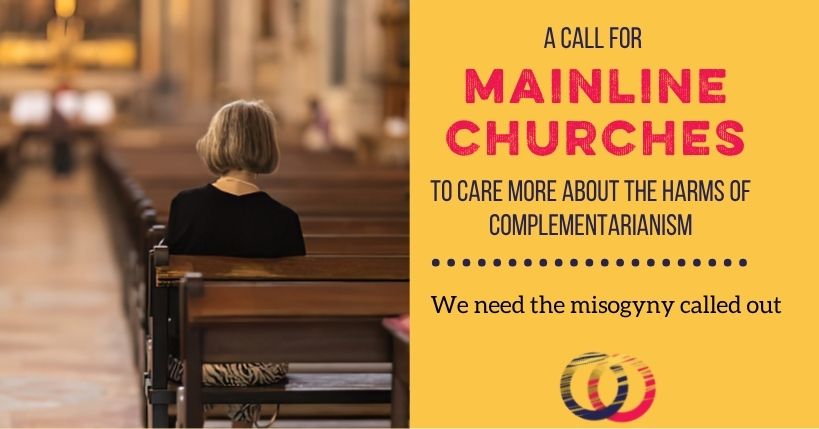


Mainline Christians are salt of the earth people.
Ever noticed that? They often fill all the volunteer slots at soup kitchens. They do the Christmas and Thanksgiving community giving programs. They volunteer with recent immigrants and refugees. It’s often the more mainline churches that are the most involved in making the community a better place and being Jesus’ hands and feet there.
We’ve noticed that as we’ve been attending an Anglican church for the last few years. People truly want to build a lovely community.
And in the last year, mainline churches in the US have been especially motivated by to work against injustice. Just last week I saw yet another news story of clergy being arrested outside an area where ICE was operating–and one of those clergy was a very pregnant woman, being led away in cuffs.
While evangelicals are conspicuously absent from these modern day issues of injustice, mainline Christians are often on the forefront of it.
Except they have a blindspot, and I want to talk about it today.
First, a caveat: I realize that the words “evangelical” and “mainline” don’t properly convey what I’m trying to say. It’s hard to divide churches into definite groups like these, and there are other groups as well that seem to be left out. So I’m using these words as a shortform, though I know that they aren’t entirely accurate. I’m thinking “evangelical” for churches that tend to have male hierarchy and an emphasis on a personal relationship with Christ rather than stressing the community; and I’m using “mainline” for more progressive churches that focus less on “saying the sinner’s prayer” and more on what it means to live out love.
Likely many egalitarian evangelical churches would be in the “mainline” category for my purposes today.
Also, this post is part of a larger series I’m doing on the roadblocks for fighting for justice for women and children in evangelical spaces. I talked on Monday about how evangelical church services and theology actually work directly against a pursuit of justice, by making Christianity into only a personal religion (think “Jesus is enough!” and “all I need is Jesus!”). Today I want to turn to why mainline churches, though they care about injustice, seem to ignore the injustice towards women in other Christian spaces.
I’ve been distressed by how many manifestations of Christianity have ignored the injustice of Christian misogyny
In my experience, the issue of women being subordinate in evangelicalism is seen by more mainline Christians as merely a doctrinal choice, or a theological difference, rather than as an issue of justice.
Where women are made subordinate, abuse of women and children flourish.
Studies have shown that when rape myths are believed or domestic violence myths are believed, we’re likely to see higher rates of abuse. And we see a greater degree of domestic violence myth acceptance in many of the complementarian traditions. We also see women being devalued; women being inaequately educated or prepared for life; women being made more vulnerable; children being denied proper education; and so much more. In so many of the circles that teach male supremacy (which complementarianism does), we see social structures that are designed to promote male entitlement and thus devalue everyone else.
One only needs to read memoirs like Cait West’s Rift or Tia Levings’ A Well Trained Wife to know how deeply these theologies can hurt people.
Real women right now are being harmed in complementarian spaces.
This does not mean that all women and children are being harmed. But these complementarian spaces are conduits to more fundamentalism (both Tia’s and Cait’s families started off in run-of-the-mill complementarian evangelical churches). And the best-selling books in these communities, as we’ve shown, promote things like marital rape. One of our recent peer reviewed studies showed how teen girls raised in church spaces where modesty rules are taught are more likely to experience victimization as teens both from their pastors and from their peers. Real people are being hurt.
I don’t see an urgency on the part of mainline churches to fight against complementarianism
When I talk with mainline pastors and leaders, they’re often not even aware of how deep the misogyny goes in many of these spaces. They see the difference more in terms of doctrine and what we think of salvation (mainline churches are more focused on following Jesus in our daily lives than they are on making sure everyone “says the prayer.”). They see the problem as more political in nature, especially in the United States.
But there doesn’t seem to be this awareness that, in their own city, state or province, or country, other churches, using the same Bible they do and the same language they do, are subordinating women, with everything that entails.
It’s more like they just write off these evangelicals as crazy or as pro-Trump, but they don’t realize that maybe what we need is a sustained campaign to:
- raise awareness of what is being taught in these churches about gender (and about racism!)
- show that there is a different way to understand how Jesus sees gender
- reach out specifically to evangelicals, especially women, to show how the gospel doesn’t need women to be subordinate
I remember an interview with N.T. Wright, the former bishop of Durham who has written some wonderful books about what the gospel entails, being interviewed by American Christian media, and being asked about women as pastors. He chuckled and said that in the UK they had dealt with this issue 45 years ago, and he found it so strange that it was still an issue in the USA, but then he went on to give a very good answer.
I think that’s often the response of many mainline believers, though: “we dealt with this ages and ages ago, if you all want to wallow in what is obviously wrong doctrine, go right ahead while we will just get on with the work of following Jesus.”
There’s kind of a disdain for evangelicals (which I understand from their perspective), and a determination to leave evangelicals to their own devices (I’m not accusing NT Wright of doing this, since the whole reason he was in the US was actually to try to reach out to this group!).
But is it okay to write off a HUGE swath of those who claim Christ and use the same Bible you do just because they are so obviously wrong and unjust on so many issues? It’s one thing to do this when it’s merely a doctrinal disagreement. But the problem is that the things that evangelicals are largely wrong about are things that have consequences for real people, and real people are suffering abuse as a result.
And often those who are suffering the most are those who did not embrace evangelicalism as a true choice, but instead were born into it, grew up in a bubble, and this was all they have ever known. They don’t realize there are other ways to see Jesus than as someone who is primarily concerned with who is in charge.
In the Anglican church I go to, I’d imagine that 80% have no idea what evangelicals believe about women
Because the women issue has been settled for so long, it’s hard for them to imagine thinking differently. And they just don’t encounter a lot of evangelicals in their social circles or in places where they may debate doctrine. So they just think that evangelicals are strong believers who are a little more emotional about their faith than Anglicans are!
And there’s very little curiosity to go any deeper.
But again, people are being hurt in churches down the street, and children are having their education curtailed, and people are being sucked into extremism, and those in the more mainline traditions who have something to offer–namely a more complete version of Jesus–aren’t really saying anything about it.


One of the hallmarks of more mainline traditions is that they’re really inoffensive.
They are genuinely good people. But they don’t get angry about very much. And it’s that anger against injustice that often fuels social change.
Esau McCaulley, a biblical scholar and professor at Wheaton, has written some books about African American biblical interpretation, including Reading While Black, which is next in my to-read pile. I think it may have the answers I’m looking for as I try to figure out why I can’t get the two primary church traditions that I’m used to–evangelicalism and mainline denominations–to act against injustice towards women. But one of the things I’ve heard him say is that he’s afraid that many who are leaving the evangelical church are finding solace in white mainline spaces, but neither space has an answer to injustice. The evangelical one doesn’t have an answer because it chooses to focus on individual and deny that problems exist; and the mainline doesn’t because culturally it has chosen to be agreeable.
But we don’t get change by being agreeable.
Someone has to care about the injustices towards women in evangelicalism.
Yes, this is hard because women are adults whom we can hold accountable for what they choose to accept. Yes, women can walk away. But anyone who has worked in cult deprogramming knows that it isn’t that easy. And it is not only adult women who are being hurt; it is children and teen girls too.
When people are being subjugated using the very Scriptures that we claim to believe, I believe that all Christians have a moral obligation to call this out and fight against it. This is taking the Lord’s name in vain, and we can’t let that stand. It isn’t just a doctrinal disagreement.
What I’d love to see is for more mainline churches to realize that it is an affront to Jesus to have women being subjugated in His name, and those of us who are Jesus followers, whatever church we’re in, have an obligation to call this out and attempt to help people who are being hurt in His name.
What I don’t know is what that would look like–so let me know your suggestions in the comments!
So far we’ve looked at the obstacles from different faith expressions to solving the problem of women’s subordination in evangelicalism–we’ve seen how evangelicals work against justice, and how mainline churches often downplay the urgency of the problem. Next I want to look at people who see the problem–but don’t think the women there are worthy of our attention.









0 Comments