


Learning how the sausage is made is not always a pleasant experience.
But ignorance isn’t always bliss. And knowing the truth is fascinating, and maturing, and mesmerizing even as it evokes horror and disgust.
In the last few years there have been a plethora of books explaining, in all different ways, how the sausage is made of “biblical womanhood.” Beth Allison Barr has looked at the history of the church, and how women were systematically excluded from places they had once served freely. We looked at the data of how this affected women.
And Kristin Kobes Du Mez has used her historian skills to map how we got where we are.
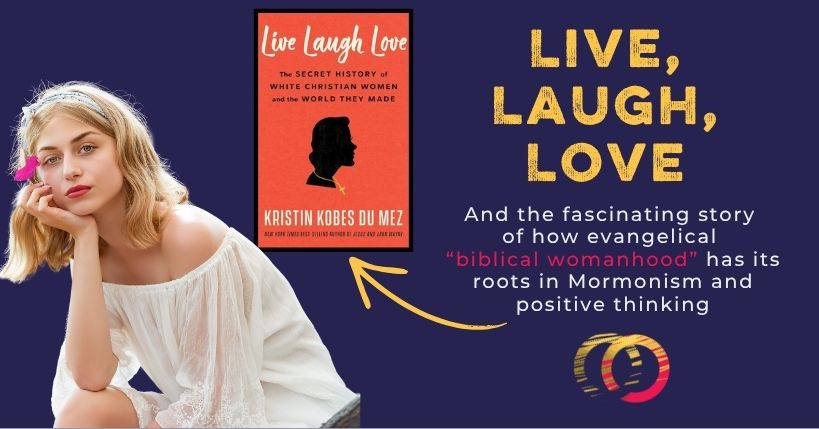
She did it for Jesus and John Wayne, and this week her much-anticipated new book Live, Laugh, Love launches, as she tries to answer how evangelical women got where we are now—what we believe, where we serve, how we act.
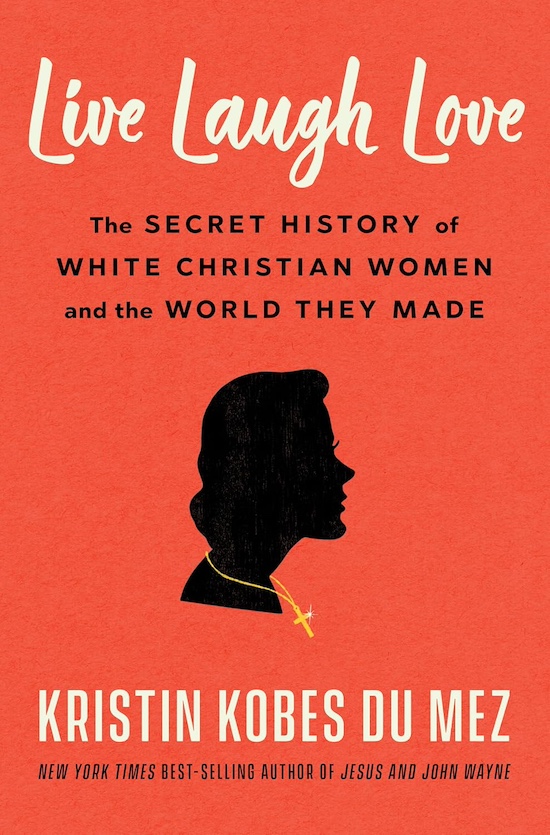
Live, Laugh, Love is an important book.
I read an early copy a few months ago to get ready for my podcast episode with her (it’s out tomorrow!), and I found myself feeling the whole gamut of emotions.
There’s wry laughter and humor as we read about Holy Crap and all the Jesus Junk that evangelical women embraced as evangelicalism became so commodified in the 80s and 90s.
There was flashes of melancholy and finally understanding as I read about the holiness movement and Hannah Whitall Smith searching for happiness, and finally realizing why my grandmother was actually so miserable! Ironic I know, but I saw the religious map that she had growing up in the early part of the 20th century, and maturing in the middle of that century, and how she embraced these doctrines that helped her make sense of her misery—but never really brought the happiness she wanted.
There’s anger at all the wasted opportunities as you realize that Elisabeth Elliot could have gone in such a different direction—that she was once very critical of the evangelical industrial machine; that she was once exploring Christian feminism; that when she was single and widowed her writing was so different than that which we now associate with her. And you wonder what would have happened to modern evangelicalism had she not remarried to an abusive man, had she not had to make sense of her lot by preaching about suffering and submission and accepting God’s will.
There’s validation that you’re not crazy if you have grown up in church wondering where Jesus is, and finding smoke machines and politics instead.
And that validation is likely the most important part of the book.
Maybe that wasn’t Kristin’s main aim, but I think all of us need to read this just to know, “it’s not you, it’s them.”
For those of us who have found our home and identity in the evangelical church, and yet at the same time have felt pushed out, marginalized, and not wanted, it shows that the problem was never you. The problem was that you were seeking after Jesus, and the church wasn’t. And it’s hard to fit those two things together comfortably.
The book paints the history of evangelical women and shows that it’s complex. That as the church often focuses on “flighty” things for women, it’s also upheld by extremely rigorous theology and Bible studies. That women have always been drawn to study the Scriptures, but we can’t ignore the cultural milieu, and the political landscape, that will push evangelicalism in certain directions.

The part that I found so interesting for our work was the story behind Marabel Morgan’s book The Total Woman
And that’s what I want to talk about today.
Morgan wrote the book in 1974, and it was one of the first “Christian women’s” marriage books. It told a wide audience, but especially a Christian one, how to be a good wife, which included showing unconditional respect; having sex on demand; managing your husband’s emotions; and being his very best cheerleader.
Sound familiar?
Every other marriage book written after Morgan’s was modelled after hers. In fact, you can find the framework for Love & Respect in Morgan’s pages. And Morgan’s book went huge. Phylis Schlafly picked up on it as a way to counteract the Equal Rights movement of the 1970s. It became a tremendous cultural phenomenon, and it was the first that addressed all of marriage, especially sex.
But here’s what’s really interesting, that Kristin explains in detail that I never realized: while Morgan’s book became the framework for teaching on what it means to be a Christian wife, not only was Morgan’s book not rooted in Scripture—it was rooted in cultural Mormonism and the positive thinking movement. Nothing to do with evangelicalism or Jesus at all.
This is Kristin’s incredible strength, and why she is such a gift to the body of Christ. She’s able to tease out these connections and show how Morgan didn’t just erupt out of nowhere.
Morgan herself was shaped by cultural forces, and for her that was primarily the book Fascinating Woman by Helen Andelin. Andelin was Mormon, and trying to make sense out of a marriage that wasn’t ideal. And she wrote her own book that turned into classes and coaching sessions and groups for women all over the United States. It crossed over out of Mormonism and into the culture at large as women learned about things like “fundie baby voice”, as Tia Levings described it. Levings read Fascinating Womanhood when she was deep into fundamentalism, and learned how wives were to change their voices to be childlike, lilting, and quiet.
But here’s where things get even more interesting.
Andelin herself didn’t get these ideas out of nowhere. In the 1930s, in the middle of the positive thinking movement, there were a series of booklets called Fascinating Womanhood that Andelin basically just took and turned into a book thirty years later. And those booklets were written not by people trying to find the “Christian” way to live, but rather came out of the New Thought or Positive Thinking movement, where people tried to make sense out of difficult circumstances by believing that if they just reframed it and changed their attitude, blessings would come to them.
Do you understand the significance of all of this?
The modern idea of “biblical womanhood”, and what practically this entails for wives, that is taught in evangelical best-sellers and by organizations like the Council for Biblical Manhood and Womanhood, got their ideas not from centuries of biblical scholars searching the Scriptures for what God calls women to, but rather from a century of women trying to make sense of difficult marriages, and seeking answers in psychological movements. And those ideas went big first in Mormon circles.
All this idea about how these are God’s unchanging ideas for womanhood kind of go out of the window when you read Kristin’s history of the booklets, and Fascinating Womanhood, and The Total Woman. You start to realize how much is actually not about God but about sex.
And it’s just so very…validating.
Yes, it’s infuriating. Yes, it’s sad. But it also tells you, you weren’t crazy. There were reasons this never sat well with you.
And like Elisabeth Elliot, all of us can take different roads. We can continue down the road towards justice and mutuality, or we can travel down the road of oppression and trying to make sense of God’s suffering by making sure other women stay in line.
Hers was a tragic story of a woman who truly loved Jesus, who was shaped by cultural forces that made her see God as someone who demanded much of her and didn’t care about her suffering, and who ended up normalizing and perpetuating the suffering of other women.
What would our lives be like now had Elisabeth Elliot chosen a different road?
And what will the lives of our daughters and granddaughters and the women who come after us be like if we leave oppression behind, and choose freedom in Christ?
That’s the choice that Kristin offers us.
Showing us how the sausage is made shows us that none of this was inevitable, which means the future isn’t inevitable either.
So what will we choose?



“showing unconditional respect; having sex on demand; managing your husband’s emotions; and being his very best cheerleader.”
Sounds like an AI chatbot with an additional suction peripheral.
“Phylis Schlafly picked up on it as a way to counteract the Equal Rights movement of the 1970s.”
At the time, I remember Schlafly’s movement being called “Ladies Against Women”.
“it was rooted in cultural Mormonism and the positive thinking movement.”
Mormon Culture is near-identical to American Christian Culture; the two originated from the same culture at the same place and time — The Burned-over District of Upstate New York, i.e. the Weird New Religion capital of the 1830s.
Mormons differ almost entirely in their Theology, not in their Culture. Here is a tongue-in-cheek essay on the parallels:
https://baptistnews.com/article/mormons-southern-baptist-zombies/
And among Mormons, Utah Mormons have a reputation for being the most tight-assed rigid. But then, Utah’s always had its own way of doing things. With its own unique terminology — “Salad” for jello with fruit bits, “Relief Society Voice” or “Primary Voice” for Fundy Baby Voice…
That bit about the 1930s makes sense. In the interwar years and in the Great Depression, so many people could do everything right and still not get what they needed. When you have nothing else, you turn to what you do have – thoughts and words and some sense that there is something bigger than what we know that could help.
So humans try to influence that bigger thing into creating favorable events. We create rituals and beliefs to convince ourselves that if we just get the formula right, we’ll be okay and to comfort ourselves that bad things won’t happen to us like to other people because they clearly didn’t get the formula right.
This human tendency is why I believe Pentecostalism is one of the fastest growing forms of Christianity. Its heavy emphasis on doing and believing the right things and good things will happen for you gives people a sense of control in times when they can’t control anything. What worries me is that the promises of Pentecostalism are verifiably overstated. Anytime a spiritual system promises something that we know is oversimplified to the point of being untrue, I get very worried for the people who find their hope and comfort in it. And then people get mad at me because I’m taking away a source of comfort and pointing people to the path of uncomfortable uncertainty.
“So humans try to influence that bigger thing into creating favorable events. We create rituals and beliefs to convince ourselves that if we just get the formula right, we’ll be okay”
Isn’t that the whole idea behind Ritual Magick?