
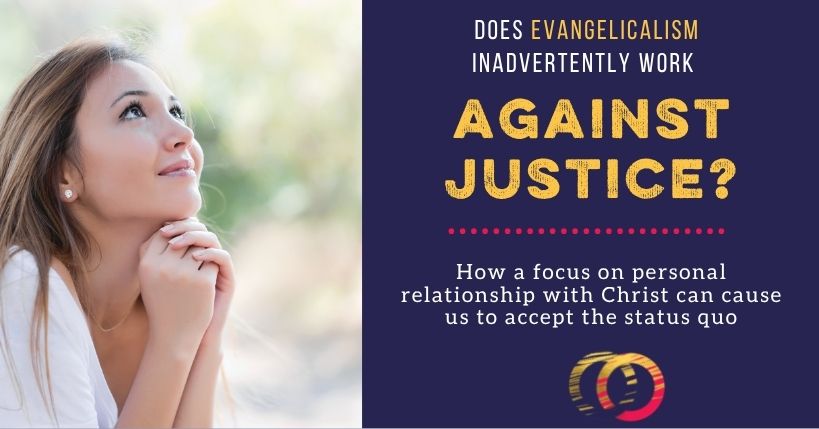

Is the evangelical church missing the boat when it comes to justice for women?
Not just missing the boat theologically by supporting doctrines that subordinate women, but missing the boat in general when it comes to advocating for justice?
I think it is. But I don’t think the evangelical church is the only one missing the boat. I think the more progressive version of Christianity can also miss the boat, as can many online progessive activists. And I’d like to spend the next three or four posts showing how this happens in different ways with all three groups, and asking us to seek Jesus in a different way that will actually bring healing and justice.
But I want to start today with the typical evangelical church–either complementarian or egalitarian. For the purposes of this post, it actually doesn’t matter for once, and you’ll see why in a minute.
I have this test that I often use when it comes to church services, and it goes something like this:
The News Story Test for Church Services
Pick the biggest news story that has made you sad and enraged this week. That has had you begging God to do something about it.
If the victim in the middle of that news story were to go into your church service this week, would their pain have been acknowledged properly, and would they feel as if the community of God had called out the injustice on their behalf?
Or would they feel as if people had been encouraged to ignore injustice and gaslight themselves into thinking “it wasn’t that bad”?
Here’s how this test works.
For me, the news story this week would have been the Cornell Rapists (or the Cornell 7). News broke late last week of a young woman, 18 at the time, who was attending Cornell in 2024. She was invited by a friend back to his frat house, where she was drugged. He then sent out a text to the entire frat (55 people in all, I believe), inviting them to come and use her sexually (I won’t repeat what he wrote). She was then sexually assaulted for seven hours by seven men.
She reported the rape. Cornell expelled two of the students, but had five of them just write essays. The DA declined to prosecute (they announced today that they would be reopening the case).
So, here’s the question: Would that sexual assault survivor, or other survivors who had their trauma brought to the surface again by this story of extreme injustice, have felt seen and heard in your church service yesterday? Would they feel as if God was pleading their case for them? As if people cared what had happened to them?
I don’t mean that the church service had to talk about their particular case.
But would they feel as if the people cared about injustice? As if God did? Would they hear that God was angry at oppression and injustice and violence? Would they hear that God wants us to do something to end that injustice and to figure out a solution to the violence against women (or whatever group we’re talking about in the particular news story) that all Christians should be a part of? Even if the injustice is talked about in theoretical terms rather than specifics, would they feel, in this church, that dealing with injustice and confronting evil is part of the work that God wants us to do?
And I am afraid that the vast majority of evangelical churches and church services would fail this test, for several reasons.
Evangelicalism focuses on our personal relationship with Christ.
Think of Billy Graham, the epitome of evangelicalism, even the one that defined modern evangelicalism. What was it largely about? People accepting Jesus as their personal Saviour. This is the end all and be all, and nothing much else matters.
Once you have Jesus as your Saviour, then you are right with God. And so the focus of the faith is on your personal walk with God.
Yes, this has implications for how we treat others, obviously, but largely we see the solution to problems that people are going through as being individual in nature:
- “They just need Jesus”
- “They need to surrender more to Jesus”
- “They need to feel the healing power of Jesus”
Think about how our sermons focus on how we need to experience more of Christ, or surrender more to Christ, or spend more time with Christ.
All of these things are true, yes. But they are not the whole story of faith that is presented in Scripture (as we’ll explore more in later posts).
So let’s go back to our sexual assault victim who is a victim of multiple areas of systemic injustice, where the justice system has ignored her; the university system has ignored her; and her peers have violated her.
Does the message “you just need Jesus” address these problems? Is it sufficient? Or does she also need to hear, “Jesus is angry when people are treated badly and when there is injustice, and Jesus wants us to fight for the oppressed?”


Evangelicalism encourages us to let go of the emotions that would motivate us to fix things
One of the things we talk about in our upcoming book Fawn: How a Trauma Response Became Biblical Womanhood, is that anger is actually a motivating and energizing emotion. It feels uncomfortable, so, properly channelled, it prompts us to do something to change things. It’s like one of my favourite quotes from A Wrinkle in Time: “Stay angry, little Meg. You will need all your anger now.”
In 2018 Rebecca Traister wrote Good and Mad: The Revolutionary Power of Women’s Anger, detailing how women’s anger was actually the catalyst to all the positive social change movements we’ve seen in the last 150 years–an end to child labour; health care; equal rights. When we see injustice, when we’re angry about injustice, and when that anger fuels us to fight injustice, then change can come.
But what happens if evangelical church services are geared to calm us down from our anger, and take away the uncomfortable emotions that may motivate us to fight for something better?
Imagine that you enter church doors upset about the Cornell 7, or about the rash of hangings of African Americans in the south, or about Nolan Wells’ death, or about ICE detention centers. You feel sad about the state of the world, but helpless to do anything about it.
And at that church service, you sing songs that say things like this:
- “All of you is more than enough for all of me, for every hurt and every need, you satisfy me with your love, and all I have in you is more than enough.”
- “He walks with me, and He talks with me, and He tells me I am His own. And the joy we share, as we tarry there, no other has ever known.”
- “Over the mountains and the seas, your river runs with love for me, and I will open up my heart and let the Healer set me free…I could sing of your love forever”
Those songs are emotional. They calm you down. They assure you that God is with you, that all you need is His love.
And so those energizing emotions that may motivate you to fight for change are calmed, and you feel as if this is a good thing, like you have just encountered Jesus who brought you peace.
But you feeling better about the state of the world does not help the sexaul assault victim who is dealing with injustice. She does not just need to sing of God’s love forever. She needs the community of believers to stand around her and say, “what happened to you isn’t right, and we will be part of acknowledging that out loud and helping you get justice.”
Evangelical church services are often geared towards helping people accept the status quo.
Is this intentional? No, I don’t think so.
And I know that because one of the things that haunts me is that, years ago when I spoke at women’s retreats, this was largely the substance of the messages I gave. When life is tough, realize that God is enough, and He will give you peace.
I wasn’t trying to get people to accept any status quo. I didn’t think to myself “this is a way to calm everyone down so they don’t upset the apple cart.” No, this is what I was taught was what Jesus wanted.
What if there’s more to Jesus than just Him comforting us?
The New Testament is not only about our relationship with Christ. It’s also about how we build a healthy community. It’s about what the kingdom of God is like, and how we’re supposed to be part of bringing that kingdom to earth. And the New Testament tells us that we fight not just against flesh and blood, but about powers and principalities–which are basically the systemic evils that we see in our society.
When we reduce the Christian life to simply our own personal relationship with Christ, we don’t end up with answers for people who are truly hurting. We don’t prevent others from being hurt in the same way.
There are also issues, of course, of many evangelical churches contributing to the suffering of others by promoting doctrines that are inherently oppressive and hierarchical, and I don’t mean to diminish that (indeed, I have written so many posts about that and podcasts about that I feel as if I’ve handled that from all angles).
But it goes beyond that. Part of the reason that evangelicalism cannot begin to address the sexual abuse crisis in its ranks or the racism in its ranks or the sexism in its ranks is because of the focus in evangelicalism on personal piety over healthy community.
And until we realize that Jesus came not just to transform our own hearts but to transform the world as a whole, then we’ll remain largely ineffective, and even dismissive, of those with real trauma.
Next time we’ll look at how the progressive/mainstream churches often don’t have an answer to the sexism and oppression of women either.
What do you think? Has evangelicalism centered individual feelings too much? Do you have counter-examples? Let’s talk in the comments!








I don’t have the words to express how much I needed this and am looking forward to the other parts. I used to comment here as ‘Bre’ (great hiding myself there…I am not the Brianna you are looking for…the e and I spellings are different lol) and A LOT has changed in my life in the last 3.5 years. I ended up realizing that, with it’s social policing of mental health, thoughts, hobbies and stuff and wanting to label everything they disliked as evil or influenced by a spirit of satan and the experiences that led to for me on top of the ableism, I was in a very spiritually toxic and traumatic church environment. I ended up leaving, after like a year of attending Sundays at a more liberal, liturgical church that I started attending just to help my autistic, disabled, lesbian friend get over her social anxiety to find a new church…I ended up feeling that God told me it was okay to want to go.
And it’s kinda a weird place to be in. Like they talk and preach about justice, love, and Jesus coming to bring the kingdom of heaven to earth, but the pastor rarely ever talks about sin or Christ dying to save from our sins. And from some comments she’s made, I think she might be adverse to that part of theology. The majority of the people (old people) obviously do believe in christ dying to save us and the justice component but…it’s just weird for me. It’s a denomination of church that was literally created for people who survived church hurt/trauma and/or were pushed out for being too “liberal”.
Aside from the trauma part and realizing how much being told I’m evil and can’t trust myself or gods voice because it be satan or just me making stuff up (and all the issues that caused with my autism, mental health issues, and past trauma and trust issues), the fact that a lot of the people at my old church supported a lot of the injustices going on with immigration and cutting services for the poor and disabled was what made me leave. If you’ve become convicted you need to stand up for others because that’s what god wants you to do, but are too scared to talk about it or mention your thoughts to others because you know you’ll be labeled as “worldly” and “deceived” and hounded to “come back to god” and think the right way just for trying your best to live out your life as a mirror of Christ…yeah that made me realize something had to change cause I was actively not fully engaging with God or following him because I was conditioned to shut down because of fear.
It’s been amazing; I’ve grown so much as a person and have grown closer to God! Like as someone with Autism and mental health issues, aside from the church thing, the last 3.5 years post college have been me realizing that I’m not capable of the things Society expects from other people (such as working all the time in a traditional work arrangement) and actually need help. Like I have an amazing job teaching little Autistic kids at a therapy center and they’ve made lots of accommodations for me, and they helped me to find a good neurodivergent therapist and apply to get a mental health case manager who helps me apply for public services and navigate healthcare. It’s been an amazing experience to realize how needy and vulnerable I actually am and how much I rely on God to take care of me and work things out. Like God is the best Autism parent and disability advocate! But that was a hard place to get to and I’m still learning to not beat up on myself and think I’m worthless because I’m not working all the time or producing things or doing something “valuable”.
But changing my church and removing myself from the constant spiritual anxiety and overstimulation (definitely agree on evangelical environments, particularly pentacostal ike I was in, being very reliant on emotional conditioning and manipulation, even if they don’t realize or intend it) really removed that wall and enabled me to be able to start trusting God and my perception of reality, and that made the biggest difference in me being able to make progress in therapy. Both my therapist and my mom saw an immediate positive difference in me after I switched churches, and I’m now to the point I don’t need therapy every week!
But that being said, trying to figure out that balance of salvation and justice and focusing on both without neglecting or denying the other is something I’m actively trying to figure out. Like, Jesus saved me from my sins and I know I’m going to heaven…but I want to be more like him and be the way humans were meant to be as much as possible in the here and now and I’m trying to figure out what that looks like. This was a lot of a rant and I feel like I haven’t really gotten out the feelings/questions in my head on the issue that I can’t put into words but…I’m trying to know God more and do better and for the season of my life/sort of focus my brain is on right now, this series is going to be super helpful and I’m so happy you’ve been addressing more of these bigger picture Evangelic things that feed into the whole system. I haven’t commented in years, but I’ve still been following and reading your stuff!
That was a great rant! And it’s great to hear from you again. I’m so glad you’re doing better and that you’ve found a place that has helped you actually get the help that you need. And I think the fact that others see that you’re doing better after leaving that church speaks volumes!
I know this isn’t your main point, but re the songs: I heard a stat once that a third of the Psalms have themes related to the environment (God as creator, God as sustainer, community spiritual health linked to environmental health, etc etc..) compared to almost no contemporary worship songs. (I wish I could remember the source and the exact stat, but that’s it at a vibe level)).
It would be interesting to do the same analysis for justice themes, as they’re everywhere in the Psalms but pretty rare in contemporary worship music. There’s these ones:
– “I can see Your heart
Eight billion different ways
Every precious one
A child You died to save
If You gave Your life to love them so will I”
– “To the broken, I’ll witness it
To the hurting, I’ll witness it
To the lost I will witness it”
But those weren’t super easy to think of and the exception proves the rule.
Side note: I think you’d struggle to find any evangelical church that’s singing the songs you gave as examples in 2026!
I have had conversations with folks about how I think that Ozzy Osbourne actually wrote some of the greatest worship music ever because he was willing to express anger sadness frustration and how hope can feel scary. You read the psalms and folks are like why is the psalmist being like God knock the teeth out of these degenerates and you go ok that seems excessive but the context is thus person writing just witnessed how horrific warfare truly gets and he wants to believe and see that wrongdoing will be dealt with.
I do believe that a genuine relationship with Christ will change you. That in turn change in individuals creates societal changes.
The first sermon saying slavery is an affront to God came out a few centuries after Jesus.
Folks are like why didnt slavery just end? Because you can not end it without destroying the foundation of it which is the idea that some humans are only fit to be slaves. The notion of all mankind as brothers is a Judeo Christisn concept. It is one however that came to bear so much good fruit it became the basis for entire constitutions even as the theological aspect got shoved aside.
Also yay A Wrinkle in Time. I love that book.
We follow the Jesus who flipped tables, too.
Exactly we do!
“Evangelicalism focuses on our personal relationship with Christ.”
The Gospel of Personal Salvation and ONLY Personal Salvation is as selfish a gospel as anything written by Ayn Rand.
And reduces Christ to nothing more than a Postmortem Fire Escape.
“Those songs are emotional. They calm you down. They assure you that God is with you, that all you need is His love.”
Doublepluswarmfeelies and nothing else.
“Ignorance is Bliss and I Want Utopia!”
“…the focus in evangelicalism on personal piety over healthy community.”
i.e. More Pious Than Thou, LUKEWARM!
(I’ve got my Fire Insurance ticket punched and Rapture Boarding Pass; Have Fun in Hell!)
“When somebody hits you with the line ‘What Would Jesus Do?”, remind them that flipping out and throwing tables around is a valid WWJD action.”
When you have your eyes fixed on Heaven (like the praying woman in the title block), you will never see those around you that are hurting. You have to look horizontally instead of vertically to see them at all.
American Christianity needs an infusion of Judaism, with Judaism’s emphasis on the Here and Now, its doctrine of Tikkun Olam (healing a broken world), and its ability to laugh at itself. Christianity has become all Vertical and needs Judaism’s Horizontal to restore balance.
Who knows? Maybe the Second Coming of Christ can be Hope and Healing (as is the Jewish Coming of Messiah) instead of Death and Destruction, Fear and Terror.
Yes, I think today’s evangelicalism is far too focused on heaven and ignores everything else. It’s one reason why so many Christians don’t care about the environment at all. It’s going to burn up anyway!
Define what you mean by caring for the environment. Because see i see a massive difference between people throwing soup at art in the Louvre which is abject stupidity and folks being like nuclear power is a good thing and I pick up nails I tind so folks dont pop their tires. One is stupid and designed to get attention so folks feel like a hero. The others actually work.
My former youth pastor (many years ago!), Jim Cantelon (whom you can still listen to online), talks about how faith is both vertical (righteousness) and horizontal (justice). God requires both from us. It’s all over scripture, and how much clearer could Jesus have made it than to tell us to love God with all our hearts (love flowing vertically) and our neighbour as ourselves (love flowing horizontally, love in action)? You’re right, Sheila, that the evangelical church ignores the horizontal love-in-action part, to its shame and to the harm of many.
A few months ago, I read *Lives of Unstoppable Hope* by Stant Litore, which is, in part, a meditation on the Beatitudes, and I was really struck by his commentary on the fourth Beatitude, “Blessed are those who hunger and thirst for righteousness.” According to Litore (who, like Marg Mowczko, reads Koine Greek), the Greek word which we translate as “righteousness”, *dikaiosunei*, “is about rightness and justice in God’s eyes” (50). He would agree with the Bible Project that the word “means living in right relationship with God, other people, and all creation” (https://bibleproject.com/videos/vocab-insight-dikaiosune-righteousness/). When we think of “righteousness” as meaning primarily personal holiness, we misunderstand what Jesus is teaching; we miss the emphasis on seeking justice. I think it’s worth quoting Litore here, if you will bear with me:
” . . . those hungering and thirsting for justice, are those who are not satisfied with a general rule that neglects individuals’ needs, those who are not content with the status quo, those who are not only discontented but *ravenous* for change when they look upon the world and see wrongness instead of rightness, when they see human beings acting unjustly and abusing one another. [. . .] Longing to rest in God’s arms, in religious communities we often forget our hunger, our thirst. We may be too quick to dismiss those who are blessed with a restless, discontented, famished desire for justice. ‘Why can’t you just forgive and forget?’ one community mutters. ‘Don’t worry about these bad things happening, they are all part of God’s Plan,” a second community pollyannas. ‘If you’ve received injustice, you probably did something to earn it,’ a third community pronounces.
Yet Yeshua never said any of these things.
Yeshua said, ‘Blessed are those hungering and thirsting for justice.'” (Litore, Stant. *Lives of Unstoppable Hope.* Westmarch, 2021. 52)
I thought immediately of all of the women who have cried out for justice for themselves, and been told by their evangelical churches to shut up and just forgive. Yet Jesus commends them for seeking justice (as he does any of us who seek justice on anyone’s behalf, not only our own). To follow Jesus includes obeying his teaching to continually seek justice.
As I understand it, “Righteousness” in the original language (classical Hebrew) always had an element of bringing about justice. Like the two were inseparable. Once again, Judaism’s emphasis on the horizontal.
Absolutely! That’s beautifully put.
Unfortunately, the Gospel of Personal Salvation and ONLY Personal Salvation (“It’s All Gonna Burn”) is exclusively Vertical.
Being aware of so many things happening all over the world can be a lot to process…when can (or should) we do something, and when is something beyond us? And even when we do decide we must fight an injustice, etc, there are times we still have to let go of certain things and say “it’s in your hands now, Jesus,” because we are finite people at the end of the day.
And sermons or talks to large groups of people are so hard because everyone gets lumped together. Some messages about finding peace and joy in Jesus may speak to those who feel stuck in circumstances they can’t change (like a cancer diagnosis or terminal illness, etc), while also unhelpfully “quieting” the righteous anger of others who maybe need to deal with or face something that’s not right.
I think that’s such a great point!
And I completely agree that we would be better served learning how to listen to our anger and try to find out what it’s telling us rather than ignoring it or covering it up. When I was young and struggling with anger, I was told, read your Bible more. Pray more. Rest in God’s love for you, be grateful for Jesus’ sacrifice…
But those things didn’t help me where I was at! I was ashamed of that failure and of my anger (which simply created a vicious cycle), rather than being curious and compassionate about what I was feeling and why Which was what I really needed.
Having been in the church since childhood (connected and involved with a couple evangelical denominations), it wasn’t until my 6th decade that I learned there were “Precatory Psalms” – which was when I visited an Anglican church. There were many good experiences and preaching but basically the Psalms were ignored.
The emphasis got put on having a service of ‘celebration’ – which is one emotion/aspect of experience. A black southern U.S. Christian activist for justice lawyer (he’s well known but I am unfamiliar with his name) in an interview I heard, said he played in a worship band, and that his grandmother asked him: “Where is the lament”? He went on to say that this is missing in modern worship services and there needs to be a time of expression of lament in the service.
So often there is little to no place in/at church for acknowledging what is on one’s heart and the concerns people bring in the door with them (such as what’s in the news, world events) are ignored.
Things have to first be acknowledged before anything can get done about them.
The Stimpy Happy Helmet school of church culture.
“Your father made a religion of cheerfulness. I suppose there can be nothing more hellish than never for an instant being allowed to frown or to shed tears or to be bad tempered. No one in this house… was permitted the luxury of unhappiness… Everlasting good humor, eternal happiness, eternal joyousness? Not even Lucifer himself could devise such torment! … No, cheerfulness is a cruel religion.”
— G.K.Chesterton, “Three Tools of Death” (Father Brown Mystery)
I was introduced to Nan Merrill’s “Psalms for Praying” at a retreat this summer. What a beautiful breath of fresh air on the Psalms. She took out all the anger, wounded ego, and violent retribution. What sings instead is beautiful, luminous, powerful.
It’s a window into how I imagine ancient women spoke about, sang about God.
As a Woman of Color (hi, intersectionality!), I’ve been dealing with this in “evangelical” circles for at least 40 years. Which is why I no longer consider myself “evangelical.”
I’m reading Esau McCaulay’s book Reading While Black right now, and I do think in many ways the African American church is the true confessional church, because it’s still rooted in foundations but also committed to the larger story of Scripture and justice.