


The medium is the message.
And when it comes to Christian patriarchy, the medium is super pretty right now!
Marshall McLuhan, a Canadian sociologist, said that famous “medium is the message” line sixty years ago now. He was explaining how the medium that we hear a message in actually changes the message that we internalize. Think about news, for instance. When you read the news from a newspaper, you’re often reading an in-depth coverage of one particular incident.
But when you see it on TV (or now the internet!), they often use only about 10% as many words. And they have to tell the story in a way that keeps you hooked and makes it less likely that you’ll turn the TV dial. So “sound bites” became a thing, and news became far less nuanced, and more black and white.
The medium changed the message.
And that’s what’s happening with how social media is selling patriarchy.
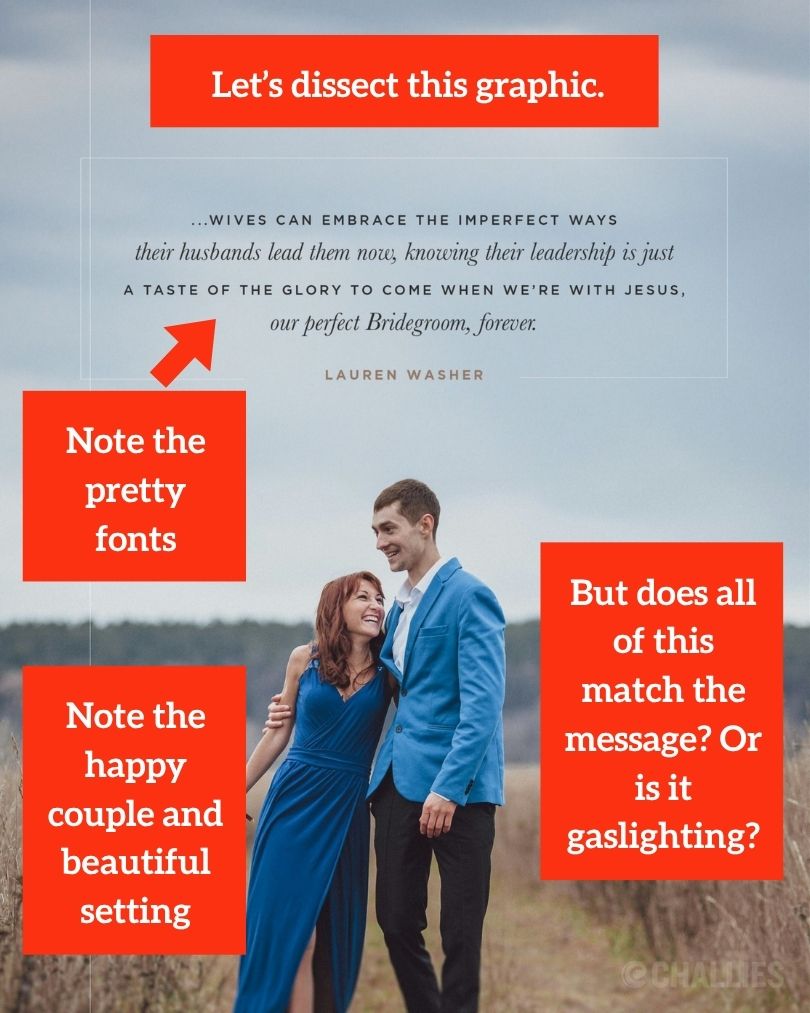
Last week Tim Challies shared this ridiculous graphic.
Tim Challies is a popular Reformed pastor from Toronto, my hometown.
Here’s his graphic, with my edits:
(read all the way to the end; I’ve got several more graphics that put this one to shame!)
Let’s analyze this for a minute.
What is the actual, overt message?
Wives can embrace the imperfect ways their husbands lead them now, knowing their leadership is just a taste of the glory to come when we’re with Jesus, our perfect Bridegroom, forever.
On its face this is just plain ridiculous.
It’s saying that a husband’s imperfect leadership is a taste of…what exactly? Jesus? So his imperfect leadership is a taste of what? Jesus’ imperfect leadership? We need someone’s bad leadership to remind us of Jesus? It really makes no sense.
And, as we showed so clearly in our book The Marriage You Want, this doesn’t work at all. Couples where the husband exercises authority do far worse than couples who function as partners, as a team. I’ve shared this chart before from chapter 1 (one of many in the book!), but it’s an important one!
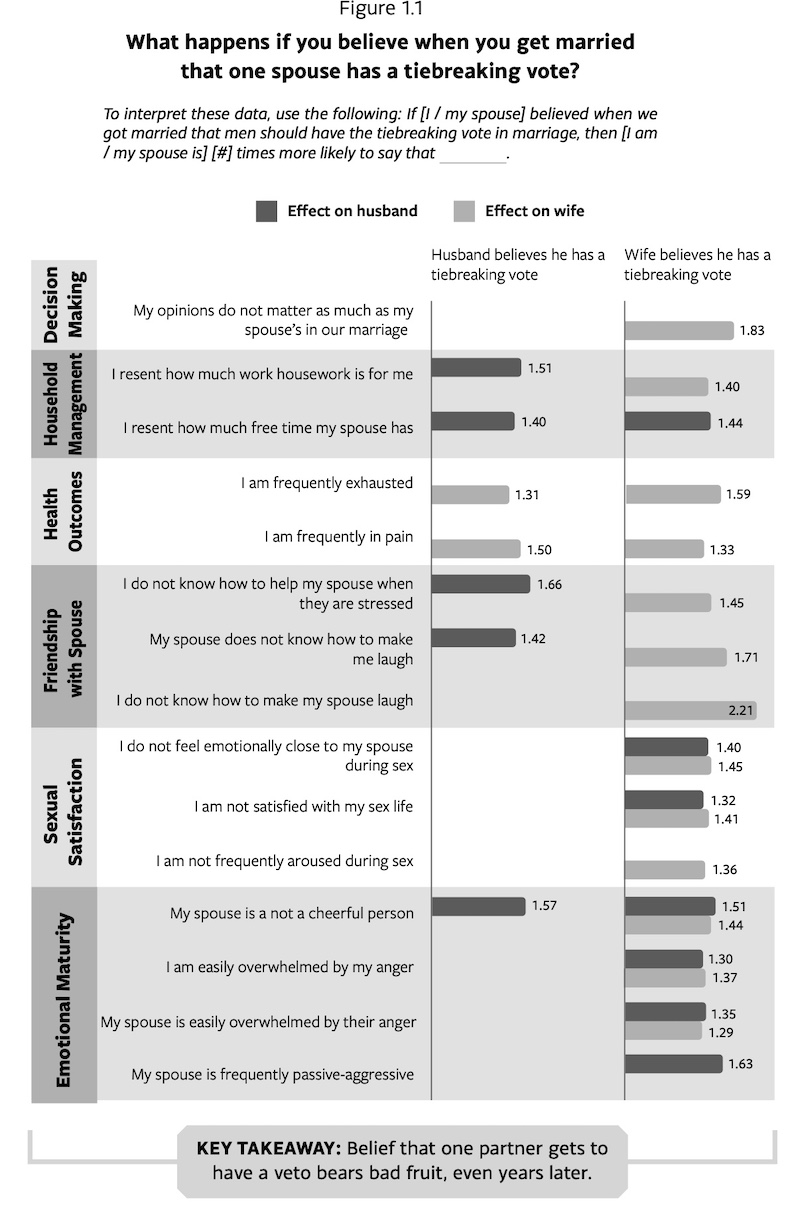
So please hear me on this: this message of Christian patriarchy hurts women. It hurts couples. It hurts marriage. People do worse after hearing this message than they would otherwise. Couples who may have had good marriages end up with struggles they didn’t need to have when they are taught stuff like this.
This is toxic.
But it’s also presented as so, so pretty.
What is the subliminal message?
When I took Sociology in university, subliminal messages in advertising was all the rage. We’d analyze ads and magazine copy to see how companies were subtly trying to get people to associate their brand with something good—strength, sexiness, wealth—so that they would choose their brand, even if they didn’t know why, or even if they didn’t think they were being influenced.
This image is doing the same thing.
By using pretty fonts; by using pretty people; by using an idyllic environment for the picture, we’re given the message:
His imperfect leadership is beautiful and you should aspire to be blissfully happy under his imperfect leadership.
We’re told: People who live like this look like this. They’re smiling, adoring, enjoying life, living a beautiful life.
So the converse is also true: If you are not happy; if your life is not blissful; if your environment is not beautiful—it must be because you aren’t embracing his imperfect leadership.
And so, if you read that quote and it rubs you the wrong way, you start to question yourself, rather than the quote. Because look at how happy those people are! Look at how beautiful they are! Don’t you want to be like them?
What are the even more subliminal messages here?
But wait—there’s more!
Let’s analyze this picture a little bit more, perhaps even more than the person who made that graphic did. What else is this picture normalizing?
- She is looking at him, with her gaze revolving around him. He is not looking at her. He is looking straight ahead.
- She is hanging on to him, as if she needs him and is an appendage of him. He has an arm around her, but is standing upright on his own.
The picture itself stresses that the husband is the one with agency; the wife merely hangs on his every word and goes where he decides to go.
What would happen if we changed the picture?
What would happen if we put that same quote on a graphic that more accurately portrayed the reality of what it is like to live under “a husband’s imperfect leadership”?
Here are five far more realistic graphics:
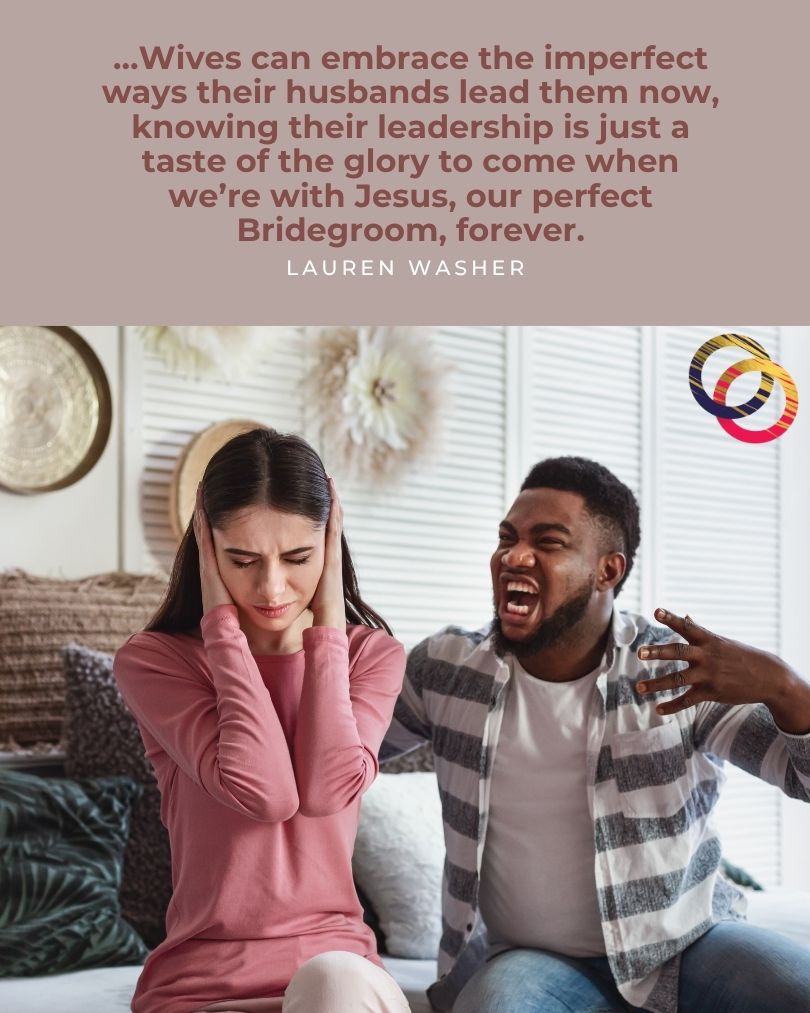
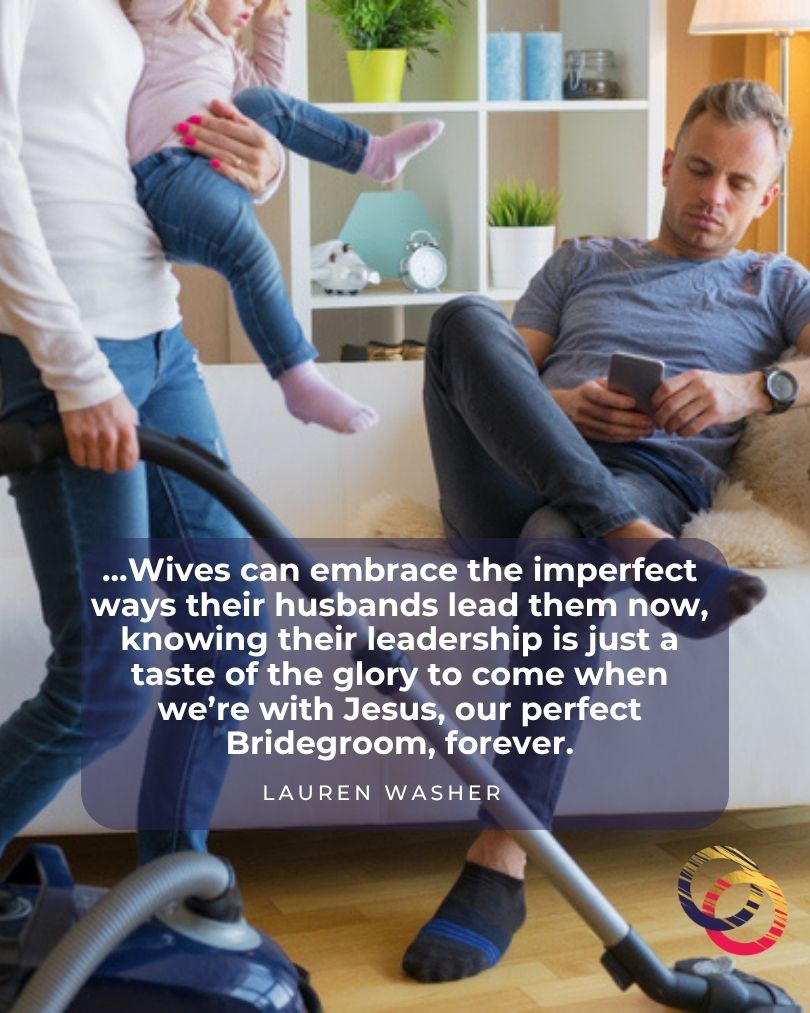
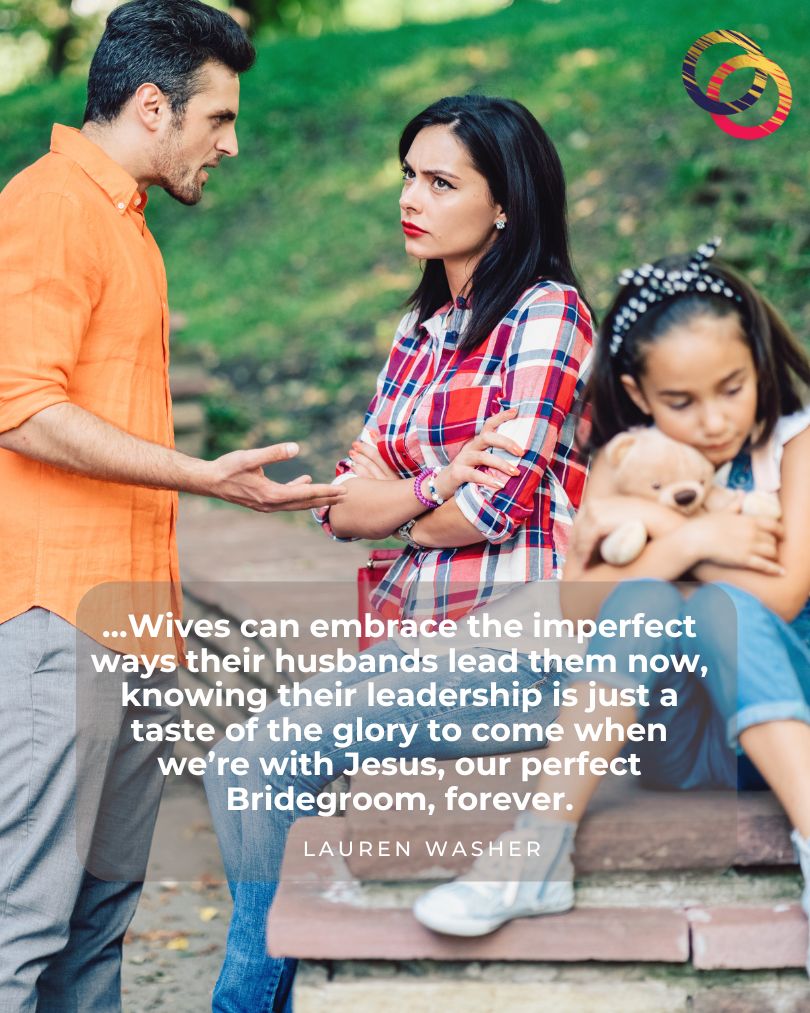
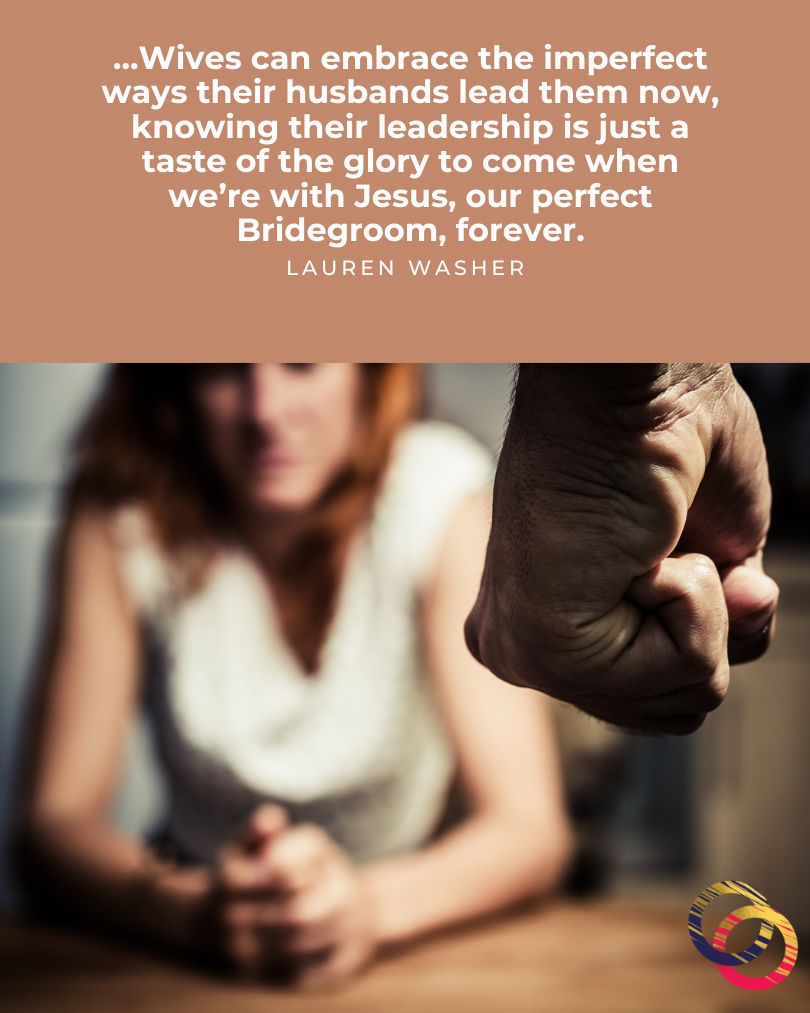
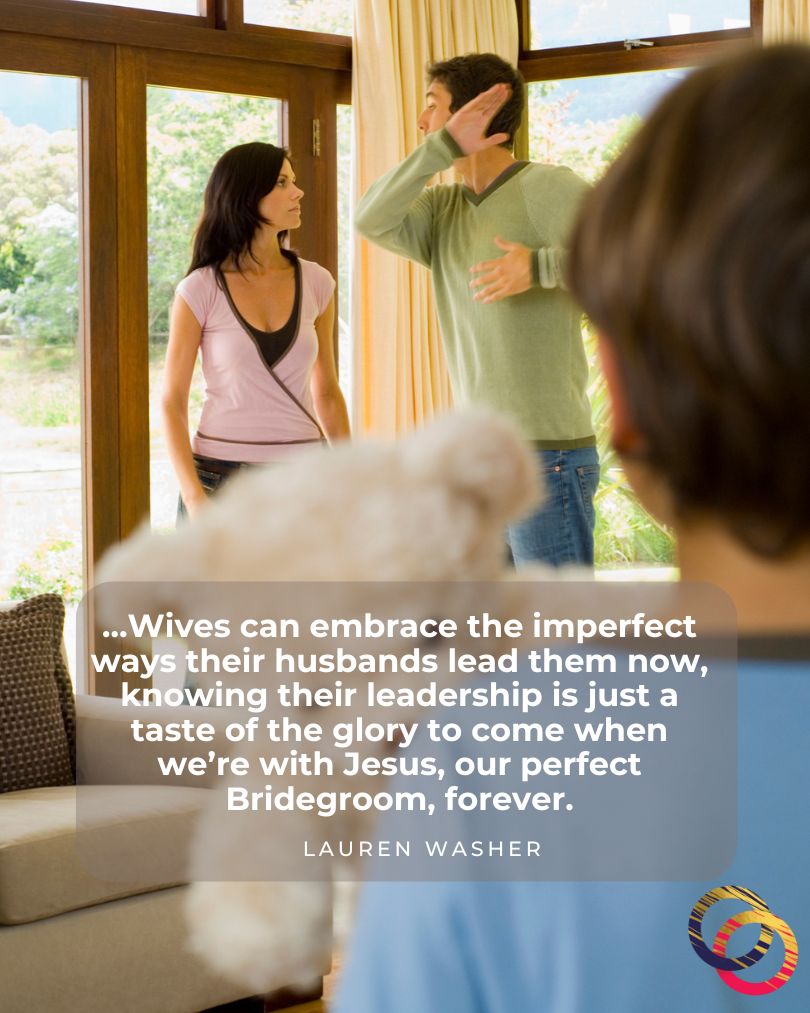
Somehow these don’t land the same way, do they?
In these graphics, the image matches the quotation.
And when the image matches the quote, you can’t hide the fact that the quote is absolutely atrocious.
You can’t pretend that a husband hitting his wife in front of the child is a “taste of the glory to come with Jesus.” You can’t pretend that living with a man yelling at you reminds you of what you’ll get with Christ.
It’s all shown to be the farce that it is.
Christian patriarchy has thrived because they hide the reality of what they’re selling.
The trad wife accounts (that lie for Jesus!), the pastor’s accounts that use graphics like this, the pretty book covers on books that sell patriarchy—they don’t let you see behind the curtain.
And so when your reality doesn’t match the pretty pictures they sell, you question yourself.
But it’s time to start separating what they’re saying from the pretty picture they’re portraying.
It’s time to just look at what they’re saying. Because when you do that, it becomes much more obvious that this is all ridiculous, harmful slop.
This week our video series for The Marriage You Want launches.
We wrote The Marriage You Want to combat all these ridiculous patriarchal messages, and show, with evidence and data, what kinds of marriages actually thrive and what kinds of marriages actually reflect Christ.
Up until now, almost all Christian marriage books are based on the faulty premise that men have to be in authority over women. And that’s why the advice in these books doesn’t work (as we’ve measured!).
But what if we could have a marriage book that didn’t sell Christian patriarchy, but was actually healthy? We’re trying to provide churches with EVERYTHING they need for a new kind of marriage curriculum. The Marriage You Want has:
- a book, in paperback, ebook, or audiobook form (and Keith and I read the audiobook!)
- A study guide, with questions for small groups, for couples, and even for premarital counseling
- And now an 8-week video series for small groups to work through together (coming Friday!).
Now Christians will have an alternative to the Christian patriarchy message that doesn’t work and does harm.

So next time you see a pretty graphic like this, ask yourself: What’s the message?
- Does the message match the image?
- Are they trying to sell me something, or accurately portray truth?
- Is this something I need to pay attention to?
And if you realize that it’s just pretty Christian patriarchy, hit the “unfollow”, “mute”, or “block” button. Let’s stop feeding the algorithm.
And pick up The Marriage You Want instead for actual truth!
Let me know: Which “corrected” graphic is your favourite?








None of them are my favorite. They all project truth which is harm in this case. When I look at the graphics the truth they project is sadness.
I know what you mean!
In my experience, white evangelical Christianity often feels transactional, as if there’s always something being sold—whether it’s a particular belief system, a political agenda, or even a set of behaviors and emotions that are deemed acceptable. This constant undercurrent of persuasion can make it difficult to feel genuinely seen or supported, especially during times of struggle or grief. Instead of offering unconditional presence or compassion, the focus is often on promoting certainty, conformity, or growth metrics, which can leave little room for authentic questions or honest expressions of pain.
Doesn’t just “feel transactional”, it IS transactional.
Look at their Soteriology (Theology of Salvation) is as transactional as you get — Walk the Aisle, Say the Magic Words (and really really mean it) and you get your Fire Insurance policy (always individual, never group) and a complementary Rapture Boarding Pass (for one).
With an underlying mechanism of a transaction – Penal Substitutionary Atonement instead of Victory over Death.
I want to do a podcast sometime on how the different theories of atonement play out in our marriage and parenting. Because you’re right–it does make things super transactional that don’t need to be, and I think it stems from our transactional view of our relationship with God.
Absolutely! And no matter how you’re feeling, there’s also always something you should be doing. You never get to be the one cared for.
All of the graphics, even the original, are disturbing. Just this morning a Facebook friend who’s in her 60s posted about the importance of being a proverbs 31 woman and how wives need to be submissive to their husbands who are supposed to be the leader of the home. Yet in this same post, she tries to give the caveat that submission does not mean being a doormat and women can still work outside the home. I so wanted to respond by saying that submission is to be mutual as we are both to submit to each other out of reverence for Christ then point out some resources. I also wanted to say that when I practiced this patriarchal model of submission in my first marriage, it led to abuse. I decided there’s no use responding and I can just pray that God shows her what it is He needs to show her. Also, October is Domestic Violence Awareness month. Even though I’ve been in a wonderful marriage for one year and almost 5 months, some things like posts that push patriarchy in marriage trigger me.
Interesting. A cursory reading of Proverbs 31 (NIV) reveals to me no outright demands for submission. It mostly talks of the goodness and strength of the woman.
Example, Proverbs 31:16 “She considers a field and buys it; out of her earnings she plants a vineyard.”
Note that she buys the land and uses her own assets to work it. She doesn’t ask her husbands permission first.
But, as we have often pointed out on this site, the idea of male patriarchy and female submission is mostly a creation of specific people on earth.
Good for you!
I remember Rachel Held Evans (sp?) posting once that to Jews (the original culture Proverbs came from), Proverbs 31 was or is a song of praise a husband sings to his wife about her achievements.
As for “pretty fonts”, I remember a sampling of of covers of Christians books for women. So much Pastels, soft-focus backgrounds, and curlicued fonts I could feel my testicles shriveling up from the estrogen overload — ten times worse than when I was on a testosterone blocker for my enlarged prostate.
I think you have a problem.
The original image also has the woman physically under the control of the man. Look at their arms. Both his arms are free to do whatever he wants. Only one of hers is free and she’s using it to support herself on him. It makes the woman look like a possession to be maneuvered around wherever the man wants while she stumbles along, off balance. This is woman as arm candy. And we all know arm candy gets discarded or added to when the next pretty thing catches our attention.
Yes, absolutely!
The overt message I got from the original paragraph (pretty fonts and all) is “The husband is in charge no matter what. And however horrible his leadership is, support it enthusiastically, because that’s what you’re gonna get in Heaven, too”.
That’s what I took as well.
One thing I noticed is that grammatically, the sentence only works if you already believe in wifely submission.
I assume that they are trying to say that given how wonderful his leadership is even though imperfect, think how amazing Jesus’ perfect leadership will be. (C. S. Lewis had something similar to say about good food and sex being foretastes of heaven) But that requires you to already think that his leadership is a good thing. so who is this message even for?
We have another good example of using vague words so people have to infer the meaning. Someone who has a really lovely husband is going to think of something very different at the work “imperfect” than someone in an abusive marriage and we aren’t differentiating.
I’m going to do a whole podcast on euphemisms soon, and how they obscure what we’re really saying about marriage!
The graphic of the wife holding the baby and vacuuming is, for me, the one that is most realistic in that it applies to many, many complementarian (sometimes even egalitarian) households, especially ones where the husband works outside the home and the wife does not. The other graphics are overtly abusive in their feel, and while the tragic truth is that there are many women stuck in abusive complementarian marriages, there are far more, I think, are in ones where the wife’s voice, efforts, time for self and agency are minimized while she “serves” the family and the husband gets to sit back and be the “king of the castle.” This one just resonated with me, as my first marriage looked exactly like this (replace phone in man’s hand with beer…).
I was trying to find some images of a man drinking while she works but I couldn’t! The search terms are too vague!
“Up on Cripple Creek, she sends me,
If I spring a leak, she mends me,
I don’t have to speak, she defends me —
A drunkard’s dream if I ever did see one…”
— “Up on Cripple Creek”, The Band, 1969
P.S. Shiela, everybody – go to YouTube and search for “magic coffee table”.
I love that skit! It’s so good!
Only marginally on topic, but is there a video course for she deserves better? I thought I remembered hearing about it but could only find the book when I went looking.
Yes! It’s right here:
Thanks!
SHEILA
please see this podcast from girls gone bible. These women are incredibly popular with younger women, they are former actresses, look beautiful, and are just repeating the same “submission” talking points. They also keep advertising wellness products like natural skin care and vitamins and stuff.
I hope someone sounds the alarm about these people!
https://youtu.be/BGmO4wH08Jk?si=_VMkWVDRvYmJ4YWz
I’ve heard a lot of bad things about them! I’ll try to take a look and maybe do some stitches!
“Girls Gone Bible”?
REALLY?
I know Christians are into “See-How-Clever-I-Am” Bad Knockoff Titles, but… REALLY?
Here is my question: do these men present a vision of a relationship between man and wife that models Christ and His church, *such that they are actually excited for Heaven and to assume an analogous role to a Christian wife*?
“Hey ladies, on earth, we, the husbands, get to be Christ and you, the wives, get to be the church.” Okay, but in heaven, every person gets to be the church (aka the wife).
I know, that’s what’s always bothered me about this. ALL of us are called to be the Bride of Christ.
I wonder if that sounds “too faggy” for the Biblical Manhood types.
I think the young couple look anaemic and underfed both spiritually and physically.
They do not radiate ‘health’ in any context.
Comment on above post: My niece (age 19) is a little into Girls Gone Bible. I’ve heard of them, and seen a few of their videos. The little I’ve seen, though, is fairly vague and generic. I don’t recall hearing them push submission in particular, but I’ve seen only a very small portion of their stuff.
Nathan, I greatly suggest you warn your niece about listening to Girls Gone Bible.
First, they are NOT biblical scholars so things are going be vague at best. At worst there are stowaway doctrines that Sheila has already addressed in past podcasts, just in prettier and more modern packaging. They have a podcast episode literally titled “submission ”
They also have one titled “overcoming ocd” that i have tried to report to a reputable mental health organization as misleading at best.
Okay, I keep hearing really bad stuff about them. I’m going to have to look into it!
Your article makes me sad. Your picutres are also very misleading. It presents as if there are “NO” good marriages where the husband and wife believe that God has called the husband to be the leader of the home. Both styles of marriage (husband led vs. equal partnership) have there fair share of successes and tragedies. It would have been nice to read an article more balanced and fair, instead of one that seemed so slanted against one side.
Yes, both sides have good and bad marriages–but the bad ones are more likely to happen in marriages where the husband is in authority.
The point of these pictures is to show what isn’t being acknowledged. If you take that quote at face value, then it would have to apply to all of these marriages in these pictures. And it doesn’t. That shows how ludicrous the quote is. And here’s the thing: if that quote can’t apply to all marriages, then the quote isn’t true. The teaching isn’t good. And it’s not!
When it is done right … “leadership” (the word the quote used) is servanthood and responsibility, not authoritarian. This is what Jesus called all “leaders” to in Matthew 20:24-28. You use the word “husband in authority” … what about “husband who serves and is responsible”? This would especially be true in marriage and family. In my decades of years of ministry, I have observed wives who are desperate for their husbands to take Godly leadership in the home. They neither believe they are called to it, nor do they want it, though many times, sadly, they end up with it because to many men have “sat down” on the job and are undisciplined and immature. I’m curious why you interpreted “leadership” as “authority” … that’s not how the Bible defines it in the Matthew 20 passage.
I will agree with you that the quote seems “unclear” at best at what it is even saying. I was not trying to defend the quote. The teaching of a Godly husband leading his family is more what I would defend. You stated that the quote is not good and “the teaching is not good” – the quote, probably so but the teaching (at least the poing I believe the author was intending to make) derseves credit for many godly marriages, homes and children it has produced over the years.
Respectfully