


Toxic marriage advice hurts those in abusive marriages.
But it also hurts those in so-called good marriages–because bad advice is just plain bad advice.
Here at Bare Marriage we often critique marriage advice that’s given in evangelical circles, showing how that marriage advice would be really harmful if someone in an abusive marriage heard it. Sometimes the things we say won’t do serious damage to people in good or normal marriages, but it would seriously harm someone in a destructive marriage.
And we’ve written before about how marriage advice shouldn’t harm, and how it’s possible to write a book that doesn’t harm people.
But more and more I’m realizing that the problem is not just that people are giving advice that would harm those in abusive marriages; it’s that the advice is lousy even for people in relatively good marriages.
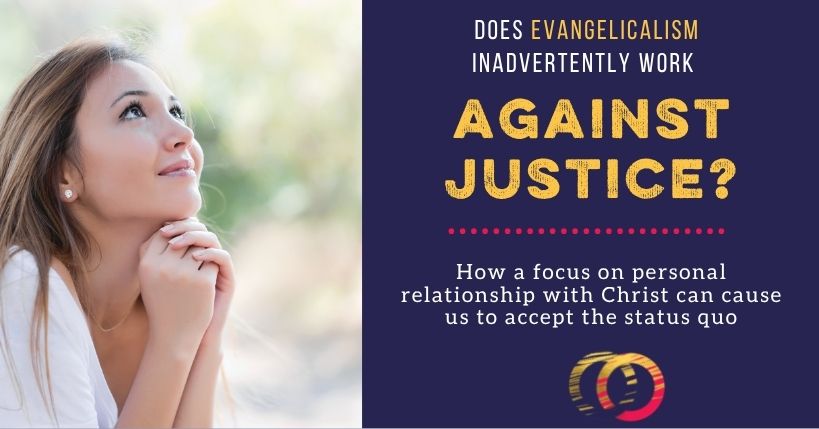
Here’s a recent example from Focus on the Family. This week, they posted this on Facebook.
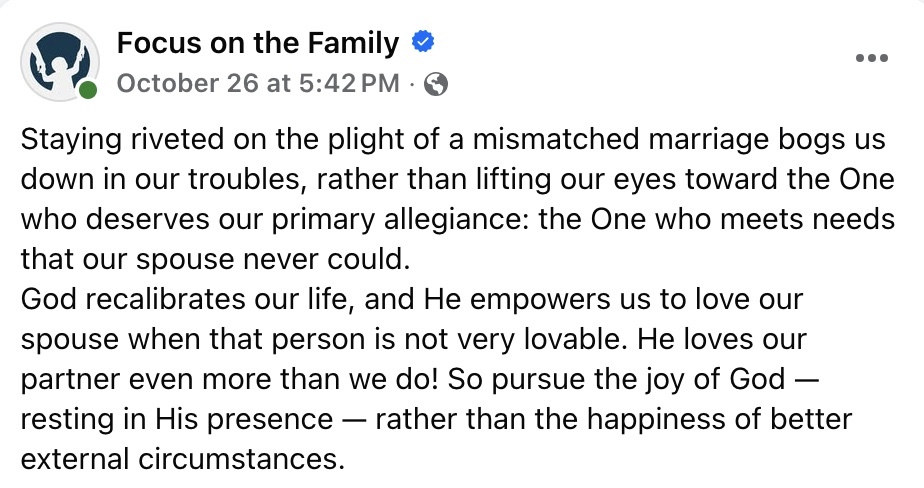
I asked those on my Facebook page what they thought of it, without giving my thoughts first.
Many mentioned that it was destructive to those in abusive marriages. Many also noted that this was a textbook case of spiritual bypassing, and I’ll let a really good article from Psychology Today explain this:
The late clinical psychologist and author John Welwood coined the term spiritual bypassing as a tendency to turn away from what is difficult, painful, or unpleasant, and to use spiritual ideas or beliefs to avoid the pain of facing these circumstances. In his book Toward a Psychology of Awakening, Welwood admits that it’s “tempting to use spirituality as a way of trying to rise above this shaky ground. In a sense, spirituality becomes just another way of rejecting one’s experience.”
Yep. It uses spiritual language to allow you to ignore the hard work that’s actually required to fix the problems you’re facing.
And quite a few recognized that, by spiritual bypassing, they were actually teaching people to NOT solve problems. As Sheryce, one of my commenters, said:
Exactly!
So let’s break down how this advice is lousy even for those in okay marriages, and then ask the questions:
- What is the effect of this advice to couples in okay marriages?
- Why do they give advice this bad in the first place?
Let’s take a closer look at the scenario they’re giving:
1. The couple is “mismatched”
They don’t explain what that means, but there’s a conflict going on somehow. It could be personality differences (he’s an introvert, she’s an extravert); it could be religious differences (she’s a believer, he’s not); it could be that they have some major differences of opinion or there’s a big area of their marriage that isn’t working (she’s tired of carrying all the mental load, or he’s afraid her spending is driving them into debt). Or, of course, it could be that one is abusive.
2. This couple is being told that the solution is to pursue God rather than addressing the issue
No matter what the issue is, the solution is to get your needs met in God, and ignore the problems in your marriage.
Do you see what the problem is here?

No matter how solvable this problem is, the couple is told not to address it at all.
If the problem is mental load, for instance, there’s lots of ways to address this (and we detail them in The Marriage You Want!). This is absolutely solvable, if your spouse has goodwill.
If the problem is that you’re really different personalities and you don’t connect easily or naturally anymore, again, that’s solvable if you intentionally figure out how to foster friendship and companionship (chapter 3 in The Marriage You Want!).
If the problem is that you don’t share a faith, again, you can still address your intimacy levels by focusing on friendship, and more.
What will happen if the couple doesn’t address this problem?
Does it magically get better by not talking about it and ignoring it? Even if you feel closer to God, you do not build intimacy with your spouse by ignoring a problem. And this is the central problem: Intimacy requires that you actually share what you’re feeling with your spouse. You can’t have intimacy if you ignore things. Intimacy is only attainable if you are able to talk about your issues.
Now, some things may not be resolved easily, if at all. But at least if you’ve talked them through and figured out why they can’t be resolved, you know how each other is feeling and thinking, and hopefully you’ve come up with some other strategies to mitigate the fallout.
But by ignoring it and not talking about it, you don’t magically create intimacy. Instead, you create a superficial relationship that will never be intimate.
The Marriage You Want is HERE!
It's time for HEALTHY and SAFE marriage advice!
It's time for a marriage book that doesn't leave you defeated or guilty--but instead leaves you empowered, hopeful, and excited.
It's evidence-based. It's got tons of charts! And it's fun.
Available in audio, ebook, or paperback, with an accompanying study guide, let's talk about the things that actually go into making a great marriage, rather than the things that evangelicals have tended to stress that all too often harm.
Together, we can change the evangelical conversation about marriage!
This advice will only worsen marriages, and not help them.
And Jesus said “blessed are the peacemakers”, not “blessed are the peacekeepers.” Blessed are those who do the hard work of making peace, not those who simply paper over problems and pretend they aren’t there in order to keep the peace.
So the question is: Why give this advice?
If this is advice is just so patently bad (which it is), then why give it in the first place? Why is so much evangelical marriage advice focused on this idea that the problems in your marriage are that you’re expecting too much and not going to God for your needs?
Incidentally, this exact type of advice–that you’re supposed to get your needs met in God not the marriage–was #3 in the 5 toxic teachings that we showed most evangelical books have–it’s a textbook example of it!
See our podcast talking about this, and my post breaking this down.
The best explanation I can come up with is this one: They aren’t focusing on improving marriages; they’re focused on both keeping marriages together at all costs, and making sure that the husband is in authority over the wife.
And when that is your focus, intimacy falls by the wayside.
I honestly don’t even know if they understand what intimacy is, because when marriage must be kept together at all costs, you can’t address real issues or you may rock the boat too much. And when the husband is in authority over the wife, then real intimacy is impossible, because intimacy requires that both people’s opinions are seen equally and matter equally. When one person can override the other, then that person just isn’t as important. And that destroys intimacy.
The more I read terrible advice like this, the more I realize that the aim actually isn’t intimacy at all. And if you live in a subculture where these are the main two aims, then it’s likely that the people within that subculture may never have experienced real intimacy themselves.
Eliminate real intimacy from the equation of what makes a great marriage, and all of your advice becomes harmful for people in any kind of marriage situation–not just those in abusive marriages.
True intimacy in marriage is being fully seen and still fully accepted and loved. That’s a gift, and that’s what we all should be after. God created us for this deep kind of knowing, not just a superficial relationship. And as a church, we deserve good advice–not this kind of advice that masquerades as wisdom, but really just brings dissatisfaction.
What do you think of this advice? Why do you think Focus on the Family keeps giving it? Let’s talk in the comments!





Why are these people so scared of precision? ‘Mismatched’ is such a vague term. Are we talking mismatched height? Energy/health levels? Physical attractiveness? Educational level? Earnings? Share of workload? Financial attitudes? Political beliefs?… It could mean pretty much anything from a ‘learn to live with it’ difference to a ‘get out now this is dangerously abusive’ one!
You’re SO right! It’s because they want that vagueness on purpose. They don’t want to give anyone a reason to get divorced, but also, they don’t want to take accountability for giving bad advice that is telling someone married to an abusive spouse to stay.
I know! Keith and I are going to do a podcast on this soon. (We were going to record today but I woke up with a cold. We were baby-sitting my youngest grand baby for a few days and there’s really nothing you can do when a baby sneezes in your mouth!)
Vague descriptions like this make me think of fraudsters like charlatan faith healers and psychics, who rely on broad generalizations and probability to persuade people that they know what they are talking about. If you make it vague enough, it will apply to pretty much everyone, even if you say the exact same thing to a large number of people in variety of circumstances.
And yet, if the husband feels he isn’t having enough orgasms, he can throw a Bible at his wife’s head and demand she provide one right now.
Wives need to start telling their husbands to get God to meet that need for more orgasms.
Oh, then the husbands will say, “That’s why God gave me a wife.”
To which the wives need to say, “Yes, a WIFE, not a live-in bangmaid.”
This advice is absolutely destructive to even good marriages. I spent years feeling like my only option when I was frustrated or discouraged was to stuff it down and pray harder, because actually communicating with my husband was somehow not respecting his authority. I learned that from these books, and he had NO IDEA that I felt that way! He is always open to hearing my thoughts and advice, but it took me a long time to work through what I had read and to be able to open up to him. This advice absolutely does destroy intimacy. It’s unconscionable that it’s so prevalent in the church.
I love that your husband was so healing when you told him how you were feeling! Seriously, these books ruin things for people especially whose husbands would never want their wives to stuff their feelings down!
Evangelicals have five main solutions to every problem.
In no particular order:
1. You need to pray more.
2. You just need to give it to God.
3. You need to get into the Word.
4. You need wait for God’s timing.
5. You need to get right with God.
Some variation of these solutions can apply to everything from stage four cancer to the alternator going out on your pickup truck. The truth is all denominations want to keep their congregations calm and obedient. Problems cause trouble and especially problems that utilize self help or a source outside the church for their solutions. Before long everybody will be outsourcing their help and the powers that be won’t be so powerful any more.
You’re exactly right. It’s a way to pacify people and make sure they never expect real solutions.
From experience, all five of those solutions need to append an (unspoken) “- like MEEEEEE!”
I am so sick of Christianese One-Upmanship…
This article should be what goes viral across every platform out there. As I replied to Angharad’s comment, the way that most Evangelical Christian authors and preachers give such bad advice like the one from FOTF with vague terms like “mismatched” is because they want that vagueness on purpose. They don’t want to give anyone a reason to get divorced, but also, they don’t want to take accountability for giving bad advice that is telling someone married to an abusive spouse to stay. Also, they don’t want to do the work of learning and understanding what true intimacy is, and how to cultivate it. They also refuse to admit that gender hierarchy is NOT from God. And the results are exactly what Elizabeth described in her comment. It’s shameful and despicable.
“spirituality becomes just another way of rejecting one’s experience”
Daaang.
This goes way deeper than crappy marriage advice.
Faith can be comforting, but it isn’t meant to be a defense mechanism to avoid facing difficult realities. I’ve been thinking a lot lately about what it means to face hard truths. The world seems to be forcing that lately, or maybe I’m just paying more attention now. “You will know the truth, and the truth will set you free.” Self deception is the opposite of knowing the truth, so spiritual bypassing is the opposite of real spiritual freedom.
Maybe we don’t always want to truly be free. Getting there seems terrifying sometimes.
I think that’s exactly right–we have to face hard truths. And so much of this advice is designed to not let us!
The vague flowery language extends to “lift your eyes to God,” “let God meet your needs,” “God recalibrates your life,” “God empowers you to love the unlovable,” “pursue the joy of God,” “rest in God’s presence”— BUT WHAT DOES ANY OF THAT ACTUALLY MEAN???
I’ve been saturated in this kind of Christian language since I can remember, with regard to literally EVERYTHING in life, but particularly relationships, and it comes across as super spiritual and free of worldliness, but for me, it’s come up empty. And it always makes you feel guilty, like you’re some kind of faithless worldly carnal Christian if you’re not finding joy and happiness in God. Bible study questions like, “how many times do we search Google or ask our friends for advice instead of asking God on our knees in prayer?” Well, maybe we could do both? Or how long are we supposed to wait for God to “whisper an answer”? Maybe God is saying, “I put the answer at the top of the Google search results!”
Yes, promise people all these vague results from God, then insinuate they are weak in faith if they can’t honestly say that God is doing all this stuff for them.
I honestly feel like this spiritual bypassing has its root in the evangelical “salvation message”- in which you have to convince skeptics that:
1) there is no such thing as a good person
2) all you deserve is death and hell because of your sin
3) therefore, you are not entitled to anything and it is your carnal nature and/or the devil that makes you think otherwise
4) once you are justified, you should expect a lifetime of sanctification, where God uses unfair and difficult circumstances to refine you and reveal how sinful you are to you. Your biggest problem is your own sin.
So, naturally anything that isn’t spiritual bypassing would contradict that narrative. Anytime you are sinned against, devotionals and Bible studies always want you to spend most of your effort recalling how gracious God was to forgive you all your terrible sins, and it’s not necessary to try to think of a fair resolution if you’re only supposed to think about how unworthy you are of God’s forgiveness.
AKA “This WAS Your Life” by Jack Chick, reinforced by book after book, preacher after preacher.
Even 50 years after going over the Berlin Wall, some of the damage is permanent – Like Frodo Baggins after he bore The Ring, there is no healing this side of the Undying Lands.
Last week, YouTube’s Sacred Algorithm fed me a video about “The Five WORST Afterlifes”. The second (after the Sumerian/Mesopotamian underworld of endless dusty darkness) was “Medieval Catholic”, i.e. The Constant Threat of Eternal Hell for any sin or slip-up; no wonder any layman with the means would pay big bucks for Indulgences – anything to get out of it. (Medieval Catholicism was also prone to the Heresy of Clericalism, i.e. that ONLY Priests, Monks, and Nuns mattered and the laity could all go to Hell).
Though in the past 100-500 years Catholics and Protestants (especcially the Born-Again Bible-Believers have completely swapped places. Even to the Heresy of Clericalism (except they’re now called Pastors, Elders, Fill-in-the-Blank Minsters, and Worship Band Leaders instead of Priests, Monks, and Nuns).
I think you’re right. So much goes back to our views of salvation/atonement. When I realized that the gospel is not ONLY “Jesus died for your sins so that you can go to heaven” and actually encompasses so much more, since Jesus taught “the gospel” before He even died, things clicked into place.
“I’ve been saturated in this kind of Christian language since I can remember…”
And you’ve become allergic to Christianese, too?
(Only took me two Rapture Ready years during the Dispensation of Hal Lindsay, reinforced by other encounters since.)
Some time in the past, Christianese made the jump from a “technical language” (with specialized technical jargon) to a “mystery langauge” (Special Secret Code language for the Inner Ring of Illuminati, smug and superior).
“I put the answer in the top Google result”!!!! I love that.
[IT DOESN’T JUST HURT THOSE IN ABUSIVE MARRIAGES]
It screws up Everybody!